How keen investors are surviving market volatility
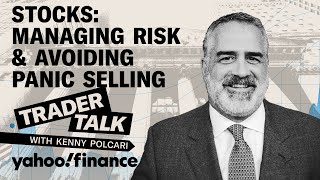
A recorded episode of Trader Talk (host Kenny Polcari) filmed live from the New York Stock Exchange (April 9, 2025). The host argues holding cash is an active, disciplined position during volatility. Guest Barbara Duran (founder/CEO of BD8 Capital Partners, veteran wealth advisor) discusses managing client anxiety, defending large-cap growth allocations, tariff/trade-policy risks, recession odds, bank loan-loss reserves and near-term earnings. The episode closes with three practical market tips (set realistic expectations, focus on risk management, keep learning) and a cooking recipe (pasta rota: broken spaghetti with zucchini and pecorino Romano).
Questions this video answers
April 9, 2025.
Barbara Duran — founder and CEO of BD8 Capital Partners, a New York–based wealth advisory firm.
Over 35 years on Wall Street.
Penn State undergraduate; MBA from Harvard.
Chapters
Foreign. Welcome to Trader Talk, where we dish out the latest Wall street buzz to keep your portfolio sizzling. I'm Kenny Pori, your host, and I'm coming to you live from the iconic New York Stock Exchange, a place that had been my home for four decades, but it still fuels the pulse of capitalism, entrepreneurship, and freedom. Let's take a jump into my big take for the the week. Somewhere along the way, holding cash got a bad rap. People think if you're sitting on cash, you're scared, you're uncertain, or worse, you're missing out. But here's the truth. Cash isn't a sign of fear. It's a sign of control. Or can be. In a world where every dip feels like a buying opportunity and FOMO runs wild, holding cash takes discipline. But smart investors know that cash is an active position, not a passive one. It's dry powder, it's optionality, it's flexibility. When the market gives you a gift, when valuations are stretched, headlines are chaotic, or the setup just doesn't feel right, cash gives you the power to wait, to be selective, to enter the market on your terms, not the markets. Cash also gives you resilience. It protects you on the downside in the drawdown. And it keeps you from having to sell quality assets at a loss just to raise liquidity. That kind of stability matters, especially when volatility spikes and emotions run high. Does this mean staying cash forever? Of course not. Cash doesn't compound well. It does very little. Over time, staying on the sideline costs you money. But in the short term, when the setup isn't right, cash is a position and can be a powerful one. Bottom line, don't let anyone shame you out of holding cash. It's not weakness, it's patience. And patience in this game is what separates the pros from the panic. And sometimes patience is a virtue. I'd like to introduce my next guest, Barbara Durant, founder and CEO of BD8 Capital Partners, a new York based wealth advisory firm with over 35 years on wall street, including senior roles at Neuberger Burnham and Morgan Stanley. And Barbara brings extensive investment management experience. A Penn State alumna with an MBA from Harvard, she has served as an Emirates trustee on Penn State's board and is a member of the Investment Council Beyond Finance. Barbara represented the US on national lacrosse and field hockey games. Please join me in welcoming Barbara Duran. Wow, that is pretty exciting. And I want to talk about that, but let's get to the markets first. Tell the audience just a little bit more. Kind of how I introduced you kind of how you ended up where you are.
Right, right. Well, originally as we were talking ahead of time, I was, I started as a journalist and was determined to have a career in magazine publishing. But I invested in a stock called Tandon Computer, no longer around, that went up 20 points in two weeks. I had to investigate this suddenly it lit the fuse. It sure did. You know. Anyway, so the short version is that that's what made my transition to Wall street and business school, was the transition.
Right.
And so I've been on what's called the buy and sell side back and forth over the many years, big firms doing entrepreneurial things. And right now I have my own firm which is a wealth advisory and asset management with a specialty in large cap growth stocks which is made for a painful last few weeks, you know.
Yeah, but, but actually in the long run they're going to be fine. We can talk about that too.
Yeah, I can't, I can't wait to talk about that. But so basically I have. What differentiates my background in wealth advisory is that I have actual professional investment management experience. When I was at Lehman Brothers, when there was a Lehman Brothers, I managed what's called firms proprietary capital, which is their own capital. I ran a hedge fund, learned about risk management the hard way. And I also co managed a TMT fund. Technology, media and telecom. Yes, at Neuberger Berman. No, that was at Newberg, who was then owned, had been acquired by Lehman. So effectively at Lehman.
But yeah, you know, it's funny because you and I probably without either one of us knowing it, because I used to do a lot of business for Lehman Brothers and I would do a lot when they had their proprietary business. I used to do that. I used to client business as a broker when I was running around here in the floor. So it's interesting, I wonder, you know, had. Were you when you were there if in fact that might have been the case? Because it was such an exciting time down here in the floor to be in the thick of it. But you had it from a different angle and it must have been very, very exciting.
It was actually because in those days, you know, Lehman, I was an institutional equity sales.
Right.
You know, before there was information everywhere so you had real value added. And basically, you know, I had Michael Steinhardt as a client, one of the first three hedge funds and boy, that was, you know, you had to have tough skin to work with that group.
Steinhardt is a blast from the past.
I know. Remember it was Soros Steinhardt and who was the Third, there were three at that time.
Was it Ivan Boeski? Was he.
No, he was doing. He was doing the Starbucks. Yeah, yeah, he was doing the M and A. But there were only really three big hedge funds. Oh, Soros, of course.
Soros. Right. Yeah, yeah, yeah. Oh, my God, what an exciting experience.
What an exciting career it was at that time.
And so now you, now you're a wealth advisor here in New York City.
Right.
And you focus on large cap growth.
Right.
Let's talk about that. Considering where we are, what the market is, let's talk to you about. What do you think about Liberation Day? You know, I said it to, I said it before that, you know, we've all been liberated from some of our.
We've been liberated from our profits and our winning portfolio position.
Well, no, I hear you, I hear you, but so let's talk about that for a minute because, you know, as an advisor, because I'm in the same position, I'm chief market strategist and advisory firm down in Florida in Jupiter and so on times like this, you end up spending a lot of time, you know, trying to just help people calm down and understand and focus on the long term, look at their portfolio, understand what they own, help them just to understand it. Because it can be an anxious time.
Yeah, it's a very anxious time. And frankly, I've been getting calls from the beginning. I have. Any of my clients that are Democrats have had extra fear. And certainly if you saw the University of Michigan consumer survey, there really is a big split.
Yeah.
You know, between Democrats and Republicans.
There's a big split.
Yes. And so it's been this particular last few weeks has been very tough and clients have been with me for a while, you know, and I've tried to educate them, as I'm sure you have. Stocks are volatile.
Right.
It doesn't mean they're riskier. They're called riskier because of the volatility. But risk to me is risk of loss of capital.
Right.
And if you are in solid fundamental companies, you have to live through this. In 22, we got killed, Right. Because I have the large cap growth, the metas, the Googles, all that stuff. But then they came roaring back and by the end of the next year were higher than they were in the course by the end of 24. This time, I think is a bit different because this, to me, there's so much uncertainty. There's so much coming out. As you, as I'm sure you saw this morning, you know, the president came out with more threats on China. And I'm sorry, China, in my view, is not going to back down.
Well, you know, that's interesting because I don't think Trump's going to back down either. I think if he backs down now, especially after he now threatened another 50%, I think. Is that what he threatened?
Yes.
I think if he backs down now, he's going to be seen as completely weak then. Right. So I don't think he get back down.
Well, it's going to be tough because his history, as we know, is that he doubles down when he's caught in something that's not pleasant for him to acknowledge.
Right.
But the problem is when you look at who's who has the leading share in global GDP, okay, we're number one. But it's somewhere, depending what stats you look at, 26, 27%, then you have combined the EU, who also looks like they're going to come back with their own tariffs and China are higher than we are in their share of GDP.
Right.
We don't have 90% share of global GDP. So the question is, can we really throw our weight around without being hurt? And I think we're going to be severely hurt if he does not back down on a lot of this.
Well, let me ask a question. We had news over the weekend that we're going to have Vietnam, Taiwan and even Japan sending a delegation to the White House to talk about tariffs. They get it, they want to talk about it. And I wonder if they make that deal, say they make those three deals, that would show some credibility and maybe it brings others to the table. Now, is it all going to be zero? No, I don't think so. But do I think that the trade agreements can be renegotiated? I think they can be. Do you do?
Well, up until now, he has backed off on some negotiations, but the messages are very mixed.
Right.
And even I don't I forget it was Lutnick or Navarro over the weekend said, okay, zero percent, you know, for Korea. But it's all the non, you know, deficit stuff. So they're still not saying, okay, we'll back off totally. So this is a, we don't know what the end game is here because it keeps changing. First it was to cut down the flow of fentanyl.
Right.
And it says, I think it's really, they are hoping. There's a lot of libertarians in this government that really would like to get rid of all regulations and taxes.
Right.
And I think they are hoping tariffs will be that substitute. But you and I both know when you raise prices, it's economics 101. Demand goes down.
Right.
You know, so. And we don't know all the ancillary effects. You know, like foreign tourism. Right. That added pre Covid. You know, the only stats I could find, 1.1% to our GDP, right. 40% of that is from Canadians. Well, guess what?
Yeah.
Travel from the Canadians is down 70%.
Yeah.
From the EU it's down 25%. So it's all these secondary effects that are rippling out.
It's always like, you know, you can never do one thing, right. You think you're doing one thing, but there's all these ripple effects, right. That, that it's amazing because I think to myself, they have to know they're going to be ripple effects. How can they all sit there and pretend like there's no ripple effects? There's always a ripple effect, right. You can never just do one thing. So let's talk about that for a minute. Now that when we talk about your sector large cap growth, it's come under some pressure. But those are all big quality names, names that people want to be in, right?
I mean that's what we were talking about earlier, what I'm telling my clients, you know, some are very freaked out and just to say, look, we are invested in very solid companies with long runways of across sectors. Across sectors, Right. You know, because I own not just the obvious large cap growth, but it's the Netflixes, you know, it's Walmart, it's Costco. It's these names that are continue to do very well. Now we don't know what's going to happen to earnings because as demand comes down.
Right.
You know, they will take a nick and the question for all of us is where is this discounted? The market.
Right.
But you know how the market hates uncertainty. And when we can't game it out and model it out, you'll go lower.
That's right.
Yeah.
And that's the point when the. Because the market can deal with certainty if it knows what, if it knows what the problem is, it can deal with it. It's when it becomes uncertain that people come anxious and the first, the first reaction is to shoot first and ask questions later. And then you see lower prices.
Right.
And I think we're going to continue to see that. But at some point the selling becomes exhausted and the prices become screaming buys.
No, you're exactly right. I mean I was looking just before I came over at just like Meta, Amazon, Netflix and Intuitive Surgical.
Right.
You know, and Intuitive Surgical probably has the least exposure to any weakness in the consumer economy. But they are all below the historic P3, 5 and 10 years.
Yeah.
And getting lower, like meta right now is at a 20 p. E. Right. You know, and that has great growth possibilities. I mean they have figured out the advertising algorithm.
Right.
So you're right.
They, they become value names. Right. I mean that's what they become because they become so oversold and which I think a lot of people need to understand that. Right. And I think when you sit and you talk to them and you show them, okay, the equity side of your portfolio might be under some pressure, but the bonds out of your portfolio is acting very well. Right, Right. So it's, it's, it's balancing out maybe not 100%, but you, but that's exactly why you have a well diversified portfolio.
Well, exactly. And Kenny. And the next exercise I've done with some of my clients is to look back what happened to their portfolios in 22.
Right.
Where they started, where they ended, which was not a, not a pretty sight. You couldn't hide anywhere that year that the Fed was so aggressive in raising bonds, stocks, everything got killed.
Right.
And then I look at what, where it was at the beginning and end of 23 and then 24 and I say, look, we are not selling here. You know, I think the market strong possibility goes lower and I've been seeing that since last Thursday.
Right.
But we're certainly not selling. I will not be as opportunistic as I usually am.
Right.
You know, and I'm sure you're the same way. You have seen through various market crashes, it's almost always a buying opportunity, but this time this feels a little bit like 08, the fall of 08.
Well, I think you have to be cautious because I think there's still a lot out there. Right.
Yeah.
I usually go by the three day rule. Right. Somebody said to me, you know, on Friday when the market, I go, I go by the three day rule. When the, after the first visceral reaction, which was Thursday, the market closed on this lows, which is never a good idea. Friday, bang, they hit it again, closed on its lows. And look what it's doing today. Again, it's under some pressure, but it is the third day and maybe you're going to start to see a little bit of a calmer market. And so that's, I always operate under that three day rule. So I want to see what ultimately happens today.
Yeah.
You know, where it closes. I agree. You know, if we close on the lows again. If you close on a lows again, doesn't really set up for tomorrow is going to be an ugly day as well.
No, you're right. And I think that that's very smart. And in this. Normally I might step in on the second day, but not here. I rather miss that. Absolutely. 100 times. Yeah. Because it's just, it's. And also I'm not sure where the clarity comes from. You see what happened today when there was a, apparently a false rumor that Trump was going to put a 90 day hold, the market sprang up.
That's all I wanted was one little bit of positive. The S and P went from negative. I was up 200 points in the blink of an eye.
Blink of an eye.
I don't know who at CNBC decided that was the right, that was the right headline to go with, but I'm sure it's going to be a heavy price because the White House came right out, said not true. And then you saw what happened. The market immediately turned south again.
Right, right.
But it does feel to me like the worst is over. Which doesn't mean that it's not going to kind of trend a little bit lower. But I don't think we're going to get these down 6% days. On and on and on. I just don't think we're going to. I think it's feeling exhausted. Besides the fact, I think there are names that are suddenly becoming very interesting to look at.
Yes, they are. And it's across all sectors. I mean, obviously the obvious ones that have held up are utilities.
Right.
Staples, REITs, this kind of thing.
But Staples are flat on the year because I just put some men out and utility down 1%.
Right.
Everything else is really getting.
Yeah, I know, which is great because you look at everything. I think the. There's so many stocks in the S and P that are down, you know, 20% from their highs, you know, not necessarily a year from here.
Understood. Yeah.
So, and then the question is, we don't even know what the real PE is now because we don't know what the earnings are going to be and companies don't know. Nobody's been really guiding down because they don't know.
Right. So what you're at, because earnings are going to start on Friday. We're going to start with the big banks, JP Morgan, bank of America, the whole group. Right. And. And so you're going to start to get an initial sense of what the banks feel anyway. Right. I always like to look especially and I Love Jay. And listen, I own JP Morgan, I own Bank America, let's just say that, right. I love Jamie Dimon. I think he does an amazing job. But I'm always interested to learn what these banks are allocating to their loan loss reserve account because I think that is very, very telling on where they think this economy, where they think this economy is going to go. Now they're preparing for defaults and all that.
Right? That's a, that's a really good point because that is usually a good lead indicator on that stuff. But their problem is going to be if they want to assume worst case. And Jamie Dimon is a case where he always assumes worst case.
Yep.
So they will probably up their loan, you know, loan reserve, which is okay. Yeah, no, it is okay. Because you've got to be prepared that this could be. I mean, when they announced that last week, that was worse than the worst case scenario already out there. It was shocking. People thought reciprocal tariffs, right?
Oh, that.
Okay. But this thing, I mean, and that bogus formula.
Hold the, hold the line one minute. We'll be right back. All right. So welcome back. Look, I want to pick up on one thing you just said about reciprocal tariffs. So in my mind, the idea of a reciprocal tariff was if you charge us, we're going to charge you the exact same amount, not more, not less. Now, what I saw was they didn't charge 100% reciprocal tariffs. But then everybody said, ah, the formula they used was wrong. Talk to me your impression of what we just saw happen.
Well, I don't even know what to say about that formula because every credible source that I've read says it's just made up. It's not on any basic economic. Because it's not. When you look at the real tariffs are, I mean, EU, I read the exact numbers, but it's like 2% versus 2 and a half percent. And we're coming back with 30, 40, 50% tariffs.
But could some. I think Scott Bessant's a pretty smart guy. I think he had to be in the room when they were talking about this whole reciprocal tariff thing. So the idea that they're so off, as some people said, you know, they just pulled them out of thin air. I thought to myself, did anyone think that other people weren't going to recognize that the math wasn't right? That's what's so unnerving to me because I'm not sure if I don't know what to believe at the moment.
Well, I think that gives. It's an issue of credibility in the current administration because I just watched two flash polls like over the weekend with CEOs.
Yeah.
It's now almost two thirds think we're going into recession.
Yeah.
I fully, you know, a third of them think they will likely have to cut jobs. The others don't know yet. You know, and so and then also flash checking on the street recession odds have gone from 23% at the beginning of the year to 56, 57% CPI, you know, was supposed to be they were looking at, you know, 2.7. It's up almost or 2.6 or 2.8 now up to 3, 7 and the same with GDP now less than a percent.
We're going to get the March numbers, you know, we're going to get some of, yes.
CPI and PPI and the latest University of Michigan sentiment Friday, which what's your guess?
Right. Well, it's going to be bad. It's been, it's been fairly negative late. Right, Right. But let me ask question, do you think we're good? Do you think we're headed for a deep dark recession?
I think the probabilities have increased a lot and I think whether it's moderate or not, and we've started from a good place. Right. I mean the economy, you know, Trump inherited very strong economy. We started the year out very positively. And the positive effect, obviously it's not for good reasons, but oil prices are down.
Yeah.
If you go down big, they're down big. And if they go down much lower though, it's going to be tough for our producers who a lot of the shale producers have a much higher break even like 55.
We're not so far, we're not that far from there. We're 59 or 60. Right.
And obviously the 10 year rate has come down. That's helpful. We'll see probably some good refi for mortgages this week and for the government. Right. So there are good things happening but for bad reasons. It's because people are looking at reduced growth.
All right, so listen, I want to, I want to revisit this with you in a couple of months after we kind of work this through and see how it all comes out on the other end. And it may be longer than a couple of months. But I want to kind of come back and, and revisit this with you, if you don't mind.
No, I'd love to because we're going to know a lot more pretty soon.
Yeah. Yeah. All right, so let's wrap things up with three essential market tips to Keep in mind, no matter which way the wind is blowing first, you want to set realistic expectations for yourself. Markets don't always go up and not every trade is going to be a winner. Approach investing with a balanced mindset. Understand that gains may take time and losses are just part of the journey. By keeping your expectations grounded, you'll make a more level headed decisions and avoid the emotional part of trading. Focus on your risk management. Protecting your capital is just as important as growing it. Always have a clear exit plan for each trade and stick to the stop loss levels. Proper risk management helps you survive market downturns and preserves your ability to take advantage of the new opportunities and keep learning. Whether you're new to investing or have been trading for years, the market is always evolving. Stay curious, read books, follow financial news and consider taking courses to deepen your knowledge. The more you understand, the better equipped you'll be able to adapt to the changing market conditions and refining your strategies okay, so as you know, I'm always one to add a recipe to the end of these these podcasts because I'm a cook and I love to cook and I think food is fantastic. So this one is the recipe is simple. It's a one pot dish of broken spaghetti, so we call it pasta rota and it's cooked with zucchini and finished with pecorino Romano cheese. It also reflects the spirit of the kitchen and the cucina povera, which is Italy's pork kitchen. With a nod to Roman culinary roots. Pasta itself has ancient origins in Italy, with evidence of dried pasta production dating all the way back to the Arab influence in sicily around the 8th to 9th centuries. Broken pasta was a practical choice, either scraps from imperfect batches or intentionally snapped to cook faster in soups and stews. In rural households, it was often boiled with whatever vegetables were at hand, a practice common in Lazio, where zucchini became a garden favorite due to its versatility and yield. Rome's culinary identity, shaped by shepherds and farmers, leans heavily on pecorino romano, a salty, sharp sheep's cheese produced in Lazio since the ancient times. Roman dishes showcase this ingredient's ability to transform simple pasta into something rich and satisfying. The addition of Romano cheese aligns with this tradition, melting into the starchy pasta, water and zucchini to create a creamy sauce. You can get the recipe by clicking on the QR code that you see on the screen. That's a wrap for today's Trader Talk, but the conversation will keep going. Subscribe on Apple Podcasts, Spotify, Amazon Music or wherever you get your podcast. You got questions or topics you want covered? Email me at tradertalkahoo inc.com because we're listening. Until next time, stay sharp, stay disciplined and stay in touch. Take good care.
This content was not intended to be financial advice and should not be used as a substitute for professional financial services.
More from Kenny


Wall Street Is Celebrating| But Kenny Polcari Sees A Warning Sign | Kenny Polcari


Stocks Crashed After The Fed Move But Here’s What Investors Missed | Kenny Polcari
9/11 25 Years Later: Bond Market Warning, Oil Above $100 & Fed Rate Hike Fears | Kenny Polcari

Oil Hits $97, Bond Yields Surge & PPI Inflation | Markets Brace for Fed Decision | Kenny Polcari
The Fed Has a New Problem | Oil | Inflation | and Rising Yields | Kenny Polcari

The Fed Never Promised a Rate Hike | But Markets Panicked Anyway | Kenny Polcari

Nvidia Crushed Earnings | but the Biggest AI Opportunity Is Still Ahead | Kenny Polcari