Portfolio picks: Why you can't ignore defense stocks
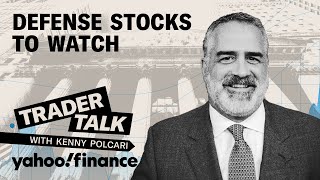
This is a Yahoo Finance "Trader Talk" interview (host Kenny Polcari) with Dan Koontz (Warrior Money co-host, veteran) arguing politics materially moves markets and investors should consider exposure to the national-security/defense sector. They review short- and long-term drivers: near-term geopolitical events boosting defense primes (Lockheed, Raytheon, Northrop, General Dynamics), and structural shifts toward AI, cyber, space, autonomous drones and dual-use infrastructure (energy, semiconductors, data centers). Investable vehicles mentioned include bellwether defense names, smaller-cap infrastructure/security tickers, Palantir, and a Gabelli aerospace & defense ETF; Anduril is discussed as a private hardware-first national-security firm. The transcript closes with a recipe/host sign-off.
Chapters
Foreign.
Welcome to Trader Talk, where we dish out the latest Wall street buzz to keep your portfolio sizzling. I'm Kenny Pulcari coming to you live from the Yahoo. Finance headquarters in the heart of New York City, a global hub where deals are made, fortunes are built, and the next market move is always just around the corner. Next, I'm going to share my big take on how politics impacts the markets. Sit down with Warrior Money co host Dan Koontz to discuss defense stocks and reveal my favorite Sicilian style linguine with clams. It is delicious. Now let's jump into my big take. Let's be honest. Every investor loves to say, I don't care about politics, I just follow the numbers. That's a fantasy. Politics moves markets, regulation, taxes, tariffs, foreign policy. Even a straight tweet can trigger rallies, crashes, or entire sector rotations. If you're not paying attention to what's happened in Washington, Brussels or be Beijing, you're driving with your eyes closed. But here's the trap. Obsessing over every headline, every poll, and every political hot take will ruin you. The market overreacts to the noise, then it corrects laws take months or years to pass, and half of what's promised on the campaign trail never really gets implemented. Traders who jump at every new development get chopped up, whipsawed by sentiment. Instead of capturing the real opportunity, savvy investors do it differently. They tune out the noise and they tune into the policy. They watch for changes with real, lasting impact. Tax reforms, major spending bills, trade deals and regulatory shifts. They keep a close eye on sectors likely to be winners or losers and position themselves from what markets expect, not what's trending. Bottom line, you can't afford to ignore the politics. And you can't afford to become a political junkie either. Use policy as your weather forecast, not your gps. Stay alert. Be ready to adjust, but don't let the headlines make your decisions. The winners are the ones who filter out the static and act on what matters. Joining us today is Dan Kunz, who's the co host of Warrior Money here at Yahoo. Finance and a sharp voice on the intersection of national security and and investing. With deep ties to the military community and a firm grasp of defense strategy, Dan brings unique insight into how geopolitics shifts government spending and global tensions shape the opportunities in the defense sector. Please join me in welcoming Dan Kunst to the show. Dan, it is a pleasure. Thank you for your service to the country. I understand it was 12 years, 14 years ago today.
Well, 14 years ago today, 12 years in total. Service.
12 years in total service.
Ford still Oklahoma for basic training.
And you were in law school when you joined the army.
But I was shaped by 911 as I know you were.
Right.
And I wanted to serve from, from the youngest age I could remember because of that day.
Right. You were younger than I was when 911 happened. They didn't want me. Yeah. They didn't want me.
Yeah.
But, but thank you for your service. I appreciate it. Where did you serve? Did you serve overseas?
I did not. I did not. I was mostly all U. S. Based. There's some interesting work that I did in Fort Bragg. I can call that now Fort Bragg. Fort Bragg during the Ukraine and Afghanistan.
I think they actually renamed it Fort.
Bragg, called Fort Bragg now. It was Fort Libert. Can come for Bragg again. But yeah. So no, most of my, all my work was stateside, but I'm doing some work overseas.
Well, thank you very much. So look, let's talk about, first of all, we can talk about kind of the whole what's going on in the world in terms of, in terms of the geopolitics and, and, and your view. Let me get your view on, on, on ultimately what happened in the middle east in terms of the decisions that we made. And actually, I thought it was the right decision because I think somebody had to bring it to an end.
I totally agree.
Right.
I, I love your. You have to pay attention what happens in Brussels and Washington. You also have to care about what happens in Tehran or in Moscow or any of these places. Right. And so here's the deal. 1979, right. That's when this new Iranian regime comes into power. Over.
I was, I was, I was a senior in College in 1970. I was 18 years old when that happened.
So 50 years, 45, however many years it is.
45 years.
And they're, they're a regional nuisance. They're. They've been a problem the whole time. They've created unrest and problems for everybody, for everybody for such a long time.
And their neighbors right there, right around them.
And the worst part is that they're sucking all of our resources away from us.
Right.
Every one of these low, low conflict, nuisance wars that we have to get into or even, or issues that we have to deal with at some point in time. President Trump stood up and said, hey, listen, like, enough's enough.
Enough's enough. And look, and he didn't just say it. He'd said it all during the campaign. He'd been saying it all along. So no one can say he stood up and said, you lost his mind. Yeah, Two years. He gave them basically. Yeah.
I went on record, actually. Right. And say that I totally agree with his.
Right.
His approach there. There's another issue which is should the president have to ask Congress. Congress for permission to do it? That's a whole other issue. Right.
Yeah.
But the reality is like, come on now, like the guy they've been paying the ass for so long, it was. Enough is enough. Time is time. Right.
And look, and I think, I think part of his, part of his trip to the Middle east, you know, prior to the war, I think not only warning, but I think he actually, I think he actually got support from the Middle East. While they won't say it out loud, I think behind the scenes they're all clapping their hands because they didn't want to deal with it anymore either.
You know, the world wants, the world wants what we have.
Right.
They want capitalism. They want an economy that works. They want modernity. They don't want to go back to all those issues.
Right.
They want what the world we have and what they have. So it's only a matter of time.
Right. And I think. Okay, so we can get off that subject. I just think that, you know, as you, as you moved into it, we saw what happened to the defense sector this year. And I mean defense sector, not defensive names. I'm talking about aerospace and defense. Lockheed. Yeah. Lockheed, Raytheon, General Dynamics, Northrop Grumman. And in my note, actually, I think the day after, on the Monday after we, after they dropped the bombs, I actually highlighted all the defense companies, Lockheed Martin, all the roles that they played in terms of either the bombs or the planes that carried them or the ship that launched them from, from the sea. Right. The Patriot missiles, the defense industries. Right. The defense industry and how they all played a role and how those stocks have actually been performing. But in fact, I think the defense sector is the sector you like.
Yes. I actually call it the national security sector, but yeah, I got you.
Right, the national security sector.
I get you, I get you. I got you. Because we're evolving from a defense sector to a national security sector. You have to be dual use. It isn't just a matter of like, let's do the missiles and bombs. You've got to also do the infrastructure behind it.
Right. And I think, you know, and I. And so, yes. That you have to do the infrastructure behind it. And I think that's all very important. But I also think in terms of investors, that they have to have exposure to that sector. Right. Is that they have to have, whether you, whether you're a hawk or dove. The fact is, I think if you want part of a well balanced portfolio, you have to consider national security.
Yeah, national security.
Really global, quite honestly, I think it's global security.
Yeah. National security is economic security. I mean, at the end of the day, they feed one another, right? So our navy patrols the petroleum, it patrols shipping lines, it shows all those things. It's national security, it's economic security.
So talk about today's modern warfare versus maybe what it was when I was much younger. So the growing role of AI drones and kind of the cyber world in the defense. In the defense, yeah.
My favorite story is to say, like the Civil War was when it was won by the rifle, right. Then World War II is won by mass production. This, this age that we're going into right now is AI, cyber and space.
Right.
That is the world that we're moving into.
And that's going to be the next kind of frontier for.
I mean, you don't want to be fighting the war from the, you don't want to be the last year's war. That's what happened in Vietnam. It's what happened.
Right. Civil war.
You don't want to be like fighting the last generation war. Right. This, this war, the next one that we're preparing for. I can talk about that in the future. But like, the one that's being prepared for is an existential problem versus a near peer adversary. That's what, that's what we're preparing for. It's a space war, it's an AI war and it's an infrastructure war. And the underpinning of all that is energy. So it is a full, a full nonstop issue that you have to have energy to support these initiatives.
Right. So let me ask a question, because when you look at the way drones have played a role in the Mideast conflict, not just Iran and Ukraine, in Ukraine, right. How that's played a role and how they've used, both sides, have used drones to really change kind of the face of the way warfare happens.
Yeah, totally. So I was in a skiff in Ford Bragg and we were talking about, well, shit, what's happening in Ukraine? What's, what's going on in this issue set right here. And so what, what we've seen is recycle times within two weeks now. And we've seen very expensive drones being replaced by much cheaper drones that have an attrition factor behind it. But their, their flash to bang, their ability to get something out in the field has completely broken the expectations of the market. It's going from $250,000 drones to $10,000 drones. They don't care what happens to it. And then they go, yeah, they blow them up. Exactly what happens.
And then, and so I think the other thing that's amazing too is when you, when you look at either the way the Israelis did it with the, with the pagers that blew up, that was unbelievable. Or the way the Ukrainians did it, right. I think everybody woke up to kind of what this new face of conflict could look like.
The amount of time that they had to prepare and seed for that to happen is just unbelievable. It's unfathomable how much time they had to put into that. They had to trace networks, they had to keep their, that had to have been a multi, decades long, a decades long thing. And it's just they were waiting for the right time. And what's the worst thing you can strike somebody? Their confidence, right? If you can't be confident about what you're about to do because your pants are about to blow up, that's a really bad day. That's a really, really bad day.
That's a really bad day. But I gotta tell you, I thought just the, the way it played out, the way that the, the way that Ukraine did it, the way that the, that the Israelis did it. When you think about the, the amount of time and the amount of, and the amount of intelligence that that had put in to create that, to create that opportunity. Yeah, it's amazing.
It's unbelievable. It's unbelievable. It's also ingenious.
So talk about companies leading that space. Separate from Lockheed Martin and Raytheon, are there other companies that we should be looking at?
Yeah, we're in, we're in a totally different transformation right now. Right. There's the historical Legacy, World War II group. And now we're moving towards the future. And Palantir.
Palantir.
Palantir Anduril is a private company.
Right.
But there's a lot of conversation about what they're about to do.
Right, hold on there one second because we're going to stop for a quick break and we're going to come right back.
Sounds great.
All right, so let's talk about Android, because that is, everyone wants a piece of Android, but it's hard to get it because the private company.
Yeah, yeah. So you can get to it though? Yeah, there's access. No, you can, you can get to it. You can get to SpaceX as well. You can get to. And you can also get to OpenAI and you get to XAI. Like all these companies are creating the new infrastructure of where this is all going, which is all in artificial intelligence.
Right.
I also like some of the smaller tickers. I like some of the. Probably not what you normally talk about, but I like some of the underlying tickers, ESP T gen tssi. They're creating foundational dataset integrations and data center integration.
Are they all on nasdaq? They're on the New York stock, yeah. Really?
Yeah.
I have to look them up because those are things I don't know.
Yeah, please do. So I have a background in smaller stage, small micro cap companies.
Yeah.
And I really like them for where they're positioning themselves for this next future.
And so what? And so, so talk about their role. What do those companies do?
They're the infrastructure of artificial intelligence. They're the, they're the component, the components of the things that have to happen to enable AI. Right, right. So they're the energy providers, they're the data center integration companies, they're the server companies. They're really the companies that are creating like the, I call it the infrastructure of AI. But the foundational elements are required for it.
Right. You know what I think is also amazing is when you look at the difference between the two technologies. So for instance, the Israelis could shoot a missile and hit you between the eyeballs, and the Iranians shoot a missile and it could land anywhere all around you. It doesn't really know where it's going to land. But the Israelis could send it. Right. And hit you between the eyeballs. I thought was amazing. And I think that's just going to be part of where this technology takes us, is the specificity in launching. Launching.
I have a lot, I have a lot of conversations with a lot of friends of mine, I live outside of Philadelphia. They're like, hey, how are we worried about this? Or they come to me like, like last weekend I got it because it was Saturday night when that. Yeah, yeah.
I was at a wedding and I.
Got a. I had a baseball game Sunday morning and my buddies were like, yo, how do I think about this? I'm like, it's gonna be okay.
Right.
And the reason it's gonna be okay is that the Iranian response, they didn't have enough resources to respond at scale. Right, Right. They're a regional nuisance.
Right.
What we're, what the US Is preparing for and what we have at our disposal is the largest and best economy and national security apparatus in the World. So our ability to project power anywhere in the world is pretty unbelievable.
And I actually think that, that, I think the world stood up and took notice of the fact that we did what we did. We didn't win in, we didn't blow up cities. We just went in there. We had a mission to do it, we did it. And so I think the world took a step back.
I think that the Afghanistan evacuation in Kandahar.
Yeah.
We had to step up and do something that demonstrate our capacity.
That was a disaster.
I agree. Yeah, I agree. We had to step up and show the world that we're going to lead.
Right.
And that we're going to protect our people. Right. And we're protect others.
Right, right.
And that, that was just, that was a really bad day for a lot of people. A lot of great Americans served there for a really, really long time. That was a bad day in Afghanistan, correct?
Yeah, that was a bad day.
But it sends a signal. It sends a signal to the rest of the world and that cascades 100%.
But I actually think that the, I actually think that the response from countries around the world was much more positive than negative. Oh, I still, I think you had, you know, Venezuela and Honduras, you know, you know, standing up. No, no, no. I think the rest of the world stood up and said, you know what? Somebody had to ultimately do it. Enough's enough.
Enough's enough. I totally agree.
Yeah. So let's talk about. Okay, so you got those small companies that, that you're looking at, but you are, you do you continue to look at companies like Lockheed Martin.
Always. Always. I always, I always come back into my compounders like your Lockheed's and Raytheon.
Right. The big, there's big names in the space. Yeah.
You get your Vol. My volunteer in the private and small cap space. Right. That's where I go. I know I can get some disproportionate returns there. I'm also a VC in two different national security and dual use firms. So you take your winnings out of there and then you put them in your, your bellwethers like your lockies, your Raytheons.
Right.
I like Palantir for a very long time for a lot of reasons.
Yeah.
So you just keep yourself in there and you take your wins, then you kind of diversify those as well. We had Cabelli on, on Warrior Money about two months ago.
Yeah.
They have an aerospace and defense ETF that's worth looking at as well.
Gabelli, Gabelli. Gabelli. Yeah. Gabelli Asset Management. Right. So Talk about retail investors and their approach to defense. Right. How do they balance their values? Yeah, right. With, with kind of where we are.
How do you balance your values?
Let's say, you know, I don't want to, I don't want to invest in, you know, companies that make guns.
I don't, I don't really want to invest in companies that make guns either. I mean, I want to invest in companies that I want to be investing. Companies that do the national security things that I care about.
Right, right. Correct.
Energy really matters.
Right.
Infrastructure really matters. Semiconductors really matter. And artificial intelligence really matters. Those four or five things. Everything else is a platform or a tool.
Right.
Those are the four or five underpinning underlying assets or underlying things that I want to invest.
Right. That investors need to pay attention to. Need to have some of the exposures.
For the next 50 years.
Yeah. We're very much at the infancy stage.
We're in the very. We are, we are, we are. ChatGPT only came out two years ago.
Yeah.
It's changed the entire world.
Well. And it's. And it changes itself almost from day.
To day every day. And so I think we just need to consider the fact that like guns and bullets won the last war.
Right.
Very true.
Guns and bullets are not going to win the next.
It's going to be part of it, but it's not going to be the whole, whole of it. Right. We, we're. It is going to be such a different environment and I have some very specific, very specific examples of where I think is me different.
Do we have to worry about a war in space? Blowing up satellites and bringing the world, you know, bringing tech like bringing. You blow up satellites, you bring communication to alt.
Yeah. So there's some really smart companies that are also thinking about alt PNT or all positioning, navigation and timing, which is essentially gps. Right. So there's a Google spin out called Sandbox that has a tool that they're working through as well. That's a whole different conversation. But my point to you is I think that the next war is gonna be a space and AI war.
Yeah.
When I AI. I mean autonomous drones.
Right. Yeah.
So you're either gonna be really far away.
Yeah.
Or you're gonna be really, really close.
Right.
And there's that supply chain in the middle of it is gonna be a very different. It's gonna look very different than what it does. Now. The war in Ukraine has taught us that already. So that means that anything in space is defensible and you have to be able to worry about it.
You have to worry about it.
Have to worry.
Yeah, no, you have to worry about it. I think that became clear.
You have to know where things are. You have to know where every, your assets are. You have to know how they're maneuvering. You have to know what's maneuvering around you.
Right.
That's really, really important.
Yeah, it's going to be and it's going to get more important as we.
Move, you know, the next five years, the amount of stuff that's in space is going to significantly increase. Thank you SpaceX for reducing the cost of launch and all the other launch providers. Yeah, but like they're reducing the cost of space. There's going to be more stuff up there and we got to be able to worry about it.
Right. So talk about, because I want to just, I want to bring this into you. Talk about veteran owned defense startups. Are there ones that, that investors should be paying attention to?
There's so many different. Yeah, there's so many different companies that we should be thinking about then. And like the veteran owner, the veteran founded companies, there's. These are mostly private, privately held still. Privately held, most of them private. Helium.
Right? Yeah, you can't really get into them.
Can'T really get into them at this point. But like ID me is a. Blake hall was the founder of that company. There's another company called One Brief. There's another, there's a few others that are.
Well, because there's going to be a bunch of guys with, with defense experience. We get it, that completely get it and understand kind of where this is going to have to go.
Yeah, they really, they really do a great job though of blending business folks with defense folks to bring it together. That's what Andrew's done exceptionally well. It's what Palantir has done exceptionally well. And then they really live and they breathe in the organization that they're working for.
So, so explain to the, to the audience really quickly if you can what Anduril is because, because it's not a public name. People hear about it but maybe people don't understand what it, you know, how it ties in.
Yeah, so they're a, what they're, they're a hardware company.
Right.
They create, they create hardware, they create military hardware. But the thing that's really brilliant about that is the United States government knows how to buy hardware. What they then do is they integrate their software into the hardware.
Right.
To show common operating picture. That's really everything that's happening.
Right.
And so the beautiful thing About Anduril is that they've created the hardware that's the new modernization for the Department of Defense. It's really, really smart. The DoD knows how to buy it, and they know how to build prototypes at scale quickly.
Right.
That's a really great thing.
Right. So does a company like Andrew create. Create this hardware for the US and allies. And allies.
Yeah. And allies. They're really wise about how they do it. I've got some. I've got some very good friends that work there, including two of my old bosses.
Oh, really?
Yeah. Like, they know what they're. Yeah, they don't. They only work. And there's. And that's the kind of the way this is working.
Right.
You have to decide who you're going to work with and who you're not going to work with. Right. There's a very clear.
Very clear.
And over the last couple of years, the investment in China has gone down, so everybody's cap table is being cleaned off. Make sure that there's no Chinese investment in there.
Right.
And if there is, it's recognized.
Right.
Other than that. Yeah. Like, it's like we're. That's how we're navigating this.
Yeah. I want you to come back, you know, in a couple of months, because I want to talk about. Because by then there'll. There'll be more conversations about Android, more conversations about where we are in terms of defense, more conversations about how AI is changing the whole space.
Yeah. And the headlines will have changed. So the consistent things will be the consistent things. We're gonna have a new headline three or four months from that we'll be talking about as well.
Well, listen, you know, I end every podcast with a recipe, so I wanna get into my recipe because I think it. I think it fits you perfectly. But I think this conversation was great. I love it. I really wanna have it again. But today I wanna talk to you about the Sicilian style linguine clam sauce, which is the dishes rooted really in the coastal culinary traditions of Sicily. Now, Sicily is the largest island in the Mediterranean and an autonomous region of Italy. Now, while the classic ling sauce really originates from Naples, the Sicilian version reflects the island's unique history and cultural influences. So here's. Let me give you a little, just brief history. Sicily's cuisine is shaped by a strategic location with influences from Greeks, Arabs, Normans, and Spanish cultures. Due to centuries of conquest and trade, seafood, including clams, has been a staple in coastal Sicilian cooking since antiquity. Linguine lavongli Sicilian style emerges a regional variation of the classic Neapolitan dish. The addition of chorizo, a Spanish cured sausage, reflects Sicily's historical Spanish rule during the 15th and 16th century. The use of chorizo in this dish may also nod to Sicilian dishes that combine seafood and pork, such as those influenced by the Arab Norman Sweet and Savory flavor profiles. You can scan the QR code that's on the screen for the full recipe and you can thank me later. Look, that's a wrap for today's Trader Talk, but the conversation continues. Subscribe on Apple Podcasts, Podcasts, Spotify, Amazon Music or wherever you get your podcast. You got questions or topics that you want us to cover? Email me@trader talkahooinc.com because I'm always listening. Until the next time, stay sharp, stay disciplined and stay in touch. And until then, take good care. This content was not intended to be.
Financial advice and should not be used.
As a substitute for professional financial services.
More from Kenny


Wall Street Is Celebrating| But Kenny Polcari Sees A Warning Sign | Kenny Polcari


Stocks Crashed After The Fed Move But Here’s What Investors Missed | Kenny Polcari
9/11 25 Years Later: Bond Market Warning, Oil Above $100 & Fed Rate Hike Fears | Kenny Polcari

Oil Hits $97, Bond Yields Surge & PPI Inflation | Markets Brace for Fed Decision | Kenny Polcari
The Fed Has a New Problem | Oil | Inflation | and Rising Yields | Kenny Polcari

The Fed Never Promised a Rate Hike | But Markets Panicked Anyway | Kenny Polcari

Nvidia Crushed Earnings | but the Biggest AI Opportunity Is Still Ahead | Kenny Polcari