Rate cut hopes are rising but the data says otherwise
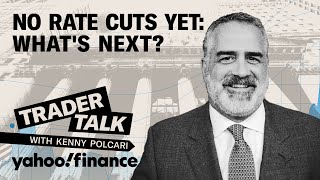
This is a Trader Talk episode (May 8, 2025) hosted by Kenny Polcari with guest Tom Essaye of Sevens Report Research. The conversation centers on Fed policy and market expectations for rate cuts (markets expect cuts but speakers argue data don't support near-term cuts), a pronounced divergence between soft (survey) and hard (economic statistics) data, and the market impact of the Trump administration's trade/reshoring policies. The episode closes with three practical market tips for investors and a signature regional pasta recipe.
Chapters
Foreign.
Welcome to Trader Talk, where we dish out the latest Wall street buzz to keep your portfolio sizzling. I'm Kenny Pulcari and today I'm not coming to you live from the New York Stock Exchange, but from the Yahoo Finances offices here at 77 Broadway. I'm still bringing you decades of market insight and energy. Now let's jump into my big take for the week. So here's a take that's going to sting. The reason most people lose money in the market isn't because they're uninformed. It's because they're addicted to the thrill of being right, not the discipline of being profitable. But let's be honest, if all you wanted was slow, steady returns, you'd be in broad index funds with automatic contributions and a long term plan. But that's not very exciting. It doesn't really scratch the itch. So what do most retail traders do? They chase the action. They over trade. They jump into speculative names with no edge and no plan because deep down, they're not in it to win, they're in it to feel. It's not about wealth. It's about the drama. The dopamine hit of a winning trade, the ego rush of calling the top, the social validation of posting gains, and even the pain of losing because it gives you something to fixate on, something to do. This is the uncomfortable truth. A lot of retail traders aren't investors. They're thrill seekers. And the market punishes that mentality brutally. Over time, the highs get more elusive, the losses get deeper, and the discipline erodes completely. You want to win? Stop chasing adrenaline. Start chasing the process. Because the market doesn't care how badly you want to feel. It only rewards those who show up with the patience, the precision and the purpose. Joining us today is my friend Tom Essay from Sevens Report Research located in Jupiter, Florida. Tom, like me, began his career on the floor of the New York Stock Exchange for Merrill Lynch's institutional equity trading division, where he regularly helped to trade multimillion dollar orders for some of the largest mutual funds and hedge funds in the world. Today he is the founder of one of the most trusted independent macro research firms out there and I am very excited to have him with me. Please welcome Tom Essay. Tom, it is a pleasure to have gotten you to come up from Florida to join me here in New York City at the Yahoo Studios.
Kenny, thank you so much for having me. It's been way too long since we've gotten together, so this is fantastic.
And you know what? I love the fact that you And I come from the same place. Right. We started at the New York Stock Exchange. I maybe spent a few more years there than you did. But we have that energy that brings us, that really defines kind of what was at the New York Stock Exchange.
And guess what? We're kind of a dying breed a little bit, because they're not too many. That's not the same that it was. Right. So you don't get the same.
No, it's definitely not the same. It was. The 5,500 people that used to be there are no longer there. I think the place functions there about 125 people, which is really amazing.
It is.
But it speaks to what technology has done to the business 100%.
And what it's done to the markets. Right.
It's done to the market. And we can talk, and we're going to talk all about that. But listen, today is a very interesting day because, you know, it's Fed Day. Right. And so it's been this anticipation building in the markets. We've seen how the markets have been very erratic, really, most of the first part of this year. Right. January right through. Right through now, got a little bit worse in April.
Yes.
You know, once Trump, once Liberation Day came, liberated many of us a lot of money from profits from our own money. But, you know, it's coming back one way or the other. Today is Fed Day. So all the eyes are on Jay Powell. All the eyes are on what is he gonna do? Especially, you know, after Trump has thrown the bombs in there about, I'm gonna get rid of him, he doesn't know what he's doing, he's no good. I think. Which I think is. Is not helpful at all.
At all.
But talk to me about. Let's talk first about your view on the Fed, what you think is gonna happen and what you think the message might be to the markets.
Sure. So I think, you know, it's interesting, right, because normally the Fed is sort of a dominant topic in the market, and now there's so many headlines coming out of the, you know, the White House, that the Fed is, to a point, like, unless it's a Fed day, it's sort of. People are like, ah, you know, I don't know how important they are.
Right.
They're still very important. And they are probably going to assert themselves a bit today. So the market expects no rate cut today, which I think everybody is going to agree upon.
Yeah, I don't think anybody, if anyone, expects a rate cut. They've been living under a rock.
100%. Right. But I think what the market is more focused on is does the Fed give any hints that, that a rate cut will come in June? Right.
So it's kind of like the forward guidance that investors are expecting from listed companies when they make their earnings announcement. Right. They all want to. They don't care what the history is because the earnings are history. They want to know what the CEO is saying about the future.
That's exactly right. Right. And that's why that forward guidance part that you get in the third paragraph of the statement is always for people like us, that's always what I'm looking at. Right. And so it may not seem like it's that big of a deal or are they going to signal they're cutting rates? Not. It is a big deal because the market is fully expecting a rate cut in June. And one of the reasons that stocks are holding up is because the market thinks the Fed is going to cut rates three to four times this year to cushion the blow from tariffs. I think there is some risk in that assumption.
I think there's a lot of risk. Listen, I think three and four times is a lot of risk. But look, they said that last year. Remember last year they were talking about 6 and 7 rate cuts. I was scratching my head going, I. How do you come up with that many rate cuts? I'm not even sure unless the economic data really starts to spin out of control. The hard data, not the soft data. And we can talk about the difference, we hard and soft data. If the hard data doesn't spin out of control, I'm finding it hard to even understand how they're going to come up with two rate cuts.
I agree with you. I think there's a lot of risk on the assumption of these rate cuts because Powell has been pretty clear. I mean, for all the Fed watchers that are out there, the Wall Street Journal, I mean, these people tell you what they're going to do if you listen to them.
Right.
And what he has said is, he said there is so much uncertain created from these tariffs. We don't know what they're gonna do to inflation. We don't know what they're gonna do to growth. We had an assumption on the tariff size that we kind of modeled in.
He blew through that.
Right. Fantastically. So now they're sitting there being like, well, what are we gonna do? Right. And if you're sitting there saying, what are we gonna do? You're gonna be very hesitant to do anything, lest you make a mistake.
That's right. And so the market is gonna be ultra focused on all the words, the sentences. What did he say this time versus last time? What words did he eliminate? What words did he add? I bit. You know, I think it drills down too much when they start looking. Which word did he change? But I'm in your camp that we're not getting a rate cut. I'm also in the camp that we're not getting one in June and we're not getting one in July. And then that brings us to August, where there's no meeting anyway because they got the Jackson Hole boondoggle and then you got September. Right. So potentially, if you want to look out, but I'm not even sure because let's talk about the hard data versus the soft data, because that's been a big conversation.
Huge deal this year. Huge deal this year. So there's two types of economic data we get, you know, in sevens report, we watch economic data all the time. Right. Soft data.
By the way, can I just say I love your report.
Thank you.
The listeners and the viewers should take a look at the seven's report. I think it's an extensive report that he produces every day. It's full of all kinds of valuable information. So that's just. My pleasure. Thank you. But I think it's a great.
I appreciate it. But, you know, you look at soft data. Soft data are surveys, right? So they call people and they say, what do you think about business? What do you think about prices? What do you think about the stock market?
Their opinions?
They are not hard statistical data.
They're not measurable.
Now, in normal times, the soft data is important because it can be a leading indicator. So if you call 100 consumers and all 100 say, oh, I'm tightening the belt, guess what? We can reasonably expect that retail sales may dip in the future. This experience that we are going through challenges that assumption because a lot of the soft data has really crashed. But the hard data, which is actual numbers, right, retail sales, gdp, jobs report, that is not crashing. And it's creating a very weird dichotomy that analysts are trying to figure out.
And so it's confusing, right? So to your point, typically the sentiment surveys would foretell or caution or at least put up the caution flags. I don't see that yet. And so while I appreciate the soft data, I'm much more focused on the hard data. And to your point, the hard data isn't going off the edge.
It's not going off the edge. And I have a theory on why the soft data is crashing. And I think some people who have read the Sevens report read it, a lot of people have a very intense reaction to the man who is behind these policies. Right, right. Tds, sure. Right. And when they are asked, what do you think is gonna happen to the economy? Many people will internalize, well, what do you think Trump is doing to the economy? And those are not the same things.
No, they're not, they're not. And I think what happens is, to your point, they have such a visceral reaction to him as a person that they can't see straight. They can't see through the noise. Right, exactly. And so I think that I agree with you. I think that that's kind of causing this schism in the data.
So to that point, in a recent conference board consumer sentiment release, more people expected the stock market to decline than at any point since the financial crisis. And I mean the depths of it.
Right.
2009. If you look around, you were there in 2009. Oh, yes, I was there in 2009. We are nowhere near how bad things are. And that was the last time this many people expected the stock market to decline.
But you know what I find interesting is that look on Liberation Day when he came out, the markets got a little bit anxious. We saw the visceral reaction. The market sold off over the next couple of days really, really swiftly, which creates more angst because people are trying to figure out where's the bottom. Where's the bottom? It feels like it's falling out of the sky.
We're watching profits go away 100% and.
People are watching the balances in their account drop every day. And that only creates more anxiety, 100%. But again, as I now as a wealth manager, I sit in a position, I have to talk to investors all day long and investors that are nervous or investors that they want to take their money out, but they're long term investors. These are not people that are, you know, need the money tomorrow or day trading. Right, or day trading. It's money that's invested for the long term. And so I end up having this conversation over and over about what they own, why we own it. You know, they're the biggest names in the industries that, that are represented. They're the mega cap names. They're not going anywhere. Right. We don't own a bunch of micro cap and nano cap stocks that are very, very volatile. Yeah. And so, and so it's interesting because, okay, so, so, so you get them on board with that and then they see the market find A, they see the market correct and they breathe this sigh of relief because then they see the balances and their accounts start to go back up again, of course. Which doesn't mean it's over by any stretch.
No, no, it's not. And I think that the one thing every investor has to prepare themselves for this year is that this roller coaster is not over. It doesn't mean it's going off the rails, but it is not over. Because whatever you think about Trump's policies, he has made it very clear, again, these people will tell you what they're going to do. He is trying to reorient industry back to the United States of America. That is going to. Whether it succeeds or fails will probably be revealed after Trump's gone, frankly. But he is going to execute this strategy, and that's not the way things have been for a long time. And it's gonna cause bumps.
All right, so hold on one second. We're just gonna take a break. We'll be right back. All right, so let's just pick up on that thought about Trump's reorienting the economy. Cuz I agree with you.
Sure.
And I also think it's long overdue. Yeah, listen, like anything, like, look, like the US capital markets, every 25 or 30 years go through a major modernization and renovation because stuff happens. Yes. The world changes, technology changes, all that stuff. And so you have to look at trade agreements that were written decades ago, and you have to say, okay, look, the world's a different place today, so let's renegotiate. So I don't think he's wrong in that sense. No. And for the most part, I think most people would agree that they need to be modernized.
Yes. Reevaluated. Right. Yeah.
Now, it might be painful a little bit.
Sure.
But I think in the end, it's gonna be just as many people expect. Not just him. There are a lot of people that expect, once we come through the other end, that we're in a better place.
Well, I think what gets lost in sort of, to our point earlier, this sort of visceral reaction to Trump is sort of the ideological backing behind this. So if you look at. That's Scott Bessant, who's the treasury secretary, he said earlier this year, it should not be the American dream to buy cheap stuff on Amazon from China, 100%. And I think most people would agree with that. And you can look at that and you can scoff, but what was the American dream? Buying a home. How easy is that for young people? These Days for most people. Right. Staying out of debt. How easy is that for most people these days? It's not right. And so these people were elected and they have this vision and they are going to execute policies and it is disruptive and we have to hold on. But it doesn't mean that everything's going to go off the rails either.
No, and it doesn't. And I think that's the part that gets lost, because I think, I think some in the community, you know, are trying to find out or trying to figure out a point to the fact that it is going to go off the rails no matter what. They just don't want to believe it. They just don't want to buy into it. And they're going to push and shove until, you know, they can be proven right. I don't think they're going to be proven right because I think this will work well.
I think it will work in the longer term. And I think that for investors, you know, as you sit there and you read these headlines and listen, Trump communicates in a very unique way. Right. And I think sometimes that he is his own worst enemy in the way he communicates. But Trump understands markets and he understands that the economy controls the electorate and he is not going. It seems very unreasonable to me that this man is going to execute policies that are clearly nosediving the economy. We've already seen him tackle.
Right.
He understands the markets. I feel better about a guy who is trying to execute a vision that's different than what we know, but understands markets than a guy who's going along with the status quo and doesn't understand markets.
Right. Which is. Which is. We can say that we've had a lot of that.
Yes, yes.
And so. And so. And so it's time for change. And that change can be uncomfortable, and I get it. But I don't think it's the end of investing. And nor do I think it's the end of, you know, people trying to plan and build and create wealth for generations to come. Whether it's for them, their family, their kids, their grandchildren, I don't think that ever goes away.
I agree with you 100%. And in the 30 years I've been doing this and studying American economies and stuff like that, there's two things you never bet against. Number one, the US Consumer. Right. Number two, the ability for US Corporations to make money.
That's right. And they do. And we're staying. And this earnings season, while we're getting to the tail end of the earnings season, we are but the earnings season has not been a disaster by any stretch of the imagination.
Not at all. Right. And of course there's a ton of uncertainty because these companies are sitting there looking at it. But they've got a lot of levers they can pull to keep profitability.
And there are some that, there are some that, you know, thrown in the towel, said, look, I'm not gonna, I'm not gonna give forecasts because there's too much uncertainty. There are others that have actually given us two forecasts. If this happens, then here's what I project and if this happens, here's what I project. Okay, that's right. But there were still others that are saying, absolutely not, we're marching forward, we see it, this is what it looks like, and we're, you know, we're confident in our ability.
Well, and that's the thing. These, these are huge corporations that have multi year strategic plans. Certainly this has changed a bit of the playing field. But don't think these people weren't aware of this possibility too. I mean, the election went on for well over a year. Right. I mean, it's not like all of a sudden Trump popped into office and.
Nobody knew what was happening. That's right, 100% for people to say he said it the whole time he was running, what he was gonna do. It wasn't exactly to your point. If anyone says they didn', they didn't know, they weren't paying attention.
That's exactly right.
They weren't paying attention.
And oh, by the way, you know, you'll get a lot of, you'll get, not a lot, but you'll get some corporate execs who will come out and they will speak out against these policies and things like that. Well, you have to realize that a lot of the policies that were set in place were very corporate friendly.
Correct.
This administration is trying to reorient, trying to rebalance a bit from strengths of the corporation profitability to also benefiting a lot of the citizenry in a way they think is appropriate. So it's reasonable that if someone says, hey listen, you're gonna have to eat a little bit of this, that you're not happy about it.
That's right. Which brings us back to the Fed day. It puts Jay Powell in a very interesting position because he's gotta take all these things that we just talked about and sit down with the 12 members on the FOMC committee and talk about what the next move is. Which leads me to say, like you say, I don't think it's gonna be a rate cut. No. And I just don't think I'm in the camp that there's not gonna be one this year at all unless the data really goes off the edge.
Well, I think that, I think the market has this a little bit short term, backwards. And this happens from time to time where the market roots for a rate cut. Right.
Yeah.
Normally the Fed will only cut rates if growth is already slowing. And guess what? That's not a good thing for markets.
Correct. But that's not happening at the moment.
No, it's not happening.
Not happening, exactly. I think that's key. People need to. People really need to take a step back and take a breath and understand.
I agree.
Right.
There's also a lot of history that people can get into as well and sort of the interplay between Trump and Powell and Nixon and Arthur Burns. For anybody who feels like and author economic history books, history doesn't repeat itself, but it does rhyme and it is kind of rhyming now, you know. Absolutely.
Listen, Tom, I appreciate this. I love this conversation. I look forward to having you back again. Maybe at the studio in Florida once we get that set up. It'd be a pleasure to have you. Thank you very much for joining us today.
Thank you, Kenny. Great to be here.
Always a pleasure. Let's wrap things up with three essential market tips to keep in mind. No matter which way the wind blows, use the 52 week range like a compass. Here's something simple most beginners overlook. Check a stock's 52 week high and low. It gives you a quick snapshot of where the stock has been and how it's behaving. Is it near the top? Might it be stretched? Is it near the bottom? Maybe it's beaten up for a reason. Or maybe it's a bargain. It doesn't tell you everything, but it gives you context. And context is key. Earnings calls are free. Use them. Do you want to know what a company's really about? Listen to the earnings call. They're public, they're free, and they're packed with gold. You'll hear the CEO talk about what's working, what's not and where they're headed. It's like getting a peek behind the curtain. And most investors never bother to do this. And you're already ahead of the pack. Look at what the CEO does, not just what they say. Every CEO sounds great in an interview, but watch what they do. Are they buying shares of their own company? Are they investing in growth? Are they hiring? Are they building? Or are they cutting staff and dumping stock while telling you that everything's just fine. Actions always speak louder than words. Now you know. Every episode I end with a pasta or a recipe for the day. Today, I'm going to give you rigatoni Puglia style. Now here's a taste of history. Puglia is at the heel of Italy's boot. It's been shaped over the millennium by Greeks, Romans, Byzantines, Normans, and Spaniards. Its cuisine reflects this layered heritage. Simple, rustic, and bursting with flavor. In ancient times, Puglia was known as the breadbasket of Rome, and today it remains a culinary paradise, famed for its wheat, olives and cheese. This dish today celebrates that tradition with a hearty rigatoni, creamy rigotta and crispy pancetta, a timeless combination. You can scan the QR code that's on the screen and get my full recipe. Now that's a wrap for today, but the conversation keeps going. Subscribe on Apple Podcasts, Spotify, Amazon Music, or wherever you get your podcast. You got questions or topics you want covered? Email us@tradertalkahooinc.com we're listening. Until next time. Stay sharp, stay disciplined, stay in touch, and take good care.
This content was not intended to be financial advice and should not be used as a substitute for professional financial services.
More from Kenny


Wall Street Is Celebrating| But Kenny Polcari Sees A Warning Sign | Kenny Polcari


Stocks Crashed After The Fed Move But Here’s What Investors Missed | Kenny Polcari
9/11 25 Years Later: Bond Market Warning, Oil Above $100 & Fed Rate Hike Fears | Kenny Polcari

Oil Hits $97, Bond Yields Surge & PPI Inflation | Markets Brace for Fed Decision | Kenny Polcari
The Fed Has a New Problem | Oil | Inflation | and Rising Yields | Kenny Polcari

The Fed Never Promised a Rate Hike | But Markets Panicked Anyway | Kenny Polcari

Nvidia Crushed Earnings | but the Biggest AI Opportunity Is Still Ahead | Kenny Polcari