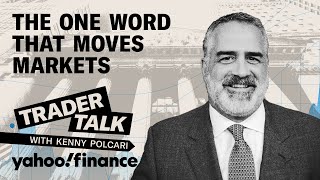
A Trader Talk episode (host Kenny Polcari) featuring Brian Levitt (Invesco global market strategist) discussing why investors should avoid trading on fear. Key themes: China–US trade negotiations and tariffs (45% mentioned as a possible tariff level, negotiation as a long game), market volatility driven by policy uncertainty (VIX spike to ~56; large single-day S&P gains such as April 9), geopolitical events typically produce short-term shocks rather than lasting economic trajectory changes, and Fed policy outlook (possible cuts later in year; jobless claims, flat yield curve, and three-year inflation breakevens ~2.5%). The episode closes with a Greek lemon chicken recipe and a standard financial-advice disclaimer.
Chapters
Foreign.
Welcome to Trader Talk, where we dish out the latest Wall street buzz to keep your portfolio sizzling. I'm Kenny Polkari coming to you live from the Yahoo Finance headquarters in the heart of New York City, a global hub where deals are made, fortunes are built, and the next market move is always just around the corner. Coming up, I'll give you my big take on negotiating with China. I'll you give. Now we're going to chat with Invesco chief market strategist Brian Levitt. And I'll share my classic Greek lemon chicken recipe. Now let's jump into the big take. Let's not sugarcoat it. China is impossible to read and even harder to trust when it comes to global markets and trade policy. For years, every administration has tried to solve the China question with everything from summits to sanctions. But the reality is simple. China plays a long game, protects its own interests, and never tips its hand until the deal is done. Enter Trump and his tariff negotiations. For all of the tough talk, threats and headline grabbing moves, Trump isn't just negotiating with another country. He's facing off against a master tactician. Each tariff, each tweet, each 11th hour deal is just one move in a much bigger chess game. And if you think China's giving up leverage, you haven't been paying attention. Here's what most investors miss. China's negotiation style is all about patience, ambiguity and leverage. Delays, fake breakthroughs, sudden walkbacks and last minute pivots are not stumbles, they're part of the strategy. The Chinese government has weathered cycles of tariffs, restrictions and blacklists, using them to fortify domestic companies and expand their influence across Asia and Africa. Every time the US Thinks it has the upper hand, Beijing finds a new angle. It could be currency moves or rare earth controls or regulatory hurdles for American companies. That's why every round of Trump's tariff drama rattles the market. Not because tariffs are new, but because no one on Wall street trusts that the resolution will stick. Investors know the risks. There's supply chain headaches, surprise, retaliation, and deals that unravel overnight. It's not just about steel or chips or soybeans. It's about trusting a counterpart who views negotiation as a battlefield and not a handshake. Bottom line, China is the world's most important swing factor, and Trump's tariffs are just one battle in a never ending trade war. If you're betting on a quick and clean resolution, you're ignoring decades of history and misreading the game entirely. In this environment, trust is just another word for risk. Joining us today is Brian Levitt, global market strategist at Invesco, a guy who's been in the trenches of the market for more than 20 years. Brian's the kind of voice you want in your corner when you're trying to make sense of the economy, the Fed, inflation, all of it. He's got a great way of breaking down the big picture without the jargon, helping investors connect the dots between what's happening out there and what it means for their portfolios. Let's give a warm welcome to Brian Levitt. Brian, welcome to the show. Thank you for joining me. It's a pleasure to have me here on your show with me today. So listen, let's talk a little bit about first. Tell the audience just a little bit about your role at Invesco.
I work as a global market strategist at Invesco. My job is designed to try and help investors better understand how they should be thinking about their portfolios. But also I try to help ease concerns, calm their fears, help them to overcome emotions.
Don't we all? Is unbelievable. Especially, especially what's gone on the last couple of months.
Yeah, I didn't know I needed a psychology degree also, but I figured I'd just go with economics.
I end up getting a psychology degree just because I have to deal with it. I never.
So maybe, maybe you can help me, give me some pointers.
No, it's really been nuts. But you know, that speaks to, that just speaks to the level of emotion at the moment. Right. But yes, to your point, I think it's, it's, our role is to try to help these long term investors to kind of stay the path and not make those emotional decisions. But let's talk, let's talk about a couple of things. Cause there's so much going on. But I really want to start with, you know, US and China trade right where that, you know, where that, where it was and where we think it's going to be now.
So we were in a tough spot not that long ago when you were Talking about the 145% reciprocal tariffs and the fear about a tit for tat trade war. So we've got a bit of a pause here. We have a potential framework agreement where tariffs will be higher than they otherwise would have been. But it seems as if Trump and Xi are incrementally moving closer to some type of framework agreement.
Right, but they're not going to be nearly as high as when they, when he first moved them out.
No, no, It'll be like 45% on Chinese goods, 10% on US imports going into China. Maybe that's just the starting point for negotiation here.
Right, but do you think that those, do you think that's where they stay? 45%. You think they potentially come down?
I think they potentially come down. And, and my, my biggest thing about tariffs all along has been that they, they're going to lead to a less optimal outcome because somebody's got to pay for. Right, right. It's either a lower profit margin or the consumer pays for it. But they may make sense if you want to defend national security. The most important thing to this market is clarity.
Right.
Let us know where it is and things will adjust accordingly.
Right. Because the one beautiful thing about the market is the market can function as long as it's clear. It could be bad news or good news, but as long as it's clear, then the market can function. It's the lack of clarity, I think, that causes clearly all the chaos.
Well, that was a challenge with Liberation Day. Liberation Day, the hope was tariffs would be lower than we expected and at least we can move on to it.
Right.
Move on from it. And people want to talk about now the tax cuts or deregulation. As long as there's uncertainty around tariffs, that persists. So we're getting closer to perhaps better clarity on all this. And the market just wants to see signs that things are getting better 100%.
Now, let us question, do you think that this latest conversation that took place in London between Scott Besant and the Chinese representatives is as solid as they're making it sound, like, okay, we have the framework, we're ready to go, because a month ago we had the same thing and then suddenly it wasn't.
Yeah, I mean, we'll probably have fits and starts on these types of things, but I think we ultimately know where this is heading and I like to alert people to 2018. We had trade conflict between the US and China. We had a 20% downturn in the fourth quarter. We got a 90 day pause. We did not get a trade deal with China until the beginning of 2020. And yet 2019 was a great year for markets because again, the market is forward looking and the market was believing a better outcome than had previously been expected.
And I actually think the market today is still believing a better outcome. It is, it feels like, you know, okay, you could say that a month ago when, you know, when we had traded way off, down 20% that know the end was near and oh my God, it's gonna be over. But in fact, you know, once there's clarity in, the market wants to be positive, the market wants to be bullish. And I actually think that the robust, that the economic data in this country remains fairly robust. The hard data, I think, continues to point to better times. Ed. The soft data is soft data. Soft data is survey data. So you have to kind of take that with a grain of salt. Who are they serving? And I do think that this falls along party lines. At least now the Democrats are, you know, screaming and yelling about it's horrible, and the Republicans are screaming, yelling that it's great. So clearly depends on who you're asking.
Yeah. And then you have to remember the setup coming into this year was quite good. If you go back and you read 2025 outlooks, most were positive because growth was strong and inflation was stable.
Right.
And there were some animal spirits that were picking up around deregulation. So that's really what the market is still attuned to, is that we just came through a good first quarter earnings. Things may slow, but it's an economy that continues to hang in there.
That's right. And Atlanta GDP now has second quarter growth at 3.8%, I think. Right, right. The first quarter we were okay, negative three. I think it ended up being right. Right now we've gone back to 3.8. So there's no sense to me that there's this pending recession coming.
No, it doesn't look like a pending recession. And if there was going to be a pending recession, one of the first things you would see is corporate bond spreads.
Right.
And that's actually just the opposite. Corporate bond spreads have been coming in, which is really a testament to two things. One, the resilience of the economy, but also the fundamental strength of corporate America, which is again why it comes back to this original thought of you might get a less optimal outcome, but let's set the tariff rates and move on 100%.
Now, listen, let's talk about just one other very recent event that caused all kinds of angst. But in the end, I don't think it's gonna cause a lot of angst because while geopolitical chaos causes short term chaos, I think actually in the long term, investors in the markets look right through that.
I always tell investors to think of a couple of questions when something happens in the world. Number one, does it change the trajectory of the large economies of the world? Number two, does it change what their central bankers are going to do? So US and China are fairly insulated from what is going on between Iran and Israel now, could you get there with some type of meaningful impact to the oil market? You could, but we also have to remember the United States is now producing a record number of barrels of oil per day. So regional events tend to not end business and market cycles. And I think that's a great way for investors to think about it.
But I think it creates opportunity. Right, because it gets emotional and stocks sell off for no other reason than people are emotional. Not because the thesis change, not because the story in Nvidia changed. Just because people go, I want my money. And what's the first thing they do? They hit the big name stocks because those are the ones that move the most. Right. But so for the long term investor, it becomes an opportunity if, you know, if you can look through it, it does.
And think about on October 7, 2023, when the conflict between Israel and Hamas started. I mean the stock market's up a lot since the broad market. And even if you, even if you think about where we were on April 8, I mean the market started to price in going from a trade conflict to maybe even concerns about a recession or some type of financial crisis, investors were pulling money out of left and right. And that was the bottom because tends to be when volatility peaks, that's when you get a policy response.
Correct.
We got a 90 day trade.
But look, if you, if you were somebody who did nothing on April 2nd or April 5th, whenever the, whenever that the sell off started, if you did nothing today, you are back, you're probably, you're probably in a better position today than you were on April 2nd in terms of portfolio value. Right. Because most portfolios have rocketed back.
They've rocketed back. I mean you're, we're the February 19th high. We're getting close to, we're getting close to that.
But I'm talk about the April 2nd. Yeah, much better since April 2nd, I think. I think a lot of portfolios are better actually today than they were on April 2nd.
Yeah, yeah.
Right. So. So that just speaks to the point about not making emotional.
Yeah, I mean we all have an action bias. I mean if you go back and you read the behavioral finance stuff, everyone has an action bias. I mean, something happens, you want to do something. I can't just sit here. Right. But the reality is when it comes to investing, just, just waiting it out tends to be a better way to go about it. I've actually done a study, Ken, where if you look at all the major conflicts in history going all the way back, you know, most of the century. If you had added money on the day the conflict started, rather than pulled money, you'd be a lot better off.
Yeah, I think that's true and I think we can go back and verify that. But I think what's interesting is that if. Now let's talk about long term investors, not short term traders, because short term traders want nothing but chaos because that's how they make their money. But as a long term investor, if you've got a well designed and disciplined portfolio than sitting tight and not necessarily panicking. You may want to take advantage and add money, but the last thing you want to do is sell money because you're panicking. Because unless the story has fundamentally changed, and this story didn't really fundamentally change.
No.
What's happening here in this economy?
No. And I always go back to an op ed that Warren Buffett wrote in the New York times during the 2008 global financial crisis where he was talking about the dow in the 20th century having to deal with two world wars, a dozen recessions, a great depression, on and on. The Dow went from like 40 to thousand. Right, right. So the 20th century was a pretty challenging period.
No, it was. And, and yet stocks did fine.
Stocks did more than fine, which I.
Think, you know, that goes and speaks to, you know, being in the game. Right. It's, it's time in the market. Not trying to time the.
Yeah. And volatility is the cost. I mean it's the cost of, it's the price of admission.
That's right.
Right.
So, and so let me ask you a question about where you, where you view volatility and maybe how investors should, should think about volatility in their portfolio.
Well, volatility is almost always the result of policy uncertainty. It's funny, in good times, like back to back 25% up years, people will ask, well, when did the bad times come? When does the volatility come? When does the drawdown come? It's almost always the result of policy uncertainty. And this time was no different. We saw a Vix so Chicago Board Options Exchange Volatility Index spike to 56. That is way greater than a two standard deviation move. People remember a normal distribution curve. Those are the things that happen less than 5% of the time.
Right.
So make no mistake, that was a big move. The challenge investors have is they want to pull out on those moves, whereas the policymakers realize we better do something right again, a 90 day trade pause or sometimes the Fed comes in. And so investors tend to pull their money out of the market. Right. When the policymakers are trying to calm things down.
Right. But then when, and then when they do calm things down, then they try to run back in the market and, you know, become buyers and then they force the market higher.
And what happens, which is unfortunate, is you miss the best days in the market.
You missed it completely. That was the point. Yeah.
Everyone sees those charts. If you miss the 10 best days in the market, you get half the return. But what people never remember or maybe weren't taught is that those best days always happen in the worst moments.
The worst moments.
So we just had the third best day in the S&P 500 since 1957. I believe that was April 9th, nine and a half percent. It just over took over the third spot from March 24th, 2020, which was up 9.4% when we were all sitting in our homes during COVID Right.
So hold on one second. We'll take a quick break and we'll be right back. All right, so let's just move on to the Fed now because this is a big week. Right. We've got the June Fed meeting. We've got, you know, all kinds of, all kinds of, well, you got all kinds of speculation. I'm in the camp we're going to get a rate cut. I think the market is in the camp we're not getting a rate cut, but yet there are people screaming for a rate cut, starting with the President. Right. I'm in the camp that the Fed should do nothing.
Yeah, I mean, all presidents want rate cuts, right?
Sure.
So, yeah, I don't think that this is a Fed that's going to be jawboned by the President. Very, they're very committed to their credibility and so far, so good. If you look at long term inflation. Breakeven. So inflation expectations, the bond market, very stable. So no, the Fed's not going to cut rates here. What you're starting to see a little bit is jobless claims pick up.
Right.
You're going to see prices up, too. So the Fed's going to be in a little bit of a rock and a hard place, but I think they're going to respond more to some cracks in the labor market than to perhaps a price shock from tariffs.
So do you, do you see a Fed rate cut this year?
I'm starting to think that may be the case. I, I was moving into the camp that it wouldn't happen, but I'm starting to see what's happening with continuous continuing jobless claims. They're, they're getting up to that Couple of million level. And when you've got a flat yield curve, it means the Fed's too tight.
Yeah.
So it's probably time to start bringing rates lower.
Well, but let me ask you a question. The, the, if inflation is a problem.
Yeah.
Do you think inflation is going to be a problem the second half of the year?
I think you're going to have a price shock.
Right.
But not inflation. So what do I mean?
One time shock.
One time shock. No different than a war or a drought. Right, Right. That's what happened in 2018. The price of your washing machine went up once. Right, right. And then it stayed and then stayed there. So that's not. And the way you would want to look at it, I mean even the three year inflation break even, which you think might think would be rocketing higher, is back down to two and a half percent. Right in the comfort zone in my opinion.
And so where do you think 10 year bond yields end the year?
I think actually maybe a bit lower. And the reason for that is, I mean for all our talk about a resilient economy, things are going to slow perhaps a bit. Bit. And so I don't think that we're in a place now where the bond market is questioning U.S. fiscal sustainability. The bond market's going to trade on what the growth prospects are.
Are you worried about the amount of money that now Scotty Besson has to bring to the market to finance the debt?
So far the bond auctions have been just fine.
Right, right.
So any reports that people are listening to saying the bond auctions are bad? It's, it's, it's fine.
I agree. I don't necessarily think they're oversubscribed. But there also have not been a disaster.
The bit to cover ratio is pretty much right in line balance. And if you think of a ten year, what should the ten year rate be? Inflation expectations plus real gdp. Four and a half percent seems fine.
Right?
Right.
Correct.
And if the economy slows a little, then you're going to be below four and a half percent. So no, I'm not one of these people who is overly concerned about the US debt or the big deficits that we face. I don't worry about those from a funding perspective. One thing I say to myself to keep it contextualized is that household net worth in this country is over $160 trillion compared to a debt that's going to be 40 trillion. So 40 trillion is a scary number. It is larger than what we produce every year. But compared to the actual wealth of this country. Not as large as I think people suspect it is.
Right, but they don't. You know, that's a narrative that you don't hear a lot.
No, I mean, politicians want us to be worried about the debt because they have agend. Right. If you're in the Freedom Caucus, you want to cut spending. If you're in the Democratic Party, you want to increase taxes or you want to increase space. So they give us reasons to worry about it. But, Ken, I've been doing this long enough that I remember when I was being told 5 trillion was a bad number, and now we're close to 40 trillion. Meanwhile, for the last 20 years, the dollar has been very strong and rates have been historically low.
Right. It's funny that you said you were worried about 5 trillion. You know, I've been in it long enough to that. One trillion.
One trillion. Yeah.
Oh, my God. Right now we're talking 40 trillion.
Yeah. People are pulling it up now to see how old we are.
I'm older than you.
I got the sense when you said one trillion.
Yeah, yeah. That gave it away. All right, so let's just tighten this up and finish off with if you think the Fed, if you're now in the camp that you think the Fed is going to potentially cut rates in September, I guess because you're not getting it in June, I don't think you're getting in July. And then there's no August meeting right now unless there's an emergency because they can cut intermediate.
Doesn't seem like there'll be something that's an emergency, at least where we are right now.
Yeah, I don't think there is. I'm still in the camp. Funny that I don't think we're getting a rate cut. Yeah, I can see that it's going to hold steady.
I could see that.
Right. And you got people screaming and yelling about the housing market. Quite honestly, I think the housing market got inflated because they kept rates so low for so long. I actually think if he keeps rates where they are and mortgages stay at 6.8% and housing prices are going to have to. People that really want to sell the house are going to have to. Are going to have to come down a little bit and that's. I think that's going to be helpful.
Well, it certainly would be helpful for a. For a younger generation home buyer. Yeah.
People that can't buy a house. Right now.
The problem is the supply issue right now. I mean, this country needs to build more homes.
Well, agreed. Okay. I'm not disagreeing with that, but I think that the current, you know, they're. And I live in Florida. Right. Right now I happen to live along the coast, so I think there's probably less pullback along the water. But if you move inland a little bit, like Port St. Lucie, which they really, they built up like crazy, but now there's almost an oversupply in Port St. Lucie, so you can start to see prices come down.
Right.
You know, and they're coming down a fair amount, which I actually am not so worried about. I actually think that's good for first time home buyers that want to come in and buy out.
Want to come in and buy house. I mean, it's a little bit different in my area in Northern Jersey where, you know, you have probably a baby boomer generation that can't leave because of the mortgage rate. And then anything that comes on the market, you still get bids for it, even at today's mortgage rates. But, but it's all local, as we know. It's all regional.
It's all. I got to tell you, I'm still surprised at the strength of the, of the real estate market in the city.
Yes.
Still surprised of the strength of the market in the city.
People want to be here. People want to be here.
They do want to be here. They do want to be here, which I think is great because I love New York. I just, I'm just.
We're not building any more islands like this one.
No. Building any more islands.
For better or worse.
Yeah. Yeah. All right, well, listen, I really appreciate you coming in and having this conversation. I want to circle back with you in five or six months and see how this conversation.
Oh, I would love it to see.
In fact, where we are in, you know, November, December of this year and then what it looks like going forward into. Into 2026. But I remain really bullish on the outlook. So I think we're going to end the year. I think we're in the near just fine. We're not going to end it up 20%, I don't think, but just fine.
I agree with you.
Just fine. If we return to historical norms, I think it's great.
I agree with you.
Anyway, thank you very much.
My pleasure. Thank you.
Always a pleasure. Now, as you know, I end every podcast with a recipe. And today I'm giving you the classic Greek lemon chicken. Now, the history of Greek lemon chicken is a rustic dish deeply rooted in the peasant cooking traditions of mainland Greece. It represents the very essence of Hellenic cuisine. Simple, honest ingredients elevated by bold Mediterranean flavors. Lemon trees have flourished in Greece since antiquity, brought over from the Middle east during ancient trade routes. By the Byzantine era, lemons were a common flavoring agent in meat dishes, prized not just for their taste, but also for their preserving and tenderizing quality. Combined with oregano, garlic, olive oil, the holy trinity of Greek cooking, lemon brought brightness and depth to an otherwise simple meal. Historically, chicken was not eaten as frequently as lamb or goat because it was more valuable for the eggs they produced. When it was prepared, it was often for very special occasions. The lemonato style, braised or roasted meat in a lemon based sauce became a beloved household staple over time, especially as chicken became more widely available in the 20th century. Today, Greek lemon chicken is a comfort food across generations, often served with potatoes that soak up the pan juices. You can scan the QR code on the screen for the full recipe and you can thank me later. So that's a wrap for today's Potato Talk, but the conversation keeps going. Subscribe on Apple Podcasts, Spotify, Amazon Music or wherever you get your podcast. You've got questions or topics you want covered. Email us@tradertalkahooinc.com because we're always listening. Until next time. Stay sharp, stay disciplined, stay in touch and take good care.
This content was not intended to be financial advice and should not be used as a substitute for professional financial services.
More from Kenny


Wall Street Is Celebrating| But Kenny Polcari Sees A Warning Sign | Kenny Polcari


Stocks Crashed After The Fed Move But Here’s What Investors Missed | Kenny Polcari
9/11 25 Years Later: Bond Market Warning, Oil Above $100 & Fed Rate Hike Fears | Kenny Polcari

Oil Hits $97, Bond Yields Surge & PPI Inflation | Markets Brace for Fed Decision | Kenny Polcari
The Fed Has a New Problem | Oil | Inflation | and Rising Yields | Kenny Polcari

The Fed Never Promised a Rate Hike | But Markets Panicked Anyway | Kenny Polcari

Nvidia Crushed Earnings | but the Biggest AI Opportunity Is Still Ahead | Kenny Polcari