Why this strategist raised their recession odds
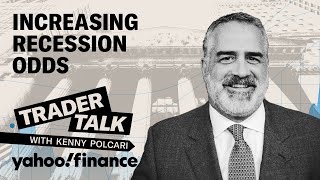
Transcript of a Trader Talk episode (YouTube/podcast) hosted by Kenny Polcari with guest Christina Hooper (Invesco Chief Global Market Strategist). They discuss the 2025 global market outlook, four 'swing factors' (tariffs, China stimulus, inflation resurgence, fiscal spending cuts) that have increased Hooper's assessed US recession probability to ~30–35%, the economic multiplier effects of government spending cuts (Medicaid/Medicare), tariffs and trade policy, labor-market indicators and Fed reaction, and actionable trading tips (focus on corporate guidance, use volatility, watch sector rotation). The episode ends with a culinary segment (porcini-rubbed ribeye recipe) and show sign-off.
Chapters
Foreign. Welcome to Trader Talk, where we dish out the latest Wall street buzz to keep your portfolio sizzling. I'm Kenny Polkari coming to you live from the New York Stock Exchange, a place that's been my home for decades and still fuels the pulse of capitalism, entrepreneurship, and I like to say, freedom. Now let's jump into my big take for today. Trading with emotion is going to destroy your portfolio. Period. The end.
I'm.
I see it all the time. Traders jump into the market, they're fired up, they chase momentum, they feel euphoric, and then they're up and panicked when. When they suddenly turn down. Here's the truth. Trading on emotion is a guaranteed way to lose money all the time. When you're emotional, you're not thinking straight, you're gambling, you're doubling down to make it back. Holding onto the losers for too long or exiting winners too early because you're scared that they'll slip away. That's not a strategy. That's a recipe for disaster. The markets don't care about your feelings. They don't care if you're afraid, hopeful, angry, or desperate. The market moves on fundamentals, on earnings data, on economic data, and reality does not move on your gut feelings. You want to succeed. Separate emotion from the action. Make decisions based on strategy, discipline and analysis, not impulse. Define your entry, set your stop loss and know your exit before you even enter your buy button. The reality is the market doesn't care how you feel. It rewards calm, disciplined traders who stick to their plan and punishes those who panic or chase euphoria. Bottom line, check your emotions at the door or prepare to pay a big price. Trading is a business, not therapy. Keep your head, keep. Keep your discipline and stay profitable. Okay, so now it is absolutely my pleasure to introduce my next guest, Christina Hooper. Christina is the chief Global Market Strategist at Invesco and a veteran of the Investment community since 1995. Christina is known globally for analyzing market trends, economic conditions, and translating these insights into actionable investment strategies. With previous leadership roles at Allianz global investors, Pimco, UBS, and MetLife, Christina brings deep experience and a nuanced perspective on navigating financial markets. A sought after expert and influential thought leader, Christina regularly shares her insights worldwide. So join me in welcoming Christina to the show. Christina, I am so looking forward to having this conversation with you. I know before we started this, we were having this conversation. We really need to kind of have it now because now it's important. So let's just talk. First of all, with kind of a 2025 global market outlook and key trends that you're watching that you think retail investors, investors in general, should be aware of.
Sure. Well, Kenny, I should preface by saying that our 2025 outlook we released in November of 2024, which seems like years ago, Eastern dog years, and our outlook was probably five fairly conventional. Our expectation was that we would avoid a recession globally and that the US would, in fact the US Would have a very modest slowdown and then have a re acceleration in growth that we'd see that occur bringing along other Western developed nations. And the reality is that though we recognize there was a lot of uncertainty, more uncertainty than usual going into 2025. So we also articulated four swing factors. The first swing factor that we thought could alter our base case, the introduction of tariffs and the potential for a tariff war. The second swing factor was China stimulus, that that could be a positive and actually could boost Chinese economic growth and the stock market there. Our third swing factor was the potential for resurgence in inflation. And that could come from a variety of different drivers.
Right.
And then the final swing factor was fiscal pressures that resulted in government spending cuts. Now, we never, when we laid this out, assumed we'd get all four swing factors come to fruition all at the same time. Exactly. But that is in fact what has happened. So that certainly has caused me to alter my expectations and certainly in particular my probability of a US Recession this year, which went from essentially zero, zero or near zero to I think, quite significant now.
So define for me what quite significant in your mind means.
So I think at this point we're at 30, 35% chance of a recession and climbing every day.
Right. And you can't, it's difficult to define how deep or not that recession is going to be because it is a moving target.
Absolutely. And there are so many unknowns. I mean, what we've seen is really aggressive cuts and what appears to be plans for very aggressive government spending cuts going forward. But we just don't know how far this goes before it peters out.
Right. So. So I agree with you. It appears as if there's going to be some aggressive spending cuts, but I'm really curious whether or not it's going to be as aggressive as it. You know, I always get a sense that the market always overreacts. Right. It takes the worst case scenario and it tries to price it in and then we don't necessarily get. I'm not going to say it's going to be any. But I don't necessarily not sure we're going to get these drastic, drastic cuts.
It's just hard to know because there's a political component and I am no political scientist, nor do I want to.
Be, nor do I.
So we can just assume that plans are for some significant cuts. And the way I look at it is that every line item of government spending has a multiplier effect attached to it. Essentially the knock on effects that impact the overall economy so someone doesn't lose a job in a vacuum. There are knock on effects for that. And if you have cuts to welfare benefits or Medicaid spending, that has a knock on effect, in fact, a multiplier effect that's higher typically than the kind of multiplier effect we see with tax cuts for wealthy households.
Right.
So we have to recognize that what looks to be happening in terms of the plans for the budget going forward would be cuts to higher multiplier effect line items of spending replaced with lower multiplier effects for line items of spending.
Okay, but here's a question. You know, let's just use Medicaid because it's the hot button issue right now. And I don't suggest that people should be taking Medicaid away from anybody that needs it, but is there in fact wasteful spending in Medicaid that we could pull back without destroying Medicaid?
So I don't know the answer to that, but I did do a fair amount of research on Medicare last year, just sort of a bespoke research project for a specific client. And, and what we found was that Medicare actually does a phenomenal job managing costs. We were surprised at how well it does in terms of controlling costs. The kind of growth in Medicare does not come from sort of profligate spending. It could be the number of enrollees. So as demographics grow, that will increase spending, but it is well controlled. So perhaps Medicare is the same way. I don't know enough to tell you whether or not.
Right, Medicare and Medicaid.
Correct.
Right, the two.
So yeah, so Medicare, I, we've explored Medicaid. I haven't.
Right. So Medicaid I was on, I was actually on Fox Business today with Mary Baromo and Cheryl Casson was talking about, she had a study there that said there's $50 billion worth of reckless spending in Medicaid. Now we have to look into that because I'm not really sure how they define that, but that's a big number, $50 billion in reckless spending. So, so my argument is if they pull back the reckless spending, are we really, are we really damaging the economy.
And I think it all depends. It seems as though the government spending cuts thus far have not been that targeted and surgical.
Right.
Right. So if it really is the $50 billion, if there really is that $50 billion and that's what's targeted, then I think that certainly can be a positive. Right.
A multiplier effect that, that, that if you eliminate all that, there'll be a negative multiplier effect. Right. But in the long run, is that really a positive for the economy and for the, and for the, you know, for U.S. spending?
Right. It, it really depends. I mean, I, I hearken back to Simpson Bowles.
Right.
Right. So this was a bipartisan commission that went in with a lot of great intentions and did that sort of thoughtful, surgical type of exploration and propose a series of ways we could close that gap in the, in the fiscal budget. And the problem was that it was very thoughtful, reasoned, but it was not adopted.
Right.
And so there should be, hopefully, a happy medium where you have that kind of thoughtfulness on the front end.
Right.
And then a rapid implementation as opposed to no implementation whatsoever. But instead, I think what we're doing is putting the cart before the horse. And that's where I think you can run into more issues where you're cutting appropriate spending that could be very problematic for the economy and is not a positive.
Right. So you're thinking there's rapid implementation before there's the thoughtful, the thoughtfulness about it. Right?
Yes, I think they've got it in reverse. Yes. If we could find that happy medium of Simpson Bowles plus a Doge implementation, that to me would make a lot more sense.
And so I would like to think that we will get there. I'd like to think that, you know, there are some adults in the room that, while it's all very dramatic now, and they're talking about Doge and, you know, Elon Musk with the chainsaw and all that stuff that, you know, that the, that the adults in the room will tell everyone to relax and that there'll be this thoughtful conversation. At least I hope there is.
Yes. But what we do have to worry about is that we're already seeing plans being changed in anticipation of significant government cuts. It came through in the Federal Reserve beige book last week.
Plans being changed from company, you know, exactly.
Because again, it's that multiplier effect. And so it's having a chilling effect on hiring plans and spending plans. Now, it's not just government spending, it's also tariffs. But that message came through loud and clear in a lot of the anecdotal comments captured in the Federal Reserve base.
Right. Okay, but let's talk about this for a minute. He, he ran, I mean, he talked about it for months. He ran on the idea that tariffs was how he was going to go. So it didn't, tariffs didn't come and surprise everybody out of the blue. He'd been talking about it, and, you know, we'd been talking about the markets, had been talking about, you know, the potential. And what does this mean and what does it not mean, in your view? Are tariffs as negative as some people would, like, make them think, or are they strategically going to be used to try to bring people to the table to have a conversation about fairer trade?
So I don't think tariffs are very negative in the grand scheme of things, because we've lived through it in the first Trump administration. We know they can come on, they can come off. And so what we saw was no real damage to the economy because Biden.
Kept those tariffs on China all through his four years. He did.
He did. I mean, the bulk of the tariff wars did end, and that's why we did see a stock market recovery later in the Trump presidency. But you're right, some of those tariffs were kept on for sure and still exist.
Right.
But I think what, and so I don't think that it's this huge issue, but I do think the longer it stays on or you have that uncertainty of where it seems, you know, where markets might perceive it to be whimsical, that it's on, it's off, because, let's face it, markets want certainty. So I think they'd be more comfortable with, but with knowing what's happening. But that doesn't help with negotiations. So I think, you know, what I would do is I would ring fence tariffs and understand that they'll contribute to volatility. But assuming that first administration playbook, I don't think it'll have any kind of lasting negative impact.
So, so let's just talk about something real quick, because I want to get on to. I want to get on some other things, but currently the market has been under pressure the last couple of weeks, more so really, like since the 19th, it's just down, down, down, lower lows, lower highs, low. Right. Because I think a lot of that is about the uncertainty, because to your point, markets hate lack of clarity. They hate when it's so uncertain. And I think they really hate, you know, today they're on, tomorrow they're off, today they're on, tomorrow they're off, they don't like that at all. But the idea of a reciprocal tariff, that we're only going to charge you what you charge us. So if you charge us 200%, we're going to charge you 200%. Right. Canada, for instance, apparently I didn't know this. I found this out. Charges, has a 200% tariff on eggs that we send to Canada. That's ridiculous. Is it not 200% that they're charging us? So if he were going to turn around and say, okay, we're going to have reciprocal tariffs now we're going to charge you 200%, I get it, it's nuts. But will that create, will that bring people to the table and cause new trade agreements in your mind?
Well, I certainly think it could. And by the way, why are we sending eggs to Canada? We need as many eggs as possible.
I have no idea. I was surprised.
I don't see that.
No, no, no, I don't either. But I think that was, you know, before the chickens all get sick. But whatever.
But so agreed. And in fact I think what we can look to is the Reagan playbook.
Right.
You know, back in, back in the 80s, Reagan of course was a very strident believer in free trade.
Right.
But he edged a little closer to protectionism when sort of in the midst of his presidency, he forced upon Germany and Japan what I believe the term was voluntary production controls, which were anything but voluntary. And it was essentially saying you cannot send more than X amount of vehicles into the United States. And it was hard handed. It went against his, you know, belief in free trade, but it had a lasting positive impact. And that, that was when both German and Japanese automakers began building plants in the United States. And of course many jobs were created by that exist to this day.
To this day.
So I certainly think that's the goal. But with, with reciprocal tariffs and just the idea that, that we can change the playing field. So I'm not going to argue with that. I just think we have to recognize that it will create some short term volatility for sure.
And it, and it has, I mean you can see it in the markets. Right? There's that, that, that, that anxiety that's building in the markets. But look, you can also already see a lot of these companies that are now have made a decision, look, we're going to, we're going to start manufacturing, we're going to start to build plants in America. We're going to start to manufacture our products. That's actually a good thing. Right, right. Long term, that would be a good thing. So, so yes, to your point, and I agree with you, it's the uncertainty about the tariffs that I think is causing the markets to be so anxious. I think if there was, you know, if, if, if it was like, okay, here's what it's going to be, then the markets would settle down a little bit. They can reprice. It may be negative news, but the markets will reprice and then trade as long as it knows what that news is. Right.
I think markets should be more nervous about cuts to government spending.
Right.
And maybe that's part of this reaction, but to me that's a much greater concern.
And maybe that, maybe that is the reason, I mean, the market's getting crushed today, but maybe that is the reason that it is becoming more concerned about government spending. But, but, so then here's the next question. At some point, do you think this is going to cause the adults in the room, not just Trump at the president, but, you know, all the legislative people, the senators and congressmen to sit back and go, okay, we really need to have this thoughtful conversation about cutting and slashing?
I think so. Unless there's an assumption that the Fed will do the heavy lifting and start cutting and then we don't necessarily have to worry as much.
Yeah, but can the Fed really cut in this environment?
I don't think so. And I think Jay Powell was pretty clear that we, we're going to sit on our hands and watch this whole thing play out. But Jay Powell was also the person who said back at the January FOMC press conference, yeah, hey, things are pretty well balanced now. We have low job growth, but we have low job cuts. But if that were to change and job cuts were to increase significantly, we might have some problems.
Well, okay, so we have to define, see, we have a different opinion on, we have the, defined the job cuts. I think at 4% or 4.1%, we're at the historically low end of the 3 to 10% range. Since 1948, I think that's been really the range. So I still view it as we're still at the low end of that range. Right. It doesn't sound like an alarm bell to me, but at what point do you think it becomes more of an alarm bell?
So I think, you know, I know you've thought of sort of getting close to 5% as the trigger. I think it can be lower than that. I think if you get to four and a half percent, I think if you trigger the SAHM rule, it's not that I believe in as hard and fast in an actual recession occurring. But I think that certainly increases the odds a lot. We're at a low base, but if you have a lot of layoffs and of course not that job creation.
Right.
That can be problematic. And again, we have to think about that multiplier effect.
Well, okay, so here's the next question because the NFP report which just came out, you know, we produced 151,000 jobs, which was a little bit less than the expectation, but wasn't a disaster. I think that some people thought it was going to be, but some people said, but it doesn't really. It hasn't yet counted all these federal employees that took that bio plan. Right. That decided to take the bio plan. But here's my question. If you're a federal employee and you opted to take the buyout plan, are you just opting to do that because you're so angry? Trump, you say, I'm not going to work. Are you doing that because you've already got another job, but maybe you've been working in the gig economy all this time, so you've really had two jobs. You've had a government job plus a gig job. So now you're saying, okay, I'll take the buyout, I'll get paid for six months and I still have my gig job.
I don't know how many are voluntary. Take the buyouts versus mandatory layoffs. Okay, so, but yeah, for the voluntary, I mean, I think your questions are well taken. I just, I think that probably the majority are more in that camp of mandatory.
Really? Okay, let's hold that thought for one minute. We'll just take a break. So let's just wrap this up with three essential market tips to keep in mind. No matter which way the wind is blowing, you want to pay attention to corporate guidance. Earnings reports matter, but what really moves the market is the guidance. This week, zero in on what companies say about future expectations. Because earnings are earnings, they're history. If guidance comes in strong, consider positioning yourself ahead of the broader market reaction. If guidance disappoints, be ready to trim your exposure. Good or bad guidance often gives you an early indication of where the sectors are headed next. Use volatility to your advantage. Markets naturally experience volatility, particularly around earnings season and economic releases. Instead of fearing volatility, embrace it strategically. Tighten your stop loss levels on volatile stocks. Protect gains, or consider smaller position sizes to maintain exposure without risking unnecessary losses. Volatility often creates excellent trading opportunities, so make sure you are well positioned to capitalize on them and then look for signs for sector rotation. Markets rarely remain static and and investor preferences can shift quickly, and we've seen that over the last couple of weeks. Regularly review your sector performance for rotation trends and notice when money is moving out of growth sectors into defensive ones or vice versa. Gradually adjust your allocation accordingly. It might mean trimming exposure to sectors, losing steam and reallocating to emerging leaders. Staying ahead of these rotations is what helps you remain in sync with with market sentiment. Okay, so as you know, every week I end the podcast with a recipe and today I've got the porcini rubbed ribeye served tagliata style. Right now, the porcini rubbed ribeye is a modern twist on European classics, right? Combining the deep, earthy richness of porcini mushrooms with the bold decadence of a ribeye steak. Now, while this exact dish doesn't have centuries of history, both porcini and beef have long been staples in the Italian and Western cuisine, right? Porcini is the king of mushrooms. So porcini or funghi porcini in Italian have been prized since Roman times. Their name actually means little pigs, likely refers to their plump, meaty texture. By the Middle Ages, they were a forager's treasure. In Tuscany, Umbria and Piedmont, drying porcini became common, preserving their nutty umani rich flavor for soups, risottos and sauces. The real game changer? Grinding the porcini into a powder, a 20th century innovation that amplifies its flavor. The technique makes them a perfect rub for meats, giving a rib eye a deep, woodsy complexity that elevates every single bite. Now you can scan the QR code to get the recipe. Trust me, you won't regret it. It is really a great dish, but tagliata style is how you slice it at an angle and fan it out on top of the arugula and then dress it with some shredded grana padano. And it's really delicious.
I'm sold.
Anyway, that's a wrap for today's Trader Talk, but the conversation keeps going. Catch Trader Talk Every Wednesday at 12pm on Yahoo. Finance or wherever you get your podcast. You got questions or topics you want covered? Email us at trader talkahoo inc.com we're listening. Until next time. Stay sharp, stay disciplined and stay in touch. Take good care.
This content was not intended to be financial advice and should not be used as a substitute for professional financial services.
More from Kenny


Wall Street Is Celebrating| But Kenny Polcari Sees A Warning Sign | Kenny Polcari


Stocks Crashed After The Fed Move But Here’s What Investors Missed | Kenny Polcari
9/11 25 Years Later: Bond Market Warning, Oil Above $100 & Fed Rate Hike Fears | Kenny Polcari

Oil Hits $97, Bond Yields Surge & PPI Inflation | Markets Brace for Fed Decision | Kenny Polcari
The Fed Has a New Problem | Oil | Inflation | and Rising Yields | Kenny Polcari

The Fed Never Promised a Rate Hike | But Markets Panicked Anyway | Kenny Polcari

Nvidia Crushed Earnings | but the Biggest AI Opportunity Is Still Ahead | Kenny Polcari