In this episode of "The Real Entrepreneur," host Mike Michalowicz reviews a clip that outlines five productivity habits attributed to Elon Musk: (1) skipping a detailed business plan, (2) cutting off pointless conversations, (3) walking out of useless meetings, (4) choosing to decide quickly rather than over‑deliberate, and (5) being willing to contradict oneself. For each habit, Mike offers his perspective—sometimes agreeing, sometimes challenging Musk’s approach—while weaving in his own entrepreneurial experience. He emphasizes the value of a clear vision even without a rigid plan, the importance of listening versus cutting off dialogue, the cost of unproductive meetings, the merit of rapid, reversible action, and the necessity of admitting past mistakes. Throughout, he frames Musk’s polarizing nature as a sign of authenticity and encourages viewers to consider which of these habits might fit their own businesses. The episode closes with a call to subscribe and a reminder to visit his website for further questions.
Chapters
The Real Entrepreneur. Maybe you are. I'm not saying I am. I'm saying this is. That makes sense. You're watching the Real Entrepreneur. I review movies, video clips, TV shows. I give you entrepreneurial insights within. My name is Mike Michalowicz, and before we kick off a little discussion about a clip with Elon Musk, want to invite you to push that subscribe button and hit that notification bell. All right. I assume you did it because it will serve you. All right, let's see what Elon Musk has to say. I love the last name Musk.
Elon Musk is the polarizing entrepreneur behind PayPal SpaceX.
Right there. Polarizing is a good thing because that means inevitably you're being true to yourself. Well, at least in most cases, that's the goal. If you're authentic, if you're true, if you lean into your natural self, you will have people that oppose you. That's polarizing. It's good because you're being authentic.
The Boring Company and Tesla. Whether you consider him a genius, you must admit that he's a productivity whiz. Here are five things Elon Musk does that have helped him be more productive. 1. Don't bother with a business plan. Last year at south by Southwest.
All right, I'll give that a check. I agree. Business plans. We'll see what he says but. Or what they convey that he says but business plans are so hard to predict. The future, meaning this. If you could predict what a small business, your business is going to do in the next few years, you can predict the stock market for a day. Invest in the stock market, you'll be a billionaire overnight. It's that predictability that's not there. But I think the good thing about a business plan is the vision. So record the vision. Where is the X on the map you want to head? But the route to get there, it's unpredictable.
When asked about his business plan, Musk explained, I don't really have a business plan. These things are just always wrong. Musk is not a big fan of starting up with a firm business plan.
Oh, so it's interesting there. He says, I don't believe in starting up with a firm business plan. What I heard there is there's probably a vision and you got to document it. I'm not saying that they're conveying that here, but that is something I believe in. Set the X on the map and then tack your way. Zigzag your way there. Considering what's the immediate needs your business has, what's the challenge you're facing, what's the opportunities that present themselves and how do you grasp those? Move forward for a quarter, 90 days, realign, move forward 90 days and move ahead in increments.
What does that have to do with productivity? It frees up his time and mental energy to work on a visionary level and leaves the operational details to others. 2. Immediately end any pointless conversation. When Musk thinks people are wasting his time, he cuts them off.
I disagree. Now let's put this into perspective. He has multi billion dollar corporations. I have multi million dollar corporations. I think he has more financial success and growth in the industry. And that style of cutting off conversations does not work for me. I believe there's so much discovering conversations that I don't know. I know the biggest risk I run is trusting myself. And when there is conversations happening, especially that are contrary to my belief, I need to listen. And it is hard. It's easy to cut it off because I want to just comply with what I believe to be true. But sometimes those endless conversations are people trying to tactfully get their point across. So often I have to listen more acutely. So I quasi to his way of thinking.
What's truly rude is forcing him to listen to conversations that are neither interesting.
Nor let me add to that, I think it's. It is rude for me me to speak endlessly with the simple intent of hearing my own voice. If I'm not being of service to the person I'm communicating with. If I'm not being service to you, I should shut up. Hopefully I'm being of service to you.
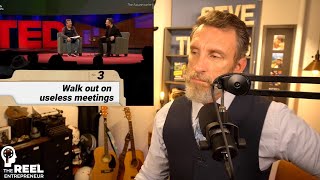
3. Walk out on useless meetings. If a meeting wanders or is on a subject that's not immediately relevant, Musk simply gets up and leaves.
Okay, I agree with this. It sounds like the similar context meetings with one on one conversations. If it's useless, are we listening? Well, but the other point is a meeting usually engages more than just one the person. I've seen meetings where five, 10 now with virtual meetings, 50 people are sitting there and two people are having a conversation. We're killing 50 people's or 52 people's time. So yeah, a useless meeting is damaging.
He also gives his staff and employees permission to do the same. 4. Decide rather than deliberate. It's obvious from the pace of his decision making that he prefers to decide to take action rather than talking a decision to death. A perfect example of this was when he fired all the Tesla contractors who couldn't find a Tesla employee to vouch for them.
Yeah, okay, so there it is. Action over further consideration. Yes, I'll give that one a check. I mean I agree with that. I think it was Colin Powell who said every war plan goes out the window the second the first bullet flies. No matter how much you envision where your business wants to go, how much you plan for it. Even though I'm not a big fan for business plans. No matter how much you envision and plan and prepare, there's so many variables when that first bullet flies. There's so many variables going on with the dynamically adjust. So I think taking action where there isn't potentially catastrophic consequences is better. Meaning take action that has a consequence so you can measure it but give yourself the position to rewind if necessary. But indecision in action, that can be very costly. I wonder if Tesla kept on those partnerships with were charging them through their teeth. Is that the mixed metaphors? But discharging them an arm and a leg and if Tesla would be around today. So yeah, deliberate action that's rewindable I think is a good move.
5. Don't be afraid to contradict yourself. Musk isn't afraid to walk back a decision.
All right. So yeah, don't be afraid to contradict yourself. Everything I just shared by the way, totally not right. I rewind everything and just concur with Elon Musk's assessment. Now yeah, of course contradict yourself but. But with tact meaning when you have a new revelation, it's okay to say I've had a new revelation. I believe to be true in the past was wrong. That's how Prophet first came about. When I wrote Prophet first I said I believe that Prophet should be the bottom line in the year end. It should be the last consideration but didn't work for me at revelation. That was wrong. And maybe I've. I'm sure I will have more revelations of things I'm doing now and actually just recently had one that maybe aren't right or at least not optimal. And I have to contradict what I said in the past. It's this belief that a players really exist and it's 10% of the population. I bought into that hook line and stinker and now I'm like oh my gosh, I think I was totally wrong. So I'm going to contradict what I said and share a new thing. And what I believe is everyone has a player potential. Think about that. I'll talk about that in the book.
For example, Musk frequently touted the Model 3 factory as almost entirely automated. He didn't hesitate to publicly announce it when he swapped out some automation in favor of human labor.
The way the conveyor said we had.
This crazy complex network of conveyor belts and it was not working. So we got rid of that whole thing. Rather than defiantly sticking to his guns, Musk prefers to bite the bullet and then move on.
That's perhaps the biggest argument or value right there, is when something we commit to is not working to have the courage to say, oops, that was wrong. I want to erase that or leave that or abandon that and move forward. There is this effect. I can't remember the term, but so basically the momentum effect. Like, once we do something, even if it's not working out, we stick with it. Because we're so close to the finish line, we keep extending and extending. It's common in software, maybe happens in automation, too. But if you don't have the courage to say, no, that was wrong, and take a new course that serves the company, it could be an endless spend that brings you nowhere and destroys your company. All right, there's my tips in this episode of the Real Entrepreneur. Hope you enjoyed it. Hope you got some value and have your own perspectives, too. I invite you to push that subscribe button, hit the notification bell, and please, any Questions go to mikemcalowitz.com? i'll see you on the next tree.