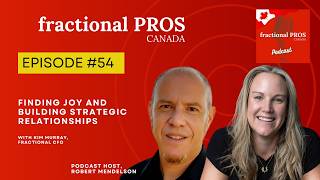
Finding Joy and Building Strategic Relationships with Kim Murray – Episode #54
Kim Murray, a fractional CFO for professional-service firms earning $2-$20 million, left traditional audit work for the freedom to choose clients and do high-impact projects. She niched down to professional services to deepen her expertise, and stresses that financial independence lets you walk away from values misalignment. Her advice: find joy in the work and be grateful.
Chapters
Hi, it's Robert Mendelson, Fractional CMO, here in beautiful Montreal, welcoming you to another episode of the Fractional Pros Canada podcast. We're part of Fractional Pros Canada, the home for Canada's fractional community, and you can find us on Facebook. We bring you conversations about everything fractional that matters for fractional executives and businesses from coast to coast. Think of this as your go-to spot for real talk practical wisdom and strategies you can actually use, all without the corporate fluff and with plenty of Canadian content. Whether you are a fractional pro or a business in our great country of Canada and beyond, this conversation is for you. Grab your espresso and let's dive in.
Welcome to the Fractional Pros Canada podcast. I'm your host and fractional CMO Robert Mendelson here in beautiful Montreal. And joining us from just down the street in Uxbridge, Ontario, is Kim Murray. Kim is a fractional CFO working with professional service businesses in the $2 to $20 million revenue range at the intersection of strategy and execution, building practical budgets, cash flow forecasts, and KPI dashboards that leaders actually use. Today's episode is sponsored by the fractionalpros canada.ca directory. When Canadian business leaders reach out to me looking for a fractional to fill a gap in the strategic C-suite, the first place I point them to is the Fractional Pros Canada directory. It's a curated hub for vetted high-tier fractional talent like Kim Murray, who you can find on the directory. Fractionals, if you're not on that list, you're missing the room where high-value connections are happening. Getting listed signals to the market that you are a serious fractional executive ready to execute. Don't just be open for business. Be findable. Go to fractionalproscanada.ca, get listed today, and put yourself exactly where Canada's leaders are already looking. Kim, welcome to the pod.
Hi, Robert. Thank you. Thank you for the intro too. That was amazing. Thank you.
Good.
Glad I got it right. So Kim, you mentioned that you are not a typical CFO in air quotes, and that you believe in aligning personal and business goals for a greater impact. And you've, also had a fascinating journey that spans industries from high-end luxury retail in South Africa to managing large shipbuilding projects in Croatia. That's pretty diverse. Talk to us about how those early experiences in those diverse markets, I think you mentioned you, you dealt with everything from Jimmy Choo inventory to helicopter procurement, shape your approach to helping professional service firms today. How does that all come together? In what you're doing as a fractional CFO now?
Yeah, I think definitely, I've definitely had a different path to where I've got to today and super grateful for all those opportunities that I have had. And, you know, to your point of, you know, arriving to this point that I'm at right now, you know, being in, being receiving the Jimmy Choos, sometimes purchasing those shoes or being, whether it being in Croatia on the ship build, you know, each, Each time that I've been in those situations has been where I've had to work with other people to make sure that there was success. And I think that's carried me well into my CFO career now in terms of just understanding the relationships that you build in those, in no matter where you are in your career, and the strength that they have and the respect that you build with people stand you in good stead to be able to advise people properly and at the right angles at the right time. So, you know, sometimes a challenger, cheerleader. And I think, you know, in each of those circumstances, I can think of people that I've worked with that have helped me along or vice versa, I've helped them along. And so, you know, it's vital that you build those relationships as you keep going, no matter. And I think also what it's brought me is just there is no perfect business. And, you know, I think it's also just allowed me to see what to do and what not to do. And so in all of those circumstances, there was cases for both. And I think by knowing especially what not to do and being able to bring that to a client is critical in being successful moving forward. So I think those would be a combo of how I've implemented that in now in my fractional CFO life.
We learned so much, arguably more from learning what doesn't work and what not to do than actually what does work.
Exactly, yeah, and I learned that even in my article days back in audit. I worked for a much smaller firm, not one of the Big Four, and so, you know, you really do see it all because the companies that you're auditing were just a little bit smaller. And so, you know, I've seen it all in those, and that's how I started out, was seeing, you know, sort of what not to do. And I really truly believe that those are probably the better lessons than just going through an audit that's perfect or something like that. Yeah.
Now you made the leap into the fractional world about 5 years ago, and you said that a big turning point was realizing how much you love the variety and the high-impact, high-touch nature of project work. So for fractionals who are listening and still in the corporate world, but feeling a little bit stuck there thinking about making the move. Talk to us about what was that final screw it moment that led you to put the bumper sticker on the wall and go all in on being a fractional?
Yeah, so I think, I'm not sure how this is reflected in the podcast, but, you know, I truly believe in do what you love and love what you do. And I think that is sort of part and parcel of why I became a fractional and where my head was at. And, you know, I have been very fortunate to work across some wonderful entities in the those type of things. And so, I had the learning and the knowledge. And, you know, I think there was just a moment where I was at a table, but maybe my seat was kind of, what do you want to say? I didn't feel like I owned that seat. And I really wanted to create the table for myself where I owned the seat and I felt empowered. And the people that I invited to that table, we had a mutual respect for each other and we wanted to all work together and make, you and really work towards that. So I think that was the moment where I felt I can do this. I have the network, I have all the capabilities. I think to your point of I was working on a very varied project just prior to starting my own business. And I just, honestly for me, there's nothing better than coming onto a project as a quote unquote new person or new fresh pair of eyes and being able to immediately add impact. For me, that is what brings me value in my day-to-day. And I feel like if, you know, sometimes if you've been in a company, I mean, I have not experienced this where you've been at a company for 10 years or whatever, you know, how fresh are you? What's that second pair of eyes, those type of things. And for me, with the variety of working with different clients, some I have been with for longer, but I'm able to kind of bring new learnings that I may be getting on a new client to this client. And so I think there's just such variety in the role, which really keeps me engaged and it keeps me on top of my game because I'm learning across all these different clients and I'm able to then share that learning. So for me, that's where there's true value in not only for the client, but honestly, I truly do love what I do. So I'm very fortunate to be able to say that. Yeah.
So you've hit on a few of the advantages of being a fractional, you know, you And this works both ways. This is great for you because it's something new for you. So, there's that kind of hit of stimulation of that learning phase, which if you love that, which I do too, I totally am like you. I love diving into something completely new. So, I love that. Very stimulating. And for the business, the advantage for them is it brings, as you said, a set of fresh eyes that is not stuck in the weeds, is not stuck in the bottle and can't read the label, so to speak, and may have some things that are obvious to the fresh pair of eyes that just aren't obvious to the full-timers there. And another advantage of being a fractional is you get to choose your clients, right? And you mentioned that you went through a period of some quiet space after having parted ways with a major client that you'd had. There was a values misalignment there and you again, I think you refer to that as the beauty of being fractional, that really the ability to choose who you work with. But that's kind of tough because when you're going through that, it's kind of like a breakup with any kind of relationship, whether it's a partner. It's very similar to the kind of emotional roller coaster we go through. Looking back on that now, any tips you can share of how to deal with that kind of a situation where you've got a client values misalignment, you know that the right thing to do is just stop working with them, but it's kind of like a conversation you don't really want to have, but you need to have. Any tips from experience about how to mitigate that?
Yeah, I think, you know, a couple of things coming out of that is I think definitely hold true to your values. You know, again, I use the word fortunate a lot in this podcast and I really truly am. But I, you know, I was able to make a decision to end that relationship from a financial point of view. So for fractionals out there, maybe if you're just starting, that might not be the option. And so sometimes we do have to plod along as we go and bite our tongues and so on and so forth. So ultimately try and build a scenario for yourself where you are able to make those decisions for yourself financially, I guess is the big one. And so that comes with time and experience. So that would be being able to be able to even make that decision is actually step one. And then, you know, in exiting any client, you know, never try and burn bridges. It's one of those things, you know, I've actually had prior employers come back to me as now I'm a consultant to them because we left on great terms. We did break up, but it was very mutual. And, you know, I think, and let's say for instance, Toronto, it's small, right? This guy knows that guy who knows this person. And so, just really trying to end things on a really high note. And if that's not possible, just ending at least cleanly. Here's great handover notes, here's where we at, I wish you luck. So, I think those are kind of things that we really, you know, really have to call out and try and do no matter the circumstances or the situation. And Trust your gut. Sometimes you just have to move on because again, and I think it always comes back to when I set up my company and I was actually quite rigid in why I'm doing that. And one of the things was I need to be adding value. And there's certain scenarios where, you know, if you feel like you're not adding the value for whatever reason, you could be working really, really hard. Sometimes it's best just to walk away from that for your own benefit. And often it's to the benefit of the client if you're we're not the right mix. And I try and view it from both ways. It, you know, it should be mutual for the client to say, hey, I don't think you're getting the best value out of me right now because of X, Y, and Z. And just calling things a day is actually sometimes kinder than just muddling through it.
Yeah. I mean, I guess the best case scenario is the hope is everybody is an adult in the room, so to speak, and that, hey, it's just business. It's not personal and let's just do the right thing here. I noticed that you decided to not just become a fractional CFO, but you've actually decided to niche down, which is definitely the right way to go. And you're really focused on servicing professional services. And so, tell us about how you decided to niche down. How did you choose your niche? A lot of fractionals, Guys like me especially, I'm like, hey, I can help any company with marketing as a fractional CMO. Marketing is marketing. But I also know that clients don't necessarily want the generalist. Often they want to, they want to know somebody who specializes in what they do. And a lot of fractals struggle with that and have trouble niching down. And then when they do niche down, there's so many choices of where to niche down to. That it often becomes a paralyzing exercise. So tell us about how you work through that.
Yeah, this one is an interesting one to your point. Like when I started my business, I was all about the variety and the projects. So I was like, I'll take on anyone. And to a point it worked. I've done crypto, I've done SaaS, I've done AI, edtech, marketing, all of the things. So I really kind of dabbled. And I think just in the last couple of years, it's an— we're in such an interesting space, right? Because there's this mindset now that generalist is actually where we should be focused on in terms of skills. And but to your point, from a marketing value proposition, people still want the specialist. And so we're in this, this interesting space. And, you know, once I looked at sort of the array of clients that I've had and where I've really sort of been able to help and be impactful is in that professional space. And I think once you get really comfortable with understanding all the levers, being able to know when to pull, what the milestones are, all of those, it really does help you to hone in on the value that you can bring pretty immediately. And so I think you do bring a higher level of value by niching down because you know what the KPIs, you know what the benchmarks are, you know what the red flags are. And so, you know, that's the experience that people are really looking for and are willing to pay or versus, you know, me saying I'm in X, Y, and Z, and I also know this and that and that. And they're like, but does she really know our business then? And the fact of the matter is I know professional services businesses in and out. And I, you know, I just kind of know what works. And so I think that's the difference then is now picking my lane, which is uncomfortable, but it makes a lot of sense from just explaining what it is that I do and how I can help.
I think you mentioned also that along your journey, as you were deciding what direction to go in, you also discovered, you know, there are some larger fractional CFO aggregators, if you want to call it that, organizations who just, you know, have a system. They invite fractional CFOs to be a part of it. And talk to us about your experience of looking at those. We don't have to mention any names, but what kind of criteria, what kind of rubric did you use to evaluate whether that was gonna be something that was gonna work for you or not?
Yeah, I think in sort of this journey that I've been on over the last couple of months, I call it my inflection point. You know, really I've buckled down on so many different avenues and really looking at what's gonna set me up for the next 5 years of being a fractional, you know? And so in talking to some of the more like CFO aggregators, you've got some who only provide CFOs, you've got some who provide a quote-unquote a pod. So, you know, that's bookkeeper, controller, and CFO. And so, you know, I think it's, I think it's kind of interesting from that in terms of I sometimes think that at least with the, with the just the CFO service, they can be very niched and very nuanced to what what the ask is. Sometimes, although, you know, do they don't necessarily always provide a, from what my understanding was that not everyone provides the same service. So even though you're going to that one aggregator, they don't necessarily have a streamlined system, tech stack that they use, an onboarding that they use. So, you know, one day you could get Robert who does it this way, but then the next day you could get Kim Murray does it that way. And so, you know, I wonder if that takes away some of the dilution of what they really offer, because that would be why you would go sort of under an umbrella, you know. And then the pod model, I like the pod model because it does give you potentially some sort of, I guess, just a way of having a way of doing things in our pod. And so you've got some consistency throughout the pod. So there is a, an element to that. And I guess as a fractional CFO, some of the parts could be that you might be missing a team. You might be missing that involvement in a team, those type of things. So that gives you a little bit of that, right? And that would be a reason why you would look at maybe going to one of these aggregators is if you're missing a team element or you hate selling. So there's a couple of reasons why you would go that route and some of them are quite lucrative. You know, you could just be at the end of your BD tether and you're like, I'm done, I don't want to sell, I just want to do, you know, and then also you get to maybe work with a team so you can have, have a sounding board. So I think there's a lot of pros and cons to, to that model in terms of, you know, what could work for you. Yeah.
Yeah. I think one of the most attractive things— excuse me— is, is, you know, if you don't want to get bogged down with the BD You don't want to have to worry about your sales pipeline. Excuse me, losing my voice here today. But yeah, it's kind of an easy out to go like, okay, I'll go, I'll join this collective, I'll join this group. But you're giving away a significant percentage of your earnings in exchange for that. And some people are fine with that and say that's worth it. And others are Well, I'm not so sure about that. And I think the other thing you touched on is, you know, the importance of having a system, right? So onboarding, for example, is not always a system that is well-oiled. And it's so important whether you're onboarding to an organization like a fractional aggregator or whether, you know, when you come into a company, a new company with a new client, you're kind of onboarding yourself very often. and very often it's up to the fractional to be ready with that system, ready to go, to know what to do rather than day one sitting down with, you know, the CEO or the founder and saying, all right, so what am I doing today? That, that certainly does not play well with the CEO. They didn't hire, they didn't hire the fractional to come in and sit there and be told what to do. They're, they're there for strategy and the expectation is that the fractional is going to come to the company, hit the ground running, and knows exactly where to start and what to do. So that's really important, is having that system in place all around.
Yeah, agreed.
The fractional world can be a lonely place. There's a lot of lonely at the top syndrome in the C-suite within companies. And then there's the kind of lonely as a fractional. Like we're both sitting here in our— this is my dining room that looks like your perhaps home office slash maybe another multipurpose room. What I hear, right? And there's not a lot of people around here. There's no water cooler. There's nobody to, you know, collide with. Incidentally, the coffee maker and then discuss what's coming up for the weekend or how was that party last night. So that's part of the reasons why Fractional Pros Canada exists. That's exactly why I started it. And, you know, that connection is so important. What has been your biggest benefit, I guess, of being part of the Fractional Pros Canada community?
Yeah, I think for me, it's just been about seeing movement out there, what's going on in the fractional world, you know, just keeping a pulse check on it. I think also meeting people like yourself. So just understanding it, you know, from a from a different point of view, you're still a fractional, but you're not maybe a CFO world, you're in the CMO. And so I think it's so important to just keep perspective on like the bigger picture and getting inputs from those different people. I think, you know, finance people, we like to surround ourselves with finance people. And so, you know, I think it's important to just have perspective on that. I have not attended a meeting just yet because I'm fairly new to the world, but, you know, just in person. And I think sort of now I'm ready to start just hanging out with real people a bit more. You know, when I first started my business, it was just heads down, frantic. And now I'm just in a much calmer place. And so I think it's so important to have relationships in person a little bit, you know, and just those touchpoints. So really surrounding yourself with people. And what I love about the Fractional Pros is it doesn't feel competitive. You know, I don't get the sense that, you know, somebody's going to steal a client from you. It feels like we're respectful of where you're at as a professional and it's more just collaborative and picking people up versus like, oh, it's a jostle for, you know, a position or something like that, which I think some places might have that sort of impact. Yeah.
Yeah, that's really interesting. I've had a few people reach out to me on the side individually asking that question and saying like, "Hey, I was on the monthly virtual meetup last Tuesday of every month on Zoom and there's 30, 40 other Fractionals in the room and some of them do what I do. And I was holding back talking about what I'm doing because I don't want people stealing my clients." And I think that's a minority fear that some members of the community have, some fractionals have, and I guess it's natural in a way, but really the strength is making connections with other fractionals, even if they're in the same space as you, even if they're, if you're a fractional CFO and there's another fractional CFO, it's usually a 1 1 3 equation because at some point, you know, you don't both have exactly the same skill set and experience clients and imagine one day Kim's got too much bandwidth or, sorry, not enough bandwidth, too many clients, you just can't handle it, but you don't want to turn them away. You're like, hey, I know this other fractional CFO I'd love to introduce you. Right. So there's a lot of benefits. There's a lot of sharing. I've seen projects, projects I've seen, I've seen clients where the mandate is just so big in scope, so wide in scope that often there's two fractionals, two fractional CFOs coming in to work on it together because they complement each other to fill that whole wide spectrum of needs that a client might have. So there's just so much about being a connected strategic partner versus, you know, feeling like you're a competitor. and having that fear of somebody's gonna, gonna eat your lunch.
Yeah, exactly. And I think, yeah, that comes maybe with experience and just being in this world. But my experience is, I'm all too happy to collaborate. I've worked with other fractional CFOs. I've referred them. And I think there's a benefit. And I was actually chatting to somebody who I, another fractional CFO, and he's kind of sat in on some of my calls that I've had with my clients. And he said he's learned a lot from just listening to how I dealt with a situation or whatever that is. You know, and so if you view it like that versus a competition, like all power to us, you know, like I think we'll only get better.
Yeah, totally agree. Now, fractional CFO is a bit of an interesting beast because there are some people who one day they're, you know, working as a bookkeeper at a company, maybe they've been a bookkeeper for 10 years and then the next they decide, oh, you know what? I'm going to leave here. I'm going to become a fractional CFO. And there's just a little bit of a skillset gap missing there from bookkeeper to CFO. And I think that there is definitely some kind of fractional CFO PTSD, if we could call it that, that some company executives have probably experienced. They've probably had an experience where they hired somebody who said they're a fractional CFO, and they quickly learned that this person actually doesn't have that level of strategic experience. What would you recommend to a company owner, a founder, a CEO who's shopping for a fractional CFO to help them, you know, separate the chaff from the wheat, as they say, right? Know who's really got the experience as a fractional CFO versus somebody who doesn't quite, but is trying to just borrow the title.
Yeah, this is a little bit of a bugbear for me. You know, I think it it's becoming, yeah, to your point, there is some PTSD around it and it's becoming hard because, you know, some people are just budget conscious and so maybe there's, you know, there's that too, which also leads to that. So often it is a case of you get what you pay for and it's not, it doesn't mean that you have to pay a million dollars for the best, but you have to pay somewhat decently to get somebody with experience and skills, right? So I think there's a budgetary, output there, I guess, that, that, that can be considered. Um, and then, you know, I think ultimately outside of that, understanding what that person has done to truly add value to a business, and you will quickly understand who has actually added value. And, um, truly a bookkeeper adds value in terms of they are presenting that, you know, they're able to co— like bring the keep things up to date and keep transactionals up to date. And so there is a value to that, but what a C-suite is looking for is a completely different level of value, right? They're looking for what have you done from a strategy point of view? Where, you know, have you helped somebody in hiring decisions? Have you flagged a cash flow issue that was maybe coming up next week and we didn't see it? So I think that's the differentiation, right, is really getting to the nitty-gritty with somebody on like where have you really helped strategically? That will very clearly distinguish somebody who's, you know, done the transactional, they can probably produce wonderful reports. I mean, there's so many things out there that can do that these days versus what has somebody actually done with that report? What have they flagged, highlighted, risk mitigated against, brought to their attention, made critical decisions because of that, right? And I think that's the differentiation there in terms of the value that each person's bringing. And I would assume that a C-suite is looking for that more, that high-end value impact that will really kind of take the company into that next phase.
Yeah, I would even build on that and say that in the case where there's somebody who's starting out as a fractional CFO, but has never actually had the title of CFO, but it's very possible that they're at the level, they have the skill set because when they're working at corporate, but maybe they were controller, maybe they were chief accountant, just that one level below, and they kind of never got that promotion, but they were ready for it. And so how do you tell if that person is the right person? It's maybe if I'm the CEO, I'm maybe sharing with the candidate probably a real situation that I'm facing, which a CFO would hopefully help me solve and lay it out. You know, here's, here's the situation. Talk to me about not so much how you would solve it, but more about what's your approach. Walk me through your approach of how you would tackle this problem. That's often a more telling sign of how strategic that person is going to be and what kind of lens they're using to address the problem and figure out what the right— put a strategy together to, to solve that issue. I find that's a really useful way of kind of the litmus test. I've used that in hiring when I've had my own business. No matter what the level of employee I've been hiring for, it's been asking questions like that to really, you know, I don't— let's pretend you haven't walked in here with a CV and I've never heard of you and I have no idea what you do. Getting the answer to questions like that immediately gives me a good read on what kind of skill level this person is at, how does their brain work, and is it going to be the right fit for this position?
Yeah, agreed. And I think I read somewhere on LinkedIn the other day, like somebody was, you know, how do I go from controller to CFO? And it's exactly that. Like, how did you, you got the numbers, but how did you storytell that to the C-suite? Like, what did you, what, what did you pick out of the numbers and what was important? Who did you work with? Like, you know, our role as CFO doesn't just, we don't just sit in our 'office and we just work with, you know, X, Y, and Z, and this is what we do.' It's got to be, you know, 'You spoke to the marketing head,' or 'You spoke to this person,' or 'the product,' you know. So, I think there's so much more as a CFO. There's relationships, there's storytelling, there's strategy that's beyond that controller role. And so, if you've done that in your controllership, great, you probably are ready for that jump. But, you know, I think those are the steps, yeah.
Kim, let's wrap this up with the final question that we ask all the guests here on the Fractional Pros Canada pod. So if you could put one message on a billboard for millions of fractionals and business leaders to see as they drive by every day on the highway of life, what would you be putting on that billboard?
Oh, wow. I think it's just going to be to find joy in what you are doing.
Find joy in what you are doing.
And be grateful for it, right? And I think if you live simply like that, life is going to be good.
Cheers to that. I love that. That's great. And it's so great because that's really applicable to— it's not just about business. It's kind of like a billboard to live by for your whole life. Yeah.
Yeah. I think, you know, I'm— I like I said to you in the email, just simplicity is best and just find joy in it. Be grateful every day. And I think you can't go wrong.
I love that. That is a great note to end this podcast on. Kim, thanks so much again for joining us here on the Fractional Pros Canada podcast.
Well, thank you so much for having me. I really enjoyed it.
That's a wrap on another episode of the Fractional Pros Canada podcast. If you're a fractional professional based in Canada, we'd love to have you join us in the Fractional Pros Canada Facebook group, the home for Canada's fractional community. It's where Canadian fractional executives connect, share insights, and help each other succeed. Until next time, I'm Robert Mendelson, Fractional CMO. May your impact be full-time, even if your hours are fractional.