34 vs 44 Time Signature - What's the Difference? Time Signature Explained
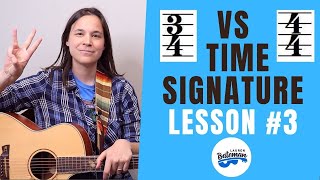
Lauren Bateman breaks down 3/4 waltz time versus 4/4 straight time. Waltz sways in threes; 4/4 hits a steady one-two-three-four. Listen for the snare on beats 2 and 4, find the downbeat where chords change, and count along with her acoustic examples.
Questions this video answers
May 12, 2021
Unsung Hero; Coffee Song; Rose Full of Thorns
Chapters
Hey, guitar enthusiasts, welcome back here. Lauren Bateman in lesson three, where we're going to be listening to some music to talk about different timings and see if we can start getting you to hear different chord changes and different things that are happening in music, particularly in regards to rhythm.
Now, before we start listening to some of the music that I've picked out here, we're going to. What I want to do is talk about another concept we haven't touched upon yet that's very important in rhythm. And I have a lot of songs here that demonstrate this, and I want you to be able to hear and feel this. So, so far we've worked in what's called four, four time, four beats. Okay?
1, 2, 3, 4. 1, 2, 3, 4.
In music, there's also something called three, four time, where we would only count to three.
1, 2, 3. 1, 2, 3, 1, 2, 3.
We call that a wal. You feel like you can sway to the music, and that's very important because if you're counting in four and the song really needs to be counted in three, you're timing. You're going to feel like your timing is always off a little bit. So it's very good to understand the difference between a waltz song and what we call a straight time song.
1, 2, 3, 4. 1, 2, 3, four.
1, 2, 3. 1, 2, 3. One, two, three.
One, two, three, four.
One.
One, two, three, Four.
One, two, three. 1, 2, 3.
Okay. Waltz feels like you can sway to the music. So we're going to listen. I have a bunch of songs here. About half of them are in waltz time, half of them are in a straight time. So what I first want to do, let's start with those straight time songs and see if we can just hear and find the rhythm. Now, the songs we'll be listening today are songs from one of my albums. I. I'm using my music because I actually own the copyright to this, so we can use it. So. Fantastic. Let's start with one that has a very strong drum beat. Because when I'm trying to listen to music and figure out what is the rhythm, what is the timing, the biggest thing, especially if it's rock and roll. Listen for the drums, because the drums usually play a snare. This is not always, but the drums usually play a snare on two and four. Okay. I. I don't know if that's gonna happen in this song, but it does have a very strong rhythm and timing to it. Okay. This song is called Unsung Hero, and we're just gonna listen First. Okay.
Okay.
Okay.
So I'm hearing this.
Can you hear that?
1, 2, 3, 4. 1, 2, 3, 4. 1, 2, 3, 4 dot Time.
Okay, so can you. I don't know if you guys can hear the timing, but can you hear changes? Could you hear a change? As we went from the verse into the chorus, something different happened musically. Okay, let me listen to this one more time with you guys. All right, we're going to keep. I'm just going to back it up a little bit for this verse. Okay, so we have the drums.
1, 2, 3, 4.
All right, could you hear that change? All of a sudden, something really changed musically. And it changed on that one, right? We counted 1, 2, 3, 4, and it changed right on the one. Now I want you guys to listen. I'm going to take this. I know this song. I'm going to take it to before our guitar solo. So I fast forwarded this to the solo because there's going to be a guitar part that comes in, but you'll hear the drums really good in this section. In the intro, we didn't really have a good snare drum to go off of. But listen now.
If you can hear that snare drum.
One, two, three, four.
All right, so there's a lot going on in some of these songs, so sometimes it's easier to hear rhythm for more acoustic sounding songs versus a full band. But I think it's important to listen. Let's do another example in four, four time here. Okay. This one here, Coffee Song. So let's take it from here.
So you can hear the guitar in the beginning. No drums yet.
So what's the rhythm?
What do you think? Can you find it?
Right. Here we go.
Faster.
2, 3, 4. 1, 2, 3, 4. 1st, 2, 3, 4.
Here's the drums. The drums are gonna come in now. See if you can find it.
There's the snare drum. 2 and 4. Ready?
1, 2, 3, 4. 1, 2, 3, 4. 1, 2.
So this is a pepier. You can hear that song. It was a little bit faster than the last song, so hopefully you're getting a feel for this. Four, four, time. Okay, it's very straight, very on the beat. Let's do a song that now is not in four, four time. Let me find a song here.
Now you're gonna feel like you.
Can you feel that sway with me? That's telling you that this is three, four. Okay. Feel this way. Let's go back to that last one that I was just listening to. Coffee song here. Different.
You can't sway to this Right. But if we go back to that one I was just listening to, you can definitely sway to that. Listen to this.
1, 2, 3.
1, 2, 3.
One, two, three. One, two, three, two, three.
Can you feel that sway?
Okay, Very important to listen. Let's take another one that's in three, four time and see if you can feel the sway. All right, I'll pull this one from the beginning here. This one's called Rose Full of Thorns. Starts with the mandolin, so maybe hard to hear, but you can hear the guitar picking.
You feel this way.
Okay, so if I counted this in 4, 4, it'd be hard. 1, 2, 3, 4. 1, 2, 3, 1. It's like. It feels weird. You have to count it in three.
One, two, three. One, two, three dot One, two, three. One thousand two, three. One, two- three. One, two, three. One, two, three.
So I hope. Hope you guys have a better understanding here now of the difference between a waltz. Feel that swaying feel. And the straight time. Feel that four, four feel. That's really what I wanted to convey in this lesson. Can you hear the difference between a sway and can you hear the difference between just a generic four, four kind of rock beat? So what I would recommend is go listen to some of your favorite musicians and see if you can just hear the rhythm. Is it in 4, 4 time? It in 3, 4 time? Because if you can figure that out, you know how many beats you need to count to. So now that we've listened to a few real song examples with 3, 4, and 4, 4 time, what I want to do is play a couple chord progressions for you. And I just want you to see if you can hear with just an acoustic guitar when the chord change is coming. Now I'm going to mix it up. It's not just going to be the chord changes we've already done. All right, I want you to start. See, each of these chords is going to be four beats. Four beats. So I want you to work and count, See if you can hear. See if you can sense when the next chord change is coming. Ready? 1, 2, 3, 4.
Okay, now you've locked in with that. I'm going to make the strumming more intricate. See if you can still hear where the four beats are. Okay.
Okay. So when I made the strumming more difficult, did you have more difficulty really counting and feeling that rhythm? So what I would do, go back, be like a metronome. 1, 2, 3, 4. Know where those beats are. Okay, let's do another example. All right, again, we'll stay in 4, 4 for now. All right, here we go. Ready? I'll change up the chords a little bit. Here we go. 1, 2, 3, 4.
Okay, now see if you can hear it when I spice it up again.
All right. Could you hear the rhythm still? Were you still able to count to four, four, and keep it going? Hopefully you were able to do that again. What I would do. Go listen to some of your favorite musicians, some of your favorite artists. See if you can find acoustic versions or acoustic covers of their songs and listen to them. Is it in three, four? Is it in four, four? Because you got to know if you're counting to three or if you're counting to four. Okay? And then start the count.
One, two, three, four, four.
Listen for the chord changes. Okay. Are the chords one measure.
Or does it stay for two measures?
So listen for those changes. See if you can hear chord changes. And by being able to know where the I beat is, it can help you. Because a lot of chords change on the 1. Not all the time, but most of the times they change on the one. Sometimes you'll have chords that will change every other beat, like we did in our first example for the half beats. 1, 2, 3, 4. 1, 2, 3, four.
But can you. Can you hear. Are you starting to hear a little bit the change in the chords? It's not just this. It's.
Here'S the change.
You hear. Each one of those chords sounds different.
So I know this lesson was a little bit more of an ear training instead of really, like, applying a lot of rhythm. But I want you guys to be able to start hearing these little differences because they provide so many clues in rhythm and what kind of strumming patterns you could use for a song. Because you, you. When you're in 3, 4, you can't play a 3, 4. Strumming pattern over a 4, 4. And you can't play a 3, four over a 4, 4. You have to put the right strumming pattern with the right rhythm. So very important to know, very important to understand, start listening, and then start playing. So I hope you guys enjoyed that lesson. In the next lesson, we're going to be talking about some very common strumming patterns that you can use over lots of songs. Go check out lesson four right now.










