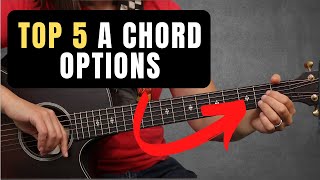
Lauren Bateman demonstrates five ways to play an A major chord and gives ergonomic advice to help players with different hand sizes. Options shown: a simple two-finger version (first and second fingers on the 2nd fret, play bottom three strings); the traditional three-finger A (1,2,3 on the 2nd fret, five-string strum); a shifted version using fingers 2,3,4; a spaced variant that facilitates sliding into D and E chords; and a single-finger barre across the 2nd fret for those with large/fat fingers. She notes pros/cons of each approach and recommends considering guitar neck width or jumbo frets for large hands.
Hey, guitar enthusiasts, I'm going to show you five ways to play an A chord. So many students who have really big fingers and they say, lauren, I can't play this A chord. It's nearly impossible. It's so frustrating. I want to give up on the guitar. I don't want you to do that. So I'm going to give you five options and I want you to choose the most comfortable one for you.
So let's start off with the simplest option. Okay. And we're going to just use two fingers, our first finger and our second finger. And we're going going to be using the second fret of the guitar, the A chord. The tricky part of it is that everything takes place in one fret. So we have to smoosh everything into one little piece of the guitar. So what we're going to do is we're going to take the first finger and we're going to put it on the G string at the second fret and the second finger on the B string at the second fret. And all I want you to do is play the bottom three string. Okay. That's the easiest A chord. If you're an absolute beginner, you can do that. Like Lauren. You can do that? Yes, absolutely. To get started and get your fingers comfortable with an A chord, if you're an absolute beginner. There you go. You can use an A chord on just the bottom three strings. Again, first and second finger play only the bottom three strings. Don't hit the other strings or it's not going to sound good. But that is a good, easy beginner option. Or while you're figuring out finger dexterity and developing these muscles and these knuckles so that they can bend more to make a full A chord, which I'm going to show you next. So the traditional way to make an A chord that I like to do, but it's very hard for a lot of people. I'm going to show you why in two seconds. So I, you know, I'm about five, five. So I'm a smaller person, I have smaller hands and doing this A chord. So this A chord features the first finger, the second finger and the third finger all smooshed in the second fret on strings four, three and two. Okay. And it's a five string chord. So we would strum all five strings. Okay. Now the difficulty, if you see on the close up, you'll notice my first finger ends all the way in the back of the chord. And that's not a good thing for chords and fretting. The guitar, because the further back you go, the harder you have to press the string to make it to sound. So for a lot of people, they play the A chord, and that D string sounds like this. Now you just have to press it a little bit harder. So if you're someone who has smaller hands, and you can fit all three of these fingers in there like this, just press down on that first finger a little bit harder because it's all the way in the back of the string. Now, I get a lot of students who are like, Lauren, I just can't do that. I can't fit that. So there's some other options that I'm going to show you. So the next one's option three. What we can do is we can actually shift all of our fingers. So instead of using fingers 1, 2, and 3, just shift everything up. So you use fingers 2, 3, and 4. Now, still, 2 ends up in the back of the fret, so you don't really fix that back of the fret issue. But now you've introduced the pinky, and the pinky is your smallest finger. And for some people, that just gives them enough room to get all three fingers down on that A chord. So that is option number three for the A chord. Now option number four, it's probably one of my least favorite ways to play an A chord. But a lot of people like it because you can slide and get easy access to an E chord and a D chord. Let me show you. So you would play with your second and third fingers, with the string in between. So the second finger ends up on the second fret of the fourth string. The third finger ends up on the second fret of the second string. And then the first finger ends up here on the second fret of the G string. Now, again, you still have to contend with this first finger being further back in the fret, but you can see you can play it this way. And a lot of beginner. Again, this is probably my least favorite version. I don't know, maybe because it's just I'm so comfortable playing with fingers 1, 2, and 3 the other way I showed you. But this is a great option for beginners because you can slide from A into D. Okay, look at that. Your first finger is already in place for that D chord. Or to get to an E major chord, you just slide the first finger up to the first fret. So it is a great option, particularly for beginners. But there's so many things you can do with an A chord this way. You know Easy suspended chords.
So that's why I prefer to play my A chord this way. Could you do suspended chords this way? Absolutely.
You can do it for me. It just feels a little bit more awkward now for my people with the biggest hands. I got some people who've got some really, really big hands. And something also to note, if you're someone that has big hands, you may want to get a guitar that has a slightly wider neck. Or you might want to try jumbo frets on your guitar. Every guitar is as unique as there are guitarists. So sometimes it takes finding the right guitar to fit your physiology. Remember, everyone is physically different. My hands are different than your hands. But this last option, we're going to show you really great for people who really do have what we would call, like, sausage fingers. I get students all the time, like Lauren. I have sausage fingers. What do I do on this A chord? Well, what you can do is you could just use a single finger. You could use your first finger, and you could bar that entire fret. Now, the issue with this is a lot of people run into the issue of muting this E string. Not a huge deal.
But you'll notice by doing this, I actually can fret closer to the front of the fret versus having fingers back here. And you'll see I'm putting a lot of pressure to bend this knuckle. And if you're someone with arthritis, that could be. That could be tricky. But if you're someone and your fingers are pretty good, your knuckle joints are pretty good, I'm bending this finger to get it away from that bottom string. So that is position number five. Give that a try. I don't particularly like it because it's a bar. It's harder to play, but. But you might find that the most comfortable way to play it. Now, if you guys enjoyed this video, you might want to check out my video over there on the five different ways that you can play a G chord, easiest to hardest. I'll see you guys in that lesson.