Best Guitar Exercises for Your Pinky!
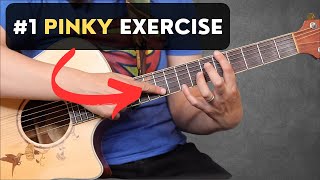
Lauren Bateman teaches spider exercises to strengthen your pinky finger on guitar. She walks through three patterns using frets 5-8, starting slow and focusing on relaxed tendons and correct thumb placement. The goal is mindless repetition to build control before you chase speed.
Questions this video answers
June 24, 2023
Chapters
So you're learning guitar, and you're trying to get this pinky under control. Students ask me all the time, Lauren, do you have an exercise specifically for the pinky? And yes, I do. I'm going to show you something that'll help you focus in on getting a lot more control and keep your fingers from flying away from the fretboard.
So a lot of you probably know the standard spider exercise is kind of like another level to that, because the standard spider exercise is just trying to get you to get some flexibility and dexterity in hands. So we're going to use the typical spider exercise setup, which is using frets 5, 6, 7, and 8. The first finger is going to own the fifth fret. The second finger is going to own the sixth fret. The third finger is going to own the seventh fret, and the pinky is going to own that eighth fret. Now, again, if this is too much of a stretch for you, you can always shift things up to slightly higher frets. Maybe you start on the 7th, 8th, and 9th, 10th frets. Okay, that'll be a less stretch, but I'm going to do everything from 5, 6, 7, and 8. Now, the issue here is that our third finger and our pinky are really, like, tied together. So put your hand up here, bend your pinky, and you're going to see what happens to your third finger. You cannot bend your pinky without your third finger moving with it. It's because of the ways your hands are and the way the tendons work together. So the biggest thing is you have to work on kind of relaxing those tendons, getting these fingers to work in independently. And this is a great way to kind of take your typical spider exercise to the next level and really focus on the fingers that are giving you trouble, which for a lot of people tends to be the third finger in the pinky. Let's start off with the pinky. So typically when you do a spider exercise, you do something like this, where you go, 5, 6, 7, 8.
Can you work your way down the fretboard and back up? Okay.
Typical spider exercise. Okay. Typical spider exercise I use in my seven level guitar system. Okay. What we can do then is take this to the next level once you get comfortable with that, and you can really start focusing in on fingers. So what I would recommend doing, we'll take the first example. We're gonna do the first finger and the pinky. Okay. This is not the hardest example, but it's usually one of the easier ones to start with. So we're Just gonna be playing the frets five and eight. Okay? And. And we're going to work our way down the strings and back up. So it's going to be 5, 8, 5, 8, 5, 8th, 5, 8, 5,8, 5, 8. We're going to do a little turnaround here and go back to the fifth fret. So that bottom string is going to be 5, 8, 5. Okay? And then 8, 5, 8, 5, 8, 5,. Okay. I'm using an alternate picking pattern here, nothing fancy. And what I'm doing with this exercise, before I show you the more complicated one, is I want to focus on relaxing. So that might even be too fast for some of you, especially if you have a pinky that tends to do this. My pinky used to do that. It'd be, like, all over the place when my other fingers are moving. It's like my pinky would shoot off the fretboard because there was so much tension in it. And what I had to do is I had to play the first note. You know, my fingers would be out here like this, and I would have to breathe, and I'd have to relax my fingers. So you can see I'm moving my fingers to relax them. Then I would play the pinky note. Okay. And then you go down to the next one. And again, it would do that, and I would stop, and I'd have to breathe. So if you want to get control of your fingers, you have to practice for control. Practicing for speed is one thing. Okay. That's something different. Right now, we want to go slow because we want to work on teaching our fingers and our tendons to relax instead of spasm. Okay? So I think that's probably what's happening to a lot of students. All right? If your pinky does that, it spasms and it shoots off the fretboard. Let me know in the comments below. Below. So that's what I would do. I go nice and slow to the point where I could just lift my fingers slightly above the strings. Okay. Maybe a quarter of an inch, you know, less than a centimeter, if you're in the metric system. And you just go nice and slow and get control over those fingers. Now, the other thing I want to talk about is my actual fingers. So a lot of times when people do spider exercises like this, they get down to the bottom and their fingers start looking like this. See how they're angled? See how they're angled? You want to straighten out those hands. And a lot of times, this is caused by the thumb. The thumb will Tend to curl up on the back of the fretboard. So as you're doing this exercise, pay attention to your fingers. If they're jutting off the fretboard, just slow it down just a little bit. Okay? Slow it down. Get control. Don't forget to breathe. Breathing is very important. I have so many students, they do finger exercises and they get to the bottom and they're like, okay, so don't forget to breathe. Breathing will help you relax. But watch that thumb as you move down the fretboard. This is kind of what you're doing on the back side of the fretboard. Here's my thumb. And as my hand moves, my thumb moves with it. My thumb's not doing this as I go down the fretboard, it's moving with my hand. Okay?
So my thumb is kind of sliding down the fretboard. Because if you change things and your thumb ends up here, you're going to end up with, with these angled fingers and that's going to put a lot of extra tension that you don't need. So you're trying to keep a nice curve. So like my pinky finger and my first finger are kind of edged out almost at like a 45 degree angle, maybe not that sharp. And then these two are a little bit more perpendicular to the guitar. So just want you guys to know that to pay attention. So that is exercise one. Now number two is we work on the second finger in the pinky. Okay? Again, this one is not the most difficult. So second finger and pinky. And for some of you it may be tricky. Alright, so we're going between fret six and eight, six, eight. And then we're going to do the turnaround on the bottom. It's going to be 6, 8, 6 and then 8, 6, 8, 6, 8, 6, 8, 6, 8, 6. Okay, so that's the next one and the final one which is the hardest. This is actually the one I use the most to get the most control of my pink. Because why? For that reason I showed you earlier. The pinky and the third finger are so connected. So three and four. This is going to be the most difficult one to do. So we're going to start on frets seven and then we have eight. And what you're going to do is very slowly move your way down, going 7, 8, 7, 8. And you can see my first finger is a little, I'm noticing a little tension there. So I'm going to stop, going to relax my fingers and then I'm going to work my way Again. Okay. And then the bottom is going to be seven, eight, six, seven, eight, seven, eight, seven, Eight, seven, eight, seven, 8, seven. And this alone is a great workout. Now, something I want you guys to keep an eye on. You may have to go very slow on this, but something that happens with the pinky. And I know this happened with me and I have really had to work on it. And sometimes I still have a little bit of a tough time bending the knuckle. So a lot of times when people, they play with their pinky and they play very flat, fat, fat, flat. They play very flat on the pad of their finger instead of the tip of the finger. Okay. So you kind of get to work trying to bend that pinky. And this exercise is great for doing that. Okay. I still have a lot of probably work that I could do on my pinky, but I don't play a ton of lead guitar. I have worked on it. I mean, this thing used to. When I started this exercise, my pinky used to flip fly off the guitar. It was horrible. But this was an exercise that I did over and over. I would just sit here.
So you can just sit on finger pierce.
Okay. And again, you heard some bad notes come in. If you play a bad note, don't stop. Keep going. You learn the most when you play through your mistakes. Now if you're going very slow and you're trying to get everything to sound nice and neat, that's one thing. Okay. But that's what I would do. This is such a great exercise to just sit. This is something you can do while you're watching tv because it's almost very mindless. And you can go very slow. Your spouse might kill you. Sorry, spouses. But this is a great exercise that you could mindlessly do in front of the tv. And it's just getting this pinky to work. Alright. And then you can pick up the speed and start going forward faster with that finger. So that's what I would do. I would start 1 to 4. 2 to 4. 3 to 4. Okay. And then run through it again. 1 to 4, 2 to 4, 3 to 4. You might want to do a couple laps up and down on three and four. But I promise, if you focus on these exercises, your pinky will get faster. And if you're looking for a way to get all your fingers faster so that you can make even faster chord changes with your hand that I highly recommend you go check out my number one guitar finger exercise right over there.










