BEST Guitar Picks for Beginners & Older Adults
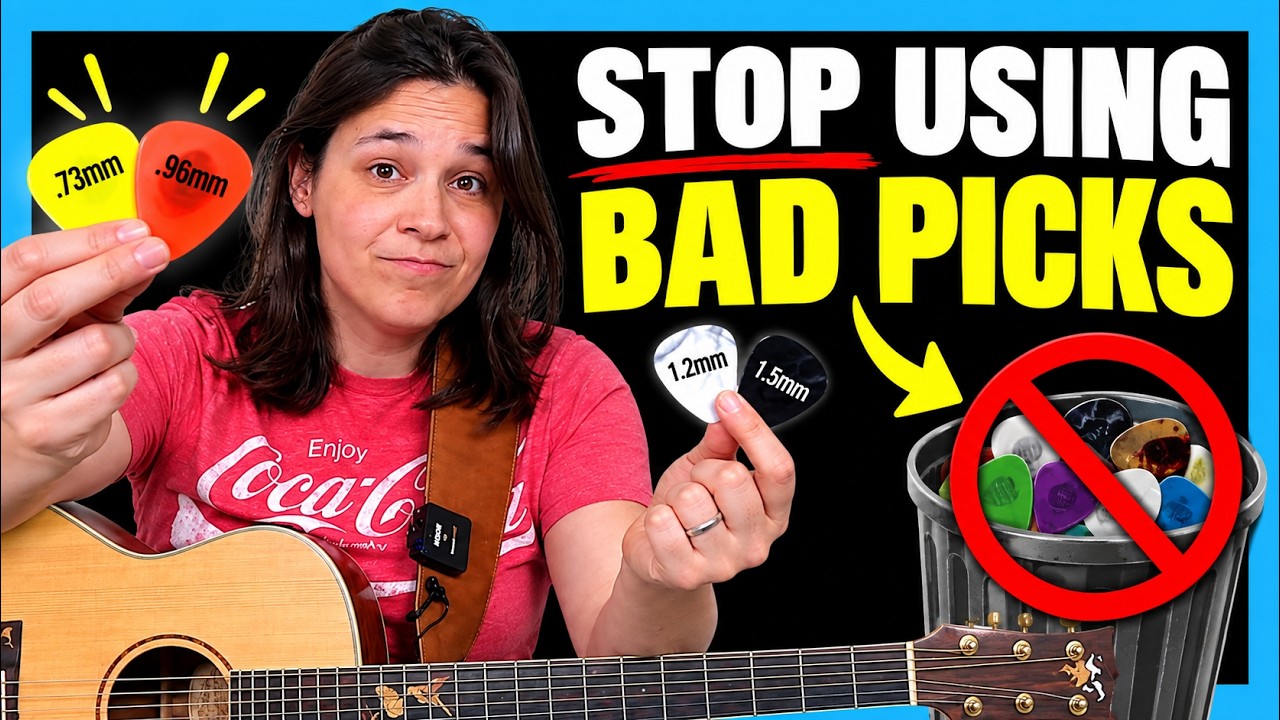
Lauren Bateman, a guitar teacher for beginners and adults over 50, explains how pick thickness and grip affect your sound and comfort. Start with ultra-thin training picks (0.50-0.60 mm), move to medium (0.73-0.88 mm) for general playing, and try grip-enhancing brands like Dunlop Tortex. For arthritis or hand issues, hole-punch picks and thumb-mounted options make playing easier.
Chapters
If you're an absolute beginner or you're someone that's over the age of 50 learning to play guitar, your pick can make a huge difference in your playing. And using the wrong thickness pick in the beginning can make you sound a lot worse than you really are. So what we're going to do in this video is we're going to go over some different types of picks that are out there— ones that are best for grip, some that are better for sound, some that are better for control— and what thickness I recommend to all my beginners just getting started. Let's get into it. So let's get started off with why a good guitar pick matters. And for those of you who don't know me, my name is Lauren Bateman and I specialize in helping absolute beginners, particularly those over the age of 50. I have many students in their 60s, 70s, and 80s, and they find some of these simple tips Very, very helpful. So what can the wrong pick do for you? It can make you sound worse than you are. It can fall on the floor. Okay, because that's a big problem that a lot of beginner students have. Either the pick is falling out of their hand onto the floor, or worst of all, it's falling into the guitar, and then you're having to shake the guitar to try and get it out. So there are a number of different picks for different applications. Some of my older adults. They suffer from arthritis. They have arthritis in the thumb. So I'm gonna tell you, if you're one of those students, there's options for you. There's always plenty of options when it comes to guitar picks, and we're gonna talk about each of them here. First things first, pick thickness. Okay, so picks have different thicknesses. We call it gauge. So if you're an electrician, think of a wire. It's a different thickness, a different gauge of thickness of a pick. And a lot of students sometimes start off with a really, really thick pick. I got this one here. This one is 1.14 meters. Now, the tricky thing with a thick pick, you can see it's very stiff. Okay, this is, this is a really great pick if you're gonna do like lead guitar and pick individual notes. Love a thick pick for that. But a lot of my students are trying to strum along and play to songs, and especially when you're a beginner, your hand is really stiff. Okay, because it's a new mechanic. So you're holding on to this pick really tight because you don't want it to fall on the floor, and then your strumming ends up sounding like this. And my students are like, oh, why does my strumming sound so bad? Particularly on the up strum, sounds very, very tinny. It sounds very, very bad. Well, what's happening is when you're strumming, your pick is supposed to fluctuate. So let me grab a pick here. So your pick, when you're strumming, is not supposed to stay flat like this. It is actually supposed to move a little bit. Okay? It's supposed to be flexible. All right, so that's the hard part about a pick is you want it to hold it soft enough that it's flexible enough to move, but not so stiff that it causes really, really, really tight strumming. So there are different options for picks. There's what we call light picks, and I really like the Dunlop Tortex. The reason I like that is they have a little bit of a coating that makes them a little bit stickier. We'll get into that later. But these are thin picks. These are 0.50, 0.6 millimeters. I'm gonna take this 0.50, and you can see, woo, it is very bendy, okay? It's very thin, it has a lot of flexibility. So this is something— these 2 picks are what I recommend for absolute beginners, okay? Because especially if you're usually beginners, they're just holding on to the pick for dear life because they don't want it to fall on the floor. So if I take this really, really thin pick now and strum my guitar as hard as I was before, the guitar already sounds nicer, and you didn't have to change anything about your technique. And that's a hard thing for beginners, is there is some technique to strumming, but unfortunately the relaxation comes with experience, and that's not probably going to happen for 3 to 6 months. So you might want to use the— I call these like the training wheel picks, the 0.50, the 0.60. These are the training wheel picks to get started with. And if you're a strummer, eventually you might want to upgrade to a slightly thicker pick. These are medium picks. 0.73, 0.88. These are kind of my go-tos. I really like the 0.73 because it's got a little bit of stiffness but still some bendability to it. And then your really, really thick picks here, like your 1mm or the 1.14, these are really great for like lead guitar playing, individual notes. They're super stiff. There's not a lot of bend to them, which is what you want when you're trying to like target individual notes. Okay, you want more, or for me, I want a stiffer pick. And all of this stuff is personal preference. So as you get better and better at the guitar, you're gonna decide which thickness you like for which applications. So let's talk about grip. I mentioned earlier the reason I like these Tortex picks is that they're, they're kind of rough a little bit. They have like a little bit of a coating that makes them a little bit more grippy versus something like this nylon pick, very smooth. Very easy for me. I can just pull this right out of my hand. And something I've learned, because like I said, I work with a lot of older adults, and I didn't know this because I'm still in my 40s, but I have a lot of students who are in their 60s, 70s, 80s, even into their 90s, and they're like, Lauren, my fingertips are, are much smoother than they used to be when I was younger. And obviously I didn't know that because I'm still fairly young. So these really smooth picks are just very easy to yank out of the hand. So what you can do if you're an older adult, I have some options for. I'm gonna show you a few here. This is my top recommendation if you're looking for a good pick is Dunlop Max Grip Picks. That's what I have in my hand here. They almost have like a little coating on the back that feels like sandpaper. Okay, I cannot— I'm really— I am trying to pull this pick out of my hand. It's very, very hard. It's got a nice grip to it. A lot of my students really like it. And it comes in various sizes. So this one is a thinner one, 0.60. Okay. And this one here is 0.73. So a little bit more thicker. So it's a really great option if you're like, man, I feel like my picks are just falling out of my hand. Another one, this is an asteroid pick, but there are some picks that come with a hole completely in the middle. I've had a number of students say they like that because their thumb feels like it can grip. So there's little rivets in this and It feels like your thumb can grip the rivets. But there's also ones— I don't have an example of that here, but they have holes in the middle. And my students really like them because they feel like they can get a really, really good grip on them. And then something that some of my students have really, really enjoyed in recent years. So this is called a Black Mountain pick. And they're not endorsing me for this video, but I have a number of students who use these. These picks were originally made for fingerpicking. But if you're an older adult, particularly someone that maybe has some nerve issues or you have arthritis, I have a lot of students have arthritis in this knuckle and their thumb, and it makes holding the pick really hard or sometimes very painful. So this is a little spring-loaded. You can see on the back here is a spring. Okay. And this is a thin pick. They have a light pick. That's what I recommend for strumming. And all you do is you slide it onto your thumb. Okay, you can probably see it's on my thumb now. Okay, I don't even have to hold the pick. I'm gonna keep my hand straight, and I can strum now. I can strum now without even using my fingers. And this is a great tool because I've had some students over the years. I've taught you know tens of thousands of students by now, and some of them are like, Lauren, I'm missing my first finger. I'm missing my third finger. Like how do I hold the pick? I don't have any. I have one student who had a completely deformed strumming hand. I think he had a thumb and like a couple. Strum, strum. He really did have a deformed hand and he's like, what do I do? So this is one option. Another one is they make a contraption that kind of wraps around your wrist and then you put the pick in the middle so you can strum with the flat hand. Okay? So if you're someone that has a handicap, there are options for you out there. So I always tell students, there's people who don't have hands that play the guitar with their feet. So don't give up, just find a solution that works for you. And these Black Mountain picks are a great solution for older students who might have some arthritis or maybe have some nerve issues. I had a student who had, um, they cut their finger and they ended up cutting the nerve and they couldn't— they actually couldn't feel the pick, but this worked for them and, and they're strumming away. So definitely check that out, Black Mountain picks. Now I want to talk about picks to avoid in the beginning. I already mentioned if you're a beginner Stay away from the really, really thick picks. Okay? This is kind of like a medium-sized pick. I'm gonna put another pick over it. This is what we call like a jazz three style pick. You can see they're pointier and they're much smaller. Okay? Pointier and much smaller. I don't particularly recommend the small picks in the beginning because there's less. There's actually less to grab onto. I know a lot of people who are like do sweep picking down the road that really, really like these. But for beginners, I really don't recommend them. Get something that's medium. I don't have any extra large picks, but they actually have extra large picks that almost look like a tortilla chip. And I have some students that really, really love those. So I would stay on the thinner side and stick to a medium to a large pick just so you have enough to grab onto. And then once you get better and better, you can make different decisions about maybe trying a smaller pick. Now finally, Lauren, how do we hold on to the pick? Okay, that's a great question. And you know, there's a number of different ways, and I unfortunately, I am mostly self-taught. So if you don't know me, I didn't go to school for music. My degrees are actually in archaeology and biology. I just really love music. So I'm more like you than most of the guitar teachers on here on YouTube. I didn't go to school for music. I just learned guitar out of a love for it. And hopefully that's why you're here too, because you love it. So I have the very, very bad habit Of holding the pick with my thumb and my second finger. I do not recommend that. My guitar teacher, when I finally took lessons in my 20s, tried to get me out of this habit, and it's a bad habit I have. So what's the better way to hold your guitar pick? So the better way is to hold it with your first finger. Okay, and sometimes depending if I'm doing a lot of strumming, like a lot of really really fast strumming, I might hold it with both fingers just to give myself a little extra support and stability. But the best way to hold it. Is we have this teardrop shape of our pick, so the point points down. You wanna put the thumb across the back and you just wanna point your first finger down so that it's kind of like the thumb and the index finger are squeezing together like a clamp on this pick. Okay, so that's one option. The other is to hold it with 2, but I usually, like I said, I only do this if I'm doing a song that's very fast, has a lot of strumming, and needs a little extra support. Most of the time I'm just holding the pick with one finger. Why? Because of what we talked about earlier. You need a little bit of that flexibility in the pick for it to be going up and down. So when you're strumming down, the pick is pointing up, and when you're strumming up, the pick is slightly pointing down. So it's gliding over the strings as opposed to like poking through them. Okay, that's what a lot of beginners do. They kind of poke— they poke through the strings because they think you have to keep the pick straight. You don't. It kind of does this. But it takes a little while to get there. Okay, the other option for holding your pick, because everyone's hand's different, and I really like this more for lead guitar when I'm picking individual notes. Again, put your thumb across the fat part in the back and then curl your knuckle. Okay, I don't know if you can see that I'm curling my knuckle so that the point of my knuckle is kind of pointing down with the point of the pick. Okay, and I like doing this because when you're playing lead guitar, I can use my thumb to mute the other strings. Now that's a That's a little bit more— that's a little bit more of what I would call an intermediate technique. As a beginner, I wouldn't show someone to do that because they don't quite have the control yet. So if you're just someone like me who likes to do a lot of rhythm and strumming, thumb across the back, point the first finger down, and just hold on to that pick. And if you feel like you're having a tough time really gripping it, get one of these Max Grip picks. You're gonna feel like you really can hold on to it and work on your strumming. Okay, and the grip, like I said, it's a tightrope. It's a balance between holding it on to it— holding on to it stiff enough that it's not going to fall on the floor or fall in your guitar. And trust me, I've been playing the guitar for 20-plus years, I still sometimes drop my pick on the ground. It happens. We're— nobody's perfect, okay? So if it happens to you, trust me, it happens to everyone else. Happens to professionals, okay? And then the other thing is it's a balance between holding it too tight, because if you hold it too tight, now you get the snapping strings. And that doesn't sound good. But like I said, that does come with time. I bet if you— after 3 to 6 months, that's gonna naturally sort itself out for you, and then you can graduate to those thicker picks. So I hope this video helped you understand the different picks that are out there as options and what might work best for you. And if you're just getting started with a guitar, I have an absolutely free guitar crash course. I'll put a link in the description below where I teach you the ins and outs of getting started with the guitar, and my goal is to teach you to play real music real songs within 14 days. So if you are looking for step-by-step instruction, go check out my free crash course. I'll put a link in the description below. I love YouTube. It's a great resource. There's lots of information here. The downside is there's lots of information here, and a lot of times it's in the wrong order. All right, so you want a system that's step 1, step 2, step 3, step 4. And if you're looking for that system, go check out my free guitar crash course right now.










