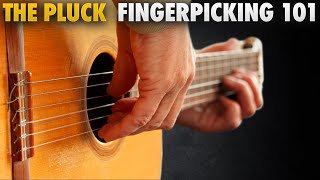
Lauren Bateman teaches alternating bass fingerpicking patterns for guitar beginners, covering 6-string, 5-string, and 4-string variations in chords like G, C, and Fmaj7. The pluck technique combines simultaneous thumb and finger picks in cycles, with practical tips on hand position and speed. Examples include Blackbird and Dust in the Wind.
Questions this video answers
Lesson 4 of a 6-part series.
March 16, 2023.
From the download link in the video's description (video description).
Chapters
Hey guitar enthusiasts. I'm going to show you a very simple finger picking pattern that you could use over your favorite songs. But not only that, I'm going to show you a very special technique in finger picking called the pluck. It shows up in so many songs, you're going to want to know how to do it. Let's get started.
Before we get started, I want to make sure that you have the tab that goes along with this lesson. You can scroll down to the description below, click on the link and you'll be taken to where you can get your download. This is lesson four in a six part series. So if you missed any of those other previous lessons, the links are included in the course guide. Now in lesson three, I showed you how to do finger picking over songs that are in what's called six, eight time. That waltz feel when you, when the song is swaying. But not all songs have that sway feel. They're more what we call four, four time. So instead of that waltz feel where you feel like you're swinging, these songs have more of a straight feel, almost like a rock and roll feel to them. Although we're playing folk style because it's finger picking. But there's going to be four beats for each chord. So I'm going to show you a very classical alternating bass line. Right, We've learned what that alternating bass line is. It's that.
It'S two bass notes. It' of the drive of the song. And we're going to throw in a couple treble notes over that. So the pattern we're going to be using for a G chord is we're going to be hopping the string. So we're going to be going from string six to string four. So you might want to just practice hopping that string. 6, 4, 6, 4. Okay, these are your quarter notes. 1, 2, 3, 4. 1, 2, 3, four. Now in between each of those we're going to add a second note played by either finger one or two marked by the letter I and M on your tablature. All right? The thumb is the P. Remember that. So it's P I, M, A. Okay for your fingers. Now we're going to be going P I, P M, P I, P M. Okay? So that's going to be strings six, three, four two six three four two. Okay. Very common thing you can do over chords. Let's just try that with the G chord a couple times. I think G is probably the trickiest because you gotta hop over that string. All right, so we've got P I, P M P I, P M, P I, P, M M.
So that's a pattern you could use for six string chords that could also be used on something like an E minor. Okay.
So you can hear how this strumming pattern can be played slow, can be played fast. It's not a strumming pattern, it's a picking pattern. I know. I always make mistakes. Sometimes my brain gets a mind of its own. So that's what we can do on any six string chord. Okay, five string chords, we're going to do something a little bit different. All right? We're not going to be hopping over the bass note. This C chord, we're going to be playing strings right next to each other. So it's going to be strings five and four. Okay, so that's your bass line. One, two, three, four. The other two fingers are doing the exact same thing. So it's going to be string three followed by string two. So it's P I, P M.
Okay, so start real slow. Ready? 1, 2, 3, m, 4, m, p, I, p, m p I.
Okay, so just start slow and you can work your way up to a faster speed. Now again, if you're hearing muting on that C chord, just make sure one, the third finger knuckle is bent. It's going to be bent. You may need to adjust the thumb on the back of your neck so that you have more room to curve that finger. The other option is just play the finger a little higher up on the string. Okay. If you're someone with big fingers, you can just play that a little bit higher up on the string and it might give you enough clearance to not mute that string. F major seven. Here's an exception. Okay? Four string chord, we're gonna move the thumb. The thumb is gonna be alternating now between three and four. And our first finger is gonna be on the second string. Our third finger is now going to be on the bottom string. But the pattern is the same. Okay.
So it's P I, P M. P. I, P M.
Okay, so there it is. That's what we got. So we got our G chord.
C chord.
And our F major 7.
So practice moving around to different chords. A C chord could easily be an A minor chord.
Okay. An F major 7 could ease easily be a D chord.
Okay? So play around with the different chords, you know, between a six string pattern, a five string pattern, and a four string pattern. Now what I want to teach you is a very important technique in finger picking called the pluck. It's when we use two fingers at the Same time. Alright. So what we're going to do is we're just going to stick with the same bass note. We're not going to worry about alternating bass notes or changing bass notes. All I want to focus on is changing the treble note. So let's take our G chord and what we're going to do is the P, the thumb is always going to play that sixth string. But we're going to alternate between I, M and A. All right. At least we are on the. On the C and G chords. All right. We can't really do that on the F chord. I'll let you know what we're going to do when we get there. But all I want you to do is we're going to play the thumb and the first finger at the same time. It's going to sound like this.
Okay. So we're playing the G string and that low E string at the same time. Okay. Then we're going to go and pluck the thumb and the next finger M and then the next finger A and then back to M. So what we're doing on the bottom strings is we're going I, M a M, I, M a M and we're just putting the bass note on the top. So it's going to sound like this.
Just want you to get used to the mechanic of playing two strings at the same time. It can be awkward in the beginning if you've never done that before. Let's go back to five string chords. Let's go to our C chord. Same thing. Except this time we're playing the fifth string on the bass now. So here we go. 1, 2, 3, 4.
I am a M.
So F major 7. Since the thumb typically plays the third and fourth strings, we're just going to alternate between P and I and P and M. So it's going to be.
So weird. This come in handy? Think of a song like Blackbird.
Okay. Think of a song like that or a song like Dust in the Wind.
You can hear how that pluck really adds another level of depth to the song. It's a very, very common technique used in finger picking. And that's why we want to develop an exercise to practice and get comfortable with it. Once you get comfortable with this lesson, I'm going to show you how to add other notes to that pluck technique as well and is how you can incorporate walkdowns into your fingerstyle playing. Go click on lesson number five.