Friday Afternoon Q&A With Lauren + LAST CALL
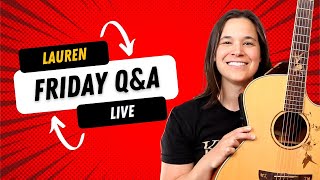
Lauren Bateman's YouTube live Q&A (titled "Friday Afternoon Q&A With Lauren + LAST CALL", Nov 25, 2022) mixes practical guitar-teaching tips, mental/advice for learners, and course/event promotions. Lauren discusses consistency and mindset for beginners, chord-change and barre-chord technique (muscle-memory finger "push-ups", thumb positioning, starting higher on the neck), pick technique and alternate-picking/spider exercises (metronome-based practice, tremolo picking), troubleshooting (string noise, neck movement), practice strategies when unable to play (ear training, timing, theory), memorization strategies for songs, and details about courses, pricing, and live events.
Questions this video answers
November 25, 2022
Ends tonight at midnight Eastern time (Lauren's stated local time on stream)
$197 (one-time); payment plan available (three payments of $75 mentioned)
April 15 (UK live event)
Dunlop Tortex Jazz 3, 0.88 (pointed tip)
Chapters
Foreign.
How's it going? I'm up here in Vermont this weekend. It was the Thanksgiving holiday here in the US So I brought my stuff with me. You can see olives in the background hanging out in the guitar case. If anyone else has a pet that likes to sleep in their guitar case, let me know in the chat. Put a 1 in the chat if your cat or your dog. I had a cat who loved sleeping in my guitar case. So I want to pop on quickly as like kind of like a final reminder that today is is Black Friday here in the US and that's when there's a lot of cool sales and discounts. I just wanted to let you guys know briefly before the Q and A that the Black Friday sale is still on. It's going to end tonight at midnight. It is 12 o'. Clock. So there's 12 hours left for you guys to get some courses at 50% off. So if you're interested in grabbing some courses, we have the finger picking course. Hey George. We have the lead guitar course, the power and bar chords course, the expressive rhythm course. Lots of great courses, the blues guitar course. And I also have a bundle that bundles five of them together that you guys can get. So go over there, check those out. There's a lot of great options, especially if you guys are looking to add some new skills to your guitar player playing. And today I was just going to talk a little bit about the guitar for the new year because this is the time of year where a lot of people pick up guitar as a new hobby or sometimes they're like they're getting back into it. They played years ago and they're kind of getting back into it. I had a Q A so I do this every month with my students in, in my membership and I do Q and A's every month. And this last Q and A, we have one on Tuesday. And a big part of that Q A was all about the mental side of playing guitar. And what is, what did you say, Christopher? Different background to normal? Yes, I'm up in Vermont. If you missed the first 30 seconds, it's Thanksgiving. So I'm up at the in laws house and we have Olive in the background sleeping in the guitar case. But yeah, I'm up here in Vermont this weekend. It's very cold outside. There's some snow out there. I'm almost in Canada. I'm about 30 minutes from Canada where I'm staying in Vermont this weekend. So a little different, different backdrop. This is my guest bedroom that I'm in for the weekend. But as I was saying, you know, there's a big part of learning guitar that is mental. And I had students ask me at Alarm, what's the best tip you could give for someone that's learning guitar? I'm really hard on myself. I see all these great guitarists and all these great guitar players, and I look at them and I feel like I'm never going to get there. And the thing with guitar, and I'll take some other questions live here as well, is, you know, what you tell yourself is what happens. And this isn't true for only guitar. This is for anything in life. What you say is what you do. So if I'm never going to be good at guitar, is what you keep telling yourself, then you will never be good at guitar. But if you flip that narrative, you just have to flip the narrative, flip their perspective, and say, listen, I'm a beginner. I'm learning. But if I keep going, one day I will be like this person or I'll be able to play the guitar and have fun with it. Okay, yeah, maybe my C chord and my D chord. I have trouble with chord transitions, but I know if I keep practicing, in one month, they're going to be so much better than they are today. So, you know, I was telling the students, like, you can. You can YouTube search videos of people playing guitar with their feet because they don't have hands, right? Their desire to play the guitar, their desire and termination is so great that they figured out how to play the guitar with their feet. All right? So if you've got two hands, you have no excuses for why you. You can't learn the guitar. One, you have to prioritize it. You have to make it a priority. You have to schedule in the time to practice. It's just like going to the gym. You gotta go, you gotta be consistent. Because if not, you're gonna keep falling backwards. You're gonna feel like I keep going three steps backwards. That's because the consistency usually isn't there. Let's pop on over to the chat. We have some people from Spain, Scotland. Oh, Ian, I'm gonna be in Scotland in April. I have a live event in the UK April 15th, if you're interested in that. Laurenbatemanguitar.com backslash UK and the UK is in caps. We do have an event April 15th, so cool. Love that. And George, who's on here is also from the. From Scotland as well. We have another George from Utah. We got Canada in the house. Hello, little Carolyn from Medford. So if you guys have any questions about the courses. So earlier I mentioned the Black Friday sale. If any of you have questions about the Black Friday sale, their courses, you can always email Carolyn. Info@lauren bateman.com info@laurenbateman.com and Carolyn will be able to help you. I did pin the link for the Black Friday sale. It's lauren bateman.com backslash courses. So you guys can go over there and check that out. We got everyone coming in here. Holland, Washington, Melbourne, Australia. Hey, Peter, were you on the other day, Glasgow here? Oh, awesome. Fantastic. Yeah. So any of you guys that are interested in information on the event that I'm having in Scotland or shoot an email to Carolyn, it's infoaurenbateman.com I think we have like five or six tickets left. If you guys are interested in spending a day with me and playing guitar, that's what we're going to be doing. So. Chord changes. Let's talk about chord changes. Another common question I get asked my students all the time is, Lauren, how do I get my fingers faster for these darn chord changes, especially C to G? A lot of people get hung up on that. And I tell people, you know, there's a little trick, and it's all about building muscle memory. And the best way to build muscle memory, most people when they're doing chords, especially when you start learning them, is your eyes are focused on the cord. Okay? Your eyes are focused on the cord. And then you keep. You're doing this. You know, if you guys do this, just throw a little one in the chat. If you're used to the back and forth going between the strumming hand and the fretting hand. And what I used to do with students is I used to take like a booklet or piece of paper and I used to do this over their hands so that they couldn't see it because they didn't trust. They didn't trust that they knew the chords. So after you've been practicing chords for maybe, I would say two to three months, you're going to start developing enough muscle memory. And my recommendation when learning chords, if you're not in my seven level guitar system, you'll know in that system, we only start with four chords. Why? Because it's easier for your brain and your fingers to remember four things versus 20 things. That's a big mistake a lot of students make. They try to learn every single chord under the sun in the beginning and really just break it down, down to the four major chords, G, E minor, C and D. You can play tons and tons of songs with just those four chords. And what I recommend is doing little finger push ups. Even if you're starting my two finger chords or you're doing the full three fingers. Little finger push ups. You can do this while you're watching tv. All right? And the goal is, start by watching the fingers and then take your hand away from the fingers and see if you can do. You're not even. We're not even worried about strumming or playing the chords clean. We're just worried about getting the muscle memory. So can you sit here? You're not watching your favorite TV show. You're gonna do a C chord. You're like, great. Now I'm gonna go do a G chord for a while. I'm gonna switch to a D chord. I'm gonna do the E minor chord. Okay. And that's all you want to do. It's just a little finger push up. And I'm barely. I'm barely lifting my fingers off the guitar. Okay. Maybe like a centimeter, right? For those of you on the metric system, maybe a quarter of an inch for those in the US but that is a great way to start building muscle memory without always having to sit there and do the chord change. Because eventually, like, I can make a C chord in the air. I don't know if you guys can see that behind my light background. There we go. There's C chord. Make a G chord. I can make an E minor chord. I can make an A minor. You know, I can make all the chords in the air, and my hand knows how to find them. Because I've worked on this muscle memory so much. I see those ones in the chat. Yep. You guys know who you are. Silas says I don't have hands. I don't have a method for teaching guitar without any hands. But again, if you have the desire to do it, you can do it. There's ways to do it. There's people out there who have done it. You might have to tune the guitar to a different tuning is my guess on it. Problem I have a chord changes is the strings. I'm taking my fingers off ring out loud. Any tips for improving that? You know, Christopher, that's kind of a normal thing, especially with acoustic guitar. And these round wound strings.
These round wound strings tend to be very noisy. You could try flat wound strings. Different sound to them. I've never played with. With flat round before. I've always used round wound. I can't even say that. Round wound strings. It's just A normal thing. You could also be pressing the strings a little bit too hard. And then when you're releasing, see, I. If I bring this up to my microphone, you'll hear it.
Okay. Can you hear that? So it does happen. It's just a normal thing with the guitar that does happen when you release the strings, but usually you're strumming.
So usually you don't hear. Hear it between the music. But it is a normal thing. If you listen. If you listen close enough more to acoustic versions of songs, you will hear the string noise in the guitar. It's just there. You can't get rid of it. So it's totally normal. Jerome says, hi, Lauren. Love your videos. Can you please give me advice on the shape bar chord, as I'm finding it difficult to hold down the three strings? Yeah. So bar chords, they're always easier to play up here. Okay. Down here because of this nut. All right. This first fret is the hardest to press. And I will admit, if you guys listen hard enough, a lot of times I mute my F bar chord. I'll sometimes do it because it is. It's hard to. And this has 12s. I haven't switched this out to 11's yet. I usually play with 11s, which are a little easier to play. So thinner strings can help you play bar chords easier. But my recommendation is to start a little bit higher up, maybe the seventh fret, the ninth fret, where these chords are easier to play because the strings have more flexibility in the middle of the guitar versus the end up here. It's very, very taut here. So the recommendation. I like that starting with the E shape chords. Okay. So we have our E shaped barre chord. And then this first finger is acting like a capo.
Okay. You don't even have to get all of the strings to ring because these three are taken care of. But practice just getting that first finger with enough strength. There's a big strength component. Two bar chords. All right, so you've got to get this. This first finger is just acting like a capo. And then these other fingers are coming in.
And you can notice I use this as leverage. My first finger. I tend. It doesn't line up this way. I tend to have my first finger on these six string chords overlap the top string a lot. I feel like it gives me more leverage for the shape of my finger on the bottom here. You guys can't see it, but I have all lines in my fingers now. I. But I'm also using my thumb on the back side of the Fretboard to provide a little extra leverage because you need that squeeze on the bar chords, you know, where, like, you know, an open chord, my C chord, I could have my thumb in the middle here, but on a bar chord, really need that thumb behind that bar just to get that extra little leverage. And usually where the issue is for most people on bar chords is the bottom two strings. You just don't have enough squeeze yet. And over time, if you play bar chords a lot and you're sliding around and you're getting that string noise, you will eventually develop a little bit of a callus on the side of your finger, which does help you with playing, because obviously calluses are thicker skin and helps with pressing on that chord. So hopefully there's a couple tips that will help you. Hello, Michael from Germany. T, nice to see you on here. You comment on my stuff all the time. Love it. I have a problem with the neck moving around too much when I'm changing cords. How can I keep it still? Well, Mike, great question. Hi, RNA Music. How are you doing? Good friend of mine.
Guitar strap. All right. If you don't have a guitar strap, I highly recommend you get one, because the guitar strap holds the guitar in place for you. Now, if you're doing a lot of this, there could be some tension in the arm. So the best thing when playing chords, you want to relax your hand down and bring it up to the guitar. This will be a natural position for you. And when you switch chords, release. Come back to the guitar. Okay. Release. And you can see I'm going slow. You know, a lot of guitar practice is actually going slow to develop muscle memory. Especially if you're an older learner, the process of slow is very helpful because slow helps to develop the correct muscle memory. And when you get the correct muscle memory, you can relax. And relaxation is what actually gives you the speed. So if you're finding this is moving or this, you're doing this. One, if you don't have a guitar strap, get that, because it's going to hold the guitar in place for you. And two, if there's a lot of back and forth here, it's probably there's some tension in your forearm and your biceps, so pay attention to that. Breathe out. Lower your arm. Shake it out. Bring it back up. Okay. Bring it down. Shake it up. Bring it back up. Okay. So you just might have to slowly train your arm to relax. That's probably what's happening there. Chances are, if you don't have a guitar strap, a guitar strap will help A lot. Jeanette Gibson says, Lauren, I was doing fine learning the chords for you. And I even opened my own YouTube channel Woohoo. And did some bars. Then I stopped. Even Covid came. I need to start afresh. Yes. And the best thing to do when you're restarting lessons again, so there's a lot of people, I hear this over and over again. Like, I started two years ago, I stopped and I'm coming back to it, or I did it, you know, last New Year's I was trying to make a resolution to learn guitar. And then I stopped and I came back to it. And I feel like I keep going away and coming back. And those are people who are kind of like dabbling in guitar for fun. But it's all about being consistent. I talked about this a little earlier. It's about being consistent and scheduling your time to practice. So you're just, you know, you're just gonna say, hey, you know what, on Monday, Wednesday and Friday, I'm gonna get up in the morning, I'm gonna make my coffee and I'm gonna sit with my guitar for 15 minutes. Make it the first thing you do. The earlier in the day you can practice, the less things that are gonna come up to get in the way of it. Because what happens? I mean, you know, I'm human, you're human, stuff happens. People call, emergencies come up. So the earlier in the day you can practice, the more likely you will be successful at achieving that practice. Okay, so that's a huge tip. And if you're someone who you know is still going to work and stuff, just as soon as you come home, scheduling schedule in time, making those scheduled times. Another thing is, you know, I know there's a lot of people over here on YouTube and you know, you guys are, are learning for free and there's a lot of free resources here. And I did that for a long time. I was a self Learner for about 10 years. 10 years. Took piano lessons. I hated them. So, you know, when my sister got me a guitar when I was 16, you know, my parents, we didn't have a ton of money. We weren't poor, but we didn't have a ton of money. You can see Olive popping up in the back there. You know, they weren't going to pay for guitar lessons, so I kind of had to teach myself. I don't. YouTube didn't even exist, so I was using like ultimate guitar at the time and some VHS tapes and books. It's kind of all over the place. When I really finally Started making improvements on the guitar was when I actually got guitar lessons with the teacher. Bottom line, listen, you can only go so far by yourself. At some point, you need to go with someone else who knows a little bit more than you. I'm taking guitar lessons right now. I don't know if you guys know. I'm actually taking some classical guitar lessons. I'd never taken classical guitar before. I wanted to work more on finger picking and different chords and chord shapes because I knew I needed that accountability. I needed that accountability. And that's why I encourage you. If you're someone who's been dabbling on YouTube for one, two, three years or however long you've been dabbling with this instrument, I would recommend getting a blueprint. And I have a blueprint. It's called the seven level guitar system. You can go to laurenbateman.com course it's the seven level guitar system. And the Black Friday sale does not apply to that course because that course, it's 197. It's worth every single penny. There's people in the chat right now who've gone through the course, and maybe they can chime in and tell you how much it's. It's helped them. But just having that blueprint of knowing what I need to do at step one, what I need to do at step two, what I need to do at step three, having that blueprint gives you guys a little bit more focus, and it reduces a lot of the overwhelm. I actually answered a question from a student the other day. He emailed me, and he was like, I have this one teacher telling me I need to learn the cage system. And then I go watch this video, and this other teacher's telling me I need to learn scales. And then this other teacher over here is telling me I have to learn music theory. And I responded to him and I said, listen, I can't comment on other teachers, so I can only comment on myself. And I said. And basically I disagreed with all three of the teachers. And I said, listen, there's a lot of guitar players out there. There's a lot of guitar players on YouTube who aren't great teachers. I don't consider myself a great guitar player, but I am a good teacher. All right? There's lots of guitar teachers here on YouTube who could probably play me under the rug, but, you know, I'm a very, very good teacher. I'm very good at breaking things down, especially for beginners, Especially for beginner to intermediate players and older players. All right? Really have Developed a system over the years, and that's who I love working with. So if you're one of those people. Yeah, the seven level course is the way to go, guys. George says thank you. Thank you.
See, I just saw some. Jeffrey asked a question here. Sorry. Jeffrey says having major shoulder surgery in January, February would not be able to play for months. What can I do to keep learning? Yeah, Jeffrey, my recommendations when you're having surgery or. I have a lot of people, sometimes they get tendinitis. Carpal tunnel theory is one option. So that's a good thing. Ear training is another thing. Can you listen to music and actually hear the chord changes? Can you listen to the music and hear the strumming patterns? Sometimes, you know, I tell students, find the favorite versions of your songs in an acoustic version because you can hear the guitar a lot easier than you could with a band. So ear training is great timing. Can you hear strumming? Can you keep. Could you just clap in time with a song? Okay. Because that also helps with eventually with strumming down the road. So those are kind of like the three big things. Ear training, music theory. And you can still work on timing. You know, I've worked with people who've broken their arms, and that's usually what we went to. We went to theory, timing, and sometimes even songwriting. If you're interested in songwriting. That's a great thing to learn about. When you can't, you know, use your hands too much. What are the best exercises to improve pick accuracy and speed? Oh, great question. I just actually released a video the other day which was kind of like a spider exercise. I think if you search Lauren Bateman alternate picking exercise, you'll find it. I like to use these picks. These are a Jazz 3 pick. I don't know if you can see that it's a little bit pointier. This is a Tortex 0.88. You can go thicker, but I like these because you can get really pinpointed accuracy. Most of the people I know who kind of like speed guitar players, they usually play with a pointed pick or like a Jazz 3. So this is a. It's a Jazz 3 style pick, but it's. It's more like a regular size pick. I don't like the teeny tiny picks because I feel like I can't hold on to them at well. So it's a regular size pick pick with a pointed tip. Okay. It's called the Jazz 3. This is the Dunlop Tortex Jazz 3 pick. And basically what you want to do when you're working on speed again. We're going back to metronomes. Using metronomes is you're going to do it at a speed that you can do it as clean as possible. Okay. And I'm just doing, I'm just going first finger, second finger, third finger, fourth finger, okay? It's just a typical little spider exercise. And I'm moving down the strings.
And you're doing that. Then you find out what speed, maybe at 100 beats per minute, that's the maximum speed where you can do it clean. Then what you're going to do is you're going to try and find a speed where it falls apart.
You want to try and go as fast as you can. And it's going to sound horrible, it's going to fall apart. But you're trying to push yourself out of your comfort zone. Okay. You're trying to. So, you know, it could be, you know, you can see my pick is much, my pick is actually much more accurate than my fingers. But you're trying to find a speed where it gets a little bit sloppy. Not completely fall apart, but it's a little bit sloppy, but it's faster. So you want to have those two speeds. You need to know your clean speed and kind of like your faster, sloppy speed. Because eventually we want to keep pushing those, those digits forward. So that's one way for measuring it. Great exercise that you can work on is just doing tremolo picking, where you do down ups really fast on like a single string.
And you see how fast you can go. The goal is to try again. You don't want to tense up the hand. You have to do this relaxed and you're just going down, up, down, up on the guitar. And you'll see it's, it's, it's all in my arm. I'm not really moving my wrist when I do tremolo picking.
And so that's something you can do. And you can just again, work on that as fast as you can and then go back to your exercise and work on, work on that. And you can work on the hands separately. Like you could just do, you could just do one hand and then the left hand without anything, and then you put them together. Because sometimes part of speed is syncing these two hands up together. And sometimes you have to practice them separately to work on them individually and then you put them back together. Usually the picking hand, that's what happens to me. My picking hand is much faster than my fretting hand. So a lot of times it's getting the fretting hand to catch up with the picking hand. So hopefully that helps a little bit. So I'm gonna have to get your course. You've been awesome so far. Oh, Jason, I would be absolutely love to help you. Like I said, that course, the seven level guitar system, that one's not on sale for Black Friday because honestly, it's worth its weight in gold and I don't discount what I deliver in that course for you guys, so. So that course. Lauren bateman.com backslash course. You can go grab that right now. Um, I do have some Black Friday deals that are going on. Today's the last day courses like the finger picking course, my intermediate strumming course, the.
You. Um, there's a music theory.
50 off. I think the blues guitar course is 30% off. So go check those out. Laurenbatement.com backslash courses. I think I put a link in the description below and there should be one pinned here. Go check them out. The sale ends tonight at midnight Eastern time, so. So jump on that if you're interested. Even if you're not in the US and you don't do Black Friday if you're in Australia, if you're wherever, just it's open to everyone. Congratulations. So go get those Black Friday deals. Honestly there, it's. It's well worth it. And I only do Black Friday deals once a year, so grab it now. You're gonna have to wait another year for this to happen. Please. Lauren. How do I play on the middle fretboard? Great question. Usually this is where you start getting into bar chords, chord inversions, or maybe you're going to start doing solo. So my recommendation if you want to get into soloing is that maybe you get the Lead Guitar 101 course and you learn a little bit about the pentatonic scale because that's where you can start really moving along the prep board. I also have a power and bar chord course which will show you power chords, you know, seven chords all over.
So I'll show how to play bar chords all over the. The guitar. But that's. Usually we're going to start getting into it when you get into power chords, when you get into bar chords, lead guitar playing, start getting into chord inversions, playing chords in different ways. You know, like a D9 or something. Well, that's not a D9, but you know your nine chords.
So there's different, different chords that you will. When you're starting off as a beginner, you're focusing on these first three.
Parts of the guitar. But that's why I love power bar chords, because it really does open up the entire fretboard for you. Okay. So definitely things to look into if you're getting more into that intermediate stage of playing. So I don't recommend bar chords for beginners just because of some of the issues we were talking about earlier. There's a huge strength component to it. A huge strength component. And if you haven't. You know, if you're. If a C chord is uncomfortable, this is going to be, like, wicked awkward for you. And wicked is a Boston term that means very. So I'm from Boston, and every once in a while, my Boston accent comes through really, really bad. But I took voice for many years and corrected a lot of it. But I always tell people it's. It's idear. I can never drop the R on the end of idea. They all. Anyone. Any word that ends in a has an R on it. That's just a Boston accent. That's just how I do it. You're welcome, Soaring Eagle. I appreciate you, too. Thanks for asking the question. When did you start playing guitar? Am wants to know. I started playing guitar at 16, and I played for a little bit, and then I stopped, because shortly after that summer, I was actually diagnosed with Hodgkin's lymphoma. So I actually stopped playing maybe for about a year. I had six months of chemo in a month of radiation. So I didn't. I didn't do much that year. Kind of little focus on something else also, too, because depending on the chemo and stuff, like, it can actually hurt your fingers. You can get sensitive nerves. So I stopped, and then I think I started picking things back up kind of like the next year. And again, like I said, I played on and off for about 10 years, and I took my first official guitar lesson when I was 26. So I've been playing literally for 10 years off and on, just kind of fumbling around, like I said. And, yeah, then I took my first. I took about a year of guitar lessons with the teacher to learn how to do finger picking. Learned a little bit of music theory because I had never done music theory before. You know, I had written an album, I'd written songs, and I knew nothing about music theory. I'd have to ask my band members and be like, what. What key is the song in? But I did. Once I took lessons, I realized I learned a lot about rhythm and becoming a better rhythm player, a lot about songwriting, which was super helpful for me because I loved writing. Songs. And my first guitar was this really big, clunky Ibanez that I still have. It's hanging up in my office. So, yeah, I started learning seven months ago. Age 63. Awesome. The more I practice, the more I love it. I can believe I'm finally doing what I've often thought about. And, you know, that's a big reason why I do this. And that's why I love working with older learners. I specialize in working with adults over the age of 50. That's just kind of like. Because you guys have the best music. You really do. The 90s. I mean, I'm a 90s child when. I mean, I was born in the 80s, but my music genre is really the 90s. But the 70s are one of my favorite decades for music. So you guys have the best music. And it is. That's why I do this, because I want to help you. You guys achieve your dream. This is so much fun. Why would I not share this with someone else? Why would I not help someone else have fun with this instrument? And that's what I love to do. And I love helping you guys. I love seeing you here. Age 63. It's awesome. 26. You mean last week. I know I'm a lot older than I look. I'm actually going to be 40 next year. I'm going to be 40. I'm going to be spending my 40th birthday in Scotland. And that's why I'm doing the live event April 15, the week after my birthday in Scotland. So again, if you guys have any questions about that, that event, or we have a US event in September, you can shoot an email to infoarnbatement.com we'll be promoting more of that after. After the new year. Right now, we're kind of focusing on end of the year stuff. Can you play a little bit of one of your original songs? Now this is the crazy thing, Christopher. I haven't played some of my songs in so long, I forget them. Let's see if I can remember one.
Another cold winter here.
Another cold.
Lonely night.
Oh, how we wonder how you been since you've gone away.
You tell me why you. You say.
Tell me. Actually, I forgot the chorus. Can you tell me you love me? I forgot it. Well, that was the. That was the verse. I see if I remember.
So there you go. That was a song called One More Time. It's off of my Here I Am album. So. Thank you. I've never been put on the spot on the live like that, but you can See, I don't play my songs as much as I used to, so I forgot get a lot of them. But I started playing Retired at 65. That's awesome. 40 is the new 25. It really is. Thank you. So any tips on how to remember songs and chord progressions? Well, as you could just see, sometimes I forget my own songs and chord progressions. It's. It's just like anything else. You have to train for memorization, you have to train for performing. I'll tell you what I did. This was my process. When I was playing with my band and I was trying to remember songs, especially cover songs, is first, I would try and memorize the lyrics because usually the lyrics are the hardest part. Chord progressions are repetitive. You know, in, like a song, the chorus is repetitive. So usually I'd start with the chorus, make sure I had all the lyrics and the melody down, and then I would write it down. Because what you say and what you write down, they're two different parts of your brain. So I would just kind of reinforce what I thought the words were by writing it down. Then I would go to the verse section, and I make sure do first verse, chorus, second verse, you know, so I would take it part by part. So usually, you know, when I would play live and people like, do you know how to play this song? And I'd be like, absolutely. Do I remember all the lyrics? No. So the lyrics, when you're performing, it's actually the lyrics that are the hardest part to remember, at least for me, because there's a lot more change in the lyrics. Usually if you can find a song, a lot of the songs have very repetitive chord progressions. And then at that point, I would start writing down what is the chord progression for the song? And, you know, you'll see a lot of. If you go see someone perform live, a lot of them have their tablet on their microphone stand, because it is. It's hard to remember all these songs. If you're doing a select few, you can remember a lot of them, but the less and less you do them, they start. You know, it's like anything with time, you start. You start losing it. So. So that was my process. First, I would start with the lyrics. Can I say the lyrics? Can I sing the song without playing? Can I write down the lyrics and get them all correctly, or at least the majority of them correctly? Then two, can I start adding in the chords and playing the guitar? Because again, like I said, the lyrics are the hardest part for me. Please, Lauren, to what extent can A beginner attend to before he can begin the intermediate level. That's a great question.
There's a few different things because the thing with guitar is it can go in so many different directions. So I usually tell people you're more of a beginner if you're using open chords. Okay. Open chords are beginners. A minor, G, C, D, E minor, A major, Any of those open chords. I usually consider bar chords more intermediate. I would consider percussive style strumming.
Or anything that's a little bit more intricate. Strumming wise 16th notes. I consider that a little bit more intermediate. So beginners really always need a framework. This is. This is kind of like. My distinction is beginners always need a framework. Like, what's the strumming pattern to this song? They can't really. They can't really figure things out on their own yet. They haven't learned enough or heard enough music to hear things. Okay. So part of it's an ear thing. And so if you're a beginner, you probably always need a framework. You probably always need to know what the strumming pattern is. Because you can't hear Hear the strumming pattern. You're probably playing open chords, and you're keeping things very simple. When you start getting more to the intermediate level, you start improvising a bit more, meaning your hand. Your strumming hand starts taking over. It gets a mind of its own. And your timing is a little bit more dialed in than you a beginner. You usually don't have the greatest timing, but you're working on it. When you get to the intermediate stage, you've usually got much better timing. You can stay in time with the song. You can play bar chords or power chords all over the fretboard of the guitar. And you can be given a framework like I could give you a strumming pattern. And you'll see. I do this in some of my lessons. They say intermediate under them, and that's what I do. I give you a framework because I understand there's a lot of improvisation that happens in some of these more intermediate songs. Like even this song. I was just playing with my own song.
I don't strum that the same way every single time. So you can be given a framework, but you understand how to flow in and out of that framework and improvise through that framework. That's when you start becoming a little bit more of an intermediate, is because the music starts to flow, becomes a little less resistant. All right? That's the best way that that I can explain it. How about playing back home again? John Denver would love to play along with you. Oh, honestly don't know that one. There's Olive in the background again. She's in my guitar case. For those of you that didn't see it, she likes to sleep in my guitar case from time to time. I don't know that one off the top of my head, Stephen. So I would have to, I would have to look that one up. I had. Oh, Heather's in here from Canada. Highly recommend everyone to join Lauren's program. I've been a platinum member for over a year. Tons of value and great results. So platinum is you get every single course under the sun that I own right now. It's the Christmas course, the beginner course, the blues course, everything, Everything. But you can find that Lauren bateman.com backslash courses again. We do have Black Friday. It ends tonight at midnight Eastern time. My time, midnight. So if you are looking to get on board this year, okay, and get some deals on courses, Black Friday is the way to do it. If you're someone that's looking to finally get some direction in your playing seven level guitar system. Lauren bateman.com course okay, go grab a course. Jump into it. Start. You know, when you put money behind something, you take it a little bit more seriously. You know, when you're doing things for free, there's, there's no risk, there's no risk involved. And you know, we're so stuck in our ways and we like doing things that are comfortable. But there's many times I've had to put my money where my mouth is. And that was the difference because I'm like, you know, I'll tell you something. So it's Black Friday and I've been wanting to get in shape and you know, I know I'm not completely out of shape, but I've been, you know, I've been working out with a trainer and because I put my money where my mouth is, I'm like, I want to get in shape and I need someone to hold me accountable. So I got a trainer that I work out and do some group classes with. And I said, well, you know what? I need something for when I'm not working out with the trainer. I was like, we have this little room at home. So what did I do? I just went and I used to love boxing. I don't know if you guys know, I used to do amateur boxing. I used to fight in the ring. And this morning I went on and I said, you know, I'm going to put my money where my mouth is and I'm going to go buy a bunch of boxing equipment and I'm going to go fill our back room and turn it into a boxing room so I can work out because if I spend the money on something, I'm not going to not use it. Okay? So I went, I bought a heavy bag. I bought a speed bag. I love speed bag. Maybe I'll do like a little live and I'll show you guys once I get everything set up. But this is it. I'm telling you guys too. So I'm. You guys are going to hold me accountable now because you're back. Lauren, what happened with the boxing thing? And also speaking of accountability, I have to, because, you know, on my last live, someone gave me some. They told me I was a scam artist because I didn't give the guitar away. The Zagger guitar giveaway that I did last week or a week and a half ago, we did pick a winner. It's not one of my students that's enrolled in my courses, so it means it's someone here on the YouTube universe.
Someone won. I think it's Karam Karam books. So I know they told me they sent that person an email. They're waiting to get an address so that we can mail them the guitar. So there was a winner that was chosen. I don't know who it is. It's not one of my personal students that's enrolled in one of my courses. So, Karen, if you're on here, please check your email because Zachary is getting in touch with you and we're trying to ship you a guitar. So how much is the course? The beginner level course is 197 and there are over, I think there's over 70 lessons now. It started with 50 lessons and then I went back and I added more because I got feedback from students and I thought I could make it better. So it's over 70 lessons and there's 90. Over 90 to 100 play along lessons now so that you can play along. Strum along with me. There's a PDF workbook that comes with it and it's absolutely 100% worth it. If you spend the 197 and you buy the seven level course and you do not think it's worth $197, I will give you your money back because I, and I never want to take money from someone and them feel like they didn't get the value for it. But I, I know it's. It's worth way more than that. It's. It is. It is. I put a lot of time and effort and everyone tells me, like, Lauren, you don't charge enough money for what you're doing for the courses. But my goal was like, hey, listen, you know, I wanted to try and make it affordable for as many people as possible. We do have a payment plan. So if you can't do the 197, I think there's three payments of 75. So, you know, payment plan or one time. But if you guys are interested, definitely go check it out. It's. It's well worth it. I literally have had thousands of people go through the course. Some of them are here on. On the chat. So definitely, please go check it out. Lauren, are each of the courses. No, they're not. So, Jeanette, great question. The big course. The big courses are a little bit more expensive. So the seven level, like I said that one 70 lessons. So that one's 197. But a lot of the courses, like the finger picking course, the lead guitar course. If you go to laurenbateman.com backslash courses, plural with an S courses, those are on sale for 48.50 right now. Right. They're 50% off. 48.50. That's a bargain. The finger picking course is one of my favorites. And that is, I think that's like 21 lessons and play alongs. Heather, who was in here earlier, she's gone through that. It's a great course if you're wanting to get into finger picking. And I made it easier. So the only chords I use in that course are G, E minor, C, D. And I think there's one lesson that I use in A minor. I tried to keep the chords simple so that you could focus on the finger picking. But I go, you know, Travis picking how to add like hammer ons in. So basically by the end of that course, you should be able to play songs like Landslide if you wanted to dust in the wind, stuff like that. Cool course. So yes, Definitely go to laurenbateman.com courses, take advantage of the Black Friday deals. And if you're interested in the beginner program, as Olive is now walking around the room here, if you're interested in that beginner program, laurenbateman.com backslash course. And I'll would love to help you guys learn the guitar. It's my favorite thing. I love this instrument. I just love it so much. And I really love my students. I really care about you guys. And we do have a little bit of a support team now, so if you have questions and stuff, you can email the support team. We try to get back to people sometimes. I get back to you. We all kind of jump in on the emails together. And there goes Olive. Bye, Olive. Thanks for coming.
That's Olive. She's. She's a dachshund. She's six years old now, so she's. She's a little sweetheart. So thank you so much, everyone. I hope you all had a wonderful Thanksgiving, and I'll see you guys in a lesson video real soon. We have Frosty the Snowman coming out tomorrow for Christmas. I hope you guys enjoy that, but go grab a course today. Go grab a course. Take guitar playing seriously. I want to help you guys. This is a lifelong dream from some of you, and I've helped lots of you make it come true, and I'd love to help more of you. So I'll see you all very soon. Have a lovely weekend, and I'll see you tomorrow in Frosty the Snowman. Have a good one, everyone.










