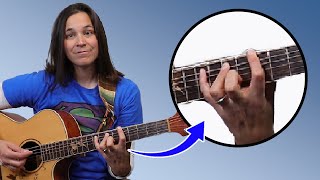
Lauren Bateman shows how to nail that classic blues sound with power chords and a five-fret pinky stretch. The trick works in any key, uses a shuffle rhythm with accents on beats 2 and 4, and includes an optional 12-bar turnaround. Electric guitar makes the stretch easier.
Chapters
So you're a big Chuck Berry fan or you're a big blues fan, and you hear this cool little thing going on.
And you want to know how that's played. Well, that's what we're going to go over in this video. So let's get started.
So hopefully you saw my previous video where I showed you guys how to play power chords over a 12 bar blues. If you didn't see that yet, that's okay. You can go check out that video. I will review it very quickly here. So in this example, we're going to be playing over the key of B. So that would be four measures of B. We're going to be doing two measures of E back to B. Then we're going to be doing an F sharp, an E and back to a B power chord. Now the little trick that I'm going to show you is based off these power chords. And the reason I'm starting at B is because for some of you, this could be a little bit of stretch, especially if you haven't stretched out your hand. Because we're going to have to stretch over five frets, okay? And we're going to be using our pinky finger to do this stretch. So. So if I have a B power chord, so my first finger's on the top string seventh fret, my third finger is on the A string at the ninth fret, okay? That is our B power chord. And what's going to happen is this pinky is going to reach out to the 11th fret on the A string. So it's going to sound like this.
And obviously this is much harder to do on an acoustic guitar than an electric guitar. But the mechanics are still the same. So what we're doing is 1, a 2, a 3, a 4, a 1, a 2, a 3,. So you can see my pinky is stretching out and hitting that 11th fret on the 2 and the 4. So we're accenting the 2 and the 4 on this shuffle rhythm one.
Okay, you can hear that. Let's do it on an A chord. Same thing. So we're starting fifth fret, seventh fret.
Okay, G, same thing.
And you're probably hearing this and you're being like, oh my God, I've heard this in so many blues songs. It's a really, really cool thing and it's a great way to have fun with the blues and make it sound really cool. Just adding this little bit of spice to, to your playing. Now if you wanted to play this over rock and roll, this doesn't just work for blues. Think of someone like Chuck Berry. You know, I think. I know even Beatles. There's some of their songs that use it. Led Zeppelin. Just think of, instead of playing a shuffle, you're going to play a straight rhythm.
Okay? Just. That's the difference between early rock and roll and blues. Blues is a shuffle rhythm. Rock and roll is that straight eighth note rhythm. It's really, really cool. So you can use this for both rock and roll and blues. But now you hear that sound, you know how to make it. Okay. It's not that hard. The hardest part is the stretch. So that's why I'm saying start up here where the frets are smaller and then work your way down. I have small hands, all right. Five frets for me is a bit of a stretch, but an electric guitar is much easier. So if you're finding it hard on your acoustic, just switch over to your electric, practice on that, and then you can bring it back to the acoustic. So let's try this little exercise in the key of B. Okay, so like I said, we're going to be going from a B chord, moving everything down, one set of strings each to our E chord and then up two frets is our F sharp power chord. Okay? And remember, we're accenting two and four. So.
Okay, one, a two, a three, a four. That's going to be our rhythm. A two, a three, a four dot okay? Okay. When you get to the end of the 12 bar blues, you just start it all over again. And I want to show you guys an extra little turnaround in this video. So so far I've taught you 12 bar blues. And I'm saying at the end, we play two measures of the I chord. Okay? In this case, that would be the B chord. Now, there's a lot of blues songs where they play a turnaround instead. So the last four measures, instead of being the fifth chord, the fourth chord, the first chord, and the first chord, we switch that last chord back to the five. So it'd be 5, 4, 1, 5. And we're going to play our turnaround. So let me show you the comparison of how that's going to sound. So here is 5, 4, 1, 1. It's going to be.
Okay. And I was just playing straight eighth notes on that. But see how it brings it back to the five, which then makes us want to go back to that B chord.
So you can hear how that adds a little bit of a different dynamic. We call that a turnaround in 12 bar blues. So you can throw that in there as well. Because sometimes playing just the straight original form gets a little boring. So you might want to do the regular form, then a turnaround, then the regular form, then turn. Or you can do it turnarounds all the way through. It doesn't matter. Blues is a great 12 bar. Blues is great because it's so repetitive. You can really, really practice a lot over this progression. If you guys enjoyed this and thought this was fun, I have another video right over there where you. Where I go over 12 bars blues. And we play this cool little guitar pattern over the whole thing. It's a lot of fun. You guys should go check out that video right now.