How a Guitar Capo Can Help Beginners Play MORE SONGS with LESS CHORDS
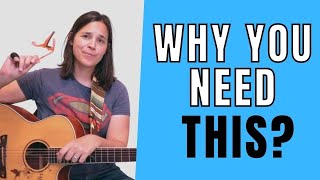
Lauren Bateman shows how a capo lets beginner guitarists play more songs using only open chords. Instead of learning difficult bar chords, you move the capo up the neck to match the original key and your voice.
Chapters
Hey, guitar enthusiasts, welcome back. And in this video, we're going to talk about this thing here. It's a capo. What do you use it for? We're going to find out in this lesson video.
So a capo is. It's one of those tools when you go buy a guitar that the guy at the guitar center or the guitar shop goes, you need to get one of these, and you don't know why. And particularly if you're an acoustic guitar player, it's a very, very important tool in your arsenal. And it's very helpful for beginners, too, because it can allow us to play more songs without necessarily having to play bar chords. It's a way for teachers like me to get rid of some of the bar chords for you guys so that you have access to more songs. Now, to use a capo, it's very simple. It's basically a clamp. So you can see it squeezes. I like the kaiser capos. This is what I have, a kaiser capo. I like them. They come in cool little colors by kaiser capo. And all you do is you squeeze the clamp. And there's rubber on this side, and the rubber goes against the strings, and there's a clear rubber piece on the back. So there's a long end and a short end. The short end goes on the back. The long end goes on the front of the fretboard. And whichever way works for you. I like going from the top down because I'm a righty and I just reach over the guitar. I've seen some people do it underneath. I know it's just awkward for me to do it that way. I always clamp it and go over the top. Okay, now some capos. Yeah, you have to be wary, because with some guitars, putting a capo on can sometimes make the guitar go out of tune a little bit. I had a cheaper guitar, a cheaper Ibanez, and it used to really, really go out of tune with the capo. This guitar doesn't do that so much. But just be aware of that, that when you squeeze the strings here, you're changing the tension. So if you have a cheaper style guitar that maybe has a lot more space between the strings and the fretboard, you may slightly put the guitar, like, out of tune, like a quarter of a note. So you may have to put the capo on, retune the guitar. But don't worry about that too much. It's probably not going to throw you off too much, but I just wanted you to know that that is A possibility when you're using the capos. Now, the placement of the capo, you know, you can either put it towards the middle of the fret. I like to put it as close to the front of the fret as I possibly can with. Without being, like, on top of the fret. Because that. That won't work because the. When you look at the nut of your guitar. So this is almost like the capo for the guitar is this nut at the top. So I try to get the capo as close to the front of the fret as I can. And just let it. Just let it sit there. Okay. And then it will change. You know, it will change the notes depending on where you put it. So I'm just playing a G chord. And we can come all the way up here.
So you can. You can come all the way up the guitar with this. And just with the G chord, you can get all kinds of different sounds. So here's a G chord here.
Here's a G chord here. And the music theory is, even though I'm just playing a G chord, these are not all G chords. It's actually a different chord, but relative to the capo, it's just. Just a G chord. Okay.
So you can hear. I can get all these different chords and sounds by just playing a G chord and moving the capo, which is very important for singers. And someone like me, who's a female singer, where sometimes I need to sing a song that's too low for me, and I need to sing it higher. So let's talk about that. So essentially, what the capo does is it's a way one to simplify songs, but also it's a way to change keys of a song. So say, for example, something like hey Jude, hey Jude for me is in a very, very low.
Key. It's kind of really low for me to sing. So if I wanted to sing hey Jude, I might throw a capo on the guitar. So let's take a song like hey Jude, which for me, there's a line that gets too low. So we got the second line. Remember to let in your remember.
Remember.
To let her into your heart Then you can start to make it better.
Now for me that's really low. If I were to sing a Johnny Cash song, it'd be pretty hard for me to sing because his voice is so low. So with the capo, I could just slap it on the guitar here and change the key of the guitar without having to worry about changing the chords. See, because on a piano, when you change the key. You have to go and figure out what chords you need to play, what the key change is. With a capo, you can just stick it on the guitar, change keys, make the guitar sound higher. And especially for women, especially with guy songs, it can make it a little bit more singable. Let's see how it is here.
Remember to let her into your heart, then you inside to make it better.
See, it's much better for my voice there than it was down low. So the capo is a great tool, especially if you want to sing a song and it's too low for you, just throw the capo on the first, second, third, or fourth fret. I mean, sometimes you can come up to the sixth fret. It'll sound really bright.
The other thing that a capo is good for is that it can make certain songs easier to play. Sometimes we can eliminate a lot of bar chords. Sometimes we can completely eliminate bar chords. For example, songs that are in the key of A. Usually you'll have like an A chord, a D chord, an E chord, and an F sharp minor. And for, you know, even though F sharp minor is one of the easier bar chords, we can completely eliminate that. Because when you make F sharp minor, your first finger is essentially a capo, right?
So if I put a capo here and I leave my other two fingers, what am I left with? I'm left with an E minor chord. So now instead of playing F sharp minor, I just play an E minor chord relative to the capo. I'm technically. You're technically still playing F sharp minor. It's just now the capo has taken my first finger over. So that's usually for signs that are in the key of A. That. So you would end up playing a G chord, a C chord, and a D chord and an E minor. My first four chords that I teach people as like the quintessential chords in my guitar course. So if you have a capo, you can play in the key of A major by just playing some different chords. So essentially by adding the capo here, instead of playing an A chord, you would play a G.
G major, because just so you know, this is a little bit of music theory stuff, but this top string, this fifth fret, is an A note. That's why this is the A chord. So that's A major. So let's see. So E. So we said F sharp minor would be E minor.
Instead of a C chord, you play instead of the D chord, you would play a C chord instead of an E major. Chord, you would play the D chord. So another song that kind of comes to mind is Adele's Rolling in the Deep, which I have on my website here. So we use the capo on the third fret. You can go to my website to check out this chord chart just to show you. So if I were to play. So this song has a capo at the third fret, and we have an A minor chord. We still have an F bar chord and we have a G. Alright. But if I had to do this without the capo, without the capo, I would have to play a C minor chord.
Followed by a G sharp major bar chord.
Followed by an A sharp major bar chord.
So there's.
Sorry. Yes.
There's a fire burning in my heart Reaching a fever pitch and it's bringing me out the dark.
Now for some people, playing three bar chords in a row might be too much of a pain. But if you're just starting to learn bar chords, we can just have you practice one at a time.
So now you only have to play one bar chord as opposed to all three at a time. Because for some people, if you're just starting to learn bar chords, playing three in a row can be really tiring. So sometimes as teachers, we use the capo to either eliminate bar chords so that you don't have to play them if you're an absolute beginner, or to minimize the number of bar chords you have to play in the beginning. Eventually you can just remove the capo and you can play all barre chords. That's awesome. That's ideal because you can start doing a lot of percussive stuff with barre chords.
Which is really cool. But in the beginning, when you're a beginner player, it's hard sometimes to do all those bar chords. So those are two uses for the capo. It's a great way to change keys without needing to figure out and do a lot of music theory to figure out what the chords are so you can adjust it for your voice. Especially if you're a female singer like me. Sometimes adjusting those keys can make things very, very helpful. By sliding this capo around also too, it can eliminate bar chords for teachers like me. Or we tend to put capos on a lot of songs in the beginning for students because it just makes them a little bit easier to play. Hope you guys enjoyed this video on how to use this capo. I'll see you guys in another lesson video.










