How I Went From ZERO Talent to Guitar Teaching Hero - It's Not What You Think
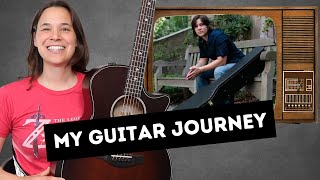
Lauren Bateman started guitar at 16 with piano basics and a Hal Leonard book, learned chords, wrote songs, and didn't take formal lessons until age 26. Teaching students forced her to learn country, Beatles, Taylor Swift, and Zeppelin. After 24 years, she still learns.
Questions this video answers
August 12, 2023
Around 16 years old
"Come as You Are" (Nirvana) and songs by Blink-182; also learning intros like "Enter Sandman"
C, G, and D
Around 26 years old (after ~10 years of playing)
Chapters
Hey, guitar enthusiasts. I had a student recently in one of my Q and A sessions in my private community ask me, Laura, what was one of the first songs you learned on the guitar? And it got me starting to think about my guitar journey and the process and, you know, the trials and tribulations that I went through. And I felt like I wanted to share that with you, that progression with my students, because I know you guys see me here on YouTube and you're like, lauren, you're so good and do all this cool stuff. And it wasn't always like that. So I want to go back to what when Lauren was 16 years old and started learning guitar, what that was like and the process I went through to get where I am today.
So to answer that question, I think one of the first songs I learned was Come as you are.
I also think Blink182 was really big at the time. Is that what it is? Yeah.
What's my age again? So I was learning lots of, like, intro intros to song like Enter Sandman. I wasn't really learning chords. I. I had learned that there was this thing called tab, which was nice because when I first started learning guitar, I approached it the way I learned piano, which. Which was wrong. So in piano, you know, I took piano lessons in the convent, of all places. And we focused very heavily on sight reading. And for me, I just couldn't figure out the sight reading. That was my biggest thing with music is I couldn't do the sight reading. And I'm still not the greatest sight reader today. Ok, hate sight reading music. Let me know in the comments below. You're not alone. But that's how I started. I started with a Hal Leonard book, Hal Leonard, level one. And it was all sight reading. And I was like, well, this is how I learned piano, so it's probably how I should learn guitar too. And I went through the majority of that book and I fortunately stuck with it long enough to get to a section on chords. Okay. And I learned a C chord. I think I learned a G chord and a D chord. And as soon as I learned my first chords, I took that book and I threw it in the trash. Because I was like, this is how you play music. This is how you make music. Chords, not sight reading, individual notes. It was kind of, like, frustrating. I'm like, why didn't they just start with the chords? That's the fun part. So I learned that songs are written with chords, and chords are just harmonies playing multiple notes at the same time. And I had played chords and piano. But no one had ever told me that they were a chorder. I didn't understand that this was a C chord. You know, these three notes you play on the piano. Our C chord. And I feel like if I knew that, I'd probably be a piano player. But I finally learned the concept of what a chord was on the guitar. And as soon as that happened, I was like, I gotta start playing songs. So I did with most people did back then. There was no YouTube back in the day. I know, I'm so old, aren't I? I just turned 40. So I know a lot of you guys think I'm younger than I am, but I know I'm still a spring chicken, though. So I went over to Ultimate Guitar, right? Ultimate Guitar was around back then. And I started looking up songs and looking up music, and I was like, I have no clue what's going on here. So there was a song I wanted to do by Melissa Etheridge. Melissa Etheridge. I love Melissa Etheridge. And that's what I was listening to. I think the Little Secret album was out. So I was, like, trying to learn all these cool Melissa Etheridge songs. And her stuff's pretty intricate and difficult. And there was a song like the Way I Do that I wanted to learn, but unfortunately, it sounded something like this.
And I was like, I have no clue what she's doing. And it was all like, bar chords. Is it so hard?
Satisfy your senses.
She's doing all, like, this percussive strumming. And I was like, I have no clue what's going on here. And I felt completely lost. And I felt completely demoralized that I was just like, you know, I'm gonna give up learning other people's songs because I just couldn't do it. I didn't have the skills to learn other people's songs. So what I did instead was I started writing my own music. Because I found out that there's certain chords that when you play them together, they sound good. And I learned later, when I finally took guitar lessons, that those are called keys. I written an entire album. I'd written tons of songs and had no clue what key my songs were in. So if you don't know anything about music theory and keys, don't worry. It definitely helps to have that information. But you can do a lot with the guitar even if you don't have that information. So I started writing my own music. That's why when I actually started teaching guitar, I didn't know a lot of other people's songs. Because I didn't know how to listen to the music. I didn't know how to hear different things. And all the songs I knew on guitar were my own. So when I started teaching, I had to start learning other people's music because I had mostly just done my own music. But that was kind of the aha moment for me was chords and having them sound good together. And that's why I start students off with like, let's learn some simple tabs, some simple melodies, some simple winds, and let's get right into chords. Because that's where the fun is, the chords and strumming along and being able to play along to one of your favorite songs. That is where the enjoyment and the motivation comes from that first time. You know, if you're in my seven level guitar system, a couple of the first chords we learn are E minor and this D69 chord. And I teach them because I say, hey, go watch my video on horse with no name.
And they're like, I can play music which is. Which is two chords. And it's a very rewarding and motivating thing for students to get into chords. And so I did that for quite a long time. And then I got into college and. And, you know, I was a resident assistant at Boston University, and we used to sit in the RA office downstairs. And a lot of times there was lots of time to kill, so people would bring their guitars down. And I remember this one guy, he was playing Wonderwall. So he put this. This capo y thing on the guitar, and then he just starts going.
And I was like, wow, he sounds really good at this point. I have been playing the guitar for maybe five or six years, and I was okay. I was okay. I never had any lessons. And I was like, what the hell did you just do? So we're in the, you know, the resident assistant hall. He's trying to teach me how to. How to play Wonderwall. And I'm learning what this thing called a capo is. So I went to Guitar center up the road, and I buy this capo thing. And I learned, like, I can take these chords that I already know and I can move them all around the guitar. So then I started writing songs with capos and all that fun stuff. And then I graduated college and I started working for the pharmaceutical company again. Still haven't taken a guitar lesson in my life. And I'm like, you know what? I really want to get better at the guitar because I'm so tired of everyone else playing the guitar better than me. Sounding better than me and still not knowing why. You know, I had two strumming patterns I have. That's why I couldn't do the Wonder Wall, because everything was like, you know, that was like, the one strumming pattern I had.
Which are great strumming patterns. You can use them on lots of songs. But the reason I couldn't play the Melissa Etheridge song or learn how to play Wonderwall was because I just had not learned enough strumming patterns yet. I kept staying in my comfort zone. So finally, when I was 26. So I've been playing the guitar 10 for 10 years at this point. 26 years old, believe it was 26, I started taking guitar lessons, okay, from a local musician. And she started teaching me about different strumming patterns. I learned finger picking. It was the first time I had learned.
You know, little like Dust in the Wind. The first song she taught me actually was Landslide. I came in being like, I'm trying to learn this thing called, you know, Stairway to Heaven. And I was showing her the picking pattern. She's like, why don't we start with the basics? I'm going to teach you a song called Landslide. We have our capo. I knew how to use a capo at that point. And she showed me, you know, this very. This very simple picking pattern. And I went home and I ate that up. That was so inspiring to me, to be like, oh, my God, I can play Landslide. She showed me that's actually not the picking pattern for Landslide, but that was the foundation of the picking pattern she wanted me to learn. And we used it on lots of different songs. Dust in the Wind, you know, Blackbird, lots of different things. And that was the start where I was like, okay, there's so many skills that I don't know, and I don't even know what I don't know on the guitar. So we worked on some Melissa Etheridge songs. We worked on a lot of songs with different strumming patterns. We even started music theory. She was the first person who showed me what a chord was on the piano. I had taken piano lessons, think two years, two or three years, and not once did I know what a chord was on the piano. We went downstairs to her piano, and she was like, this is a chord. It's. It's a root, a third and a fifth, and it's this shape. And I was like, holy crap, you're kidding me. Like, that's all it is. It's just this little shape on the piano. And she was like, yes. And if you want to make it a minor chord, you just move one finger over. And I was. It blew my mind that that's all it took to play chords on the piano. And I was like, why didn't my piano teacher teach me that? And that's why, as a guitar teacher, I focus on the chords first and the strumming, because it really gets you playing music as fast as possible. And for me, that was always the reward to be able to be inspired and play music. So I took lessons with her for about a year, and then I quit my job to become a musician full time. So I didn't have the money to take the lessons anymore. But becoming a teacher really forced me to become a better guitar player because, like I said, I had to start learning all these songs. I had people coming in, being like, well, I want to learn, like, needle in the damage done by Neil Young. And at this point, YouTube existed. So then I'd go on YouTube, I would learn the song, and then I would teach it to the student. So by becoming a teacher, I actually learned a lot more about the guitar because my students were forcing me to get out of my comfort zone and learn things that I had never considered. Country music, you know, doing some Zeppelin stuff, you know, lots of Beatles. Would you love the Beatles? But it was forcing me to do things I had never thought about doing before, because as a teacher, I always wanted to teach the students what they wanted to learn, what inspired them about music. Because I remember me wanting to learn my music in piano and being relegated to, you know, no, we must learn classical. We must learn this. There were two songs that I really learned on the piano. They were the theme for Jurassic Park. I liked it because it had dinosaurs, and I like Jurassic park, and it was Janet Jackson's. Again. Those are the two songs that I actually really sat down, practiced, and learned on the piano, because they were songs I wanted to learn. They were songs that I enjoyed. I didn't like the classical stuff, and nobody was willing to go outside of that for me. Unfortunately, my mom asked the piano teacher, like, can you just let her do something she likes so she'll actually practice? And I did. So that's why when I taught guitar, I didn't want to be like, well, I really like Melissa Etheridge, and I really like, you know, all these cool artists, but you don't. So you're gonna learn what I want to learn. So I've always been like, no, let's tell me what you want to learn. I'm gonna go listen to It. I'll write up a chart for you. Come back next week. We'll start learning that song. So I did, you know, I wasn't really big into country music, and my students forced me into, you know, country music. I learned a lot of great older music, a lot of great new new music. I learned a lot of Taylor Swift stuff. I had, you know, younger students who wanted to learn Taylor Swift. I wasn't really big into Taylor Swift, but I did it, and it got me out of my comfort zone. I learned lots of different strumming patterns, lots of different ways to write songs. So for me, becoming a better guitar player was really instigated by. By my students. So thank you so much, and thank you, you know, for all the song requests that you put out there. I'm still learning new things. I've been playing the guitar now, gosh, 24 years. 24 years I've been playing the guitar, and I still have so much to learn. I still have so much further to go. I fully admit that I am not the greatest guitar player in the world. I know there's so many great guitar teachers here on YouTube. You know, you get Rick Beato, you got Justin, you got Andy, you got Marty. They're all great people, and they're probably all way better guitar players than I am. But I think what really sets me apart is my learning processes, that I did this mostly on my own. I don't have a degree in music, and I approach the guitar because it's fun, and I'm willing to throw all the other stuff in the trash and just say, listen, let's approach this instrument and let's have fun with it. Because if you can have fun with this instrument and get motivated to actually pick it up and play, you're going to get better. All right? And then you're going to start playing for your family and friends. They're going to recognize what you're playing, and. And they're going to come in the room and be like, hey, that's pretty good, or, hey, that sounds like this song. And that's going to be so rewarding and motivating for you. So thank you so much for letting me be your guitar teacher here on YouTube. And if you want to learn about my story behind my first acoustic guitar, go watch that video over there. I'm going to show you the. The guitar that I started on. It was not the best.










