How To Bend Guitar Strings Perfectly for Beginners
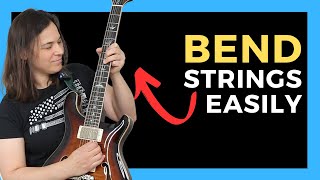
Lauren Bateman teaches guitar string bending by showing how fingers work together as a lever to pull strings upward while maintaining pitch clarity. She recommends hybrid string sets to make bends easier, uses a tuner to train your ear against target notes, and suggests starting on the high-E string with small bends before progressing to larger ones.
Chapters
Hey, guitar enthusiast Lauren Bateman here, and we're going to talk about bending strings on the guitar. How do you do it? How do you make it sound good? Because bending strings can either sound really good or it can sound really bad. And there is a specific reason for that. And I'm going to tell you what you can do, how you can practice this to ensure that you are bending your strings to the correct pitch and sounding awesome all the time. So bends are just a little phrasing technique that we use a lot in lead guitar playing, you know, so when you're playing a solo. So let's take for example, something very, very simple, like Wonderful Tonight. So something like that. Very, very simple. Just a couple little bends. But it adds a lot of emotion to the playing as opposed to just playing individual notes. Okay, so how do we bend and how do we do it correctly? So there's, you know, a few different schools of thought, but the way I was taught is how I'm going to show you, and that is to kind of create a leverage point. So I will admit, I'm female. My hands are probably a little bit weaker than a guy who has massive, massive strong hands. Okay. So for me, bending was always something that was very difficult. But I learned a little trick which I'll share with you guys here in terms of the strings, first off, okay, so the thicker the strings, the harder they are to bend in tune. So when I was playing on my electric guitars, which this is, I was playing with tens, which really aren't super heavy duty strings. But for whatever reason, I. I just could never bend the string in tune. I was always coming up just a little bit short. And when you do that on string bending, it just sounds a little bit off. It doesn't kind of sound sweet the way it's supposed to. It's supposed to sound awesome. So I was always a little bit off. And the teacher I was working with was like, well, you should put lighter strings on the bottom and keep the heavy strings on the top. And I was like, you can do that? And he said, yes. They're called hybrid string sets. I didn't even know this existed. So my top three strings are. Are thicker strings, tens. This way, when you play power chords, you get kind of the. The richer sound from your rhythm playing, but the higher strings are nines because it makes it so much easier to bend in pitch. At least for me. If you're someone who has really strong hands, stick with the tens because you'll get a better sound. But for me, I just could never get tens to bend in pitch. And that's an important part of bending. We don't want to bend it just. We're not bending. Just let me sound like a fly on the wall kind of bugging people. We're not just bending to some randomness. We're bending to something specific. And it's usually some sort of tone on the guitar. And we could do just a little quarter note bend, which you'll hear a lot kind of in blues where you're just kind of going above the note. So say, for example, I'm bending this. I'm bending the E string at the B note, which is the seventh fret. And if I just bend that a little bit, you know, it kind of. It's. It doesn't sound like anything much, but if you throw it over a little lick, it just provides a little movement on the guitar and it feels a little bit almost bluesy. So it's very common in blues to do maybe like a quarter, quarter note bend. We also have what we call the half bend. Okay. So that is going up one note. Okay. So if I'm on this B note, if I see a half bend, it usually looks like a little curve and it says half. Okay. You're bending it up to the next note. Okay. So we're trying. Instead of playing a B note, I'm trying to play a C note. And if I do a whole step bend, I'm doing two notes on the guitar. You could also have a two step bend. So if you think like Hotel California, there's a bend in the intro. I think it's that da na na na. That first bend I think is two steps. So it's actually four notes that you're trying to bend up. Very, very big bend. A lot of times commonly you're going to see the quarters, the halves and the. The whole bends much more commonly. But that's what we're doing. We're trying to bend to a specific note on the guitar. Now what I do before we work on trying to bend into pitch, I'll come here on the. Because this is like if you're learning a minor pentatonic, typically you'll bend this ninth fret a lot, which is a C note. Okay. So typically when you're bending, I like to bend with my first, second and third fingers on that string. Okay. Because it gives me enough leverage and strength to push into the guitar and up. Okay. So we're not just pushing up. We are, we do want. Because if we don't press into the guitar, we're going to lose the note as we bend. So we need to keep pressing into the frets, and then we push up. And I'm not just using my fingers. If you can see my thumb, thumb is on the top of my guitar here. I'm kind of pressing down with my thumb a little bit, and I'm using it as leverage to push those strings up. Instead of just. Instead of just doing this, I'm actually pushing into the guitar first, second, third fingers and pushing, you know, really bending that string. And I'm using this thumb as leverage. I know some people, like I said, it's different schools of thought. You always leave your thumb on the back of the guitar. Again, I have weaker hands, and for me, I like to bend the guitar that way. I think it's more the way, like Jimi Hendrix kind of did his. His bending. So it's okay. If he can do it, I can do it, too. And the key is, again, I put three fingers down. This way I have the most stability and strength. I push into the guitar and then I bend up. Okay. And then ultimately, you're determining where you want to go with this bend. If it's a whole step, I'm trying to bend it to this D note. So if I'm on the eighth fret here, which is a C not, and I'm trying to do a whole step bend, this is the note I'm trying to bend to. So instead of just playing, I'm trying to bend up to that dino. Now, how do I know if I'm doing it correctly? If your ear isn't developed yet, this is a trick I used when I was trying to learn how to bend. And I didn't have the greatest ear yet to know if I was in pitch or not. So you see here, I have a little bit tuner. I don't know if you can see that on my close up there. I have a little tuner on the end of my guitar here. And what I'm going to do is I'm going to press, make sure that I'm on a C note, which on my note, on my little snark tuner here, I can see I'm dead on C. Okay. If you play this note and it's a little off the intonation, you might need to do some adjustments on your guitar. You might need to get a setup. Because essentially, if you're pushing this note and it's supposed to be C and it's showing it a little bit sharp or a little bit flat, you Might need to adjust your bridge because the intonation of your guitar is off a little bit. But let's say it's dead on C. Like mine is. Okay. And the note I'm trying to hit is D. And I'm dead on D there. So now I'm going to bend and I'm going to watch. First I'm going to try and do it without looking at my tuner because I want to train my ear. Okay? Now if I look over, I'm just a little. There we go. Now I'm a little sharp, so I'm watching the tuner and if I push up into it, there's D. It's like, okay, that's how far I need to go to go from C to D. So. So see, now I'm looking. Oh, I'm too far. I'm too sharp. So then you try again. Now I would watch the tuner again. You're working your way into the notes, so the tuner is going to tell you if you're right or wrong. You don't have to guess. Am I doing this right? Am I doing this wrong? You watch the tuner. And that's the way to practice doing bends. First, work on your technique. Don't worry about the sound just yet. Just get comfortable. And just so you know, the high E string is the thinnest string, so it's the easiest string to start on. As soon as you go up to a B string, you get a thicker string. G is even thicker. Alright? So the thicker the strings, the harder it is to bend those strings. That's why I like the thinner strings on the top three strings because typically those are the strings you're bending a lot. The high E, the B string and the G string. Alright? So start on the high E because that's the easiest one. It's the thinnest string. And just work on the strength of building and bending. Alright? Start with just little bends because you could saw how to get this note. I really had to. I really had to bend up. I'm really pushing up the string on the fretboard. All right, so you do need some strength into this. So all I want you to do is get comfortable putting your three fingers down, okay. Using your thumb for leverage, pushing into the guitar and just pushing it up a little bit. Okay. And maintaining that, maintaining that sound as opposed to that happens to some people as they bend up, they lose the note because you're not pushing into the fretboard. You have to actually push into the fretboard. You don't have to kill it. You don't have to like overkill it. Just enough pressure pushing into the board and up. It's in and up. Okay. And I'm kind of doing this with my hand a little bit. I'm leveraging this pivot point on my thumb to give me some leverage. Because me, I need the help, I need the extra assistance. Once you start feeling good about that, just start with half note bends. So we're going from this C to C sharp. You know, you're just trying to go up a half step, then try and go to your whole step which is going to be the strongest. And eventually what's going to happen is you're going to one develop the earth to know what the difference between a half note is or whole note if you're, if you're tuning in pitch. And also you're going to develop a muscle memory for how much strength you actually need to get these notes in pitch. And I'll, I'll admit it was very, very difficult for me in the beginning. And it, you know, I would admit I'd have to practice a little bit because I don't play a ton of lead guitar. But when I was starting and I was working on bends, I could not bend in pitch for the life of me. And I use the tuner on the neck of my guitar to really correct myself. So that is a trick. If you haven't done that, if you have trouble bending your strings, use this because this is the way you're going to know if you're doing it correctly. Until you can trust your ear, until you can trust your muscle memory. And if you like this lesson and you want to learn how to use a bend in an actual song, go check out my wonderful tonight lesson right over there where you can learn a very, very simple but tasty lick that uses little bit of a bend and can get you started with playing this in real music. Go check that lesson out right over there.










