How To Count Rhythm on Guitar for Beginners
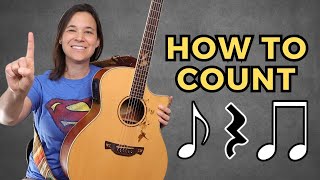
Lauren Bateman teaches how to count rhythm in 4/4 time on guitar, breaking down whole, half, quarter, and eighth notes with strumming examples. Start with single notes before moving to chords, and adjust your tempo as you get comfortable.
Questions this video answers
Lauren Bateman
December 14, 2024
Chapters
Hey, guitar enthusiasts, join me as I take on the challenge of teaching you how to master counting rhythm on guitar. This is super important. If your timing and your rhythm is off when you're playing a musical instrument, no matter how good you are, it's going to sound weird, it's going to sound bad. And that's why counting and timing is so important. That's we're going to be doing in this video. Now where we're going to start off is just what number we're counting to. So in this lesson we're going to going to be counting to the number four. Okay? So typically in music you can count to different numbers, but for this lesson, the majority of music is what in what we call four, four time. All right? Think of a measure of music, all right, As a dollar bill. And there are four quarters, all right? Four counts 1, 2, 3, 4. Within this measure. And that's how we're going to be counting for this entire lesson. So we're just going to be going.
One, two, three, four. One, two, three, four. 1, 2, 3, 4.
We're just going to be counting that over and over again. And really just keep it there, keep it simple. This way you can really work on locking in your timing. Now the first thing we're going to start off with is what we call a whole note. And that's been put right up here. You'll see it's a circle with a hole in the middle. Okay. So you can remember that whole note has a hole in the middle, alright. And it just looks like a little donut. And what we're going to do with that. So if I just play a single note. Let's talk about single notes. First. We're just going to put our first finger on the high E string at the second fret here. And I just want you to play that note and we're going to count to four.
1, 2, 3, 4.
So I'm just picking down with my picking hand.
1, 2, 3, four.
And I'm counting to four. And that's essentially what a whole note is. Now how this translates into strumming, if you know something like an E minor chord, which is one of the first chords, chords I teach people in my guitar crash course. If you're interested in checking that out. I do have a free crash course. I'll put a link in the description below. Just go check that out. Super fun. So if we play something like an E minor chord and we strum. So when you strum for this chord, we're going to hit all six strings. And we're just going to go down.
We'Re going to go one, two, three, four. One, two, three, four. 1, 2, 3, 4. One, 2, 3, 4.
Now, I know it doesn't sound very, very interesting, but the great thing about this is in the beginning when I work with students, especially because I work with a lot of older adults, that's kind of my specialty, working with students ages 50 plus and a lot of times doing these chord changes, it's a little bit tough in the beginning to get them to go fast enough to do really fast strumming. Because the faster your strumming is, the. The faster your chord changes have to be or you end up sounding like this.
Get these kind of like big pauses in between, in between your strumming as you're changing the chords. So by using this whole note strumming first one, you get to really focus on timing, okay. Which is super important, especially if you want to play music with others or you want to play music along to your favorite songs. Timing is super important. So what it does is it allows us to just simply focus on a four cone.
1, 2, 3, 4.
And it gives you time to change into your chords.
1, 2, 3, 4. 1.
It gives you time to move through those chords. Because a lot of people ask me, do I have to hold the chord down the entire time? No. As soon as you strum, you can start moving into your next chord. Alright. And if you're in my seven level guitar system, you'll know I'll show you how to pick pivot into chords to move through things a little bit quicker. That's where we start. Whole note count, it's one note or one strum and you count to four and you just let it ring. The next step up would be a half note. Okay. So it looks like the donut, except we have a stick coming out of it now. Okay. It's called the stem on a note. So if I were to play a single note again, if I was on that high e string, second fret, I.
Would go 1, 2, 3, 4. 1, 2, 3, 4.
So a half note is two beats. The whole note was four beats.
1, 2, 3, four.
A half note is two beats.
1, 2, 1, 2, 1, 2 and.
2 plus two is four. So there is a little bit of math here. But just count on one and three is your note.
1, 2, 3, 4. 1, 2, 3, four.
And if we went back to strumming.
1, 2, 3,4. 1, 2, 3, Four.
Okay. So we have the whole note strumming to Start with when you get a little bit faster, your fingers get a little bit more nimble, we move to half notes. And then eventually I'll bring my students up to speed with quarter notes. Now, you heard me say earlier before, a measure of music is just think of it as like a page in a book. Okay? So we have this measure. It's just this one piece of music. And in between, imagine each one of those is a dollar bill. We have these quarters, Four quarters in a dollar bill. Well, in a measure of music, we have four quarter notes. Okay, four quarter notes. Now, these are a solid black with the stem sticking out. So see the picture up there? And we have four of these per measure. Okay? So again, if I went back to a single note, this is worth one beat. So every time you see one, I would play a note, it would sound like this.
Okay?
1, 2, 3, 4. 1, 2, 3, 4. 1, 2, 3, 4 dot If I.
Go back to my E minor chord, four down strums.
1, 2, 3, four. 1, 2, 3,4. 1, 4, 2, 3, 4. One, two, three, four.
All right, so you can see we had half or we had whole notes. So four count.
One, two, three, four. One, two, three, Four.
Then we had half notes.
One, two, three, 4. One, two, three, FOUR.
Then we had quarter notes.
One, two, Three, four. One, two, Three, Four.
Now, now you can see I kept the tempo the same. So the tempo, just think of it as miles per hour in a car or kilometers per hour if you're over in the UK or somewhere else outside the US it's how fast we play the music, and that's usually in what we call beats per minute, bpm. So I'm keeping the tempo the same. But you probably heard, as I got to quarter notes, it sounded like I was moving faster because I'm trying to shove a lot more into that measure. That's why, you know, as you get faster with your strumming, your chord changes have to become much faster in order for that strumming to sound smooth and in time. And a lot of students make this mistake. They try to jump onto really, really intricate strumming and throwing intricate strumming into their songs. And then the songs all of a sudden don't sound as good because we've got all these spaces and breaks between the chord changes. So keep the strumming simple and. And your songs will sound much better. Now, the final count I'm going to teach you in this lesson is what we call an eighth note. So we had whole notes, which are four beats. We had half Notes which are two beats. And we had a quarter note, which is a single beat. Now we have what's called an eighth note. Now, an eighth note is a half a beat. So there's two eighth notes for every one quarter note. Okay. So essentially we would have eight notes, and it's counted like this 1 and.
2 and 3 and 4 and. Okay, 1 and 2 and 3 and 4, and.
And if I were to strum 1.
And 2 and 3 and 4. And 1 and 2 and 3 and four.
And if I go back to the whole notes so you can hear the whole thing, it's whole notes.
1, 2, 3, 4. 1, 2, 3, four.
Half.
1, 2, 3, Four. 1, 2.
Here's quarter notes.
And 1, 2, 3, 4. 1, 2. Ready?
Eighth notes.
1 and 2 and 3 and 4. And 1 and 2 and 3 and 4.
And so again, you heard, the more strumming I shoved into that measure of music, the faster my playing sounded. So that's. This would be a great exercise, just going from whole note to half note to quarter to eighth and just going through those rhythms and working on that timing. Don't worry about changing chords just yet. Again, you want to get your chord change speed up fast enough so that you can do these faster patterns, but until then, just work on one chord by itself, just like we did in this lesson here. If you. If you're someone who is just getting started with guitar and you're not sure how to read a chord diagram, which is essential for learning to play chords and essential for learning how to play songs, go watch this next video on how to read a chord diagram, and I'm going to show you what all the little symbols mean and how it's going to help you learn to play even more chords on your guitar.










