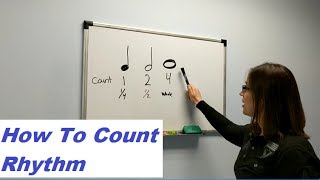
A short instructional video lesson by Lauren Bateman (LB Music Schools) introducing basic rhythm counting for beginners. Covers the visual appearance and time values of quarter, half, and whole notes and demonstrates counting measures in 4/4 time to support simple strumming patterns.
Chapters
Hi, my name is Lauren Bateman, and I'm the owner here at LB Music Schools in Massachusetts. And today, what we're going to talk about, or in this video lesson we're going to talk about, is a review of basic counting. So counting is very important to keeping time and making sure that your rhythm is staying the course. So what we're going to do is I'm going to go over to the whiteboard and I'm going to show you three different types of rhythm notes that you'll come across in the beginning parts of your rhythm studies. And this will be the foundation for us building upon some basic strumming patterns for you to use in some of the first songs you learned. So I'm going to jump on over to the whiteboard and talk a little bit about that. Welcome to the whiteboard. Here I have written out the three different types of notes that we're going to go over. So first, let's just talk about the names of these notes before we get into anything else. So you're going to see this first note here is a little black ball with a stem sticking out of it. Almost looks like a hockey stick, kinda. This is what we call quarter note. The next one you'll see looks very similar to the quarter note, except it's white in the middle. We call this a half note. And the very last one here, that looks like a donut, that is called a whole note. Now, in terms of counting, each one of these notes has a different count to it. So this first quarter note here has a count of one. It means if we were talking about time or space, and we're talking in terms of seconds, this takes up one second in time. 1.
If we're talking about the half note, it takes up two seconds in time. One, two. If we talk about the whole note, it takes up four seconds in time. 1, 2, 3, 4. So if I were to play that on a piano for you, this way, the notes are usually held for that period of time would sound like this. It's a quarter note. 1. 1, 2. 1, 2, 3, 4. So for our counting basics, what we're going to do is we're going to count up to the number four. This helps us use whole notes very easily. So in the beginning, probably a lot of times you're going to use whole notes. In the beginning, you're going to strum once and it's going to count for that whole four count. So if you had a rhythm like this. So music is divided into what we call measures and measures. Actually, I can use a different. We'll use the same color. So measures are these little. What's that? Vertical. Horizontal. Vertical lines. They're the vertical lines and you'll see a bunch of them. So this would be two measures of music. One measure, two measure. And within those measures, you'll usually see this notation. So if I were going to do a measure, I tell people to think of measures as dollar bills. How many quarters are in a dollar bill? There are four quarters in a dollar bill. So we're gonna put four quarter notes in our dollar. So each one of these has a count of one.
And usually I have people count instead of just going 1, 1, 1, 1. After you play about 20 measures of counting the number one, you're going to lose track. So sometimes it's just easier to count to the number four. So we would go 1, 2, 3, 4. So if I were going to clap this rhythm, it would be 1, 2, 3, 4. 1, 2, 3, 4. 1, 2, 3, 4, 4. And you would repeat that until the rhythm changed or there was some kind of change in your notation. Now in this next measure, since I drew two here, I'm going to.
Draw another rhythm. This is also counted 1, 2, 3, 4. But remember, your half note takes up two spaces in time or two counts. So if I were going to play from here into this rhythm, it would be. I'll snap it. 1, 2, 3, 4. 1, 2, 3, four. And then if I went back to the beginning, 1, 2, 3, 4. 1, 2, 3, 4 dot and if I wanted to get fancy, I can fit in a little mini measure down here. And I'm gonna put a whole note in there, a little donut, which would count as 1, 2, 3, 4. Alright, so if I go through this whole rhythm and I play it on the Piano, we've got 1, 2, 3, 4. 1, 2, 3, 4. 1, 2, 3, 4. 1, 2, 3, 4.— 1, 2, 3, 4. 1, 2, 3, 4. So this is the basics of your counting. That's about as far as we're going to go in this video, since I'm trying to keep it simple. So just as a review, we went over three different types of notes. We have a quarter note which takes up one count space in time. We have a half note which takes up two count spaces in time. And we have this whole note which takes up four count spaces in time. So that is the basics of very beginner counting in music. And I hope you go through and review this and that. It makes your memory a little bit better. Under them.