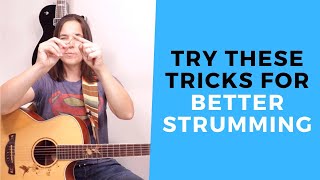
A guitar lesson video by Lauren Bateman focused on improving strumming dynamics to make acoustic strumming sound less harsh and more musical. Key advice includes loosening the pick grip, using a thinner/flexible pick, angling the pick to ‘glide’ across strings, practicing soft-versus-loud strums, and selectively striking subsets of strings (e.g., fewer strings on up-strums) to shape tone and dynamics.
Chapters
Hey, guitar enthusiasts, welcome back. Lauren Bateman. Here in this lesson video, we're going to talk about dynamics in playing. If you ever feel like you're watching someone else who's a good guitar player and you're like, why does their guitar sound so much better than mine? It's probably not the guitar. It might be something else. And I'm going to tell you about it in this lesson video.
So oftentimes I get questions from students. Lauren, why does your guitar sound so much better than mine? Is it because your guitar is more expensive? And yes, while this guitar is probably a lot more expensive than most of my beginner guitar students, it's not necessarily the guitar. A good guitar player can make any guitar sound good. Now, the tricky part for beginners is they have a very hard time getting the guitar to sing, even if you're playing your chords correctly. So if you're playing your chords and you're not getting any muted strings, sometimes students are just like, I feel like I have one level and that's it. So they strum. And their strum, no matter how hard they try, sounds like this.
Which is pretty horrible, even when the chord's good. I mean, I didn't have any muted strings, but the strumming sounded a little bit, shall we say, harsh. So something I work with with my students, to start doing that one, I might suggest using a little bit of a thin, thinner pick. So this is a pretty thick pick. It's not very flexible. And in the beginning, your wrist is usually very, very tight. All right? Very tight. So much so that there's not much flexibility when you, when you're strumming, your wrist acts like a whip. And that's how you get speed with your guitar, is this. This hand just is basically super, super relaxed. And when you're a beginner, you tend to strum like this. Very, very robotic and very mechanical. And eventually, over time, as you relax these muscles, that will get better and better. But I try working on this with students. First, we'll probably go to a light pick or even a little bit lighter than this medium level pick. We'll work on playing soft versus hard because, you know, doing this.
Sounds okay, but if you can do, you know.
So what am I doing there? Obviously, I've been playing for a while. My strumming is very fluid. But there's a few things I'm doing, and I'm going to talk about that right now. So one of those is the difference between soft and loud. And I'll do this exercise with my Students where we play really loud. And then I said, try and play as soft as you can. As soft as you can get your strum. All right? You'll have to relax the grip on your pick a little bit, because if you keep a tight grip, you're going to have it. It's going to sound harsh. A lot of that harshness comes from having a really, really tight grip on the pick. So loosen up the pick. All right? The pick should be flexing like this. It should be going up and down, depending on which way you're strumming. So when you're strumming down, the pick should be angled. I mean, this is extreme. But the pick should be angled like this. And when you're strumming up, the pick should be angled like that. So your pick pick is matching the way you're strumming. The pick should not remain flat like this. And that's where a lot of that harshness comes is because you're kind of slapping through the strings as opposed to gliding over the strings. So we want to work on gliding. So you see my wrist? It's kind of like doing that queen wave. It's doing this. It's going up and down. Hey, everybody, if you're really enjoying this video, make sure to subscribe to the channel. This way, you'll know when I release videos just like this one. Also, if you have a question for me about learning the guitar, put it in the comments below, and I'll try to make a video to answer your question. So let's get back into the lesson video. So we're working on that. By playing as soft as you can, you're going to have to loosen up your grip on the pick a little bit.
And then go hard.
All right, we don't have to go super fast. The goal of this is not to go fast, is to go slow. So soft. Okay, let's go to a medium.
And now loud.
And you'll probably notice when you go to loud, you have to grab the pick a little bit more because we don't want it falling out of our hands. So let's do that again. We're gonna soft.
Soft as you can get it. Okay, a little bit louder.
Okay, a little bit louder.
But you can hear even when I'm loud.
It doesn't sound like that because I'm letting the pick glide over the strings.
So it's all about learning how to get that pick to glide. So there was something else I was doing in that intro as well. So let's talk about that Next. All right, so something else I was doing in that intro was. Wasn't always playing the full chord. So people ask me this question a lot. They're like, hey, you know when you're doing your up strums, it doesn't sound like you're. You're hitting all the strings. Are you getting all the strings? And. And the answer is no. Usually on the down strum we're getting all six strings. But on the up strum, I'm usually maybe only getting the bottom three or four. And that's how you can tell the difference between a down strum and an up strum. A down strum has a very bassy sound, while an up strum has much more of a tinn. Because people ask me, and maybe I'll do a video on that about how do I know what rhythm to use or how can I hear the rhythm? And it's because the down strum and the up strum do sound very differently. But until you develop your ear to hear the guitar, you probably won't be able to hear that yet. But what I was doing is sometimes when I was doing a down strums, I was maybe only catching the top two or three strings.
Did you hear that? I did kind of bom bom. And then on that third down, I got the rest of the chord. So the first two strums were kind of the top few strings.
And then on the third one I got the rest of it. So I wasn't just going.
Which would be just three down strums.
Very different. Right?
Something else you notice. I can just stay on the bottom strings.
And I think that's a big difference between a beginner guitar player and a better guitar player is that they're able to pinpoint and use only parts of the chord. So they're just maybe using the bass strings, the thick strings on the top. Or maybe they're just hanging out on the treble notes down here. Alright. And they have dynam. So they can play really soft and then say we're going to go into a chorus. All of a sudden they can get really loud.
And then they come back out.
So dynamics. Think of it as like a conversation. You don't want to be shouting at someone the entire time or you're going to like push them away. And that's what a lot of people's strumming sounds like in the beginning. It sounds like you're yelling at them.
So try this exercise of playing hard and soft. All right, first soft and then loud.
And then try the exercise of playing just parts of the chord. Top, top, bottom, top, top, bottom, top, top, bottom, top, top, bottom, bottom, bottom. Just stay on the bottom and then come back up to the top. So those are just different tips and ideas that you guys can have to make you sound like a better strummer. Especially if you're feeling like you're strumming sounding really, really, really harsh. Hope you guys enjoyed this video. Don't forget to like the video and comment below about how I can help you. YouTube is going to pop up a couple more videos over here. Hope you guys go check that out. Would love to see you in another lesson video.