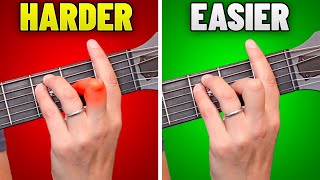
Lauren Bateman shows how to play barre chords without buzzing. Angle your index finger about 45 degrees to use the bony side, position your knuckle past the fretboard to avoid muting strings, and do squeeze-and-release exercises to build strength. A guitar with lower action helps too.
Bar chords are every guitar player's worst enemy. But what I'm going to do in this video is show you some tips I've shown to my guitar students to help them make their bar chords easier to play, buzz free, clean and more consistent.
So this first tip is something I show my students in my step by step power and bar chord course. And it's to help you with those muted strings. All right. It's first trick I'm going to show you to help with muted strings. And it's the angle of our finger is what we're going to be changing. So a lot of students, they can play bar chords cleanly by using the flat side of their finger. But for some students, that's a little bit tricky. Now if we think about a capo, you know, it's that clip that goes over our guitar like this. This is what our first fingers acting like. So we have to have contact and pressure with all of these strings. But the other thing with a capo is there's a hard piece of rubber in the midd. And when you look at your finger, this side tends to be very fleshy. But we do have a bony side of our finger on the side. So what I tell students to do is take your first finger and slightly angle it. So watch on the close up, I'm just going to roll my finger, see how it's flat and then I roll it. It's probably at about a 45 degree angle. But now I'm playing on the bony side of my finger. And if you do this, you will get a little bit of a call time which will make that even better for playing bar chords. But you can see it's just a slight angle. I'm not playing completely flat. For me, it kind of tweaks my wrist a little bit. So I'm just rolling the finger just a little bit, about 45 degree angle. And that's going to help me with squeezing those bottom two strings. So my next tip is also to help you with muted strings. Students oftentimes get their knuckle in the wrong spot. I was just in the UK recently and I did a whole workshop on bar chords with students and I noticed that the majority of students got their knuckle kind of hooked on the bottom two strings. Those are always the hardest two to get. Most students don't have trouble getting the top four. It tends to be these bottom two that don't ring through. So I noticed a lot of students, they were kind of getting their knuckle bent on those bottom Two strings. So this tip is going to help you to ignore that. What most people don't understand is you don't have to just play your bar chords like this. With this first finger, you can actually reach that finger all the way up. Okay. Especially if you're playing six string bar chords. Like I just played an F sharp major bar chord. Okay. If I'm playing that, look how far past the fretboard my finger is. By doing that, I've now moved this knuckle point up. All right? So the knuckle is now not sitting on the E and B strings. And it allows me to get a lot more squeeze and leverage on my fretting hand finger. So you might want to give that a try. If you just want to make a G barre chord here. Okay. It's an F shaped bar chord at the third fret. And you do that, just bring the finger all the way up. And this way you can get a nice good squeeze on those bottom two strings. Strength is definite, definitely a component with learning bar chords. And that's why in my course, I kind of go through a step by step process of first building some strength and then kind of getting comfortable with bar chords and moving them all over the guitar. So speaking of strength issues, here's our tip on how to build strength for your bar chords. Because honestly, that's the majority of the issue with people. They just don't have enough strength and in that squeeze of the index finger. So I always tell students, you know, if you're playing on an acoustic guitar, you can try playing on an electric. Bar chords are always much easier to play on electric because the strings are thinner. You could always put lighter strings on your guitar. But if you're on an acoustic and you don't want to change out your strings, just move your bar chord up to the middle of the guitar. There's way less tension on the strings in the middle of the guitar versus playing that F bar chord. That's why the F is such a pain in the. Most of my students tell me they know why it's called the F chord. So we're going to go in the middle of the guitar and it's much easier to squeeze. And what I tell students to do, we're just going to do bar chord push ups. All right? So you just want to get in a bar chord position, whether it's a six string bar chord or a five string bar chord. And we're just going to squeeze and release. So we're going to strum once and release the Chord. Now, for some of you, it might be sounding like this. And if it does, make sure you're squeezing. You're getting that good squeeze with the bottom of your finger. Reach this finger up and squeeze. Okay. You should hear.
All of the strings ringing through. So it's just basically going.
And as you get stronger, just move the bar further up the neck.
Until you can play all the way up to the first fret. Now this tip is an interesting one that I actually didn't come up with. One of my students told me about it and I was like, you know what, I probably inadvertently didn't know that I was doing this. Now, you can always get a little extra leverage and help from your guitar. So most of us, we have our strumming hand sitting on this top part of our acoustic, right? So you can see if I do this with my strumming hand, I can push the guitar neck forward. So if you need a little assistance in the strength department when you make your bark chords, you can kind of lean in with the acoustic. Now, for me, I find it a little bit tricky, especially if I'm doing a lot of strumming. But for some people, that's the little change that is going to make the difference. And that's why I want to let you know about it here. And a huge tip. And I think this happens to a lot of guitar players, especially beginner guitar players. The guitar makes a big difference. You guys see here, I've got my Taylor guitar. You also know I have my crafter. My tailor is definitely set up a lot easier to play than my crafter. Listen, if you're starting on a cheap acoustic guitar, it's going to be very hard to play even open chords, never mind bar chords. So, tips. Try to get a guitar that's in the three to five hundred dollar range. It'll make playing everything on your guitar easier. And second, go to a guitar store and get your guitar set up. The closer your strings are to the fretboard, the less distance you have to cover or the less strength you will need to get those strings towards the fretboard. Now, if you found these bar chord tips super helpful, then I highly recommend you scroll down to the link in the description below and check out my stick. Step by step power and bar chord course. I'm going to show you step by step how to build strength in your hand. Get more comfortable playing bar chords so that you can play them cleanly and consistently. Not only that, I'm going to show you how you can move the bar chords all over the neck of the guitar. No longer will you be stuck playing just in these first three frets of the guitar, you'll be able to utilize your entire fretboard. So scroll down to the link in the description below and go check out my power and bar chord course.