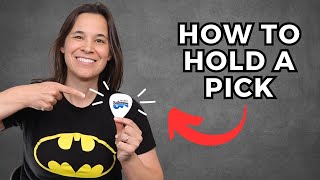
Lauren Bateman’s YouTube tutorial explains how to hold a guitar pick for beginners and surveys recommended pick types. She compares thin beginner picks (0.50–0.60 mm) with medium picks (examples: 0.73 mm and 0.88 mm Dunlop Tortex), mentions Dunlop Max Grip picks for slippery fingertips and spring-loaded Black Mountain picks for people with thumb arthritis, and demonstrates thumb placement (thumb flat, across the fat part of the pick) and finger grips for strumming vs. lead playing. The clip ends by directing learners to play “Ode to Joy.”
Questions this video answers
0.50–0.60 millimeters
0.73 mm and 0.88 mm (Dunlop Tortex)
Dunlop Max Grip picks
Spring-loaded Black Mountain picks
"Ode to Joy"
Chapters
Now before we go and learn a song, I forgot one important thing and that's how to hold your pick. Alright, we're going to need this to play our first song on the guitar. And you'll see a pick is very triangular in shape and there's a few different ways you can hold your pick. Alright, Is there a right or wrong way? I don't know. I've held my guitar pick wrong for a number of years because I was mostly self taught on the guitar. But. But I am a very good guitar player so sometimes even when you do things the wrong way, it can still come out. All right, so I'm going to show you some of the preferred ways to hold a guitar pick. But before I do that, I just want to go over a few different options for you. So this pick in my hand right here is what I call a medium pick. Alright. It's in the middle of being too thin, too thick. Now for beginner guitar players, I usually recommend something like this, which is 0.50 or 0.60 millimeters. They're very thin. Okay. Very flexible, very bendable picks. And the reason I recommend this for beginners is when we get into strumming, your hand is usually so stiff that the flexibility of the pick takes a little bit of the curse off your strumming. Eventually you'll want to graduate to something that's maybe more of a medium pick. These are the two I like to use. 0.73 and 0.88 millimeters. All right, these are the Dunlop Tortex picks. That's just what I like to use. Now if you're someone who has trouble holding on to the pick, I learned recently from a student in my private community, my seven level guitar system, that as you get older your fingers, you lose some of the texture on your fingers. So it makes it easier to drop the pick. And I didn't know that. That was a very interesting thing that I learned recently. So these are great picks. Picks. These are called the Dunlop Max Grip picks, all right. And they have a little bit of like cardboard to them, a little bit of sandpaper, really, really hard to pull them out of your hand. So if you're someone who has really, really smooth fingertips and you're finding you're just dropping the pick all over the place, these Max Grip picks are really, really good. And then finally, if you're someone that suffers from arthritis, I have a lot of students who have arthritis, particularly in their thumb, which makes it hard to hold on to a pick you can always use These spring loaded black mountain picks, you just put your thumb right into it. And guess what? You don't have to learn how to hold a pick because the pick holds it in place for you. But I would recommend learning how to hold a pick properly because you know, for these, sometimes my students have to file them to get the right angle. They are a little bit different, they have a different feel. So I recommend going through the rest of this video to really learn how to hold your pick properly. Alright, so as I showed you earlier, the pick, it's a teardrop shape, all right? Meaning there's a wide end at the top, but there is a pointy end at the bottom. Now this pointy end goes into the guitar, okay? Into your body. And what we're going to do is, you guessed it, the wide point is where we're going to place our thumb. Now the best way to do this and this is really tried and true. I think across any method of how you hold your guitar pick is we're going to put our thumb right across perpendicular to the pick, all right? And we don't want to be at the edge of the pick. We want to be really right across that flat part. You ever hear like, you know, if you're a baseball player, they say choke up on the bat, you know, choke up on the bat. We want to choke up on the pick. We don't want, we don't want a ton of guitar pick hanging out. The pick's going to be flimsy and that's another reason that it could fall out of your hand. I kind of want to go right through the fat part and you can see I don't have a lot sticking out of the bottom. So this right here is one way to hold your pick. You can put your thumb flat across and, and just grab it loosely with your first finger. All right? Another method is to put your thumb flat and curl the first finger around so almost that your knuckle points down the pick. I like doing this more for lead guitar playing. I don't particularly like that for strumming. I did have a classical guitar teacher who really tried to get me to do this for strumming. For me it wasn't comfortable because had the bad habit of doing this instead. So when I self taught myself to play the guitar, if you guys don't know who I am, Lauren Bateman, you've been watching me through this series and you know, I just help make the guitar make sense. I don't have a degree in music. I'm just like You. I just love playing the guitar and having fun. And when I was a teenager, this is how I held my pick. And if you watch my videos, you will see sometimes I still hold my pick like this because it's just. It's just my habit now. I'm just doing exactly what I did. But instead of the first finger, which is what you should, I'm going to tell you what you should do. Hold it with your first finger. I tend to hold it with my second or my middle finger. And that's how I strum sometimes. Sometimes, depending if I'm doing a lot of strumming, I will hold it with both fingers. So you will typically see me hold my guitar pick like this. And the thumb, no matter which way I do it, the thumb is always flat across the back. And I will hold it either with two fingers, one finger. All right. One of these. It depends on what I'm doing and what my muscle memory is for that day. But those are some of your options for holding the pick. And like I said, you want to have a good grip. All right. We don't want to choke the pick or I'm going to start white knuckling my fingers. We want a loose grip, but firm enough that it is not falling out of your hand. And when you go to fret and pick the guitar, we talked about fretting the guitar. When you go to pick a note, we're just going to hit the string and we're going to go through the string and make a sound. That's it. I'm just putting my first finger on the second fret block. One, two on that bottom high E string. And I'm just picking down third fret.
Fourth fret, and fifth fret. Okay. So I'm making a nice little sound coming through each of those notes. And we are trying to pick it flat. Okay. Right now. We can talk later down the road as you get into other things. If you get into stuff like swee picking, you will be changing the angles of your picks. But for now, flat against the string and just go right through the string. You're not going to break the string unless your strings are very, very old, but you're not going to break the string. You can really just press right through the string. You don't want to press away. A lot of people pick and they pick away from the guitar. Just pick right through the string. Okay.
Okay. So you're just going to pick the notes with the pick. And. And I do prefer a medium pick, but if you are a beginner you can try one of those lighter picks to start, or if you're someone who's dropping your pick a lot, definitely check out the Dunlop Max Grip picks. So now that you know how to hold your guitar, how to tune it, how to hold the pick, now go right over there. We're going to learn a song called Ode to Joy. Very, very simple song that's going to tie together the tab site reading that I taught you on guitar in all of these basic skills to just get you started doing something that sounds like music on your guitar.