In this instructional video, guitarist and teacher Lauren Bateman introduces her "Pivot Point Method," a step‑by‑step approach designed to help beginners—especially older learners—play chord changes more quickly and with less frustration. She likens guitar learning to a karate belt system, arguing that many teachers skip the essential "white‑belt" fundamentals, which leads to higher dropout rates among students over 50. The method focuses on identifying "pivot points" where a single finger is shared between two chords, allowing the player to move between chords by lifting or repositioning just one finger. Bateman demonstrates this with easy versions of common chords: an E minor shape as the base, an "easy C" (first finger on the B string 1st fret), an "easy G" (G6) by moving the second finger, an A minor variation, and an "easy D" (Dsus2) using a two‑finger shape. She explains the ergonomic benefits of playing near the front of the fret, reducing pressure, and minimizing the cognitive bandwidth required to remember multiple finger placements. By mastering four core chords—G, E minor, C, and D (or Dsus2)—students can play thousands of songs, as she illustrates with a simple progression. Throughout, she emphasizes incremental learning, muscle memory, and the psychological advantage of small, achievable steps, and she directs viewers to a free guitar crash course on her website for further practice.
Chapters
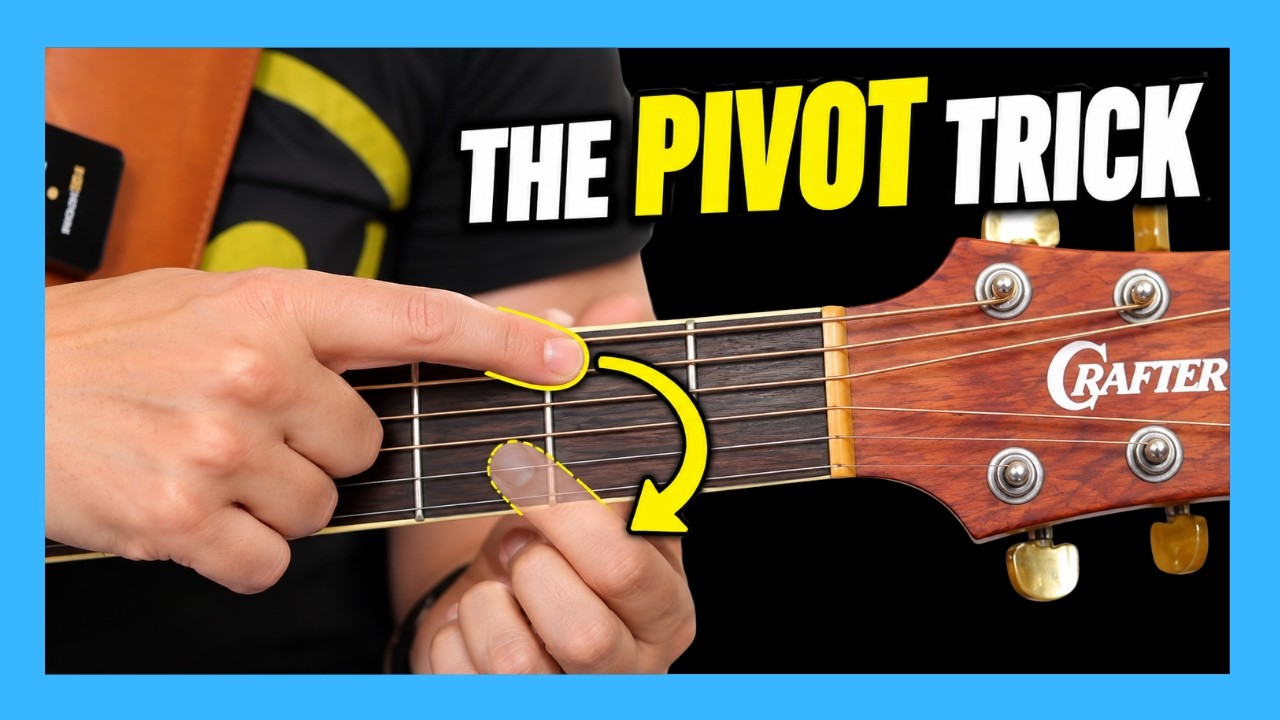
Hey guitar enthusiasts, Lauren Bateman here, and I'm gonna teach you about my Pivot Point Method to help you play your chords faster. I've taught over 10,000 students in my 7-level guitar system now, and they say that this really has helped them with getting started with the guitar and feeling like they can play music a lot faster. See, the thing is, a lot of teachers— and it's not their fault— they start students just a little too far down the path. So I always compare it to like the level system in karate. So you start at a white belt and yellow belt, orange belt. Well, I feel like a lot of teachers start guitar students— and I did this myself when I first started teaching— we start them at the yellow belt and we skip over the white belt level. And there was something I noticed, particularly with my older students, my students over the age of 50, is that when I skipped over the white belt techniques, it was more frustrating for them and they were more likely to give up. So what I did was I added in these little Kind of stepping stones to help them get to the yellow belt, and that's what I'm gonna teach you in this video. So what do I mean by a pivot point? Okay, so the pivot point is, is places in guitar chords where, where fingers are shared. Let's start off with a very simple example. I'm gonna use an E minor chord and my easy C chord. So in my 7-Level Guitar System, I teach people Easy chords. Okay, we will graduate to the full chords. So before you yell at me and say, Lauren, that's not the way you play a C chord, it is a C chord. It's just an easier version of the C chord. So when I play an E minor chord, I usually teach students to play with your first finger on the second fret. So these blocks are called frets. Okay, in your strings, you have your sixth, fifth, fourth, third, second, first. Okay, the low string I say is the first string. 6th string on the bottom. Okay, so I'm gonna put my 1st finger on the 5th string at the 2nd fret. Okay, it's just a coordinate system. And then I'm gonna put my 2nd finger right below it on the 2nd fret of the D string. Okay, this gives us an E minor chord, and we can strum all 6 strings. Beautiful sounding chord. Now for me to get to a C chord, all I have to do is pivot my 1st finger down to the 1st fret on the B string. Okay, so instead of me having to put 3— get 3 fingers down. The other thing with the full C chord that's really, really tough for beginners, they don't have the stretch yet to play this chord. This is a 3-fret stretch, and if you notice, these frets down here are much wider than the frets down there. So I have a lot of students, they're trying to play a C chord and it sounds like this because they can't get this finger to play in the right spot, so it's always muted. Mm-hmm. Okay, 'cause really when you play chords, you wanna try and play with your finger to the front of the fret because you require less pressure at the front of the fret to make a— I'm using the same amount of pressure. Mm-hmm. Okay? So you need less pressure at the front of the fret to get a note to play. So what we do is we just start by, hey, let's just get the fingers moving, 'cause it's really hard to move 1 or 2 fingers on guitar, never mind 3 or 4. If you've never played guitar before, it can be hard to move 1 finger, and I think a lot of teachers forget that, like how hard it is just get started with the guitar. It is not an easy instrument, but it's a lot of fun, so do not let that deter you. So we're back to our E minor chord, okay? First finger, second finger in place. Now we're gonna lift up our first finger and just pivot into our easy C. Now we're just gonna strum the bottom 4 strings, okay? It's not gonna sound as nice and full as the full C chord, but it's gonna allow you to switch between an E minor and a C chord by just Moving one finger. Okay, so much easier for a lot of students. And they're like, okay, I can do that, I can do that, that's not a problem. All right, so that's pivot point 1, is moving from an E minor chord to a C chord. Okay, pivot point 1. Pivot point 2 is I teach you an easy G chord. From this E minor chord, all we're gonna do is lift our 2nd finger up to the 3rd fret on that top string. Okay. Now this is called a G6 chord. Tech is the technical name. It is still a G chord. Okay, again, does it sound as warm and beautiful as the full G chord? No, but guess what? You can do this and you're playing a G chord. Guess what? By just moving fingers, we can go between a C chord, E minor, and a G chord just by moving one finger at a time. Okay. Because when you're learning chords, not only are you learning the mechanics of where to put your fingers, you're learning the chord. Okay? So you have to remember, where do my fingers go? You have to remember that your 1st finger goes on the 5th fret at the 2nd— or sorry, the 5th string at the 2nd fret. See, I can't even say it right. You have to remember that your 2nd finger is going to be going on the 4th string at the 2nd fret. Okay? And then you have to remember, wait, where was that new chord? And maybe you got to go check with your chord chart. Okay? So there's a lot of information, and if we can reduce the amount of bandwidth your brain needs, you can learn faster. Okay, so just by moving one finger, we're reducing the bandwidth, and your brain's like, cool, this is a C chord and this is a G chord. Okay, and this isn't a bad habit because all we're going to do is we're just going to— the fingers are going to go in the same spot, we're just adding. Okay, so when you learn the full C chord, you're going to add your 3rd finger, and when you learn the full G chord, you're also going to add your 3rd finger or your pinky, whichever is more comfortable. So it's not like you're creating a bad habit, but it's getting you moving. Okay, so those are, those are some pivot points. We have E minor to C, easy C. E minor to easy G. Okay, now another cool little pivot point. If you play E minor, you can play a chord called A minor, which is the 2nd finger doesn't move, the 3rd finger comes right below it on the G string on the 2nd fret, and then you put your 1st finger Back where that easy C chord was. Okay, so if you want to go from A minor to easy C chord, you just lift up your 3rd finger, put it down, lift it up, put it down. So we've got C, A minor, E minor, E minor, A minor, C, or E minor, C, A minor. Okay, it's easier for you to learn the chords this way because you're, you're learning it from positions that are familiar. Okay, so if you know an easy C chord, it's very easy to just add one more finger below where you're already playing, right? Okay, so, so work from where you know things first. Okay, so we have E minor to C, E minor to G, E minor to A minor. We have C to A minor, not really pivoting, but all we're doing is lifting a finger up and putting it down. And then if you really want to fill things in to be able to play songs you're gonna need a chord called a D chord. All right, so if you learn 4 chords— these are the 4 chords I teach in my free guitar crash course, okay? You can get that over on my website if you're interested— is the G chord, the E minor chord, the C chord, and the D chord. And the reason I teach those 4 chords first, and the easy versions, because it allows you to play thousands of songs. You literally can play thousands of songs with those 4 chords. Trust me, I've done it. I've changed songs for students using just those 4 chords. We can do a lot with just 4 chords. So you're gonna need a D chord. All right, now there is no fun way to pivot into a D chord from what we've learned so far. So what I recommend, start where you know. A lot of people know that E minor chord, and we're just gonna lift up our 2nd finger, move it down 1, 2 frets. Okay, and then we're gonna put our 3rd finger on the B string at the 3rd fret. Okay, so there is no pivot into this chord, unfortunately. But this is called a Dsus2 chord. It is a beautiful sounding D chord. Okay, call it the easy D because it only requires 2 fingers. Okay, so we have E minor to C, there's a pivot. E minor to G, there's a pivot. Okay, then we have E minor to C to A minor. Okay, not really a pivot, but we're just adding to something we already know. Okay, and then to get to our D chord E minor. Lift up the second finger, move 2 fingers down. Third finger goes on the third fret of that B string, and you've got a beautiful sounding D chord. So you could play something like— okay, so that chord progression could be something like Earth Angel, Earth Angel. So see, with just 4 simple chords, look at that, we just, we just played a song. Isn't that great? And that G, E minor, C, D, those chords show up in so many songs. All right, and just to show you, I want you to go watch this video over here where I'm going to show you how easy it is to play music with just those 4 chords.