How to Play Guitar WITHOUT a Pick for Beginners - 5 Techniques That Will Make You Sound GOOD
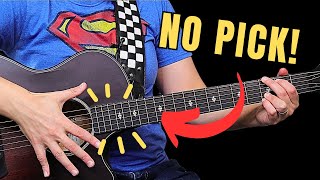
A beginner-focused guitar tutorial by Lauren Bateman explaining five finger-based strumming techniques as alternatives to using a pick. The instructor compares tonal differences between fingers and picks, demonstrates thumb-only, fingers-only, thumb+finger, bass-pluck, and percussive/tap methods, and gives practical tips on hand position, wrist relaxation, and when to persist with a pick.
Chapters
Have you tried strumming with your fingers? And you're wondering if you're doing it right. There are several reasons why you might want to use your fingers. For example, maybe you're traveling on vacation, or you go over a friend's house and they have a guitar and you don't have a pick on you. This happened to me in Portugal one time. We were at a restaurant. There was a guitar in there. Everyone's like, lauren, play a song on the guitar. I didn't have a pick on me, so I needed to use my fingers instead. Now, many people prefer using their fingers because they prefer the sound they get out of the guitar, which is a little bit warmer, versus using a pick, which can be a little bit brighter. Let me show you. I'm going to play a little G chord here. And this is the tone you're going to get out of strumming with your fingers.
It's very warm. It's a very round tone. It's got a lot of balance to it. Now, here's what it's going to sound like with a pick.
So, same strumming pattern, but you can hear there's a bit more brightness to it. And you can also, if you listen hard enough, you're gonna hear the noise of the pick. And some people don't like that. It doesn't particularly bother me too much. But some people don't like hearing the pick. They just want the warmth of their fingers. So. So in this video, I'm going to show you some tried and true methods for strumming and playing the guitar with your fingers. But I don't want you to make a big mistake that I see a lot of beginner guitar students making.
Now, when my students ask me this question about how to play the guitar with their fingers, it's usually because they find it easier than using a pick. For many guitar students, especially beginners, using that pick can be very difficult. Maybe it spins in your hand, it falls on the floor, and with your fingers, it's a lot more tactile. You can feel the strings. And sometimes when students are doing picking, they find it hard to find the strings. They're like, you know what? I'm just going to give up on this pick thing. I'm going to use my fingers. And while I'm going to show you how to play with your fingers, in this video, I want to emphasize, do not give up on the guitar pick if it's a little bit challenging, not maybe switch over to a thinner pick. I find a lot of students they start by using a pick that's too thick. Go for a very thin pick, 0.4, 3 millimeters, 0.5 millimeters, and stick with it. Because I use my pick a lot more, especially for strumming, because you can get a lot more out of the guitar than I do with my hands. If I'm finger picking, I'm always using my fingers. But very rarely do I strum with my fingers, because you'll have a lot more songs available to you with the pick. So don't give up on the pick. But right now, we're going to jump into some different strumming techniques you can use with your fingers. So technique number one is just going to be using our thumb. Okay. And we want to use the fleshy part of our thumb. We could use the nail, and it's going to give us a slightly brighter tone, like the pickwood. I don't particularly like playing with my nails. It feels a little weird to me. But you want to use this fleshy part of the thumb. And I have my nails cut back really short. But sometimes, if you have a longer nail, you might want to be careful, especially on this bottom string, that you don't catch the nail on the string. That's important. So all I want you to do. Let's go back to a G chord or actually an E minor. E minor tends to be an easy chord for a lot of students. And all I want you to do is do down, then up with your thumb. Okay. And you can see my hand is kind of in a fist over here. It's a loose fist. I'm not gripping as tight as possible. It's a loose fist. And I almost am holding my second finger against my thumb like I'm holding a pick. Okay. And I'm just using the fleshy part of my thumb to go up and down over the strings. Okay. So that is one way to go about strumming the guitar. On the opposite end, you could use just your fingers. All right. So some people like to use just their thumb. Some people like to use.
Just their fingers. Now, what's happening is on the up strum, you can see I'm using multiple fingers. I'm not just using one finger, kind of more like a. Almost a flamenco style. I'm using all the fingers, and I'm using the nail on the way down, so I get that brighter tone. And then with the up, I'm using the fleshy part of my fingertips. So down is the nail, up is the fleshy part.
So it sounds just A little bit different, a little more aggressive than just using your thumb. Right, that's your thumb. Now here's the fingers.
So it really gives you a good accent on that down strum. Now, technique three is what I prefer to do, which is a combination of the thumb and the fingers. But again, I mentioned earlier, I don't particularly like using my nails. I tend to stick with the fleshy part of the finger. So what I do is I use the thumb on a down strum. Again, I'm using this fleshy part of my thumb, and then I'm going to use the fleshy part of my index finger. And why do I do this? Watch.
It's very easy. And I feel like I can go very fast.
By doing that. So I'm going down with the thumb, up with the first finger, down with the thumb, up with the first finger and my hand on all of these. Now, whether you're using a pick or whether you're using your fingers, your wrist is always very loose. Okay. We're not doing this. You know, I'm not going like this with my. With my strumming hand. It's loose. You can see there's a lot of movement. If we take a look at this close up camera, there's a lot of movement in my wrist. There's not so much. A lot of movement in my elbow. There's a little up and down, but. But most of the movement is coming in the wrist. All right? So we want to make sure that when we strum, we're just trying to stay relaxed. All right. And if you're having a tough time doing that, just go very slow and just. You have to train your muscles to relax. And if we go too fast, we tend to tense things up. So keep that in mind when you're practicing these different techniques. So technique number four is going to sound very good. With those old style country songs or those old style folk songs. We're going to be playing a bass note with our thumb and then strumming up with our other fingers. Kind of call this like a bass pluck. If you were finger picking, think of something like yesterday, a song. It works very well on something like that, but we're gonna do it a little bit slower. I'm just gonna play a G chord. So I'm gonna be playing the bass note, which is the lowest note of the chord. Okay. So that's gonna be the sixth string on this G chord. And then I'm just gonna strum up with.
Okay. And if I were going to move this over progression, it would sound like this. So if we're going to go G, C, D, E minor, it would sound like this.
So see, I kind of got this bass treble thing going on with my guitar and it sounds very cool. And it's not really that hard to do, especially if you're using your fingers. If you were using a pick. If I were doing this with a pick, I'd have to really target the bass note.
That might be again difficult for someone if you're a beginner using a pick. But using your fingers, your fingers just kind of hover right over the string. So it makes it really easy to to do this type of technique with your fingers versus a pick. But again, don't give up on the pick, alright? I promise. Now before I show you the fifth and final technique, which is a little bit more late beginner, these ones are all a little bit more on the beginner side. I just want to play through a quick progression using all of these so that you can hear the difference in sound between all these different techniques. So what I'll do is I'm going to go G, E minor, C, D. Just keep a simple progression. Here's technique one. Just the thumb. Here's what it sounds like. One and two and three and four and.
Okay, that's technique one. Here's technique two.
Big difference, huh?
Okay, so you can hear a little bit more bite to it. Here's technique three. This is how I like to do strumming.
Very similar in sound to just the thumb.
I just feel it's easy, easier to control. And now we have the one I just showed you, which is the bass and the pluck.
Feel like that one makes you sound like a real guitar player. It's really cool. So I'm going to show you technique 5 now which is a little bit of a percussive rhythm. So probably not something for beginners, but what we're going to be doing is we're going to be tapping our strings. And you can hear when I do that gives me this percussive drum like sound. So there's a couple ways you can do this. You can just tap the strings which will give you this sound. Or you could karate chop the guitar which gives you a little bit more of like a drum feel. So it'll be like this.
Think of a song like Took a Good Job in the City.
Okay, think of a song. What's that? Proud Mary? I couldn't think of the name of the song. Think of something like that. This is a great rhythm to use over a song like that. So what am I doing? So I'm taking technique three, which is down on the thumb, up with the first finger, and then I'm hitting the guitar, just hitting the guitar. Or you can tap your strings if you don't want to hit your guitar. You're not going to hurt the guitar if you hit it, so don't worry. So it's going to be down with the thumb, up with the first finger, tap the strings. Or if you do like, you can see my hand. It's more almost like I'm doing a karate chop to the guitar. That's my pinky hitting the body of the guitar. And the body of the guitar is hollow, so it makes a nice drum. So here it is.
So it's down, up, hit. Up, down, up hit. Up, down, up, hit.
So this hit is sometimes replacing the down that we would do with our thumb.
So it's down, up hit. Up, down, up hit. Up, down, up hit. Up, down, up, hit.
And if I move it a little bit quicker, it's going to be down, up hit.
Up, down, up hit. Up, down, up, hit.
Very, very cool sound. So if I put this over the progression now, this is what it's going to sound like.
Very, very, very cool sound. So go check out a song like Proud Mary. Actually, I'll put that lesson right up over there. So you guys can go check that out and try this strumming pattern on it.










