Live Q&A with Lauren Bateman
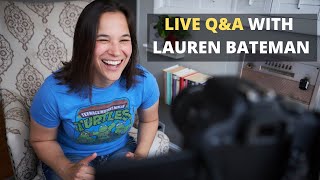
Lauren Bateman answers students' questions about guitar fundamentals. She walks through specific exercises like the spider finger drill and chord push-ups, explains how to build toward barre chords, and shares her seven-level course structure with play-alongs for practice.
Chapters
Hello, everybody. Pull my microphone over here so I'm just a little bit clearer. Hope everyone is doing well today. Gonna move my laptop out screen. But you see everyone, I know we have a New York here. Sacramento, California. Fantastic. What else we have here? Where? Put in where you're from in the chat so I can see where everyone's calling, calling in from today. Back it up a little bit here. Tampa, Florida. Springfield, Mass. So we have a Mass person. I was out in Western Mass earlier this week before the hurricane came through. I was supposed to see a Brandy Carlisle concert, but unfortunately it got canceled because of. Because of the. Well, not because of the impending weather because Brandy actually got sick and wasn't able to do the show. New Jersey. Fort Myers, Florida. India. Nama is from India. I want. I want your guitar. Liveson says I want your guitar. Well, I got a couple guitars back here today. I'll put on my acoustic and I will play the tuning song for you guys because. Oh, actually sounds pretty good. I did put my air conditioner on to kind of cool things off here. It's a little humid in the Boston area today, so I do have my camera in front of me and my laptop is off to the side. So I'll be going back and forth to just check in and say hello to everyone. So we have Luxembourg, Amsterdam, Tom Morton, Leighton, Buzzard, England. Awesome. Yeah, I know it's the afternoon so a lot of my UK people can be on. Clarksville, Arkansas. Awesome. Belgium. That's awesome. Well, I'm so glad and so happy that you guys can make it. So nice to connect to everyone. I'm going to move my water glass out of the way and I'm going to move this over here so you guys can actually see my guitar and my strumming. But I do want the microphone there so you guys can hear me and what I'm going to say today. So I will take some Q and A over here. I see other people. Manchester, uk. Trevor, Australia. So nice seeing everyone. I wanted to start off today because, you know, I get a lot of questions from students. You know, I get comments on the videos and, and I get emails from the students that are in my guitar course. All right, so if you're interested in the guitar course, it's laurenbatemanguitar.com backslash course. That is the seven level guitar course. And you know, people will get into playing the guitar and if you're on here learning for free on YouTube, that's fine too. But the biggest question I get asked by students is you Know, why do my chords sound like crap? When am I going to start sounding good on the guitar? Right? We all have that thing like we're playing along or strumming along. It just doesn't quite sound the way you want it to yet. I want to make sure everyone has the right expectations when they're learning guitar, because this is not. Oh, thank you. Someone did a little chat donation, T. Thank you so much. T comments on a lot of my, my, my videos and posts. So thank you for the five dollar contribution, T. I appreciate that. So as I was saying, everyone has like these big, grand expectations. You know, we're going to be Eric Clapton or we're going to be, you know, whoever our guitar player is. And that's totally possible. It just takes time to get there. And I always let students know, you know, when you're watching me because people like, wow, you just look like it's so easy for you to do what you're doing. And I always tell people, you know, I'm on. You know, I'm 38 years old, so I just told you all my age. If you didn't know how old I was. I've been playing the guitar since I was 16. Ten of those years, I was teaching myself, much like you guys. And YouTube didn't exist at the time. Ultimate Guitar did. So I was just kind of going on ultimate Guitar, you know, trying to learn tabs. I had a VHS tape. I don't even know who the guitar teacher was. And they taught me chords and I had a Hal Leonard book. I am on chapter 22 of my guitar journey, and a lot of you guys are on chapter one. But you're watching people like me. Or maybe you're seeing someone else who's been playing guitar for a little bit. This happens a lot in the private Facebook group with, with my students. They'll see a student who's been doing my courses for one or two years and they're like, wow, you're great. I feel like I'm horrible. And I just want to remind everyone you are exactly where you need to be for where you are in your chapter of the book. Now, in the beginning, a lot of times with cords, the reason it doesn't sound good because you haven't developed your calluses yet. And the other reason is the angle of the fingers. So I just want you guys to accept a little bit. We'll talk a little bit about that stuff today, but I want you to accept a little bit that you're not going to be perfect or sound Perfect. In the beginning, I always focus on students. Hey, let's work on the fundamentals. Let's get the strumming. Let's get the chords, all right? And let's get some of these dexterity exercises in to get your fingers moving. And let's just have fun with it, okay? Down the road, perfection will come. I'm still not perfect. If you guys have watched any of my videos, you will see I make mistakes. I leave those mistakes and intentionally so you can see I'm human. I am not perfect. I drop my picks on the ground, okay? 20 years later, I'm still dropping pics on the ground. So if you think that you're dropping the pick on the ground, it's just going to happen for the rest of your life. Accept it. So. So I just wanted to let you guys know, want to level with you a little bit that you know you will get to where you want to be. It's just going to take time and that's going to be different for every single student. Just so you know, I just got a guitar, but I'm struggling with the size of my fingers and hands. Yeah, Wayne, you know, I get a lot of people who say that. And it was funny in the guitar group. We all, everyone got a ruler and we measured our middle fingers. So I know I have about a 3 inch middle finger. So if you measure from like the inside webbing of the finger to the tip of my finger and it's three inches, I don't think I have really big hands. I'm just under 5 5. So I am a smaller person. The biggest thing that you can do with small hands, if you truly have small hands, there are some people who do have hands that are smaller than mine. You may want to get a three quarter size guitar where the sizing is a little bit smaller. But I have found that 80 to 90% of people can get away with a regular size guitar. Now what I would focus on, let's focus on a finger dexterity exercise. So you guys may know, you can go to my YouTube channel. There is a finger dexterity playlist. Okay. And one of the first exercises in that playlist is just a very simple little spider exercise where we start on the fifth fret with the first finger, the sixth fret with the second finger, and the third fret with the. Or, sorry. I fifth fret, sixth fret, seventh fret. Fingers, 1, 2, 3. I got the finger numbers and the fret numbers mixed up. See, I make mistakes all the time. And this little exercise, I tell you to work down the guitar. And we're not worrying about the pinky yet, because the pinky is it. When we're doing chords in the beginning, if you're doing my easy two finger chords or you're doing the full chords, a lot of times we're just using these first three fingers. So I want you to start building the flexibility and dexterity in those first three fingers, okay? And my camera might move because my dog is walking around by the camera. Now, eventually, what's going to happen is you can see these frets down here are wider than the frets up here, right? So if you feel like 5, 6, and 7 is too much of a stretch, try 7, 8, 9. Now, if you're not feeling a stretch, move it down 3, 4, 5, or eventually 1, 2, 3.
All right. And this is a great place to be because when you're just getting started with guitar, a lot of your chords are being played in this open, what we call open position because there's a lot of open strings you're playing in those first three frets. Okay? One. So if you start stretching, this spider exercise, I mean, even me, I've been playing for a while and I still feel this is a little bit of a stretch. Like I said, I don't have the biggest fingers, but this will start helping you stretch out and making that more comfortable. Usually, usually the biggest issue for people is the C chord. It's usually the C chord. And it's this third finger, which is usually the finger that gives you everyone a pain. Why? Because, you know, a D chord, two frets, a G chord, two frets. All right? E minor. Whether you do it with the first and second fingers, the second and third one fret, C chord, three frets. Okay? One, two, three. You gotta spread. And my dog found the one toy that still squeaks. Olive, come here. Let me get that away from her. Be right back.
She found the one ball that still squeaks. And I don't want that squeaking in the background for you guys. So the three frets on the C chord is the hardest part. Okay? And that's why I say bring that spider exercise down to the first three frets.
Because you're going to start stretching for that C chord. What happens is this third finger will place these if. Oh, we're trying to stretch that third finger over. You want to get these fingers as close to the front of the frets as possible. So the C chord is one of your issues. That's what I would focus on. Bringing that spider exercise down to the first three frets. All right. If you want to go learn that spider exercise, it's the finger dexterity exercise series. It's a playlist on my home channel. So you can go check that out. If you're looking for that pentatonic, just memorize the patterns. One, three, one, four. Yep. Yeah, everything. That's another way you can work on it. You could definitely go through and practice your pentatonic skills as well. My problem with C is getting all the fingers down at the same time. I go from top to bottom, but doesn't sound good. Yeah, Paul, that is a very, very, very common issue. What I would recommend is building the C chord in two different ways because we're always trying to build muscle memory, right? So muscle memory in our fingers. So when I start students off learning a C chord, we usually start with the first and second fingers. We add the third finger later. So everyone gets used to building the C chord with 1 and 2. And usually people can put down these two fingers at the same time. Not a problem at all. It's adding that third finger. When you go to a three fingered C chord, I recommend putting the third finger down first and building your chord this way. So instead of building it 1, 2, 3. Build it 3, 2, 1. I mean, build it both ways. Because you want to build the muscle memory both ways, but something you can start doing. Because I know a lot of people, they're like, I can't put my hand down and come like, I can make a C chord in the air. Okay. That's how much muscle memory I have. I can just form chord shapes in the air and I know what they are. I could do a D chord. My hand just knows what to do. But in the beginning, when you haven't fully developed that muscle memory yet, it can be tricky. So what I tell people to do is make your C chord or whatever chord you're trying to make, make that chord on the guitar and lift it off the guitar just like an eighth of an inch. Or if you're, you're, you're in metric system, just do it like half a centimeter or something off the guitar. A few millimeters off the guitar and lift and put your fingers down. Watch my fingers. See how they're lifting? I'm not taking the, the hand fully away from the guitar. I'm lifting and putting that. This is a great way to start. You're training your fingers because what's going to happen if you, if you don't have the muscle memory built in yet when you Lift your fingers. Your fingers are going to maybe flatten out a little bit. So we want to train the fingers to maintain this shape for the C chord. Same with the G chord. All right. If you do it with the pinky or the third finger, it doesn't matter to me. Practice your muscle memory for the way you're making the chord. Okay. I'm just lifting. They're little chord push ups. Okay. I call them little cord push ups. And then eventually, what you can do. I'm very good spy, thank you for asking. Then what you can do is you can lift your fingers away from the strings more and more. Okay. So maybe you're not. Maybe you start by just a little bit, and then you move it a little bit more, and then a little bit more, and then you fully move it away. Okay. See what I'm doing here. And then what you do is you drop your hand, you bring it up, make the cord. You drop your hand, you bring it up, make the cord. Okay. I always tell people with chords or whatever, we practice. Our brain is really not good at multitasking. So we need to focus on one thing at a time, Right? So if we're trying to focus on speed and getting those chords faster, we have to focus on speed. And when we work on speed, we lose the clarity, we lose the cleanliness of the chords. They get a little bit messy, but that's okay because you're trying to push yourself. We can then slow things down and go for clarity. And this is kind of one of those clarity exercises. I'm not doing anything with my fretting hand. I'm sorry, My picking hand. The fretting hand is doing a lot of work. You can see it. I'm not doing anything with my pick. I don't even need a pick. Okay. To practice this, this is a good exercise that you could just sit even if you were watching in front of the tv. I never recommend practicing in front of the tv, but if you do practice in front of the tv, this is an exercise you can pract. It doesn't make a lot of noise, and you're working on memorizing your shapes. So that is something you can do to help you with those chords. Get them a little bit faster. And the biggest thing that we work on and someone asks, what's the first bar chord to start with? I'll answer that question in a second. The biggest thing to focus on is chord changes. Focus on doing two chords. So G to C back and forth. You're going to need to do this 10,000 times before it will sound good. Okay? Bruce Lee said, I'm not afraid of the person who knows 10,000 kicks. I'm afraid of the person who has practiced one kick 10,000 times. Okay? 10,000 times back and forth. GNC, I promise if you do this 10,000 times, it will get better. It will sound good. The first few thousand are not going to sound so great. It's just repetition, building that muscle memory. Okay, now in regards to bar chords. Okay. In regards to bar chords, the easiest one or the ones that I usually start my students off with are F sharp minor and B minor. Because F is usually. Because it's the first fret, it's hard for people. And an exercise that I teach in my bar chord course is we start in the middle of the guitar because the strings here are much more flexible in the middle and we will work our way back. So we will take that minor shape.
And we will slide it down the guitar. Okay. Because it's easier to make them sound clean in the middle of the guitar versus at this first fret. F is going to be one of your hardest ones. B major is going to be hard. So I usually start people with B minor and F sharp minor because those two pop up a lot in songs. In terms of a lot of the songs I tend to do with students because of the keys that we're focusing on. So B minor is a good one. I find a lot of students can do B minor pretty well. F sharp minor, usually the bottom strings mute. If you're hearing muting on the bottom probably means you're just not squeezing enough with the bottom part of the finger. That's the part with bar chords. Is there is a strength component to the bar chords. You do have to practice for it. I do bar chord push ups. Okay. Just like we do chord push ups. We do bar chord push ups. We're just trying to build the strength. But that's where I usually start students off. F sharp minor and B minor, because you can also practice going between them. Because since they're both on the second fret.
Makes a good little. A good little practice exercise for you. Memorizing the fretboard. So memorizing the fretboard. I actually, if you're a lifetime member of my course, you get access to the fretboard memorization course. But in terms of memorizing the fretboard, where I. Since we just did bar chords, where I usually start, students is getting into power chords and getting into bar chords, because the name of the chord is usually the Top string. So what do I mean by that? So if I'm playing a major shape, bar chord, six string, bar chord, I know this note is G. This is a G barre chord. Or even if you're playing power chords, this is a G power chord. I know this note here is G. So what I recommend people do is they go back to songs that they've been playing in open position and they try playing them all as bar chord chords or all his power chords. And trust me, when you need to move around.
When you need to find chords as bar chords and power chords, it really helps you start memorizing these top three strings and knowing where things are. So that's usually where I start people, because memorizing the fretboard is a process, and it does take some time and some training. So I try to start it out in a fun way, which is doing it musically. So take some of the songs you've been learning. You know, if you have something like Brown Eyed Girl, you know, G, C, G, D, we'll play it G, C, G, D. Okay. And you'll learn that wherever this first finger is touching, that's the name of the note. If you're playing a G chord, it's the third fret in the top string. If you're playing a G sharp power chord, okay. The G sharp is the fourth fret on that top string. And it just. It's something that becomes, again, kind of like a muscle memory that develops. That's how I recommend people start out with it. And then when you get into, like, you know, doing scales and stuff, you know, there's. There's different octaves that you can play that you'll know there's different ways to memorize. I do a lot of stuff by ear, so if I'm playing a solo, I don't listen or pay attention too much about what my notes are. Obviously, I want to make sure I'm playing the right notes because you have to play the right notes. But I do a lot of stuff by ear because I am a singer too, so I have that slight advantage. Advantage where I sing something in my head and I'm able to play it on the guitar. So I do have a slight advantage on that. But. But give that a try and see if that helps you out a little bit. Let's see.
Yeah. Make a list of what your weaknesses are and work on that. Ah, Destiny. Thank you. The membership is more than worth it. I'm going to back up to see any other questions that we have. Finger push ups. Lauren Talked about is exactly what got me to land the three fingers on the C chord. So see, finger push ups do work. Oh, Lynn, Liv, you were the one who requested to do the Sweet Caroline guitar tutorial. Oh, awesome. Fantastic. Awesome, awesome. Yeah, make sure you guys hit the like button if you're enjoying this. I see I got 45 likes so far. We got 135 people on here from all over the world, Belgium, everywhere. And we were just talking about chords. We're talking about bar chords. And, you know, other questions people ask me is about finger picking. How do I develop my finger picking? And I do have a video that's called. I think it's the two most common finger picking patterns you can, you can search, Just search. Lauren Bateman. Finger picking. It should come up. And the easiest thing to do is just get the fingers moving. You know, for songs like think of a song like Hallelujah.
You can do a lot of stuff with just basic finger picking, but it's just like playing the chords. You have to develop the dexterity in these fingers to be able to do the finger picking patterns. So usually what I recommend people do is just hold your thumb on the top string, then have the bottom three strings be owned by fingers 1, 2 and 3. 1, 2, 3. On strings 3, 2, 1. And just go thumb, 1, 2, 3. I'm just playing a G chord now. In the beginning, this might seem awkward to you, but you just gotta work on getting these fingers to relax. And don't forget to breathe. A lot of people forget to breathe. Even when you're doing your spider exercises, a lot of people will go.
And then they get to the bottom and you take a deep breath. So what happens when you do that? One, you get lightheaded like I just did for holding my breath. But two, you build tension by not breathing. You're actually literally cutting off the oxygen flow to your muscles and you will tense up more. So I always tell students, I know it's hard in the beginning. Breathe, breathe in.
Make sure you are breathing throughout. Even when you're doing your chord changes in the beginning, you will want to hold your breath and that's going to bring tension into your playing. So make sure to breathe. What would be a good BPM goal to shoot with chord changes? Yeah, so in the course in the seven level guitar system, the goal I give people for the like, say the three fingered G, C, D, E minor, Those. Those are the first four chords we start with in the course. Because you can play tons of songs with those. And if you throw A capo on you can play a ton more, but I recommend a good goal, if you can do it is a hundred beats per per minute. Now that's pretty quick. Let me grab my phone. I'm going to grab my metronome just so that you guys can see where that is. Okay. And you can go faster. You're going to need to go faster than that. But I tell people.
Let me just grab my metronome. So this is. Let's try 80 first. So 80 is. Oh, I don't want an eighth note beat. Sorry. So 80 is pretty good. Okay, so you have 82. And you would change the chords on every click. 2, 3, 4, G, C. This also works on your timing. Okay, so that's 80. And for me, that's. That's very comfortable. 100. 1, 2, 3, 4.
Okay. 120. Just so you guys can hear it. 1, 2, 3, 4.
Okay, now, I think it depends on the songs you want to play. Some songs are fast. The more strumming you do. So if you want to get into 8th note strumming, 16th note strumming, your chord changes have got to get faster. And in the beginning, they're going to take their time. But the more you do it again, the muscle memory speed comes from relaxation. So if you are tense, you are not going to go faster. You cannot force your fingers to go faster, but you can relax your fingers to go faster. Which is why I have the finger exercise.
The up and down finger exercise. I bet if you search Lauren Bateman up and down or Lauren Bateman finger dexterity, this is gonna be. It's one of my top videos right now, is this little exercise that teaches you finger independence. Because for most people, and this is again why that C chord is so hard and probably why people have issues changing in and out of a C chord. This third finger is connected to the pinky. You can't bend your pinky without connecting your third finger. If you bend your middle finger, your third finger goes. The tendons are just so interconnected, so it's hard to move this third finger. So that exercise really focuses on getting this third finger to limber up. This is usually the problem where most of your cord changing issues are coming from this finger here, lack of muscle memory, and this third finger being really tight, really tense. So that is a fantastic exercise. If you do that exercise for like a minute, one to two minutes a day, for a week, I guarantee you your cords will be much faster by the following week. Sorry, another question over here. What is a good Exercise to build up speed in my fretting hand. Well, I just showed you. I just showed you one there. That is a good exercise because it's really focusing on the tendons. But again, these spider exercises, everything can be put to a metronome. I love metronomes. You can do it to quarter notes. Okay. Or you can do it to eighth notes. 1 and 2 and 3 and 4 and.
Or you could do it 16. So 1e and a 2e and a 3e and a 4e and a 1e and a 3.
So you can do these things to any. Any speed. Oh, let me just turn that metronome off, and you can push yourself. That's why I love metronome so much. I think a metronome, that's one of the most underrated accessories I have an Android. The. The one I use is metronome beats. Okay. And that's what I use to get chord changes faster. How do you know if you're making progress if you don't have something to gauge against? All right, it's about perspective. If I'm doing my spider exercise and I'm doing it at 100 beats per minute, and then two weeks from now, I'm doing it at 120, it's the visual confirmation that you are making progress. And that's. You know, I think that's the number one reason why people give up on guitar is because they just don't know how to measure if they. They're getting better or not. So they might have a friend say, oh, yeah, you're getting good. And then that, like, makes you feel good. But if you're just playing, you know, if you're just the solo guitar hero playing in your. In your bedroom or your living room, and you're practicing by yourself all the time, it's hard to gauge if you're actually getting better. So I tell all my students, all right. When I used to teach one on one in person, everything was measured in speed. I used to measure how fast people could play songs. Hey, we did the song at, like, 50% speed this week. Next week, let's try and do it at, like, 70%. Oh, congratulations. You did it at 80%. You're right. You did it better than I was hoping. That is. It's just the visual confirmation for you guys. So if you are not keeping a guitar journal, writing down how fast you're going, then I would start doing that today because it's super motivating to see. Last week, I did this at 65. This week I did it at 70. And that might not seem like a big number, but those numbers add up over time. And it's really all about the motivation. And that's what I focus on a lot with my students in the guitar course. It's. It's building the confidence that this is possible because this instrument is not easy. If anyone tells you the guitar is easy to learn, it's not. It's not. No instrument is easy to learn. But it does get easier over time. That much I can confirm. It does get easier. You know the chords. Your fingers won't hurt as much. The chords flow better. Your strumming, your timing, everything. Things gets better. But you cannot become a good guitar player in three months. You can't. It's not going to happen. I mean, unless you're a prodigy. That's the only example. If you were a guitar prodigy, okay, but it's not going to happen in three months. Can I teach you to play songs and feel good about yourself in three months? 100%. I can do that probably in a month. When I worked with students in person, by the end of the first month, we were already playing songs and having fun with the guitar. Or we were doing it very simply, though. Okay? We were the white belt level. We weren't doing the black belt level. We were doing the white belt level. And like I was talking about in the beginning of this Q and A, that's where I want people to focus on, is playing this instrument to the level you are capable of doing it at. Yes. We want to push ourselves. We want to get further and further, but don't forget to appreciate where you are in the process. All right? Guitar is a journey. It's different for everyone. Okay? It might take someone a year, two years, three years. It's your journey. Have fun with it. As long as you're having fun, that's all that matters. I don't care if you don't know what a DSUS4 chord is or a, you know, a sharp, add nine, divide by four, add six, you know, give me. I don't know. You know, that's how I tease, like, the big music theory people. I don't. If you asked me to play like. I know. If you watch, like, sorry, Rick Beato, and he'll be like, just play this chord. And it's like some crazy jazz chord. I don't. I don't know that stuff. All right? I will wholeheartedly admit I am not a jazz guitar player. I've learned some jazz chords. If you asked me to bust out A jazz chord. Right now, I wouldn't even be able to play one. Okay. But I'm happy with that. I'm happy with where I am for what I want to do with the guitar, and that's what I teach my students. Be happy with where you are and what you can do with your instrument. If you want to go further, you take it further. You go to that level. But always be happy about what you're learning and the progress you've made. So I'm getting better as the cat has stopped running away. There you go. Yeah. If your animal will stay in the room with you and not run away, that's a good sign because animals don't lie. That's awesome. My cat won't let me play. I used to have a cat and she'd always sleep in the guitar case. That's my guitar. We're always sleeping. My guitar case. Some of you won't even hit. Oh, the like button. No, that's okay. Yeah. I mean, yeah. Give me a like, guys, if you like the video, give it a thumbs up if you're finding this helpful. You know, I. I love that I went live before and I got to see, you know, some of you guys. How did you learn without a teacher for 10 years? Three DVDs. Yeah. That was a long process. So the first. So my first guitar is over in a case over here somewhere. It was an Ibanez. It was one of those big boat oars. Bigger. The guitar was too big for me, but I learned on it anyway. And it was really, really hard to play. It was at Ibanez, and my sister got it for me as a confirmation present. And it had a VHS and it had a Hal Leonard book. One. Okay. So I started with the Hal Leonard book and I started on piano. And I absolutely hated piano because I hated sight reading. I'm still not very good at sight reading music. Okay. I'm okay at it on the piano. I can read melody decently. I am not a sight reader. I can read rhythm pretty well, though. And I started on Hal Leonard, you know, playing Happy Little Birthday, Mary Had a Little Lamb, G, Cat Strut, you know, whatever the songs they came up with. And I was like, okay, this is cool. I just thought that's how you learn music. Because when I started in piano, I had to sight read. And for me, I hated sight reading. And it bogged me down. And it actually made me hate the instrument. I quit on piano. It was just. I couldn't do it. And then I popped in the VHS and I don't. Like, I said, I don't remember who the guy was. He was like some probably, like, 80s rock guy. He had, like, long blonde hair down to here. And he showed me an A chord and a D chord, and I learned these chords. And I realized that chords created songs. So what did I do there? Like, I said, There was no YouTube at the time. I know a lot of you are older than me, so there wasn't even the Internet. I at least had the Internet. I went on to Ultimate Guitar, and I was like, okay, I got these chords. Let me go look up some of my. My favorite artists and see if I can figure out how to play some of these songs, which I couldn't. I. I mean, I just didn't know enough about the guitar. And, you know, I picked up some tabs. So I learned, like, Nirvana.
I think that was like, the first song I ever learned on the guitar was. Was a Nirvana song. And, you know, I did some, like, Blink182 and Metallica, like, Enter Sam. Lots of, like, little licks. And then I got into the chords and honestly, I just started writing my own music. And that's. I taught myself to play guitar through writing music. It took 10 years. I will preface that. I did it by myself. I took a few guitar lessons when I was 23. I took some guitar lessons for, like, a year, okay, with an acoustic guitar teacher, because I really wanted to learn how to finger pick. And as a songwriter, I did want to learn and understand some things about music theory. So she taught me some songwriting skills. I was already writing my own music. I didn't know any music theory. I just knew what sounded good and what sounded bad, and that's what I went off of. So, yeah, I mostly taught myself how to play guitar based on what I understood from that Hal Leonard book, learning about rhythm and knowing chords. And I did that for 10 years, and by the time I got to college, I've been playing guitar for a long time. And I was like, everyone else is so much better than me. And I've been playing for so long. So that's. That's finally was the breaking point for me. I said, I really want to get to know this instrument. So I decided to take lessons with an. With an actual teacher. And I really. I'm so grateful to her, and you guys should be grateful to her. Her name is Sanya Mack. She's from the Boston area. She taught me what it was to be a good teacher. I know a lot of you guys are like, wow, I love how organized, you know, your courses are. And I love the check sheets and I just love your approach. A lot of that I learned from Sanya, taking lessons with her because I would come in and she'd have a checklist. She had a folder for every student and she had a checklist and she had, you know, songs that would go along with those checklists. And she was super organized. And I said, you know, when I become a guitar teacher, that's the kind of guitar teacher I want to be. I want to be the organized guitar teacher who has everything ready for their students. And I also knew I didn't have a good ear, so I had to be prepared for all my students lessons. So that, that's my spiel on, on how I learned guitar and eventually became a guitar teacher. So for those of you, surprise. I don't have a degree in music. My, my degrees are actually in biology and archaeology. I'm mainly a self taught musician, just like a lot of you guys. So that's, that's kind of cool. That's what we have in common. Really enjoying learning your songs. Thanks, Jerome. I appreciate that. Hey, Richard De Silva. Nice to see you. Not sure I have 10 years left, Brian. You know what, Brian, we're gonna, we're gonna do what we can with as many years as you do have left. I'm a senior citizen learning to play the guitar. I try the chords, but never succeeding. Yeah. So Charles, look up. Search Lauren Bateman. Easiest guitar chords. I have some one finger and two finger chords. If you're starting with the three fingered chords, three finger C, G, D. Okay. If you're starting with those and they're hard, I would recommend taking a step back and building the muscle memory. That's why in my course, you know, people yell at me all the time, like, that's not a G chord. The G chord is this many, you know, this many fingers. And it's like the G chord can be as many fingers as you want it to be or no fingers at all. But that's music theory. So I would go back, instead of playing a C chord like this, two fingered C chords, D chord. We would play a DSUS chord instead of a G chord. We would just play it. So I stick with two finger chords. This way you guys can work on. It's hard moving three fingers at a time if you've never done it before. So start by moving one finger, then add the second, then add the third. So if you're finding you're having trouble with chords and speed, just go, go Search Lauren Bateman Easiest guitar chords and and you'll find some lessons on some easier versions of chords for you to try. And that usually helps people a lot.
Book cd. Go to Lauren's website. Yes, thank you, Heather. Yes. If you're interested, if you're enjoying this, this is a lot of stuff that I actually go over in, in detail in my seven level guitar system. So if you go to lauren batemanguitar.com backslash course laurenbatemanguitar.com backSlash course. If someone wants to type it in the chat, you can do that for me. I appreciate it. I go over all this stuff and the great thing about the course is there's a lot of play alongs. So you can sit. I have videos of me just doing this.
At different speeds and you and I can practice together changing chords. Okay. Or strumming. I have strumming play alongs too where you can just sit and you can sit and strum with me. Because I find at least my experience as a teacher teaching in person, I found that my students sometimes, you know, it was. It's hard to sync up with this metronome. It's hard to link up with that in the beginning, especially if you, if you haven't worked on timing or you've never worked with the metronome before. It's. I always found that when I played with students to the metronome, they were able to go off my timing. They were able to keep time much better when I played with them versus them just going off the metronome. So I made sure to put that in the course. So you guys can, can just play along with the metronome by yourself if you want to or you can play along with the metronome with me in the course in the, in the play alongs. And I think students find that very helpful. I know there's some students here, you know, that are in the chat. So you guys can let them know if you find those, those exercises helpful. There's a lot more stuff in the course that's, that's not on YouTube. Yeah, I've been trying to learn for years, have some knowledge and very little skill, but can't push through to play full songs in time all the way. Would the seven level course help me with that? Yeah, Vic, it would. It would. And why I don't teach courses within, with or sorry songs within the course because it's copy. I can't teach copywritten material. But what I'll do is I have seven levels each. It's, it's broken up into seven sections. And at the end of each section I have a list of recommended songs and I link you over to the YouTube videos that I think are appropriate for you at your level. And that's important because a lot of students. And that's the plus and minus of YouTube. The great thing about YouTube is you and I can do stuff like this. And you know, there's lots of great free information on YouTube. The downside is you go and learn a song and it might not be ready for you at your level and then you get frustrated and you give up. So in the course, I link to the specific videos and say, hey, go check out these songs. These are appropriate for where you're at and you can go and play those songs. So that's, that's how I incorporate the songs in there. But we do a lot of. I do chord progression work in the course. That's a new section that I added this year where we will work through common chord orders for songs. So I will just pull chord orders from songs and we will practice playing through them. So yeah, I will teach you the skills needed to play beginning to end of a song. Because that's what I was in that same thing. I'm like, great. I can play like a little. I can play a little lick of a song or an intro and that was it. I could never play from the beginning to the end. One of the first songs we work on horse with no name.
Two chord song. Okay. Or Eleanor Rigby. Another two chord song.
It's like E minor and C, I think. So that's how we work out the chords in the songs in the chorus. So there you go. Hello. Technical gaming. I see you. I see you. Yes. Hello. Hello. Hello. You caught my attention. Can change basic chords fairly quickly and clean when practicing, but completely sound like a spastic monkey when I attempt to play a song. Yeah, so this happens too. You go to play a song and it falls apart. Okay. And that happens because what you're doing is you're practicing the chords but now you're adding the strumming. And sometimes when you play a song, you might have to simplify the strumming. So let's take an example. One of the first songs I used to teach a lot of beginner students was Brown Eyed Girl. G.
C, G.
D. Alright, so you heard that strumming. That's a little bit more of a late beginner strumming pattern. So what I would do with students is I would just start off. Let's just try counting and switching the chords in time. 1, 2, 3, 4. 1, 2, 3, four. 1, 2, 3, Four. 1, 2, 3,4. Music sounds much better when it's in time and simple than when it's.
You know, with all those pauses. So I tell people, simplify the strumming pattern until your chord changes get quick enough. So then the next progression, I said, that's great. We got the timing down. Let's just do the first half. Let's keep it simple.
That's it. All right. A very simple strive. It sounds good though. I mean, everyone's like, Lauren, when you play, it sounds so great. But that's it. It's just keep it simple, simple and work on those, those chord changes. Don't be afraid to simplify in the beginning, especially because there's, there's so many things. There's so many new neurons you're building. There's so many new mechanics you're learning. Keep it simple. Music will always sound better, simple and in time than fast and choppy. That's what I tell people. We will get to the point where you can play things fast and it will be okay. But in the beginning, keep it simple. Definitely keep it simple. Been trying to learn five or so songs at a time. Is that bad? Well, it depends. It depends. And someone else asked if I use a footstool. If I had lots of students who use footstools. I don't use a footstool. But, but if that, if you like that and find that comfortable, absolutely. It can help get the guitar in a better position too. So learning four or five songs at the same time, I would say it is okay if those four or five songs are teaching you the same skill. So say for. What do I mean by that? So say, for example, you were learning the chords a D and E.
I would teach you four or five songs that only use the chords a D and E. And we would use the same exact strumming pattern for all four or five of those songs. Or maybe we would use two different strumming patterns. But I would again, keep it simple for the skills you are trying to learn. Now, if you're learning five different songs with five different chord progressions with five different, you know, like, it becomes too much for the brain to absorb. Your brain can only absorb so much information. So if you're going to learn four or five songs, try and keep them very similar. Meaning they're using the same chords. Or maybe they're all songs that use like a finger picking pattern. The same finger picking pattern. That's a Great way to do four or five songs. Usually when I would work with students one on one, we would work on one or two songs a week. And we usually wouldn't advance past those songs or start a new song until I felt like they had got what they needed to get out of that song. And it doesn't mean the song has to be perfect. There were times where we would move on. You know, I had a lot of older students, they weren't Kansas fans. They didn't like Dust in the Wind. Okay, but that beginning, that intro has a skill. And I would tell them, listen, I don't care if you hate Dust in the Wind and you don't want to learn this song. All we're going to do is learn the intro and we'll throw the rest of the song out the window. I just want you to appreciate and learn the skill that is being taught, which is a Travis picking pattern with a pinch in it. And that's all I would want them to get out of that song is, can you do the finger picking? Can you play the progression? And this. There's also a little cool thing with Dust in the Wind. We're doing these, like, Pinky and first finger lifts. It's kind of. It's kind of cool. So it's a great song to learn. You know, another one, Stairway. You know, what is Stairway? You know, all of these cool chord things. I had a lot of students, they liked country. They, you know, I had a lot of female students, and they didn't really want to learn Led Zeppelin. But I was like, we're learning the intro to Stairway to Heaven because it teaches you a lot of cool, like, finger picking stuff. So that's. That was me as a teacher is I would force people to learn songs and not necessarily the entire song, but if there was something important that they. A skill they could get from that, that's what I would do. So that was my approach to teaching songs to students one on one in lessons. But great question. Absolutely. Would you happen to have a Les Paul? I do not have a Les Paul. And the reason. I'll tell you the reason why I don't have a Les Paul. So I have my Gretsch. I have my Ibanez, which is. Which is right here. My essay. Okay, so I have my Ibanez. Those are kind of like my main guitars and my crafter here. And the reason. The reason I don't use them is because they're so heavy for me, they're great guitars. Gibson is a great company, but it's the wood. It's too heavy. This is, this, this Gretch is hollow on the inside, so it's very light. And this Ibanez, if you notice, is super skinny. So there's less wood, so it's lighter. The weight of a Les Paul, it kills my shoulder. It really does. So it's just. It's not comfortable for me to play. So you will never see me play a Gibson Les Paul just because it's very, very uncomfortable for me to play. For an extended period of time I've played them, but yeah, my shoulder killed, so. But they're great guitars and if you love them, that's a great thing about guitar is there's so many different options. There's different woods, there's different colors, there's different pickups, you know, different amps. I mean, you can go down a wormhole. And I will be the first to admit I'm not like the tech junkie. I don't know the ins and outs of every single different guitar. But that's what I love about guitar. Because I could love this crafter and someone else might hate it. Okay. And that's perfectly fine because it's a personal preference. Guitar is all personal preference. So. Yeah. Have you ever considered a songwriting session or even co writing with others? Oh, okay. Awesome. And Donald, you start at age 49. I've had people ask me about a songwriting course, so it is on my list of to do projects. I'll probably do like a little mini course on songwriting. I've actually written three full length albums. I have two of them were full length productions that I did in a studio. The third was just like an acoustic session that was very, very informal. And I probably have enough material of my own songs to write another album. I love going into the recording studio and recording. It's probably one of my favorite processes in the songwriting process is watching your songs come to life one layer at a time. I just have been. Been so busy and. That's. Right. Currently not my passion right now. So I'm not. I haven't done a lot of songwriting recently because I've just been enjoying the teaching so much. Honestly. I love you guys. You guys are awesome. And all the support you guys give me with the comments and the likes and the shares. You guys are so awesome. So I've just been really enjoying this. So I'm in this moment right now and, and. And that's what I'm. That's what I'm living. So, yeah, I haven't done a lot of Songwriting probably in the last three or four years, honestly. So.
18 months. I lost you there. 18 months of playing guitar. Started learning guitar by watching your videos. Now I can easily play my favorite song. See Strumming and finger picking. You're welcome, Settix. So happy to help you. Please play. Please play. I mean, I can't play anything that's copywritten.
I mean, yeah, Could I play one of my songs? I probably should have prepared something, huh? I. I honestly, I haven't even played my own songs in a long time. The next time I go live, I will. I will try remember something.
I will. I will play one of my own songs for you guys. Next time I'll do a live and we'll do like a little concert of. Of my stuff. But honestly, I couldn't even play one of my songs off the top of my head. I haven't played them in like five or six years. I haven't performed on stage like that in quite a while. So yeah, all the stuff goes out your head. It's. It's like a language. If you don't use it, you lose it. So I lose all the lyrics and stuff. Oh, you're a really great teacher. Thank you, jc. Really, really appreciate it. Any plans for an ear training course? That's another great one. Yeah. So the things I've been asked for. Ear training course, a blues guitar course, songwriting, so. And some more lead guitar stuff. Because I. I have the. The lead guitar 101 where I teach you kind of like the basics of the pentatonic scale. But I feel like I want to expand that because there's a lot more I have to say about that. But that was just kind of like an introductory course, the lead guitar 101 course. So. Yeah.
Awesome. Excellent. Well, guys, you know what? I am so happy to have had you guys pop in. Glad to do these. These lives every once in a while. It's nice to talk to you guys and hear what you're doing and the progress you're making and keep you guys updated on what I'm doing here. So. So happy to have you. Someone says I'm stuck playing chords. How do I push myself to learn your first song? So, Praveen, what I would do is I would just pick a song. Pick a song and stick with it until you learn it. And you might have to do it in a simplified way. Accept that and that's okay. Nothing wrong with doing things in a simplified way. But pick a song, learn the chords, and keep the strumming simple and just force yourself to play beginning to end. And I think that's what happens is a lot of people, they're like, oh, well, it doesn't really sound like the song. It does. It just doesn't sound exactly the way the artist is playing it. But it's still that song. Yeah, soon I'll play a commercial song.
Yeah, no, I know. I can maybe make a commercial by Lawrence. Course. Commercial. There you go. Commercials. I like that. That was funny. Jack. I have to go. Yes, everyone, thank you so much for popping in. Don't forget to, to like watch like the video if you got some value out of this. And again, I do have the seven level guitar system. Lauren Bateman, guitar.com backslash course. Go check it out. I'm looking forward to seeing you guys. I have an Eric Clapton song coming out on Saturday morning. That's the next lesson. We're going to be learning some Eric Clapton stuff. So I hope you guys check in for that lesson. Don't forget to subscribe to the channel. This way, you know, when I go live again, I will subscribe. See you guys in a lesson video real soon. Have a great day, everyone. Bye. Bye.










