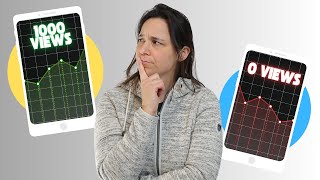
Lauren Bateman explains why superficially similar YouTube videos can have very different view counts. She emphasizes choosing topics with sufficient search demand, treating the audience (not the algorithm) as the primary metric, and analyzing micro-trends in past videos to identify what resonates. She gives concrete advice on crafting titles and thumbnails (high contrast, few words) and recommends aligning content to fulfill the title/thumbnail promise; closes with a CTA to a free YouTube crash course.
Chapters
A question I often get asked is, how come this video only got 100 views when I did the same exact thing as this video that got 2,000 views? And that's the tricky part about YouTube. Sometimes you can follow the same exact algorithm, the same exact formula pattern that you used in another video. And one video can be wildly successful and the other isn't. And there's a few reasons for this that we're going to talk about in this video. The first thing we have to understand is the general concept of the video. Are people actually searching for this topic? You know, I'll go and I'll look on YouTube and I'll say, okay, I'm gonna think about doing something about this topic. Maybe it's how to learn to play guitar. You know, what's the first chords you learn on guitar? And I'll go over to the search and I'll be like, oh, like, these videos have a lot of views. This is great. It means people are searching for this. And if I make a video on this, it's likely that I might get some views because people are actively looking for this versus if, you know, you did a search or you're going to do a topic on, like, you know, underwater basket weaving. I bet there's probably not a lot on YouTube for underwater basket weaving. So the video concept, or the video idea itself has to have enough viewership for you to even have the potential of getting thousands of views. If you're doing a topic that only has hundreds of views, there's no way you're going to get thousands of views or tens of thousands of views, okay? If you go and you find something and it's got 100,000 views, well, there's a chance that you might also get 100,000 views if you do a video that's good enough and it pleases your audience. Which brings me to my next important point. When we are putting content out, our audience is the algorithm, okay? Because everyone's like, well, the YouTube algorithm hates me. This hates me. And if people just saw my videos, they'd really like them. Your audience is the algorithm, and YouTube will tell you if you'll put a video out. And it's like, this video is getting a lot more views because your audience is watching it more. So YouTube's like, ooh, Lauren put out a video. Her audience, like her current subscribers who watch her videos, are loving this. That means this is a good video. We're gonna. We're gonna send it out to more people. We're gonna let more people watch this versus if you put out a video and your own subscribers aren't watching it, YouTube's like, oh, Lauren's audience doesn't like this. So you know what? We're just going to bury this video. And it happens. It happens to me too. You know, I've got over half a million subscribers now, and, you know, sometimes I put out a video. I put out a video last week. There's one that's already got like 45,000 views. And the video I put out the week before maybe only has like 7 or 8,000 views. Okay. Because the other video is hitting with the audience better, and it's also hitting a wider audience, too. That concept that I used was a much broader topic that has a lot more search, a lot more views on it. So it was more likely that that would get more views. So that brings us to an important point of when we're making content, we need to make sure that we're staying in our lane and we're hitting home with our audience. And I think if you can start replacing the word algorithm with audience, it'll save you a lot of time and frustration. Instead of being like, well, why doesn't the algorithm like this video? Ask yourself, why? Why doesn't my audience like this video? Because that is going to be more helpful to you and making better decisions for your next video. You know, I look at videos with my clients and, you know, we'll look at their past videos. And I tend to look for micro trends because a lot of the clients I'm working with are smaller YouTubers, probably, you know, under 10,000 subscribers. And I'll say, let's go back and look at your content. And we'll go back and we'll find videos. Most of them, they'll be like, oh, this. You know, they get 100 views, 200 views. And then I'll be, this video got 800 views. What did you do here? Why does this one have 800 views but all the other videos around it only has like one or 200 views? I'm like, there's something in this video that is hitting home with your audience. Okay, so we want to take this video as a micro example. We want to analyze and be like, what was the video topic? Was it a good video topic that got a lot more viewership? Should we try making another video around the same topic? Is this a popular enough topic that we can hit it from multiple angles? Two, what was the title? Okay, was the title just really bland or was it something intriguing? You know, first four chords to Learn on guitar, you know, could be one of them or first four chords you must know to learn to play thousands of songs. The second title is a little bit more intriguing. Or Learning guitar first. Chords you should learn Learning guitar. Don't learn these guitars first or don't learn these chords first. Something like that. Where it's like a little bit more intriguing on the title. And then of course, the thumbnail. Okay? If your thumbnails crap, it's less likely that people are going to click and watch, okay? But ultimately it's the content that is king. Okay? The content has to hit your audience and then you have to start thinking about, okay, well, how am I going to title this video in a way that's going to be intriguing and what's the thumbnail going to be? I typically do the title and thumbnail first so that when I'm recording the content, I, I can think about how the content I'm going to put in the video is going to fulfill the promise of this title and this thumbnail. Okay? I find a lot of people use too much text on their thumbnail. They're not using good colors. Ideally, if you can stick to your primary colors, blues, greens, reds, yellows, those work really, really great. You know, black background with yellow text or white text on it. Okay? Very, very clear to read. And you know, sometimes if you can do a thumbnail that tells a story without using any words, that's ideal, okay? But try to use no more than three or four words on your thumbnails because remember, on mobile, these thumbnails are going to be very, very small. So that text is going to be very, very hard to read. So you want a good thumbnail that has great contrasting colors that really pops out amongst everything else for that video. You want a great title and you really want content that hits home with your audience. And if you put a video out and it's not doing well, it's up to you to decide, okay, was this the right content for my audience? Not the algorithm. We're not trying to please an algorithm. We are trying to please our audience. Because if we make our audience happy, I promise you, YouTube's going to show your videos to a lot more people. Because you have to remember your content is about helping someone. There's someone on the other side of this camera needs your help, alright? That needs you to solve a problem. I remember I had a vet reach out to me, an email, and this was the beginning of my YouTube journey and I was only getting like a hundred, two hundred views on my videos. And I was like, this stinks. I'm gonna quit. And I got this email from this veteran who's going through. He was suffering from ptsd and he found a guitar. He was ready to end his life is essentially what he told me. And he found a guitar. He went over YouTube, he found one of my videos. He started playing guitar, and he said basically that I had saved his life. So if you, instead of doing videos to go viral, make tons of money, you instead focus on your audience and the person you're trying to help, I guarantee you, your channel will start to grow. Now, if you're someone who wants to be serious about YouTube, but you're having trouble figuring out exactly who your audience is, then I highly recommend you go check out my free YouTube crash course. I'll put a link in the description below. There's some great tips and tricks in there on Getting started with YouTube, growing your channel, and defining who your audience is so you can put out the right content all the time. I'll go see you over there.