A short guitar lesson by Lauren Bateman teaching beginner-friendly ways to play the F chord and prepare for barre chords. She explains why the F barre is difficult (first-fret string tension, thicker strings), recommends substituting easier voicings (F major 7 and F major 7/C) and demonstrates pivot-point finger movements from C to these alternatives to ease transitions while students build strength.
I have so many students who tell me, lauren, I really want to play this song. But then I see it has an F bar chord in it, and I give up. I don't want to play it. I don't know what to do. So in this lesson, I'm going to show you what I do with my beginner students to help them play F chords as they work on building the strength towards playing bar chords.
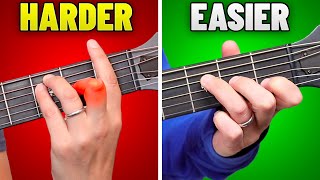
So the F bar chord is one of the hardest chords to play on the guitar. And the reason being is that it's at this first nut or it's right by the first fret, which is close to the nut of the guitar. The strings are so hard to press here, especially if you have thicker strings on your guitar. I have an acoustic, and I actually have 11s on my guitar. They're just a little bit thinner. They're called a custom light string. But a lot of guitars come standard with 12. So for example, my Taylor guitar, when I got that stock from the company, they had 12s on it. And I changed it out for 11s because it just makes it a little bit easier to play and. And press when you're playing barre chords. But no matter what you do in the beginning, an F chord is hard. So what I recommend students to do is we substitute it for some easier versions of the F chord. Now, there's two versions I show students. The first is a simple F major 7 chord. And if you know a C chord, it's very easy to get in and out of your first finger doesn't move. It's a pivot point. I love teaching my students pivot points. That's what I do in my seven level system. My we talk about how can I get from one chord to the next with moving the least amount of fingers as possible. So when going from a C chord to F, which is very, very common in music, it's very common to go from F to C or C into F. Very, very common chord transition. So if I'm looking at this C chord, I want to move my first finger down one and my third finger down one. This chord is called an F major 7 chord. Okay. F major 7. Okay. It is still an F chord. It is not going to sound as full and rich as an F bar chord, but it will help you get through playing songs that have F chords in them until you get strong enough to play a full bar chord. So that's the first version. That's kind of the easiest. You get your C chord, you move your second finger down one. You Move your third finger down one, and it's really easy to transition between the two of them because your first finger stays right in place. Once you get ready with that, you can get them first. Fuller version of The F major 7, we call this F major 7C. And the slash means that there's a C note in the bass. Instead of the F note being in the bass here, there's a C note. So just a little bit of music theory for you. It's still an F major 7 chord. We just have an additional note. You can hear it as a very, very open sound versus this really dark sound of the F bar chord. Got a little bit more of a brighter open sound, but once again, it'll work. And it's very easy to transition between this F major 7 chord and your C chord. Why? Because your third finger is now in place for your C chord, and your first finger is in place for your C chord as well. So you have F to get into your C chord. All you have to do is move that second finger up one string. All right, back to F major 7. Lift up the pinky. Move the second finger up, and you're in an F chord or you're in a C chord. C.
I was just doing a tutorial on Piano man, and there was a lot of this F to C. And I told the students, I said, don't be afraid to use F major 7. There's nothing wrong with that.
See how easy it was for me to go from a C instead of having to switch into that F bar chord, it just makes other songs accessible until you build up the strength for barre chords. Because the reason barre chords are so hard is because there is a strength component. And when you're trying to transition into playing bar chords, I recommend going from C into the F because again, you get the pivot point. And a big tip for you guys going to share right here. Grab a capo. Put it on the fifth fret of your guitar. If you do want to practice starting to build up strength for this bar chord that there's less tension in the middle of your guitar. Take this C chord again, pivot point. Third finger doesn't move. Pinky comes down. Second finger goes in place. And then create your bar chord. And just practice going from F into C because you have that pivot point. Get the pinky in place first, then the second finger. The bar is always last. Okay, C to F. And if you were looking for more tips on how to play bar chords and make them easier, I highly recommend you go check out my bar chord video right over there where I share some of my top tips for making bar chords easier to play.