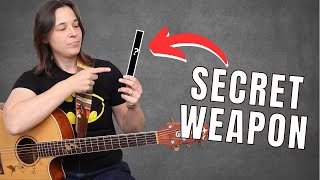
Lauren Bateman demonstrates a simple practice trick to reduce string muting when forming open chords (C, D, E minor) by placing a pen horizontally at the bottom of the fretboard. The pen forces the fretting hand to curl and leave space under the fingers so unwanted strings ring clearly; Lauren reports this fixes about 90% of students' muting issues, with wrist/thumb positioning as potential remaining causes.
Chapters
Definitely one of the top three questions I get from beginner guitar players is, Lauren, how do I make my chords sound better? How do I stop my fingers from muting other strings? And there's a number of things that we can correct when it comes to chord changes. A lot of this stuff is going to come with time. As your hand gets more flexible, you get more stretch. But I have a special trick that I've used with students over the years that I find fixes 90% of the string muting issues. Let me show you.
So, for most people, it's usually like a D chord or a C chord. I had a student who came in, and she'd been practicing the D chord for years, and she's like, I just cannot get this bottom finger or this bottom string to ring out. It's always muted. And what was happening was the third finger here was laying flat, and it was kind of muting that bottom E string. Another common one is the C chord, and it's usually the third finger. Again, the third finger usually kind of lays flat, and it mutes that D string below it. Or sometimes your finger's touching the high E string, okay, and that gets muted. So it's like, oh, what do I do to fix this? So in the beginning, a lot of students don't have the correct stretch and posture and hand positioning to actually give enough space for the chords to be played correctly. So what I do is I use this. It's a pen. It's a tool that everyone has in their household. And you're saying, lauren, this is crazy, but let me show you. So like I was saying before, if we take something like a C chord, a lot of students sometimes do not leave enough space underneath the fretboard. They rest their first finger or their hand kind of right on the fretboard. But actually, what should happen is the fingers should curl around the fretboard, so there should be space under here, whether it's a D chord, a C chord, an E minor, whatever chord you're making. So by putting a pen, it kind of reminds us to leave that space. So now we have to form these chords around the pen. We're not going to do anything with our strumming hand. So you're going to take your strumming hand, and. And you're going to hold this pen at the very bottom of your fretboard, so that's horizontal on your fretboard. And then we're going to make the C chord around that. Now, what this does is it forces your hand to curve More. Okay. Because this pen is taking up the space that you want to put your hand in. So we put the pen and now we form our C chord. And you can see I can kind of hold that pen in place. And if I actually play the chord correctly, it would sound good. Alright. I've been playing guitar for 20. Apparently I forgot how to play C chord. But it happens. We all make mistakes. Alright, so now I've got this C chord. And you'll probably notice my first finger. Now there's a lot more space underneath to make this C chord. So that first finger is not going to be resting on the bottom string. Let's take that D chord. Now put the pen back. Okay, we'll make our D chord. Okay. And you can see because my finger, because of this pens here, my finger is less likely to land flat. And now I play my D chord.
Okay. And I have found 9 out of 10 times this works for most students who've been working on guitar chords. Does it work every time? No. Because there could be something physically wrong with your wrists. We want to make sure that our wrist is in a neutral position. A lot of people, they kind of tweak their wrists. I have a great video up here on wrist positions and things that you want to correct in your wrist that could be causing you issues, pain or reducing the stretch. Because for a lot of students, they just don't have enough stretch to make these cords just yet. And the thumb could be up here and over hooking. And there's a lot of positional things that you could be doing as well. But if you have a good position and you use the pen like I said, nine out of 10 times, it's going to fix the problem. And if you think you have an issue with your wrist or your thumb placement, I highly recommend you go check out that video there where I show you the two most common wrist mistakes and how you can fix them.