Singing Tips For Guitar Players
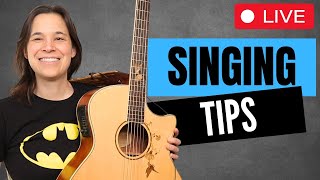
Live YouTube session (host: Lauren Bateman) giving practical singing tips for guitar players: warm-ups (lip trills, 'hun' buzz), strategies to match guitar key/range (use capo, simplify strumming), mental performance tips for nerves, and teaching/lesson structure (her Singing 101 course and seven-level guitar curriculum). The video mixes demonstration, Q&A with viewers, and personal anecdotes (cars, touring, Olive the dog).
Chapters
Hey, everyone. So I decided instead of keeping looking for my lost cable that helps me use my high definition camera that I'm just gonna pop on live here. I have no clue where my kibble went, but I'm here. So thank you for hanging out and sticking around here tonight. I wanted to talk about some singing tips so that students. You know, I used to teach voice when I had the music school. I used to do guitar and voice, and actually, I wasn't comfortable teaching guitar when I started. I used to teach voice first because I actually took voice lessons. I'd never taken guitar lessons. And I was like, there's no way someone's gonna take guitar lessons from sour. Learn from someone who's never had guitar lessons before. So I taught voice because I was like, at least I had a few years of voice coaching, so I felt more comfortable to teach that. And oftentimes I get students who ask me, hey, Lauren, you know, do you have some tips for. For singing and playing the guitar? Do you just have tips for singing in general? And. Hi. From Stormy Dublin. Is it stormy there? It was supposed to be snowing here tonight, but it's. It didn't seem to snow at all. I don't know what happened, but.
But it happened.
So, yeah, I wanted to talk a little bit about more the. The vocal aspect of singing itself, because I actually, believe it or not, I just released a Singing 101 course for those that are interested. It's in my course library now, laurenbatement.com courses but I wanted to show you a few exercises that you can use that are very, very practical and very helpful for students who. Who want to be better at singing and playing the guitar. Because a lot of students, they say, you know, Lauren, it doesn't really sound like the song until I start singing. Right? So a couple things. Let's first start a little bit with the guitar here. I got my tailor and say we're going to play a song like Brown Eyed Girl. Okay, so we have a song. I'll move this mic so you can see me, and I'll just push this down just a little bit. So we have something like this. It's GCG D. Okay. And if I were gonna strum and play along with this, hey, where do we go? Okay, so days when the rains came right now for some people, they. They struggle. Start strumming that. And the syncopated rhythm throws them off. So there are certain songs that are easier to sing and play at the same time because the chords and the words line up very Very specifically, a good example of that would be Everybody Hurts by R.E.M.
Something like Walk the Line or. Or what's the other one? Folsom Prison Blues by Johnny Cash. The words change directly with the chords. So it's actually very easy, or. I don't want to say very easy. It is easier to sing and play those types of songs together. Whereas Brown Eyed Girl, sometimes the lyrics are still going on while we're in the middle of a chord change.
Okay.
So on songs like that, you may want to simplify the strumming pattern. Okay. Okay. You might just want to take it easy, to quote the Eagles, and just slow things down. Very, very slow.
Hey, where did we go?
Days when the rain Came.
So you can see a couple of the chords, it does line up with the lyrics, but a couple of the chords, it doesn't. So you kind of want to find where your voice, where the melody sits within those chords. And you can do that by going very, very slow. Okay. So you can do that by going very slow. Now, in terms of singing, say, I was trying to sing this song, and I was having a hard time placing my voice. There's a really good exercise we use in singing that is called a lip trill. And it's one of the exercises I teach in the singing 101 course. It's a very versatile exercise because there's so many things you can do it with it. Okay. I got lots of people signing in and singing and playing Margaritaville. That's a good one. I like that. Hello from Iceland. I loved Iceland. I went to Iceland a couple years ago. Very, very beautiful, beautiful country. And hello from Jamaica. I've been to Jamaica, too. Also very beautiful. So this lip trill exercise, what I tell students to do when they first start, is to put your hands on your cheeks gently like this. Because with singing, just like playing guitar, any instrument, you want to be relaxed. And what I tell students to do, it's kind of like you're cold outside, okay. And you're gonna go.
It's almost like doing a raspberry with your lips. But I tell people do that.
Go.
It's cold outside.
And what you'll do is you'll feel a lot of vibration on your lips, okay. Because when we sing, we want to project out of our mouth. We don't want to be in our throat. And when I first started learning how to sing, I used to sing like this. Or actually, I would talk like that. My voice was down here. No, I don't have house slippers on my Feet. I just have regular socks. Just regular socks tonight, no slippers. How many content creators do you know are going to show you their, their socks live on, on YouTube? Probably not very many. I'm happy to be here for your entertainment. So again, if you want to practice this, it's just a little.
You can see my lips, they're kind of flapping. So a lot of students, when they start, they kind of go.
They kind of get this start and stop, which is just telling you there's a lot of tension. But eventually we want to balance this out. So this is a trickier exercise and we'll show you an easier one after this. But what I do for a lot of students is I say, hey, we can do this over the song. If you're having trouble. A lot of people, they have tension, they have trouble hitting a high note and your voice gets stuck here. So if you go back to that Brown Eyed Girl.
So you can do this over the melody, which is kind of funny. So that's one great exercise. It's a really great warm up once you get it down. If you're having trouble with it, a really good one to do is the word hun. H U N. Okay, Hun, like honey. And the tip of your tongue is going to go behind the front teeth. Hun.
Hun.
You're going to feel a lot of buzzing on your teeth. Again, we want the voice to get out of our throat. It's not a good thing to have your voice in your throat and you could do the same thing on the lyrics.
So I'm really leaning on that n to get my voice forward. Oh, your, your neighbor's gonna love this. It was so funny. I'll answer your question, Rob, about the Camaro in two seconds. We did a live event over the summer, actually in the fall, in September, and I had a voice teacher come in and she was doing a workshop for students who are a little bit more advanced but wanted to know about singing. And I was kind of doing a beginner strumming workshop.
And all of a sudden from next.
Door, I was on stage teaching. And we had all these people next door who were learning to do lip trills. And all of a sudden through the walls you heard.
And everyone who was in my workshop just all of a sudden like looked around and I was like, that's called a lip trill. And it's really funny. I was like, we do really crazy things in singing versus guitar. But Rob asked, why do you have a 69 Camaro behind you favorite car? Well, Rob. I actually own a 68. So I have a fire engine red 68 Camaro. And I haven't announced it yet. I have a new Camaro that I'm going to be picking up on Saturday. So I love Camaros. I always have loved Camaros. My stepfather had a 56t bird with. It was white with a black top. And he let me take it to my prom when I was 18.
So that was awesome.
So him and I used to go to car shows a lot and see a lot of the classic cars. And I just fell in love with the Camaros. I really, really like the Camaros. And many moons ago, again, when I was 18, my stepfather found this Camaro for sale around a few blocks from where we lived. It was just like this red Camaro was sitting out. And he goes, do you want to.
Go look at it?
And I said, absolutely.
Yeah.
I have a 68. It's a, it's an RS. It has a 230 straight 6S engine with a power glide transmission. So it is an automatic. But we're, we're working on fixing that one up, that one up slowly. So I do have the Camaro I currently drive. I do have a 2019 black SS Camaro. But I just went last weekend. I'm trading it in for a different Camaro because it's the last year they're making the Camaros. They're going out to pasture again. So as soon as I pick it.
Up, I'll make sure to share a.
Picture here in the post section to show you. With a 4, 4, 5, 4, big block, that's a big engine. That's a lot of power. The Camaro I'm getting on Saturday has 650 horsepower. So it's a bigger engine than what I have now. I think I have 455ish. So we're upgrading a little bit, but it's the last year, so I figured why not upgrade now? I have one of the students in my online community who private messaged me, Pam. I don't know if she's on here, but Pam said, hi, Lauren. I see your schedule to be live tonight for singing tips. It's gonna be. Oh, people are asking in the chat. So, no, it's this time zone. Sorry. I was late because I couldn't find my cable. Still don't know where the cable is. I thought it was, I thought it was a question. She was like, where are you? See, that's the thing. My students in my community, they message me all the time. And they're like, are you supposed to be here right now? And I'm like, yep, I'm here.
I'm here.
Just let everyone know I'm having technical difficulties, but I'm here.
Yeah.
Love camaros. You need a Z28. Those are nice cars, too. I like. I like anything. Anything Camaro. But back to the singing. So again, if you're someone who wants to sing and play at the same time, balancing out the voice with the guitar is something that can be tricky. So for guitarists, especially females, the capo is going to be a very, very useful tool for you, because take, for example, a song like hey Jude. That's a song I know that is very hard for me to sing because.
It is so low.
It is so low, so it gets out of pitch for me. So what I will do sometimes is I will take a capo and I will put it up higher on the fret so that the notes. The chords sound higher. All right, so take a song like free falling. So free falling. If I play it down here.
It's really.
She's a good girl, really loves her mama, loves.
So for me, that's going to be very, very hard. Hard to stick with. So if I pop a capo on the fourth fret, I can play the same exact chords.
She's a good girl, loves her mama, loves horses in America, too.
You can see how just by putting the capo on, it made it a lot easier for me to sing the song, so it puts it in a better range for my voice. So when you're playing guitar, you want to make sure that you're matching up the key of the song with your vocal range. Now, what's going to be best for your vocal range is going to depend on you. I'm an alto, so I have a lower voice, so I can typically sing a lot of guy songs, but sometimes they are low, and I have to bump them up with a capo or I have to change the key. Lauren, singing night is complete. Oh, you're so welcome. I should sing you maybe one of, like, my original tunes. I don't even. I haven't played the original stuff in so long, I forget probably most of the words to my own songs. I would have to relearn them. But when. You know, that's why when you have an artist, they will oftentimes use a lot of the same chords over and over again because they're playing in keys that are good for them to sing in. So in the music world, there's only 12 keys that you can write a song in. There's only 12 keys, and that's why we get so much repetition. So if you're someone that likes, you know, the G, the C, the D, the E minor. So these are the stuck, like, blue chords, and they're used in many songs. Okay. You can take these chords, and you can just kind of slide them along.
I was doing a Hootie and the Blowfish song the other day. I think it's I only want to be with you. And I think they capo those chords. It's something like.
I know it uses those chords, but they're playing with a capo to make it, you know, to change the key and use some of these easier chords. Sometimes when you can use a capo to get. To get rid of some of the bar chords and make it easier for you to play too. So, for example, if you go check out my Hotel California lesson, I have an easy lesson where I use a capo. I believe the capo's on the second fret. And because it's a B minor.
So it allows us to play open chords in instead of the bar chords. All right, so multiple uses for. For capos. Can you sing in color by Jamie Johnson? I don't know if I know that song. I'm a big Melissa Etheridge fan, so I can sing a lot of Melissa Etheridge stuff.
I talk a little bit about that.
In the course because students ask me because I am more of a rock singer. They ask about, you know, that grit that you get in the voice. Or if I sing something like Zombie, you can get really gritty. It's kind of like that rock sound. And I go over that a little bit in the course, how to do that. It's. It's not something I recommend for beginners because you need to have complete relaxation to do that. But, you know, when I started singing, I wanted to be able to sing like someone like Ann Wilson. And I was like, I gotta find who am. Wilson worked with knowing, you know, that the person could possibly be passed away, which they were. But I found one of his students, and I worked with the protege kind of of the teacher who taught Ann Wilson and Chris Cornell and all those kind of west coast rock singers. His name was Maestro Kyle, and he worked with a lot of kind of the west coast rock scene. And it's very interesting with voice because, you know, guitar, we can kind of hide behind the guitar, but. But with voice, it's much harder because it's so personal. So we're Very, very self conscious with voice. There's not too many singers who actually really, really like their voices. So if you're not feeling comfortable with your voice, that's okay. The more you do it, you will start developing your voice over time. So when you start singing, you might need to sing in lower pitches. But as you build strength and range, you can grow your voice, grow your range and feel more comfortable singing higher notes. So if you're someone who like, you know, you get up to those high notes and this happens to a lot of women, they kind of, they kind of crack and they go, they kind of got like this dolphin thing going. Um, I'll show you how to get.
Through that in the course.
We use some of these lip trill exercises, these hun exercises where I'll have you like slide through pitches to work on expanding your range. Because the big thing for singing, a lot of it's mental. The guitars also, a lot of it is mental too. You guys hear me talk about that a lot, all the time when I do these lives voices is usually we're just in our heads. We're in our heads and we think the note is higher than it really is. So a trick if you're trying to hit a high note. I used to do this to my students in the studio. I'd say, let's sing it again. But as you're singing the high note.
I want you to take a bow.
And they'd sing their part and then I'd have them bend at the waist and take a bow. And all of a sudden they could, they could miraculously hit the note and they're like, how come I could hit it? Like, like, what did the bow do? And I said the bow did nothing but distract you. It was a distraction technique. So you had to concentrate on bowing instead of the note you were trying to hit. So it just goes to show you there, there's a lot of mental aspect to singing too. Oh, thank. Oh, you like the Pearl Jam Black song?
Yeah, that's.
I can sing that one fairly well. It's lower. Hotel California with capo seminates. 7 eliminates all the bar chords. There you go. Do you ever do lessons on gospel worship songs? I don't, unfortunately. The only kind of like religious songs that I have are some of the Christmas songs. I do have Amazing Grace, but it's not really a gospel, not really a gospel version of that. First time viewer. But I've been watching your beginner videos as a refresher. Well, welcome Ed. Nice to have you on Here, a couple other questions. Lauren, you're the best guitar teacher ever. Thank you for everything. Lots of love from the uk. Love, my friends in the uk. It is early in the morning in the uk. Why aren't you in bed? Oh. How do you sing in your own voice instead of trying to sound like the artist? That is a great question. And that's very hard, you know, because growing up, I wanted to, you know, sing like Melissa Etheridge. You want to sing like Ann Wilson. And you can learn a lot from singing or imitating an artist's style. But eventually what's going to happen is you are going to get comfortable with your own voice. And, you know, that's what I talk about in the course. It's like, there's exercises and. And I like the way I sing. There's certain things that I like to do, but you have to find what you like for your voice and. And you'll know if you're kind of force imitating someone, because I find with students, it creates a lot of tension by. By imitating someone too much versus being yourself. It's a very hard thing. There's. There's a big confidence part to it because you really have to be confidence. Confident in yourself and your sound. But, you know, I think it's important to pull from people. You know, oftentimes people tell me, you know, I sound a lot like Stevie Nicks when I. When I sing. And, you know, I can do. I'm an alto, and Stevie is an alto, too. I think Stevie's a little bit whinier than I am, but I can do, you know.
Took my love and I took it.
Down.
I climbed the mountain and I.
Turned around.
And I think part of introducing your style is not always even singing it the way the singer sings it. I'll show you what I mean. I'm gonna look up a song here real quick.
So I used to do a Britney.
Spears song, and I didn't do it the way that Britney Spears does it. We kind of have more of a rock version. So it was. It was a cover and it was a little bit more aggressive. I'm just looking up the chords because I can't remember all the chords. It's the same progression. Let me just make sure there's no capo. There's capo on the third fret.
Look at that.
I'm already there. So we got.
Oh, baby, baby how was I supposed to know.
Something wasn't right here? Oh, baby, baby I shouldn't have let you go.
But now you're out of sight. Yeah.
And I don't like this version because I want bar chords, so I'm gonna have to like.
So the reason I want bar chords.
Is because I want to get percussion percussive with this. Let me find. You're gonna see in two seconds. I need to get percussive with this song. So I want one without a capo. This one has no capo. Okay, great. Here we go. That will be better. Yeah, we'll take it from the pre chorus. My loneliness. Yeah, so we got.
My loneliness is killing me.
I must confess.
This is totally off. See, this is why I don't do things unprepared. But if I were to sing it, like Brittany and I don't even know, it just sounds like this is totally wrong. So this is why you need to listen to things and look at them beforehand. But I feel like it was something like. I know there were a lot of bar chords.
There it is.
I'm doing this off muscle memory.
So it has a very different feel than a pop song. Okay. So that's where you can. You can integrate or inject your own style into it. Because I was more of a rock person, so I wanted. I didn't want it to sound like a pop song. I wanted to sound like a rock song. So we. That's why we wanted to play with bar chords.
We wanted it to happen. Have more of a rocking feel to it. So those are different things you can do. You can play with the melody, you can play with a different key, a different feel. Again, if it's a pop song, it could be a rock song. If it's a rock song, you can make it into a country song. Sean Colvin does a great song, Crazy Gnarls Barkley, which is a very like, kind of poppy R and B esque type song. But then she finger picks it and turns it into a folk song, and it's so cool. And I think that's the best way to learn different songs. Like, go listen to people cover other people's music, for example. I used to do this in studio with my students.
Adele Rolling in the Deep.
Go watch Adele perform Rolling in the Deep live and then go watch Aretha.
Franklin perform Rolling in the Deep live.
Now, Aretha comes from more of a gospel background, so she's a little bit more free form in her singing and the way she hits the notes, obviously she's got a much better range than Adele, but you can see how stylistically you can. You know, you can put different spices into the singing. It's really, really cool. You're welcome.
Do I do the blues?
Hi, Jerry. Yes, I have a Blues 101 course.
Lauren bateman.com courses. So all my courses are the singing.
Courses up there now, singing 101. And I do have a blues guitar 101 as well. So check that out. Can you sing Ain't no Sunshine by Bill Withers? I did do a lesson on that. And if you guys haven't checked out my new website, Lauren bateman.com. we totally updated the songs on there. And I believe. I believe I did do Bill Withers. So you requested it.
I'll look it up real quick.
I wasn't.
I mean, I should have known I.
Would be singing a bit on here because I was going to be talking about Ain't no Sunshine right here. That would probably, you know, I might want to capo that. But let's see what we got. This one would be a tricky one to sing.
Ain't no sunshine when she's gone.
It'S not warm when she's away.
Ain't no sunshine when she's gone she's always gone too long Anytime she goes away.
So, you know, that's one that I could do.
It feels okay. But that's something where maybe I could. I could pull it up a little bit more in vocal range so that I can lean into it and I.
Talk a little bit about what's my.
Vocal range in singing 101. Because everyone, everyone has a different power to their voice. So an alto's power range is much lower than someone who's a soprano. Think of like Whitney Houston versus Stevie Nicks. Whitney Houston was a soprano or was she a mezzo? I'm trying to think if she was a soprano or not, but you think of someone like Whitney Houston either way, they had very different power ranges, you know, so depending on where you are, base for men, power range is going to be a very different spot. So that's where range becomes important. And yeah. Someone asked, do you need to learn. Is it necessary to read music? Please say no.
No, it's not.
It's not necessary to read music. What I think is necessary, I want to. I want to put this as like a side note. What I think is necessary to understand is how to read rhythm. I think that is very, very important.
I don't think you need to know.
How to read melody. Unless you want to become a professional who wants to do studio session work or you want to play on Broadway, then, yes, you're going to. You're going to need to read sight music. It's just going to become more important professionally. But I am not the greatest sight reader. I never was. I wrote two albums barely being able to sight read music. And then I took some piano lessons again and I kind of relearned. I'm still not great at reading treble clef. I can read.
Sorry.
I can read treble clef. I'm not the greatest at reading bass clef. It's just. It's just not my strength. So if you're someone who feels like. Or if you have a guitar teacher, you know, and I hate. I hate ragging on other guitar teachers. But if you have a guitar teacher who's insisting, insisting that you might sight read need to sight read music, it might not be a good fit.
Unless you want to be a purist.
And go down that road and learn how to sight read.
Awesome.
But I've taught thousands of students to play guitar without reading a single note of music. They do understand how to read rhythm, though, because reading rhythm is very important. You have to be in time with music. Did I ever do face? Oh, I've done fast car.
Yeah, I do have a lesson for.
Fast car on here.
Tracy Chapman.
Let me see if I can remember that. I can't remember how that one. That one goes. I can hear it in my head, but I don't remember how to play them all off the top of my head.
But yes, the.
That's a great one. And again, Tracy's an alto too, so I can sing her music very, very well.
I'd love to hear a little Gordon.
Lightfoot if you could read my mind. Strummed. I'm working on that. Did I do a lesson? I think I did a lesson on that. Let me just pull that one up real quick. Let's find Gordon here. So you were saying strumming it. I think I did a finger picking version. I might have done a strumming version. This says capo at the second fret. Again, you're putting me on the spot without practicing. So I'm just going.
If you could read my. My love would tell my thoughts.
Could tell.
Just like an old time movie about.
A ghost from a wishing well. So you see, I'm keeping it. I'm keeping it really gentle and keeping it really gentle, kind of letting the bass note ring out.
If you could read my mind.
Now see this again, it's maybe for me a little too low. I might want to bump this up if I were a female singer trying to sing this.
If you could read my Love what a tale my thoughts could tell.
Just like an old time movie About a.
Ghost wishing well so you can just see.
I got a tickle in my throat so you can see Just moving up two notes made it a lot easier for me to sing. So, you know, these are things, especially if you're a female, you might need to play around with the capo a bit to put it in a little bit better of a sot. So Season by Chris Cornell. Chris is a great singer. I saw Chris live at the Berkeley center many moons ago. One of my students took me. This is when I first started teaching guitar. And it was just him solo and he's a phenomenal singer. And he worked with maestro Kyle as well. Phenomenal singer. Phenomenal. I was so impressed. I mean, I like Soundgarden, I liked Chris Cornell, but seeing him perform solo really put it over the top for me. He is a phenomenal singer. Yes, a mic can help. Let me. Let me grab my microphone. I think it's over there. I'm pretty sure it's over there. I have a special microphone. There's different microphones for different ranges. I use Shure, I think mine's an 87Amicrophone. It's built a little bit more for. For higher frequencies for the female voice. But a Shure 58, those are kind of standard microphones. But yes, when I recorded my album, we used a $5,000 microphone to do the vocals.
And it makes a difference.
It does make a difference.
Now do you want to go out and gig with the $5,000 microphone?
Probably not. My microphone, I think when I bought it many moons ago was a couple hundred dollars.
And the reason you buy a microphone.
So there's the Billy Joel Piano man lyric. And the microphone smells like a beer. If you use the bar's microphone, it smells like beer in someone else's saliva. So, you know, you kind of get.
Used to it, I think.
But it's nice to have your own microphone and know that the only spit and saliva is probably yours on it. But yeah, you can find, you know, Shure makes great microphones. Blue makes great microphones. Who else? Sennheiser makes great microphones. There's so many great companies. But, you know, buy something that's a little bit more in the 200 to 300 range. Just like a guitar, you get what you pay for. So you can definitely. I don't want to run over there because I don't see the microphone ready and out in the open. So I don't want to waste your time grabbing it, but I'm pretty sure mine is a short 87 beta microphone. It uses phantom power, if that matters to anyone. I know you can't play songs on.
YouTube due to copyright, but does your.
Course offer lessons on popular beginner guitar songs, for example, the Beatles? So, Michael, what I do, yes, you're right. I. Due to copyright law, I, I can't do songs. I can't do copywritten music in the courses. I do have some songs that are.
In the public domain.
For example, a song like Amazing Grace, oh De Joy, the Star Spangled Banner's in there too. But I, I can't teach a Beatlesong in, in the course. I would have to pay thousands and thousands and thousands of dollars in licensing one to publish it. So there's multiple copyrights. You have to get a copyright to publish the music. To put it in a workbook. You need to get a performance license to actually perform it.
So, you know, I don't teach songs.
But I'm just going to turn this phone off here. What I usually do is I recommend songs on YouTube. So if you go through level 1, 2 and 3, I'll usually say, hey, you know, go over to my website, click on these buttons, click the songs, you know, that use G, E minor, C and D. These are going to be songs that you can play if you're in level two and level three. Now when you move on to level four and level five, these are the songs I would recommend for you to, to pick. The thing that's tough about YouTube is, you know, sometimes you'll see a video and it'll say it's for a beginner. And then you click on it and you're like, I'm a beginner and I don't know what's going on here. So I kind of break things up and I'm like, here's the level you're at and these are the types of songs you should be able to play. Here's some suggestions. Go learn the simple version of Brown Eyed Girl. So that's why on my website, some of the songs have multiple strumming patterns.
Because I'll have an easier strumming pattern.
And then maybe I'll have a more intermediate or maybe a late beginner strumming pattern, depending on the song. So that's a great question. But yes, unfortunately I cannot, due to copyright laws, I cannot teach songs like the Beatles, Zeppelin, Eric Clapton. But what I can teach you is.
I can teach you the mechanics. I can teach you the techniques they use in all these songs.
So that you can play any song you want. For example, you know this strumming pattern.
You learn that strumming pattern, you can use it on tons and tons of songs. So that's what I teach you. I teach you what I call, like, the three foundations of music.
Okay, so we have the chords.
So we have to get the chords and the chord changes. I teach fingers, finger dexterity, and finger exercises because we've got to get these hands moving, especially if you're an older learner. Most of my students are in their 60s and 70s.
I have a lot of students in.
Their 50s, too, and some younger, but.
I've noticed I have a lot of.
Students in their 60s and 70s.
I actually had a woman, 85 years.
Old, who emailed me the other day.
Who said she had just joined the.
Course and she's having a blast. So you're never too old. You're never too old to start learning guitar. But I focus on the three fundamentals.
If you learn these fundamentals, you'll be.
Able to play probably 90% of the songs you want to play.
Now there's more advanced stuff.
You know, you think of the James Taylor type stuff, the finger picking. It's a little bit more late beginner, early intermediate.
Some of the percussive strumming stuff.
I get into that in later courses. But the seven levels designed to take you from being like an absolute beginner to kind of like early intermediate, very late beginner, early intermediate.
And then once you graduate the seven.
Level, I have some other courses that.
Kind of start at the late beginner level and take you into different directions, like singing 101.
Singing 101, you can do as a.
Beginner because there's no guitar, so that's fine. But we have the finger picking 101, which dives more into finger picking. I have expressive rhythm and strumming.
So if you're someone who knows a.
Lot of chords but you. You really want to get more into. Does Olive like to play the guitar? Robin wants to know. I'll talk about Olive. Maybe we'll invite her in here real quick. But the expressive rhythm and strumming, that.
One is more about percussive rhythms.
And I just added a whole new rock section last year for electric guitar, so that's in there.
Now there's a Music Theory 101.
There's lots of stuff.
And again, yeah. See, Joseph says I am 74. Started 13 years ago. And. Oh, I taught you.
Imagine.
Isn't that great?
That's awesome. I Love it.
See? 60. Yeah.
Please pop your age in the chat.
I want to know how old you are. I'm going to text and see if.
We can get Olive to.
To pop in here real quick. Megan is next door with Olive. We'll see if we. I'll say they are asking for an Olive cameo.
We'll see if she'll open the door and let her in.
But I see here 71, 19. Oh, Darius, you're the youngest. Probably.
Stu is 70, 60, 64, 57, 49.
64, 73. Who's gonna win the prize?
But see, you can see here all different ages. All different ages. You're not too old, you're not too young. I hear the doors opening.
I.
We're gonna have.
Olive is gonna make an appearance.
So Olive doesn't mind when I play the guitar. I think she's used to it. Olive likes to sleep in my guitar case. Here she comes. Hi, Nana. Hi. Everyone on YouTube wants to see you. There she is. So this is Olive, and she is a dachshund and mixed with Pitbull, actually. God bless you. So we did one of those DNA tests because we knew she was a dachshund, but she's like a very sturdy. She's very strong, and she's very agile. So we did one of those DNA tests, and now we found out that she is a dachshund in a pit bull mix. And she. She likes the guitar. She doesn't run away from the guitar. She'll stay in the room with me here. We'll let her sleep in her bed. Thank you, Olive, for making a cameo. We appreciate you. Thank you so much for being such a good manager. She manages on the side for the YouTube channel.
So 74. See, we got all ranges of ages here. Age is just a number. And I tell students, you, if you've ever gotten emails from me, you've probably heard this. You know the best time to learn play the guitar? It's that. That. That plant thing. The best time to plant a tree was 20 years ago. But the next best time is now. Listen, maybe the best time to learn guitar was 20 years ago. But you're ready now. This is when you're going to do it. Because maybe 20 years ago, you know, you had a family, you had kids, you had. You had a job.
And that's what happens with a lot of my students, especially you that are.
In your 60s and 70s or even. Even late 50s. Like Car Knight says here, I played and sang for neighbors recently.
Woof.
It was about 60% of what I do every Morning. Practicing any tricks to get over the nerves? Confidence in an intimate setting. I find for me, this is. This doesn't make me nervous at all because there's a lot of people when. What. What is the most nerve wracking for me is intimate settings. I would rather perform for 20,000 people. That doesn't make me nervous at all. But ask me to play for five people in a room, that makes me nervous. Now, the nerves, usually, again, it's all mental. The nerves come from us being concerned about what other people are thinking about us.
So we're like, am I going to.
Sound good or is it going to. Am I going to hit the right. No. Am I going to crack? So we have all these things in our head. There's that little voice that tells us we're not good enough. And what we have to understand is we just need to flip the perspective on that. Okay? And it's the same thing for guitar. Whether it's singing or guitar, you have to flip the perspective. And it's not that people are going to be judging you. It's that you're actually sharing a gift with people. You're sharing a gift. What's up, Freddie? How's it going? You're sharing a gift with people, and.
You have to understand that that is something special. And what we don't understand is that.
We actually make a lot of people happy by sharing our gift.
And, you know, unless you got someone.
Who'S a real jerk in your audience, in your intimate audience, usually if it's an intimate audience, it's people who know you really well and they're going to be supportive.
So, you know, and part of the nerves comes from doing it over and over again. So to get over that, it took.
Me about a year of performing on stage in front of small crowds to get more comfortable. And that's why I can do stuff like this on. On YouTube.
It's just. It's just.
It's just another type of performance is what this is.
So I'm very comfortable in front of a camera. I'm very comfortable on a stage.
I'm very comfortable in front of an audience. But I've been doing it for a very long time. If you go find my early YouTube videos, it was my first time talking to a camera, so it was very weird. And you'll see that I'm actually quite.
Awkward in some of my early videos.
Some.
Some of my students have found some.
As early as 2010, my first soiree with. With YouTube. But again, you get more comfortable with the things that you do. I was training down in Florida back in early December, and one of the trainers there, he says, experience.
Brings relaxation. That's what it does. And he talked about, you know, my wife was there and he asked her what she did, and she was a nurse. And she said, the first time you were on the nursing floor, were you.
Like, pooping your pants?
And she was like, absolutely. Because you don't know where anything is. You don't know anyone. Like, there's a lot of pressure. And he was like, how did you feel after being on the floor for a year?
It's like you feel like you own.
The place because you know where everything is. You know the expectations.
So it's the same thing.
We're performing. If you do it enough for a long enough period of time and you get enough exposure to it, eventually it just becomes comfortable. I love all these little hearts I see keep popping up on the side here. I don't know when YouTube added a heart button, but I love it. I see a lot of little hearts coming in.
Thank you for the love you got. You know, I have some of the best students.
I say that you all are so very supportive.
I love that you're here.
You know, it's 8 o' clock at night here on the east coast coast, and you're here spending time with me and the lovely Olive, who's kind of just walking around back there. I play with the VA with a group of guys that are at different playing levels.
Thank you for your video.
Help me contribute. Awesome. Carlos. Thank you. Thank you for sharing that with them. I really appreciate that. I'm 63 with a back problem in a wheelchair, and I was told to play the harmonica, so I do that. But I love guitar. Listen, I have a student, he's in his 80s, and I'll have to find it because I used him as a testimonial at the end of one of my videos. This was years ago, Older gentleman, he's in a wheelchair. He's playing guitar and singing Knock it on Heaven's Door. It's like the best thing I've seen. I think he has a degenerative back disease. I can't remember. His name is Michael. And I actually, he emailed us this year.
He was.
He had some health issues, but he's back and he's excited to be playing again. But it just goes to show you, you know, I firmly believe that if you have the desire to do anything.
Whether it's play guitar, whether it's sing.
You can do it.
And no one else should tell you that you can't do it.
There's people without hands that play guitar, okay? So if you have two hands, you're already doing better. I've seen some really amazing guitar players who play with their feet because they want to play guitar, and they figure out a way to make it work for them. Them. All right, we talk about Django Reinhardt. There's a really, like, gypsy jazz guitar player.
He was in a fire and he.
Burnt his left hand, and it was so bad that his third and fourth fingers got fused together. And that's all those stuck like glue.
Cords, which the song Stuck Like Glue by Sugarland uses them. That's why I call them the Stuck Like Glue chords, because I did it with a student and I was like, oh, isn't it funny that we use these cords as stuck like glue cords, but you have all these chords, like the Wonderwall chords. Is that. I think it. Yeah. So.
Those are just the. I mean, they're like cowboy chords, too. But these are the Django Reinhardt chords because he had to play with his third and fourth finger fused together. So he created different chords and different shapes so that he could play the guitar.
And.
And he did it really well. So he worked with his handicap. And I have a lot of students.
Because I work with older students who have, you know, different issues with arthritis and other stuff, and we try and.
Come up with different solutions.
I have students who are missing fingers, and they're like, what can I do?
I can't.
I don't have an index finger to.
Play the C chord.
What can I. How do I play it? And then we just come up with a different organization of the fingers for.
Them to be able to play a C chord.
You just have to work with your handicap and figure out what works for you. Just because you have a handicap doesn't mean it's impossible.
And I'm not talking, like, handicapped, that.
You'Re in a wheelchair. I'm just saying if you have something, arthritis, that.
That technically is a handicap because it's something that makes it harder for you.
To do what you want to do. And I've had students who have arthritis.
And I'm like, listen, I.
One student, she just had a really, really hard time with bar chords. And no matter what we did, it.
Was just too painful.
And I said, listen, we're not going to play bar chords. Bar chords are just not going to be part of your guitar story and your guitar journey. But we're going to do a lot without the without bar chords. And we use the capo a lot. We transposed a lot of songs to get rid of the bar chords so that she could still play the song she wanted to play without needing to use bar chords. Or we created simplified versions of the bar chords for her to be able to play. And that's what you can do there. Just because there's something you can't do doesn't mean we can't make it doable. Okay.
They thought it was impossible to go to the moon, and we went to the moon.
See? Do you play other instruments? The piano. I can fake the piano. I took piano lessons for.
Two or three years when I was younger.
I hated it. Absolutely hate it.
It was the sight reading. Whoever asked Robin earlier asked about the sight reading. It was the sight reading. It killed me. I couldn't. I couldn't do the sight reading. And. But I wanted to create. And that's where the guitar really hit.
Home for me, because I learned.
I started by sight reading on the guitar because I had a Hal Leonard book. My. I wasted the piano lessons. So my parents weren't going to pay for the guitar lessons. We didn't have a lot of money. My grandfather paid for the piano lessons.
So, you know, two or three years.
My mom bought this upright piano that she still has at the house. And, you know, I just.
I just.
It wasn't me. It wasn't me. And then at 16, my sister bought me a guitar for my confirmation gift. And my mom was like, don't buy it. She's not going to do anything with it. She's going to waste it, just like she did with the piano lessons.
But there was something about the guitar.
I started with the Hal Leonard book, and I sight read it. But at the end of book one, it taught chords. And once I learned chords, that was it. It was done. I learned that you could put chords together and you could write music. And I started writing my own music and writing my own songs. And that's why for me as a teacher, I start students with chords and I don't focus on sight reading because I remember for me, that was such a roadblock, that was such a hurdle, and it prevented me from having fun with the instrument because all I wanted to do was create and write music and write songs.
Yeah.
Craig says I took piano lessons for two years when I was in first grade. Yeah, I think I was in third and fourth grade when I did it. And I hated it. I hated it. But I love the drums. I took drums for two or three years. I actually, it was funny. I took drum lessons before I took guitar lessons. So the instruments that I have taken lessons with, piano, drums.
Singing. I took about 10 years of singing lessons with various teachers over the years.
My voice probably doesn't show for it.
Because I'm out of shape, but I do the best I can.
But I took drum lessons for two or three years and that was very, very helpful. I was. I have an intensive that I'm doing with students where I meet with them every week like this, and we go through my seven level system. And I was talking about rhythm the other night, and I told them how being a drum student and learning about drums taught me a lot about rhythm. I actually, by playing drums and learning how to read rhythm, this is why I'm really big on reading rhythm. By learning how to read rhythm and playing drums, I became a much more better in a much more dynamic guitar player. So it was very interesting. I hadn't taken guitar lessons at that point. I actually quit the drums to take guitar lessons at 26. After playing the guitar mediocre for about 10 years, I decided I'm going to take a few lessons. And that's where I learned a little bit about music theory, which helped me with my songwriting. And I learned about finger picking. That's what I really. That's why I took the lessons. I really, really wanted to get into finger picking and learning about finger picking.
So it just goes to show you.
How to, you know, when you get on with a good coach and someone that has a little bit more of a structure, it's the biggest thing students tell me. Whenever students buy my course or people complete my course, we send them a survey saying, hey, what made you buy? Or why did you like it? And a big thing that comes up very frequently is that they love that there was structure. They love the structure. You know, you're here on YouTube and you know, you're watching this video, watching that video, and sometimes they go together, sometimes they don't. This person's telling you to do it.
This way, this person's telling you to.
Do it that way. This person's teaching bar chords to beginners.
Which I never do. This person's over here teaching you a scale, and you're like, okay, well, what do I learn?
Because there's so many things you can learn on the guitar and what the seven level system does.
My beginner course, what that does is it gives you the step by step.
Structure and it creates a linear process for you. Just a blueprint.
And it's my System for what I taught students.
Usually it's what I taught students in the first, like, nine to 12 months of lessons. And I've had some students who've gone through it quicker than that, and I've had some students who have taken longer. And that's the great thing about it is you can do it at your.
Own speed and your own time, which.
Is great, but you have that structure. And I think that's super important, you.
Know, because I come from a science.
Background, and in science, you follow procedure. And because if you do the experiment in the wrong step, you could blow something up. So we don't want to do that in science, you know, or you could cause a chemical reaction that's poisonous. And we've had that happen. I've had to evacuate labs, Someone dropped a chemical on the floor, and we had to call the HAZMAT team in. So that was fun.
But it happens. So, you know, in science, you don't want to make mistakes, because if you make mistakes, they can be hazardous to your health. Not, you know, in guitar. That can also help happen too, with wrists.
If you do things too long, you.
Can get carpal tunnel or tendonitis if you're doing things wrong for too long.
But I think it's very important people to have.
Like, this is step one.
Learn these three or four exercises, and.
When you're good, move on to step two.
Okay. Learn these chords. Here's a new set of exercises.
When these are good, move on to level three. Rob says agree 100%. Structures. Great benefit of the seven level course.
Thank you so much, Rob.
Yeah, and there's probably some people on.
Here who are in the course.
I love to play drums. Drums saison. I hope I pronounced your name right. That's one it's on. I love the guitar, but I'm not gonna lie, the drums is my favorite instrument to play because it's a.
It's a whole body experience.
It's great for stress. And while guitar, I'm more of the acoustic singer, songwriter person. On drums. I'm totally like Guns and Roses. I. I am a rock person on the. On the drums. Aerosmith, Guns and Roses, Smashing Pumpkins. That was all the stuff I played on. I loved playing Guns N Roses on the drums.
It's just like, the energy.
And I had a teacher who taught me a lot about, like, classic rock stuff. So that was. That was cool. Yeah. Drum rhythm is on the list. That's good. Yeah. Sue says I'm only on level one. Sue, Wait, Sue B. Is that you? Sue, are you the 85. Susan, are you the 85 year old student who sent me the email the other day? Because I remember, I think it was an B. Was your last name. Let me know if that's you. That's crazy. If that's you and you're here because I was just telling people about you earlier.
That's funny.
See how I remember names too. Like I tried. One of the things I try to do when I have students in the course and especially if they email me, I do try to get to know the students. I don't get to know everyone because at this point there are, you know, thousands of students who've taken the course. No, you're only 64. So different.
Sue.
Ben. But her name, her last name was B. I can't remember so well, Sue, I'm still happy to have you at 64. 64, 44, 74. Any age. I am happy to have you. Yes. Smashing Pumpkins. Oh, such a great band. Especially for drums. The, the drummer on that was amazing. The song tonight. Oh, phenomenal. I should do a Smashing Pumpkin song on guitar. That, that'd be fun. That's kind of reaching into my era of music. The 90s is, is kind of like when I grew up around music and I listened to obviously, you know, when I was growing up, I grew up in an Italian family, so you do not change your parents. Radio station in the car. So I listened to whatever my parents were listening to. My mom was more of the Motown, you know the, the, the Jackson 5, the Supremes. That was my mom. My mom was the Motown in the Beatles and the Carpenters. That's where I get the Carpenters from. I, we're always listening to the carpent Christmas music on or you know, Nat Cole and Natalie Cole, all those people. And then my dad was more of the Fleetwood Mac Rolling Stones. So I got more of my rock side from, from my dad.
So it's, it's very cool.
And I've gone to a lot of shows with my dad. We've seen Pat Benatar, BB King. I've gone to a lot of concerts with my dad. He's kind of the music person. Even though he doesn't play an instrument, he really loves music. And I think that was a big influence in my life. He also would listen to a lot of the old stuff like that his dad liked. And he would always quiz me like, who's this? And I'd be like, it's Dean Martin and who's this?
It's Frank Sinatra. Who's this.
It's Journey. Yeah. So he would quiz me all the time. Mamas and the Papas is another. Another great, another great band. Beautiful voice, beautiful voices and the harmonies, but fantastic Landslide. Yeah, Smashing Pumpkins did bring back Landslide. So that was cool. That was around when I started taking finger picking lessons was when that came out, or just a few, few years after that.
So.
Yeah. Did you ever use the Beat Buddy?
I do have a Beat Buddy here, Robin.
It's in my cabinet with my other pedals. Yes, I did use the Beat Buddy. So a lot of my students have.
Been talking about this pedal called the Beat Buddy.
And what it does is it just plays drum tracks. So for some students, I'm really big.
Proponent of practicing with a metronome because.
It helps you with timing. But, but the thing with the metronome.
Is this what it sounds like, you.
Know, it's just a little click track. And that's great. And it's really, really good for developing timing. But for some students, it's very hard to sync with that. So I tell students, use a drum beat. A drum beat can be helpful. And on some. 1. I don't know who found it, but one of my students started promoting this beep buddy in our private community. And I was like, that's really cool. And you can throw in little fills and stuff, but sometimes playing with a Beat Buddy or a drum track is a lot more musical. So it's a lot easier to. To get a feel for it. So my grandfather liked Petula Clark. Yeah, that's a good one. Patsy Klein was, I think my grandmother. My grandmother liked Patsy Cline, Tom Jones.
We did a lot of Tom Jones.
My great aunt loves Elvis, of course, but yeah, I remember we listened to a lot of Patsy Cline, Peaches and Herb. That was another good one. You know, the Commodores, Lionel Richie, all the, A lot of great.
You guys have all the great music.
You know that? So.
Landslide, Bush, Acoustic, Rooftop. Oh, I didn't know Bush did Landslide. That's interesting. The Grateful Dead and Barb Marley were in. Still my favorites. Great, great music.
Yep.
1979 by Smashing Pumpkins is a great song. Well, yeah.
Have a great night, Michael. Thanks for being on here.
So I'm probably gonna hop off because we've been on for about an hour now, but I wanted to say hello, talk a little bit about singing, let you all know that I have a singing 101 course that. That just came out. Laurenbatement.com courses.
You can go check that out.
That has all my courses on there, including the seven level. So if you want to grab both, you can grab both. If you don't have it yet.
If you're looking for a little bit.
More structure, trust me, it helps a lot. Is even for my students going through the intensive right now, they're saying, I cannot believe how much having structure in your practice is helping me get better.
You. You. You know, I.
Honestly, it really does. Structure helps so much. Even if you follow a bad plan, but you follow it to the T, you will see progress. You will, because you have a blueprint. You have a plan. Awesome.
Thank you so much, everyone, for being on here. I'm gonna go spend a little time with the wife and Olive, who's sleeping.
Over in her bed. Thank you for being on here tonight. Really appreciate it.
Appreciate your support. Have a wonderful night, everyone, and I'll see you in a lesson real soon.
Bye, everyone.










