Someone Like You Guitar Lesson
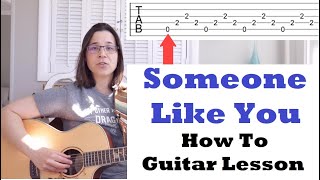
Lauren Bateman shows how to play Adele's 'Someone Like You' on guitar. The song uses a four-chord progression (A, E, F#m, D) with a thumb-index-middle picking pattern. Higher-position voicings on E and D chords help match the piano's sound.
Chapters
Hey, everybody, welcome back. Lauren here. And in this tutorial, we're going to be going over Adele's Someone like youe. Now, we're going to be splitting this song up into a couple categories. So we're going to be talking about our intro, our pre chorus, our chorus, and our bridge. So there's going to be 3, 4 parts to this tutorial. The other thing to keep in mind when we're going through this is that we are adapting the guitar for piano. This song is all piano. So this is a really great lesson on how do we adapt a song that is played exclusively on piano to a guitar? And in this tutorial, we're going to be talking about how we can use finger picking to kind of emulate the. Or.
Emulate, I think that's the right word. Should work. Okay, but anywho, we're going to try to mimic, I guess mimic the piano with our guitar. So the guitar is good. We're going to be arpeggiating chords just like you hear on the piano. So before we get into the actual tutorial, make sure you go ahead, hit the like button. Leave me a comment at the end, tell me that you liked it, and don't forget to subscribe to the channel if you haven't done so already. All right, so let's talk about the intro and the verse section of this song. So there's a couple ways to go about it, but first, let's talk about the progression. So we have an A, A major, we have E major. We have F sharp minor, and we have D. And you see here I'm using the bar chord. You can easily use the open chord. It doesn't matter. I just think it's easier to go from this shape to this shape here on the D chord. It really doesn't matter because it's the same note.
It doesn't matter. Just know later down the road I will opt to choose this one because we're going to slide up to an E. This will be, I think, in the chorus or the pre chorus. So I'm going to use that for a specific reason. But you can use the regular D. Not a problem. So let's talk about the picking pattern. So our chord progression is A, E major, F sharp minor and D over and over and over again. And in the verses and the intros, the chords get a full measure. And we're going to be playing 16th notes.
1E and a, 2e and a. 3e and a 4e and a. 1e and a, 2 e and a 3e and a.
4E and a. And what I'm going to do is show you how we're going to finger pick each of these different chords. And I'll show you some close ups in a little bit so that you can see up close how it looks on my hand, on my picking hand. So what we're going to do is we're going to start with the A major. So any of these three, I'm sorry, any of these five string chords, so A major, if you use the D bar chord or the E bar chord later, any of those, those are going to be five string chords. We're going to be only finger picking with our thumb, our index finger and our middle finger. So if you're used to the Pima method, P I M, those are the fingers we're going to be using. I like to use the numbers thumb 1, 2. Just so you know. So we're mostly gonna be using thumb one and two. And when we get to our A chord we're going to be picking. The thumb is always going to be picking the bass note. So on an A, that's going to be our fifth string, the open A string. So it's going to be A. And then our first finger is going to pick the string below the fourth string and then the string below the third string. So it's going to be, if we're talking about strings right now, it's going to be 5, 4345-4345-4345-4434. That's the picking. If we're going to do the fingers, it's going to be thumb 1, 2.
1, thumb 1, 2 1, thumb 12 1, thumb 1, 2, 1.
So there you go on that, that is how we're going to be picking any of these five string chords. A. Now our six string chords, which would be the E major and the F sharp minor thumb is still going to play the lowest note, which is this bass string, this low E. So for E major we're going to play the thumb. On the sixth string we are going to ignore the fifth string. So our first and second fingers are going to stay on strings four and three. So it's going to be 6, 4346-4346-4346-4484. And you would do the same thing for F sharp minor, it would be.
Thumb 1, 2, 1, thumb 12 1, thumb 1, 2 1, thumb 1, 2, 1.
So no matter what chord we're playing, we're always doing thumb 1, 2, 1 P I M I that's what we're doing for the finger picking side of things and for the D chord. Now like I said, if you prefer to use the kind of power chord D, that's fine. You would pick it like an A major chord. If you choose to use the open D, your thumb is going to have to move down to the fourth string. So I guess that's the other nice thing about using this D versus the other D is you don't have to adjust your picking hand. But let me show you how to do it in case you choose to use the open D. So again it's going to be thumb 1, 2, 3. Except our thumb is playing the lowest note of D which is the d string. So fourth string, third string, second string, third string, 4323-4323-4323-4323.
Thumb 1, 2, 1.
That's how you would play that D chord. And that's how we're playing through the intro and we're gonna do that thumb 1, 2, 1. It's gonna be four times per chord. So for A, it's gonna be 1E.
And a 2E and a 3E and a 4E and a 1E and a 2E and A 3E and a 4E and 1 2E and a 3 and A and a 1E and a 2e and a 3 and a 4e and a.
So ran out of breath there. So that is the, the timing of it. So what I'm going to do right now I'm going to go in for a really quick close up just so that I can show you guys really close up what my hand looks like on the finger picking side. All right, so here we're going to have the A major. So we have 4 5, 434543 4, E major. We're jumping up to the sixth string. 6434643 4. Same for F sharp minor. 643464 three.
Four. And then D thumb hops down to the fourth string 4323432 3. And there you go. That's how we're going to do the intro and the verses to the song. So next let's talk about our pre chorus. So the chord progression in the prechorus changes a little bit. We have an E major, F sharp minor, then we're playing a D chord for a whole measure and then we're again repeating that E major, F sharp minor. We're using a D chord and then we're going to an E chord and I'M not going to use the open E chord here. I am intentionally going to use this, this E chord because you can hear it's much higher in pitch than this E chord. And when you listen to the piano, she uses a higher pitched E. And that's why in this particular scenario, I am going to intentionally choose to use the D power chord in the E major power chord or the E power chord because of the sound in ease of flow. Again, you can use the open D and the open E. Not a big deal. I just think the way I'm going to play it sounds more like the actual song. Remember, we're trying to make our guitar sound like a piano, which we can never do realistically, but we can, we can imitate as best as possible. So in the pre chorus, the first two chords, the E major and the F sharp minor are now splitting a measure. So you're only going to do the thumb 1, 2, 1 twice per chord. So if we have E major, it's.
Going to be 4, thumb 1, 2.
1, thumb 1, 2, 1.
Then to F sharp minor, thumb 1, 2, 1,.
Thumb 1, 2, 1.
So it's E, 1 E and A.
2 E and A. F sharp minor.
3 E and A, 4 E and A.
And then we go to our D chord and we're going to do it for full measure.
So normal 1e and a, 2e and a, 3e and a 4e and a.
Then we go back to the E major, repeat half a measure.
1E and a, 2e and a 3e and a 4e and a D for.
Full measure, 1, 2, 3, 4. And this is now where we're going to slide up to that E for full measure.
I think you can pause on the 4 because there's a little bit of a pause in the piano before we jump into the chorus. So just to go through that one more time, so we got E for half a measure.
F sharp minor for half a measure.
D for full measure.
And then E for a measure. And I would pause on the 4.1e.
And a 2e and a 3e and a 4.
And then we're gonna jump in to our chorus. So let's check out that in the next part of the video. All right, so here we are in the chorus. All of these chords are going to be splitting a measure. So they're going to be two beats.
So one E and A, two E and A.
Switch chords three E and A, iv, E and A. And the progression stays the same for the entire chorus. It's going to be An A major, E major, F sharp minor and D. So it's the same chord progression as the verse, just the chords change twice as fast. So we're going to start again with A. So it's just going to be 1e.
And a 2e and a. Switch to e 3e and a 4e.
And a. F sharp minor, 1e and.
A 2e and A. And then the D3e and a 4e and A.
1 more time. Because this is the same as the verse, it's just. We're just switching faster. So here we go.
Chorus, 1e and a 2e and a 3e and a 4e and a 1e and a 2e and A 3e and a 4e and A.
And that's it. That's really all that we have for the chorus. Now the last section we're going to talk about is the bridge. Going into.
The chorus, after the bridge there's a little bit of a timing thing that changes. Our picking is going to change a little bit. So let's talk about that. So the chord progression for the bridge is an E major chord, F sharp minor D. These are all full measures. So we have E major, F sharp minor D followed by B minor in A splitting A measure and then D splitting a measure in E. And we're using the same picking patterns. Nothing's changing here picking wise. It's just the chord progression has changed. So we have E major one E.
And A, II, E and A three E and A four E and F.
Sharp minor 1, 2, 3, 4. Then we have D 1, 2, 3, 4. Then B minor is going to split A measure 1, 2.
And B minor is a five string chord, A major 3, 4. Then we got D 1 1, 2 and then E 3, 4. And again I think in the spot too, I, I would use the D power chord. 1, 2, 3, 4. Because that's that E is going to sound a lot more like the tune as opposed to this darker E down here. Can you do it? Absolutely. There won't be any issue. Just I think this higher E again sounds more like the tune. So let's talk about this last part, this final chorus. So what we're gonna do. So this part of the song really opens up. So we're just gonna strum the chords once. So we got a nevermind I find. So we're just gonna strum the chords once.
So it's the same chord progression. A.
E.
F sharp minor D. And you don't have to do the fancy wave like me if you don't want to. So we get single strums.
And then when we get back into the picking, Instead of doing 16th notes, we're going to do 8th notes. Because the piano, when you listen to the piano, it's kind of doing a cut time. It's half as many picks. So it's going to be.
1 and.
2 and 3 and 4 and 1 and 2 and 3 and 4.
And so all we're doing is thumb, 1, 2, 1 per chord.
So don't fall.
I think I'm in the wrong key.
For you to don't forget me, I beg I'll remember you saying.
So that's that part. So it's all just eighth notes.
1 and 2 and 3 and 4 and 1 and 2 and 3 and 4, and.
And then it goes right back into Nevermind. I find right when we get there, we're right back to the 16th note.
And that's really it. That's the entire song and the ways you can navigate through all these different sections of the song. So I really hope that you guys enjoyed this video tutorial. If you liked it, don't be afraid to go to laurenbatement.com donate. You can always make a donation. Or if you want to learn more about finger picking and get better at finger picking. I do have my guitar course online where I have a whole section on finger picking if you'd like to develop that more. So don't forget to like the video, leave me a nice comment and don't forget to subscribe and I'll see you guys in the next lesson. Video.










