Strumming, Strumming, Strumming -
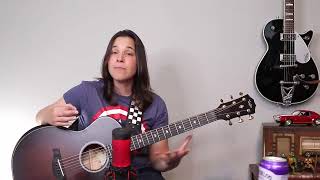
Lauren Bateman demonstrates guitar strumming fundamentals: lighter picks for beginners, wrist motion and pick angle, and 11-gauge phosphor bronze strings for tone. She emphasizes metronome practice starting at whole notes, 100 BPM, and previews her strumming course and a three-day Boston workshop in September.
Questions this video answers
0.73 mm (Dunlop Tortex, yellow); lighter picks recommended for beginners ~0.5–0.6 mm (orange 0.60 mm shown); also mentions 0.88 mm (green) and a very thin red pick ~0.50 mm.
11s — D'Addario Phosphor Bronze, on both her Crafter and Taylor guitars.
September 22–24 in Boston.
100 beats per minute (one strum per four clicks = whole-note strumming).
Course currently has ~3 modules and ~30–40 lessons; she added ~10–12 new electric guitar/rock rhythm lessons that will be released to existing students at no extra cost.
Chapters
Hello. See what we got here. Hello. Hello. I'm gonna have to fix my. My thing a little bit here. Give me one second. I thought I had zoomed it in and filtered it in. Usually, usually my wife is the one to help me with the lives, but here we'll do. This is what you have to do. You have to put it in auto focus and then it focuses on me and then I have to jump off screen real quick and get it back into manual focus.
And hopefully we are good to go. See, sometimes you're just gonna jump around a bit. This is being a content creator live here on YouTube. No one else. I'm just a one woman show, everyone. I'm just a one woman show. So it's just me. I saw T is on here. Kathleen is here from Texas. Mark was practicing his scales. I love Texas. To hear that tonight I wanted to go on talk about strumming, grab myself a nice little Waterloo. I love grape. Grape is my favorite flavor of anything. I love grape. And I want to talk tonight about strumming because with strumming, everyone always asks me about timing. Lauren, my timing stinks or my up strums just sound like crap. What do I do? First thing we want to talk about is the pick. Okay. This is a big thing I talk about in my strumming course. The right pick for strumming. Okay. Now this pick is 0.73 millimeters. This is the Dunlop Tortex picks. These are the picks that I really love to play with. But for a beginner, I would recommend even going a little bit lighter. Okay. Something like 0.5, 0.4, 3.60. Why? Because those picks, they're very more flexible than even this one. This one's kind of like right in the middle. Really like these yellow ones.73. Very nice. Kind of scared an overall pick. I like the green ones too. 0.88. But when you're a beginner, what happens is you hold on to this pick so stiff.
But it ends up sounding something like that. Move this mic over so you guys can see my strumming jam. So it ends up sounding really, really harsh. Right? Put a one in the chat. If you suffer from something like that with your guitar and your strumming. So that's number one. Move to a lighter pick. If I get my little pick thing over here. Cool thing. I've had this pick thing since 2010. This thing's 14 years old. And my wife actually made it for me when I started teaching. And, you know, because I. All my Picks were all over the place, and she threw them all in this container. And. And I yelled at her at first because I was like, you. You used my picks. But she. She loves that I still. I still have it. So this would be a lighter pick, this orange one. This Orange 1 is 0.60, super, super flexible. And then even thinner than that is this red 1.50. Look how flexible this is. Very bendy. Okay. And you'll get a slightly different sound with the thinner pick.
So you can hear a little bit more of the pick flapping.
Even that going from 0.5 to 0.6 is a huge difference. Here's 0.73.
So the stiffer the pick, the less flapping noise that you have as you're strumming. But for those of you who are beginners that have very, very stiff strumming, these thinner picks can help take the curse off just a little bit. Another point I want to make on the pick is the actual angle of the pick matters. Okay? So when we are strumming up the guitar, the pick hasn't kind of like the point is down, but the fat part is pointed up. And when we're doing a down strum, it's the opposite. And it's not this extreme, but the point is going up, and the fat part of the pick is down. So if I kind of turn my hand sideways, and I'll get out of the camera angle there for you. You can see. Can you see that pick? The points right there? Up, down. I might be over exaggerating a little bit, but you can also see my hand. My wrist is moving. I kind of doing this. So my wrist is not stiff when I'm strumming. It's going down, up, down, up, down, up, down, up. Okay? So make sure to talk, to pay attention to that, that your hand is not stiff. What gauge strings you have on your guitar, Jay wants to know. So on both my crafter and my tailor, I have 11s. Okay. I use D' Addario Phosphor Bronze 11s. Now, my. My tailor originally came with Elixir 12s, which have a great sound. And I know that that's what this guitar is made for. And people are like, you're not supposed to change the strings. But 11s for me are much more comfortable to play. And the guitar still sounds beautiful with 11s. Did I lose a little bit of the sound? Yes, just a little bit. But I'm willing to make that sacrifice and adjustment because it just makes the guitar so much easier to play. You know, for me, it's all about ease and playability. You know, the guitar already sounds great, so just, you know, I'm losing a little bit of sound because of the thinner strings, but it still sounds really, really great. So. So good question. Yeah. And, you know, the string size really isn't going to impact your strumming that much. Other than the thicker the string, the warmer the sound. Okay. So keep that in mind. If you have very, very thin strings, your strum is going to sound very, very tinny and that. And it also could be the material your strings are made out. I don't have a set of strings here, but if you use the 8020 bronze, the 8020 bronze strings are very, very bright. They have a very bright sound to them. Great. If you want to play blues and put something on a Gretch, really get that nice twangy sound. But for my acoustics, I really like the phosphor Bronze just has a much warmer sound. And when you're strumming, even when you're finger picking, it can just warm things up very nicely. Okay, thanks, Lauren. Good afternoon from sunny San Diego, Mand. Hello, how are you doing? Hi. Martin and I saw there were some people from Australia. We have Spain. Lara from Spain. Lara. It's got to be late in Spain. What is it like almost midnight in Spain? Holy smokes. Holy smokes. So that's the pick in strumming. Okay. So keep those in mind when you're strumming. And the other thing is timing. And we do a lot of this in my strumming courses. For those of you who don't know, I do have a strumming course. All right, it's laurenbateman.com.
Strumming and basically that strumming course goes from absolute beginner, meaning you know nothing about strumming, to more of the late intermediate, where we get into like percussive strumming, you know.
Or.
Kind of more percussive style of strumming, accented rhythms. And I just recorded a whole new section that I'm adding to the course which is going to be all electric guitar based. It's kind of like rock guitar rhythm. So right now there's three modules and that course is already like 30 or 40 lessons. But I think I added another like 10 or 12 lessons. So that's going to be coming out soon. So if you buy the course now, you buy the course now. When we release the new materials, you will automatically get access. You won't have to pay more for them. We will just give you access. So if you're interested in checking that out, if you really, really want to work on your strumming. Lauren Bateman.com backslash strumming laurenbateman.com backslash strUMMING and you can check out the strumming course there. Really, really great course. I say it's probably my second favorite course after the seven level guitar system. So seven level guitar system is my beginner course that a lot of you guys know. I think there's probably some of you in here that have taken the course. If you're a student in my course, let me know in the chat, let people know. And then after that is kind of the expressive rhythm course, which is one of my favorite because I am a rhythm guitar player. So we talk a lot about timing and I do a lot of play alongs because, you know, when it comes to rhythm, it's good to be able to hear what you're playing. So, you know, if you hear something, let's say we do something simple like 1, 2, 3 and 4.
Okay, so that's down, down, down, up, down. A very, very common strumming pattern that you can use in a lot of songs. And for some people, you need to hear the strumming pattern first. If so many students, they jump right to the guitar and they want to strum along. And I really encourage students. Listen. Last year at my event last year, I. I did a whole workshop and I was just in the UK too, in April, and I redid that workshop for people in the uk. There's a whole workshop on listening to the strumming pattern before you play. Because when you listen, you hear different things. Okay, so that was, that was a really cool thing. It was just like, hey, I'm going to play something and listen. Or we're going to listen to a bunch of different strumming patterns that are all doing the same thing, but still slightly different. Can you hear what that is? And in the beginning, you won't be able to hear much. Okay. Because your ear hasn't been tuned yet to strumming and hearing strumming and hearing the guitar. But as you go, you will hear the difference between a downstrom and an upstrom. Everyone goes, how do you know it's a downstream and upstrom? Downstrom is very dark.
Because you're hitting from the bass, not notes down. Whereas an up strum tends to be very tinny.
Because on an up strum, and this is a common question I get asked about strumming. Do you hit all the strings? No, you're probably only catching the bottom three or four. You don't usually catch the bass notes. And that's why.
Down strums are very dark. Up strums have a much, much brighter tone too. So when you're listening to songs, I tell students, you know, try and find the acoustic version of a song and listen to it. See if you can hear the difference between the down strums and up strums. Take a slow song to start. If you play something that's got like.
You know, you're doing like a Mumford and Sons song where they're playing this really fast 16th note rhythm, it's gonna be very hard for you to hear that in the beginning. I see we got New York City City in the house. Ohio. It's a great course. Oh, T's taking the course. Great. He goes, honestly, a definite favorite. So T's taking the strumming course. So, T, you're gonna be one of those people that when the new rocks rhythm stuff comes out, you'll get an email. We've already edited everything. I just have to update the workbook. So it's going to be coming out soon. The rock rhythm stuff, you're gonna get access to that as soon as it's live. You don't have to pay any more money. So whatever you paid for that course, we're not going to charge you any extra. And that's all my courses, whatever course you buy, whether it's the finger picking course, the power and bar chord course, the seven level, the strumming course, whatever course you buy online, once you buy it, you own it. And if I make any updates, I don't charge you for those updates, all right? You just, you get it. So you have lifetime access to these courses. And if for any reason I ever had to take a course down or was not going to offer a course anymore, I would make it available for you to download so that you could have it, you know, for as long as you need. That's the goal. So, yeah. So the strumming course, again, that's laurenbateman.com strumming or if you want to check out some of the other courses, just go to laurenbateman.com courses. I got a finger picking course. There's a music theory course. There's my Blues Guitar 101 course. That's a really popular one. That one came out last year. I had so many students that were asking me about blues guitar. And I do a lot of rhythm in that. I do a lot, you know, the blues.
Kind of like, you know, it's a different, like, boogie style and, you know.
You know, kind of that, that Johnny B. Goode style. And it's a very cool. It's very rhythm focused. But there is a module at the end where I do talk about lead guitar and improvisation. And it's all on this Gretch. All. You always ask me on YouTube, Lauren, when are you going to play the Gretsch? The Blues 101 course is almost entirely on this Gretch. I think I take the Ibanez out once and I play an acoustic once or twice in it. But 90% of the course was done on this Gretsch guitar. So for those of you that love my George Harrison Gretch that hangs in the background, you can, you can go check out that course because I use that, that song or that song, that guitar a lot in that course.
Love you, Lauren. Thanks for all you do. You're welcome, Bill. We have Charlie in Birmingham and then Eric. I can't believe I turned on YouTube and there you are. I am here. Well, Eric, I'm glad that you popped on. And, you know, some of you don't know. I've been trying to, like, tell more and more people. As you know, I live in the Boston area and I have an event coming up in September because people ask me, like, are you coming to New Jersey? When are you coming to Florida? When are you doing this? I have a big event I'm doing in Boston. Okay. I think we can have anywhere from like 80 to 90 people at the event. So it's not huge, but it's a good size event. And it's September 22nd through 24th. September 22nd through 24th. And. And so it's three days. We have a meet and greet on Friday. We're going to be doing workshops all day on Saturday, workshops on Sunday, too. We're going to be playing the guitar together. I'm going to play in lots of different songs with you guys. We have a jam room for after the event last year. We had, I think we had like 30 something people at the event last year. And they are jamming in their hotel rooms and they're like, can you get a jam room for us? So we got a dedicated jam room this year. So after the event, you all can hang out and have fun and play music music together. And like I said last year, one of the workshops I did was. Was all on strumming. And you know, we have a bunch of things. We're going to be doing a blues jam this year teaching you kind of like how to do blues jam guitar maintenance. There's going to be a chords workshop. And the great thing, I have some other teachers who are coming too. We're gonna have two rooms. So kind of I'm gonna be teaching more of the beginner, late beginner stuff. And then if you want kind of more intermediate, advanced stuff like, you know, improvisation and blues stuff, which is not really my strong suit. It's not my specialty. I have a couple other teachers, one who was at the event last year who's going to be teaching in a separate room. So if you're like, Lauren, I'm not a beginner anymore. I know this stuff. Go hang out in the, you know, the more advanced room with the other students. And it's really great because you get to meet other guitar enthusiasts. There's a bunch of you on here. And you get to see you're not alone in this guitar journey. Right everyone? Because that's the hardest part of learning is thinking you're alone. And when it comes down to strumming and timing, it's very important to be in time with others. So I know a lot of you have never had the opportunity to play music with other people. So if you're interested in learning more about that, it's laurenbatemanguitar.com event laurenbatemanguitar.combash event. And it's a three day weekend here in Boston. I'm gonna be there the entire time. I will get some one on one time. There'll be an opportunity to submit questions or come up on stage at me and get some one on one instruction, which is super beneficial because sometimes it just takes me changing your finger just a little bit to fix some of those chords. Bar chords. You know, when I was in the uk we did a whole thing on bar chords. And I feel like I'm going to do that at this event in Boston because I get so many questions about, all right, why are my bar chords not working? So we'll probably do a bar chord workshop showing you guys one simple fixes for bar chords. But also teaching you bar chords, kind of how to use them all over the neck of the guitar. And we could probably throw some strumming stuff in there. There's lots of cool strumming things you can do with bar chords. Definitely. Hello. We have Mario, who's in here and Eric's back on Roy. Oh, the guitar professionals from Jamaica. Oh my God. Two people from Jamaica. That's crazy. I love it. So awesome. You guys are Amazing. So back to strumming and timing metronomes. You guys know it. You get guys and gals, you both know it. I love the metronome, okay? And the metronome, it's just the heartbeat of the music. It's the click track of the music. And I'm going to pull up my metronome here. And the best thing to do to work on timing is what I call whole note strumming. Okay? One strum for every four clicks. Okay. I'm going to put this at 100 beats per minute here, which for some of you might seem pretty quick. Okay. I don't know if you can hear that, but it's here. All right. So each one of those clicks represents a beat.
1, 2, 3, 4. 1, 2, 3, four. 1, 2, 3, Four. 1, 2, 3,4. 1, 2, 3, FOUR. And that's where you gotta start with strumming is the timing of. Can I always get to the next chord on the one? Instead of going, 1, 2, 3, 4, 1, 2, 3, four, one, get out. Three. We don't want those hesitations and those crazy starts and stops because that's what makes music not sound good. I think a lot of students, you, you want to get into the really intricate strumming because it does sound nice. But this does not sound nice.
You guys, you guys get where I'm going with this. I'd rather you go, one, two, three, four. One, two, three, four. 1, 2, 3, 4. One, 2, 3, 4. 1. It's much more musical when you stay in time versus kind of starting and stopping. Timing is one of the most important things in music. And that's why in that strumming course, I have so many play alongs. This way you can play along with me and just practice. And there's tons of different strumming patterns because I get a lot of students who are like, I'm stuck on this strumming pattern.
A good old down, down, up, up, down. I mean, it's a great strumming pattern. It works on so many songs. It's such a good strumming pattern. But, you know, if you're one of those people that feels like Lauren, I keep coming back to the same strumming patterns stuck on this strumming pattern. How do I stop using like this one strumming pattern that my hand. What part of it is your muscle memory, Your muscle memory really likes that strumming pattern. So it's very naturally going to go back to that strumming pattern. But you want to learn as many strumming patterns as possible to expand your repertoire. But also you want to start learning songs that have really interesting strumming patterns. Something like Wonderwall.
You know, the strumming is what makes the song. Or something like Proud Mary, the intro to Proud Mary. You know, if I was playing like a Melissa Etheridge.
Okay. The strumming sometimes makes the song. So I encourage people to play more difficult songs that kind of get you out of your comfort zone a little bit. But I think there's like, there's a lot of different strumming patterns in this course. I think there's over 50 to 60 now, different strumming patterns. And there's also ones where I'll show you, like how to combine strumming patterns. There's accented rhythms, there's percussive rhythms. And it's just like the seven level course. I think it's four modules now. And the first module is listen. If you're an absolute beginner and you really need to focus in on the timing, we just focus in on quarter note strumming. And then so four strums for chord. We focus on the whole note strumming that I was just talking about. So we really focus on the simple stuff first before we get into the more intricate stuff, which would be eighth notes or syncopated patterns. Syncopated rhythms mean we're missing a down strum. So that down, down, up. This one, down, down, up, up, down, up, down, down, up, up, down, up. That is a syncopated rhythm. So for a lot of people, those can be tricky. And that's another case where it's helpful to just not play the guitar. Push play on a video and listen to me play the strumming pattern so that you can understand it. And of course, just like the videos, we put the downs and the ups on the screen so you guys, you guys can see it. I'm a member of Lawrence course. Hi, Heather from Canada and community. Highly recommend if you can attend the live event. I saw big difference in the skills and confidence of the people who attended last year's event. That's a huge point, Heather. Thank you for bringing that up. And, and as a reminder, the event is September 22nd, 24th in Boston. We do have some tickets left. It's laurenbatemanguitar.com backslash event or forward slash event, whatever it is, slash event. Laurenbatementguitar.com event and I had students. I remember one student, his name was Mick. And he came in and he was just like, I didn't even know how to Play it. He's like, I didn't know if I was gonna be able to do this. And he was like, by the end of the weekend, I realized I could do this. I was playing songs with other people. And it was just such a huge transformation. And I think that's the biggest thing is the confidence. Because, you know, I have a lot of students that come in. They're like, lauren, I'm just starting. I don't think that, like, maybe I'm not ready for this. And I had lots of students who were beginners. I had students who had gone through my course. I had some people who had never taken a course from me before. And they came in and they were nervous, you know, and then they met someone. And then all of a sudden they had a friend who was like them. And they were strumming together and they were playing music together and they were having fun. And you realize that, like, as much as guitar is a hard thing to learn, it takes time. It's not easy, okay? It's a process. And you realize that there's all these other people who are just like you, who are going through this process with you. And maybe you're at chapter one and you meet someone else who's at chapter 10. You're like, wow, you mean in six months I'm going to be just like you? Or. Or in one year I'm going to be playing just like you. It inspires you, it motivates you. And you meet people who, you know, man, I hate this C chord. And they're like, oh, my God, yeah, I hated the C chord. Or you'll meet someone's like, I hate the C chord too. So it's nice to know that you're not alone. It's nice to know that you're not alone. And I have so many students that came to the event in Boston last year. They still talk to each other, they still hang out with each other after the fact. So it's, it's, it's really is transformational. So if you have the opportunity, if you're not doing anything. September 22nd through 24th, Lauren bateman.lauren bateman guitar.com event. I would love to see you in September because we just had so much fun last year and I have so much fun meeting students. I was just in the uk. I did a one day event because I was vacationing in the uk and I was like, let me do a one day event for my people in the uk and it was a lot of fun. We had so much fun. It was a great time. I love meeting students and I would love to meet you in September. Carol says, I am a total beginner from the UK and have found your videos really good. Oh, Carol, thank you so much. I'm so happy to be helping. Helping you. Love it. Heidi says your videos are so helpful. Started from the basics with you. Well, you know what? If you started with the basics with me, I'm just really happy to say I'm glad that my teaching resonated with you. Most of you know, you know, the majority of my students are over the age of 50, so I do specialize working with older adults. And, you know, my teaching style adapts for that. I go slow. I do a lot of repetition. And that doesn't mean, you know, if you're in your 30s and 40s, that I don't want you as a student. No, I'm just saying, you know, sometimes I go a little bit slower because it helps. It helps that repetition going over things over and over again. I always know when I get someone who's like a teenager watching my videos, like, you talk too much. Shut up. And I'm like, it's okay. Like, you just need to listen, you know, that's what I love about older adults, because they have the patience and they have the wisdom to know that they can learn more from listening to someone and listening and learning from experience. So thank you so much for all your support, Carol, and everyone else on here who's watching. I really love working with you guys. You're the best. And if you can't come to the event in September again, that's September 22nd, the 24th. I highly recommend checking out the strumming course. Laurenbateman.com Strumming. It's a great course. We're going to be releasing some new materials in that course. So if you buy it today and we put those new materials in, we're not going to charge you any extra money. You just get it already. So fantastic. Everyone, thank you for, for popping in and saying hello. I have a great video coming up tomorrow. I think it's going to be Janis Joplin. Janis Joplin music a little bit tomorrow morning. So pay attention for when that video comes out and I'll see you all real soon. Bye. Bye, everyone. Have a good night. Or morning if you're in Australia.










