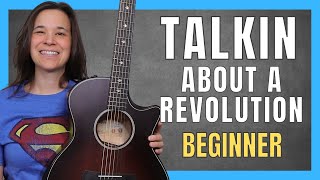
Lauren Bateman teaches an easy guitar arrangement of Tracy Chapman’s “Talkin' About a Revolution,” using four chords (G, E minor, C, D) and special "stuck like glue" voicings that keep the 3rd and 4th fingers anchored on the high strings for a brighter tone. The tutorial explains chord transitions (G → C → Em → D; each chord gets two beats), offers two strumming patterns (a simple down-stroke-based pattern and a more song-accurate down, down, up, up, down, up), and includes playthroughs of hook, verse, and a tricky bridge. Lauren directs viewers to laurenbateman.com for chords, lyrics, and strumming notes.
Questions this video answers
G, E minor, C, D.
G → C → E minor → D, repeated for the whole song.
Two beats per chord (chords split a measure).
Down, down (two strums per chord) with an optional up at the end: down, down, up, down, down, up, ... (applied across chords).
Down, down, up, up, down, up (with chord changes on the up after the two).
Chapters
Hey, guitar enthusiasts. We're going to do a super simple song by Tracy Chapman. Only uses my four favorite chords. G, E minor, C, D. You can start by using those regular chords, but I'm going to show you what I like to do in this song to make it sound a little bit brighter, a little bit better. So again, we have the traditional chords, C, G, E minor, D. And if you're someone who knows my easier two finger versions of the D chord, the C chord, and the G chord, those you can use on here as well. But you might like these versions of the chords, which I call my stuck like glue chords. And I call them that because I believe Sugar Land has a song that's called Stuck Like Glue and it uses these chords. So I always called them the stuck like glue chords. And it's very fitting because our third and fourth fingers are going to be stuck to those bottom two strings. So what am I doing? I have my third finger on. On the B string at the third fret, and I have my pinky right below it on the high E string, also at the third fret. So these two fingers are going to be stuck here, right? Stuck like glue to these bottom two strings. They're not going to move, and it's going to give the song a much brighter feel. And I think it works really, really well. The other thing that's nice about these stuck like glue chords is these two fingers are stuck, so you only have to move these other two fingers. And I like it when you have to move less fingers. So let's talk about a G ch G chord. The setup's basically the same. Okay? We have first finger, second finger up here, and the stuck like glue fingers on the bottom. Now to go from G to C. It's a very easy movement. So what we would call more of like a C, add nine chord to go from G to C. You just take these two fingers and you move them down one string. So instead of being on strings six and five, you are now on strings five and four. Okay, so we have G, we have C. Okay, let's go back to G. We have a little pivot point here to get into E minor. Now, this would technically be called an E minor 7 chord. All you have to do. See how I slide that first finger up to make room for my second finger to go underneath. Now, some of you have big enough fingers that you might be able to just put one finger down and play both of those strings. I do not have giant fingers, so I'm going to use both of My fingers. So again, for from G, lift up that second finger, slide the first finger back, put the second finger right underneath. Okay, so we have G, we have C, and we have E minor. Now to get to D, we're going to lift up our second finger and just drop the first finger down.
To the G string. And this would be what we call a DSUS4 chord, just so you guys know the terminology. And that's the D chord we're going to be. Now you can see these fingers have never moved. Watch. G.
C, E minor D. It has a very, very bright sound versus G.
C E minor D. Okay, one more time with the stuck like blue chords.
It's a little bit of a brighter tone. I really think that's probably what Tracy is using this song. So I'm going to be using the stuck like glue chords for the rest of this tutorial. You choose the chords you know best. Let's get into the strumming.
So I'm going to show you two versions of the strumming. I'm going to show you the easy version for those of you who are beginners. And then I'll do a little bit of a playthrough. And then at the end, I'm going to show you a little bit more of kind of like a late beginner strumming pattern that is probably more like the song. But let's get started with the rhythm, because with this song, I all of the chords split a measure and what that means is they're going to be two beats. Okay? So the chord progression, the great thing about this song is the chord progression is the same for the entire song. G, C, E minor D, G, C, E minor D. And all of these chords get two beats. So if I were to break that, super simple, it would be 2 strums on G, 2 strums on C, 2 strums on E minor, 2 strums on D. So B don't you know.
Okay. Works great. If you're a very, very beginner, two strums per chord is perfectly fine. Now if you want to throw an up strum in there, it means those chord changes just have to be slightly quicker. But if you're feeling good, we're just going to throw an up strum at the end. So it's going to be down, down, up, down, down, up, down, down, up, down, down, up. Okay, so let's just play on that G chord to get the strumming pattern. So we got 1, 2, ready, and.
1, 2, and 3, 4, and down, down, up, down, down, up.
One more time. Here we go.
One, two.
So that's our strumming pattern. Now we're going to put it over the chord progression, the order of the chords. G, C, E minor, D. Ready? Here we go. One, two, here we go.
One, two, and three, four. And one, two, and three, four. And down, down, up, down, down, up, down, down, up.
Here we go.
Don't you know I'm talking about a revolution? It sounds like a whisper let's keep going.
Ready?
Don't you know I'm talking about a revolution? Sounds like a whisper.
All right, so that's the. What we call the hook or the first kind of chorus of this song. And if you need notes, you can always follow along on my website, laurenbateman.com where I have the strumming patterns and the chords and the lyrics and stuff for you to follow along with. So that is a very, very simple way to go through these parts of the song. Now, there's going to be a bridge part where the singing picks up. So this is kind of a tricky song to sing and play at the same time. So this bridge goes. Don't you know you better run.
So that's a lot of words. The other parts of the song are fairly easier to see, sing, and play over. But that bridge can be very, very difficult. So to do that, you want to make sure you lock in this strumming pattern before you attempt to sing that section of the song. So those are the easy ways to play through this song. But if you're a little bit more of a late beginner, like to challenge you to play it a little bit more like the actual song. And what I'll do is I'll play a little bit more of a playthrough here. We'll do a hook, a verse, a hook, and we'll go through that bridge as well. So what Tracy's really doing on this song is she is hopping the rhythm. And what do I mean by that? So so far, we've been changing on the downbeat. Okay. On the 1, 2, 3, and 4, we're always changing the chords on a down strum.
Ooh. Little bit different there. Right? It almost feels like we're rushing to that second chord. Instead of it being nice and even kiltered.
It'S gonna be this.
We're kind of rushing on the up strum. So on this part of this strumming pattern, we're using a very, very common strumming pattern. It's going to be the down, down, up, up, down, up strumming pattern. It's very, very common. Works for a lot of songs. And all we're doing, if I just hang out on this G chord again, it's going to be down, down, up, up, down, up. So we're missing the down strum on the three. Okay?
So it's going to be down, down, up, up, down.
Okay. And what we're going to do is we're going to change the chord. The second chord is going to change on the up after the two. So it's going to sound like this.
It's going to be 1, 2, and 3, 4. 1, 2, and 3, four.
One, two, and three, four.
1, 2, and three, four.
All right, so you might want to pause the video and practice that a little bit. Just those first few strums.
Down, down, up, down, down, up. Again. Down, down, up. One more time. Down, down, up.
Okay, so you can get the feel of that. Because then you're gonna have to add another up, down, up on the end. So it's gonna sound like this.
Down, down, up, up, down, up, down, down, up.
Oh, I missed the chord change. Let's do that again.
And there you go. See, I still make mistakes. I've been playing the guitar for over 20 years now, maybe. Yeah, over 20 years, and I'm still making mistakes. So if you make a mistake with this, don't worry, it's not a big problem. Now, this song is a little bit peppy, so just go slow with that strumming at first, but let's try a little bit of a playthrough. We'll do an intro, we'll do the first hook, a verse, another hook, and we'll go through that bridge just so you can hear how that sounds and you can play along with me. Ready? Let's do. Take it from the top. 1, 2. Ready AM.
Don't you know Talking about a revolution Sounds like a Wh.
Don't you know oh, they're talking about a revolution it sounds.
While they're standing.
In the welfare lines.
Crying at the.
Doorsteps of those armies of salvation Wasting.
Time in the unemployment lines Sitting around.
Waiting for a promotion don't you know I'm talking about a revenue solution it sounds like a whisper.
People going to rise up and get their share.
More People going to rise up and take what's theirs.
Here's the bridge.
Ready? Don't you know you better run?
Absolutely. Beautiful song by Tracy Chapman. If you want to learn another Tracy song, I highly recommend you go watch my fast car lesson right over there where I get into some basic finger picking. It's a great song to get started with.