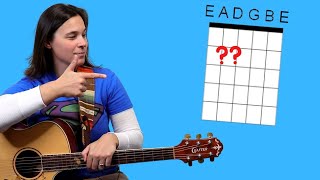
Lauren Bateman shows three ways to play E minor on guitar. The 1+2 fingering works best for beginners because it lets you pivot quickly to C, G, A, and D chords without moving your hand much.
So if a lot of students ask me, Lauren, what is the best way to play an E minor chord? I've seen lots of different variations. Well, I'm going to show you what I think is the best one to learn to get faster chord changes. But I'm also going to show you two other versions of E minor that you could use in various situations.
So this first E minor chord I'm going to show you is the one I show my students. It's originally how I learned to play an E minor chord. But I figured out how to. There's really something special about starting this way. So we're going to start with fingers one and two. Okay? Just trust me on this. You'll see why. Fingers one is on the fifth string, second fret, and finger two is on the fourth string, second fret. Now, Laurem, what is so special about this versus, you know, using fingers two and three? Well, what's so special about this is it creates pivot points, which makes it so much easier for you as a beginner student to transition between a C chord and a G chord. Let me show you. So in my seven level guitar system, students start by learning two fingered chords, and then we graduate to three fingered chords. So if I do my easy C chord, all we have to do is move one finger to go between E minor and C. We've got this pivot point, this second finger here, it never moves. You just got to move the first finger back and forth, back and forth. The same thing going between the easy G chord and the E minor chord that I show students. The first finger this time gets locked in place and you just move the second finger up and down. And then usually what I have students do is we go G, E minor, C, C, E minor, G, back and forth between those two chords. And you can see it's so much easier to just move one finger than have to move multiple fingers. Now, even to this day, even when I'm playing full chords, whenever I go from a G chord to an E minor, I still use that pivot point. And when I go from A, E minor to a full C chord, I still use the pivot point. So you can see E minor, C, E minor, C, I never have to lift up that second finger. Same with the G chord to E minor, I might have to just adjust the spacing of where my finger is in the fret. But other than that, my finger isn't really moving off that string. So that's why I like this. It's a great pivot point. And then if you add a D chord on top of it, those are four really great chords that you can use to play thousands and thousands of songs. So now that you know the version I like best, I'm going to give you the second version that a lot of students really like. And this has a really great situational approach as well. So for some people, everyone's hands are different. So the second finger is on the fifth string, and the third finger is now on the fourth string. It's the same exact chord. It doesn't matter if you're using fingers 1 or 2, 2 and 3. Some people find this more comfortable, and that's totally fine. It's not wrong, it's not incorrect. It really just is a personal preference. But I showed you why I like the other version better for certain chords. Now, situationally, I do use this version of the E minor chord, and most commonly, that's when I go from an A minor chord to an E minor chord. Why would I do that? Because you can see my fingers, my second and third finger are already positioned for an E minor. Now, I know what you're saying, learn. But you could just easily pivot into an E minor. You could, but you have to do a little bit more adjusting on the fretboard. Whereas going from A minor to E minor, it's just an up and down motion. For me, muscle memory wise, whenever I go from an A minor to an E minor, it's automatically going from this way to the second and third finger. Another situation where I might do that is if I'm going from like a D7 or an A7 chord.
To an E minor chord, because again, my second and third fingers are already in that second fret. So situationally, it just makes sense to just move these second and third fingers right up into place. Now I'm going to give you a third version of the E minor chord that you may have never even considered, but it has a very, very specific application. So the final version is using our third and fourth fingers. Okay, so the third finger is now on the fifth string. The. The pinky is now on the fourth string. And this becomes more accessible to you when you get more into that intermediate stage and you start learning bar chords. Why is this convenient? I mean, it probably seems pretty awkward if you're trying it right now. Well, if I'm playing a G major bar chord.
You can see all you have to do is slide, slide my finger. So I do this a lot sometimes when I'm playing different songs. So pick whichever E minor chord you think works best for you. And if you're interested in playing a two chord song using that E minor chord, well, go check out my Horse with no Name lesson where I show you how to simply play a full song with only two chords.