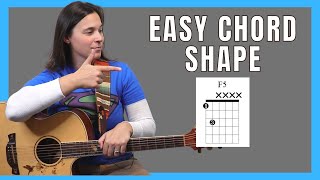
Lauren Bateman teaches power chords: two-note shapes made from a root and fifth. A B power chord sits at the 7th fret. The key is muting unwanted strings with your ring finger, then mixing down-strums with quick up-strums for that chicka chicka feel.
Chapters
So power chord is basically an abbreviated chord. I call them abbreviated chords. Because in this example that I'm going to show you today, we're only going to be playing two strings versus multiple strings with open chords. And it has a very different sound. So here is an open G chord, okay? You can hear I'm playing six strings. It's got a lot of sound that's coming out of the guitar, okay. Versus a G power chord.
It's very abrupt. We're only hitting two strings. So there's not a lot of sound like we have in an open G chord versus a power chord. So let me show you how to play them.
So now some of you, this might be a bit of a stretch. So I'm going to start us a little further up the neck. We're going to start at the seventh fret. So this is going to be a B power chord. Now the important thing to know on power chords, we're going to be using two fingers. We're going to be using our first finger, the index, and we're going to be using our ring finger, the third finger, okay? And the first finger is our lead finger. Because this is the note, this finger, whatever fret we're playing in string, that's going to be the note that names the chord. So for example, to play a B power chord, we're going to come up to the seventh fret on this top string. That's our B note, okay? We call that the root note. It gives the name to the chord. So that's where we're starting our first finger. Now the third finger plays what we call our fifth note. Just so you guys know, usually in rock music, if you see like a B flat 5 on the chord chart, it's telling you to play a power chord. And that's why it's saying play the root and the fifth. That's just a little music theory for you guys who are interested. So it's the root and the fifth. Now to find the second note, you're going to take the third finger, you're going to move up one, two frets, all right? So you're going to be on the ninth fret and down one string, alright? So your ninth fret on the A string first finger is the top string seventh fret, which is the B note. And then your third finger is going to be on the A string ninth fret, okay? And you're going to play both of those strings at the same time.
Okay? And that is a power chord. Now something that's very important for you guys to know is that I'm kind of laying my third finger flat against the other strings because we don't want to play those other strings. We want to mute them. And if you're playing on electric guitar, this is very important because you're playing through an amplifier and. And the amplifier will amplify those other strings, and it'll sound really messy and muddy. So you want to make sure you're just gently resting that finger on the other strings to mute.
Okay. And it's mostly important because you're not strumming the whole set of strings. So the ones to really focus on muting are the third string and the fourth string, those middle two strings. Okay. Because our strumming here is very short, and with power chords, you're usually playing down strums. You don't usually do up strums on power chords. You can. You can usually when we. I just dropped my pick. So as I was saying before, my pick flew out of my hand, usually we do up strums when we do something that I call a chicka chicka. That's when you'll do up strums. But usually on power chords. And there's exceptions to this. A lot of times you're going to be doing down strums on these power chords, so you're not doing really big strums as if you were playing your open chords like you would on an acoustic. So let me show you a few other chords here, and then I'm going to show you at the end of the video where you can go to learn how to use these and play something that's super fun. So what we're going to do, let's find the A power chord. So that's going to be the fifth string. Sorry, Fifth fret on the top string, then up two frets. So that would be the seventh fret down to the A string. So it's fifth fret on the top string, seventh fret on the A string. Okay. And the G power chord is the third. Third fret on the top string. Fifth fret on the A string. Now you can do this on the fifth string as well. So we have a C power chord just below the G power chord. So that would be the third fret on the fifth string. And then the fifth fret on the D string right below. So this shape.
Can go all along the top string and the fifth string.
So you can play all these cool chords all the way up and down the fret of the guitar without having to worry about different shapes and and different figures for all of the different chords. As long as you know what note the first finger is touching. There are no majors and minors with power chords. That's what's great. So you really can use them to simply play over a lot of songs. If you're interested in learning how to use power chords to play over any of your favorite blues guitar songs, why don't go check out that video over there?