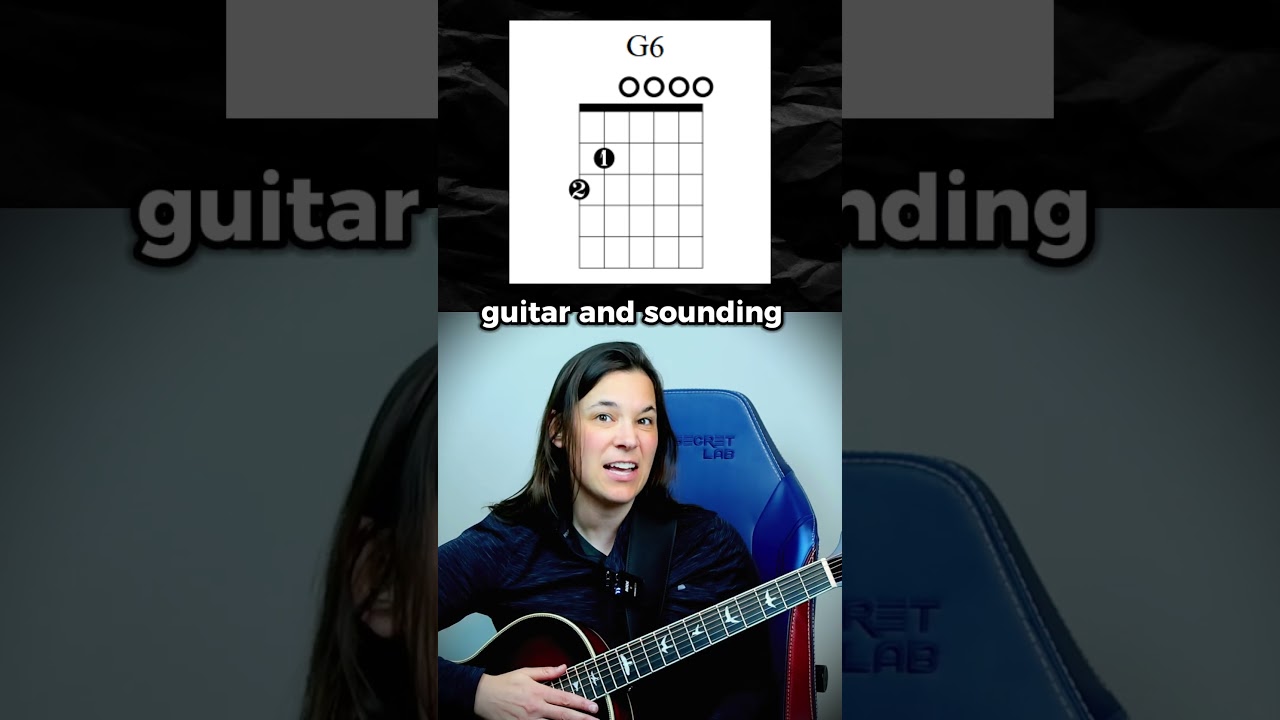
Lauren Bateman shows a two-finger G chord that's easier on your wrist than the standard version. Middle finger on the 3rd fret of the low E string, index on the 2nd fret of the A string. It opens up 50+ songs and works as a stepping stone to fuller chords.
Chapters
So I'm going to show you a simple way to play a G chord. It's just a simplified version that won't kill your fingers. I'll also show you a few options afterwards for the fuller sound of a G chord. So for a lot of my students, I work with a lot of older adults, and whether you're old or young, it's hard to move multiple fingers at the same time when you're learning to play guitar. It's just a new mechanic. So I have a two-finger G chord that I show students just to get you started with playing, getting your fingers comfortable with moving. And what it is, it's going to require your first two fingers, your index finger and your middle finger. We're going to move the middle finger to the top string, this thickest string on the guitar. So that's going to go right here on these blocks. These are called frets. So we're going to put it on the third fret of that top string. Your index finger is going to go on the string below, which is our A string, and it's going to go on the second block or second fret. So again, you're going to get what we call a G6 chord. It is a type of G chord that will get you started, okay, with playing the guitar and sounding good. Now usually you will see a G chord played with 3 fingers like this. It's a fuller sound, much more beautiful, a traditional G. A lot of people play that with their 3rd finger, but you can also play it with your pinky. For me, it's not as comfortable and it puts a lot of strain on my wrist, so I prefer playing with my 3rd finger. But if you're just getting started, I recommend just start with the 2 fingers because then you can pivot into chords like an easy E minor or easy C chord into a G. Okay, very, very popular chord used in a lot of songs. Give that one a try first and then graduate to the bigger chords.