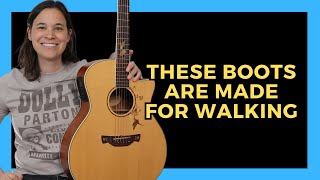
Lauren Bateman teaches Nancy Sinatra's "These Boots Are Made for Walking." Learn the slide-down intro on the low E string, three basic chords (A, E, G), and two different strumming patterns for verses and chorus. Optional 7th-chord substitutions add variation.
Questions this video answers
Single notes on the low E string from the 12th fret descending stepwise to the 5th fret (12→11→10→9→8→7→6→5).
A, E, and G.
Alternate picking (repeated down-up strokes).
E major — 12 of 16 measures played were E in the instructor's example.
Chapters
Hey, guitar enthusiast Lauren Bateman here. And we're going to be doing a super fun song called these Boots Are Made for Walking by Nancy Sinatra. And I'm going to start off with a really cool intro, show you how to do that walk down. But first, let's talk about the chords we're going to be using. You can play, for the most of the song, an A chord, an E chord, and a G chord. Right. You can play this entire song with those three chords. If you listen to the record, some of the verses, they do change and they will sometimes play a 7 instead of a, and they will play e, e 7 instead of e major. Okay? So you can go over to my website to see which of those verses they are. But if you are not good with those seven chords, you can just play with an A chord, an E chord, and a G chord, and you can play this entire song. So let's start off with that cool walk down. So this little intro, super cool. All it is is we're just going to be playing single notes on the low E str. Okay? That's all it is. Very, very simple. And all I'm doing is I'm starting at the 12th fret and I'm moving down to the 11th, 10th, 9th, 8th, 7th, 6th, and then I'm stopping at 5. And with my picking hand, I'm using alternate picking.
Okay, that's all it is. I go a little slower. It's 1 and 2 and 3 and.
4, and 1 and 2 and 3 and 4 and.
Okay, so a little faster. Okay. And then after that, we're going to get into the strumming the song, which is on an E chord. All right, now four. Just one more note on. On the picking. Which finger do you use? You know, I. I kind of start with my second, and then I go to the first finger and I just slide my first finger down until we get to the fifth fret. So it's. Okay. So that's all I'm doing is just sliding that first finger down 12 all the way to 5. And then you stop. All right. Because once you get to five, we're going to get into actually strumming the song. And you saw. I'm going to go to an E major chord. Okay. And the strumming pattern we're going to be using for this is 1, 2.
And 3, 4, and 1. Down, up, down, down, up, 1, 2, and 3, four and down, down, up, down, down.
Okay. Kind of got like a countryish kind of feel to it. I like to add a little spice to it. I like to play the bass on the first note, so I just play the lowest string of the chord, You know, because when you play these songs, they usually have an entire band behind them. So for me, it just. It gives a little bit of that feeling of a bass player being behind it. So it's bass down, up, bass down, up. So on an E chord, the lowest string would be the sixth string, or on an A chord, it would be the fifth. And on a G chord, that would be the sixth string. But when we get to the G chord, we're going to be doing a slightly different strumming pattern. I'll show you when we get there. So these verses are just E. And a lot's of E, a little bit of a. Back to E. All right, so if I take this first verse, it would sound like this. One, two. Here we go. Here we go.
You keep saying you got something for me Something you call love I confess you've been messing where you shouldn't be messing and now someone else is getting all your best.
So you saw, I just played 16 measures of music, okay? And 12 of them were an E chord, which makes this such a great song because it's mostly E. You switch down to the A chord for just four measures, and then you go back to A. All right, now, the tricky part is coming up here because we're gonna switch strumming patterns. You could use the same strumming pattern. I think it sounds a little bit better on the chorus. It opens things up more. And the strumming pattern we're going to be doing on the chorus is down.
Down, up, up, down, up, down, down, up, up, down.
So it's 1, 2, and, and 4.
And down, down, up, up, down, up.
1, 2, and, and four.
And down, down, up, up, down.
Now, if you're not used to going from one strumming pattern to the other, you might need to practice. You. And just starting on the e chord.
Go 1, 2, and 3, 4. And down, down, up, up, down, up, down, down, up, down, down, up, down, down, up, up, down, up.
Okay, so I would just start with the chord, then I would put the chord change in.
Because on the chorus, this is what that strumming pattern is gonna sound like. We're just going between a G chord and an E major chord here. So we got.
These boots were made for walking and that's just what they'll do. One of these days these boots are gonna walk all over you.
Ok, on the end of that chorus, I hit the E chord. I strummed it once and then immediately with my fretting hand, I just relaxed my grip on the strings and muted it. All right? So I went, okay, so again I'm gonna let the strings ring, I'm gonna release my hand and then I'm just gonna lay my fingers very lightly. I'm not. I'm not gripping the strings at all. Just gonna lightly lay my hand on the guitar and it's going to mute that note. So one of these days these boots.
Are going to walk all over you.
Now do you have to slide the hand up the guitar? No, you don't. I'm just used to doing that. And you'll get that little. If you have round wound strings, you're going to get a little bit of that. That string noise that you get on the acoustic guitar. It's just a habit for me to do that, you know, doing stuff like that, sliding up the guitar. Just a habit. You don't have to, but it just makes it a little bit more fun, a little more rock and roll. And then you heard on the end of the chorus, you can just go right back into. You can either just go back to strumming or you can go back into that intro, Okay. And jump right back into it. And that is the entirety of the different parts of the song. So what I'm going to do now, so just so we can play through a little bit, I'm going to do an intro, verse, a chorus, we'll do an interlude, another verse and a chorus. And that will get you through most of the song just for you to play along with me. And I will throw in the. I will throw this in so that you can practice playing along if you want to. Or if you just want to strum, you can strum along. But I have one thing to mention. I forgot the next verse. The second verse uses the seven chords. So I'm gonna play the seven chords. But if you just want to stick with the regular chords, that's totally fine. One, two, one, two. Here we go. Ready? Here we go.
You keep saying you got something for.
Me.
Something you I confess you been messing where you shouldn't have been messing and now someone is getting all your best these boots are made for walking and that's just what they'll do? One of these days these boots are gonna walk all over?
Yeah, right.
Now here comes E7. Ready?
You is lying when you oughta be truthin? You keep losing when you ought to not bet? You keep saving when you want to be a changin? Now that's right? As you ain't been right yet? Well, these boots are made for walking? And that's just what they'll do? One of these days these boots are gonna walk all over you?
Now, if you enjoyed this lesson, I highly recommend you go watch my Walk the Line lesson. Right over there. It only uses three corners chords A, E, and D. So a lot of what you applied in this song is going to work right over there. Go check that one out right now.