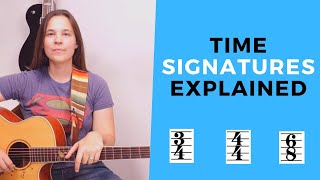
A short instructional YouTube lesson by Lauren Bateman explaining musical time signatures for guitarists. Covers how to read the top and bottom numbers (count and note value) and demonstrates common meters: 4/4 (common time), 3/4 (waltz feel), and 6/8 (two groups of three eighth notes), with practical counting and picking examples.
Chapters
Hey, guitar enthusiasts, welcome back. Lauren Bateman. Here in this video, we're going to go over a common question I get, which is about time signatures. What are they? What's the difference? What the heck does it actually mean? We're going to talk about that in this lesson video.
Real quick. Before we get into the actual lesson video, I just want to say thank you to some of my YouTube supporters. Michael Cannon, James Burke, Tim. Timothy Timmerman. Thank you guys so much for your donations. I really appreciate you guys doing that. Shows me that you guys love what I'm doing here on YouTube. Thank you so much. Let's get into the lesson video. So when we're talking about time signatures, I usually start people off with what we call four. Four time signature. So you can see from the diagram over here, it's two fours stacked on top of each other. Now, all time signatures look like this. There's a number on top, and there's a number on the bottom. Now, the number on top tells us what the actual count is. So in this example here, we have a four on the top. So that's going to tell us our count is four.
1, 2, 3, 4. 1, 2, 3, four. 1, 2, 3,.
The number on the bottom tells us what kind of note equals one. So in this example, we have a number four. So that's going to be a quarter note. So every time you see a quarter note, you would count one. All right, so think of it as like a dollar bill. A dollar bill equals one. And if you subdivide that into quarters, you would have four quarters. Okay, so think about that with four, four, time. So once again, the top number is the count.
1, 2, 3, 4. 1, 2, 3, four.
And the bottom note indicates that a quarter note is equal to the number one. So what does that mean when we have something like three, four for a time signature, which is a very common time signature in music. 4, 4 and 3, 4, both. So there's now a 3 on the top. The bottom is still 4. So we're still talking about quarter notes as the subdivision here. Okay, now we're going to count to three. Okay?
1, 2, 3. 1, 2, 3. 1st, 2, 3. 1, two, three.
And if you notice with three four times, you feel like you're going to sway, we call this a waltz, okay? And that's how you know the difference. So if you're like, I don't know what time signature my song is usually four. Four is right on the beat. You can tap your foot to it. It's straight in line. It's dead on. A waltz is more like a flow.
1, 2, 3.
You feel like you can sway.
1, 2, 3. 1, 2, 3. One, two, three.
So that's the difference between three, four, and what we call four, four. Hey, guys, real quick, if you're enjoying this content, make sure to subscribe to my channel so that, you know, when I release more lessons and videos. Now, you might have seen another common pattern, which is 6, 8, and 6, 8 and 3, 4 are fairly interchangeable. They're both swing or waltz feels. So when we have something like six, eight, you'll see on the top, we have the number six. So instead of counting to three or to four, we're going to count to six. 1, 2, 3, 4, 5, 6. 1, 2, 3, four, five, six. 1, two, three, four, five, six. Now, the bottom note is an eight. So this is telling us that eighth notes equal one. All right, so when you see the rhythm here, you'll see we have pairs of eighth notes. So instead of having six quarter notes, we have three pairs of eighth notes or six individual eighth notes here. So that's all it's saying. It's saying count to six and it's an eighth note. Now, how do you know when you're going to use 3, 4 versus 6? Because they kind of feel the same. You could just go one and two.
And three and one and two and.
Three and one, two, three, four, five, six. One, two, three, four, five, six. So what's the difference? And when would you. When would you use it? I use 6, 8 a lot for picking. So say you're just going to put my pick down here. So I was going to finger pick something like a song like Hallelujah. Okay. I'm just picking a G chord. It's easier to count. Now, eventually you're not going to have to count everything, but I think it's easier to count as 1, 2, 3, 4, 5, 6. 1, 2, 3, 4th, 5, 6. 1, two, three, four, five, six. 1, 2, 3, four, five, six. Versus going 1 and 2 and 3.
And 1 and 2 and 3 and 1 & 2 and 3 and 1 and 2.
& 3. And can you do it either way? Yes. They're kind of. They're kind of interchangeable, but on the sheet music, the sheet music, you'll see eighth notes versus quarter notes. So if you have a song that has picking and it has that waltz feel, it's probably going to be in 6, 8. If you have a song that's more strumming and just simple downbeats, it's probably going to be in 3, 4. But I'll let you know on songs we do hear whether we're going to be counting to three or whether we're going to be counting to six. Six. Now those are your three most common that you're probably going to run into. But you can have some weird time signatures. You could have 17, 16, which means there's going to be 17 beats and 16th notes are going to be the count. Now we're talking about really weird kind of like percussive music, but it does happen. There are. You could see 12, eight as well. That's another time signature. But the most common ones that you're going to see in kind of pop, popular in contemporary music are 4, 4, 3, 4 and 6, 8. But now you know what to do when you see those time signatures. I hope you guys enjoyed this video. Make sure to like and leave a comment below with questions you might have that you want me to answer. YouTube is going to pop a couple more videos over here. Go check those out. I love helping students. There might be something cool over here that YouTube's going to suggest. I hope I'll see you guys in another lesson video.