Tips for Learning Songs & Performing Them
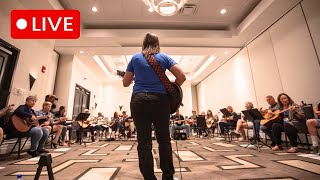
Guitar teacher Lauren Bateman walks through how she learned Bob Dylan's "Blowin' in the Wind" for a performance. She breaks down her memorization process: start with the chorus, isolate verses, repeat heavily, test without melody. Her advice: use cheat sheets early, have three songs ready, practice until your hands remember it.
Chapters
Hello. All right, let's give this a try again because obviously the Internet is under the weather too, because it's raining outside. And my house here in Massachusetts does not like when it rains outside. It doesn't like when it's cold. It doesn't like when it's rainy. We have a visitor here with us today. We have Olive, who's going to be with us for the duration of the live show. She was just sleeping here on the couch, so. Sorry, Olive, we are going to disturb your sleep with this. A little bit of a live and a little bit of playing, but hopefully she won't mind. All right, let me get my guitar back over here, so. All right, just go back to the. The beginning of this because we lost the. The intro. So basically I was saying, you know, a lot of students ask me, lauren, you know, how do you go about memorizing a song to be able to perform it, right? So, like, you wanna. Or. Or maybe a few songs to actually be able to perform. So about a week and a half ago, I performed a song at a student's ceremony of life. That song happened to be Blowing in the Wind by Bob Dylan, which poses its own challenges. Even though it's a very simple song in terms of. The chords are very simple, it's a very hard song to memorize because one, the chord progression is not consistent all the way through. So you have a chord progression you have to memorize. The lyrics are very similar throughout. So I have how many times, how many roads, how many years? So it's very easy to mix up these verses. And I worked on this song for about a month. I would say two weeks kind of off and on, and then two weeks off. Excuse me. Sorry. I told you I'm under the weather. Two weeks, very, very consistently to really work on memorization and work on understanding the song. So the first two weeks, I really just sat down with the song because, you know, I didn't grow up with this song, so I didn't hear it every day on the radio. I kind of knew the chorus, but all the other lyrics were kind of like, wishy washy to me. So it wasn't something that was part of my muscle memory, as if it were a song that, like, I grew up with when I was a kid or that we listened to in the house a lot. I don't think either. My parents were big Dylan fans. My dad's like a Fleetwood Mac, Rolling Stones guy, and my mom is a Beatles Motown gal. Okay. So that's kind of like what I Grew up with. So if it were like, you know, for, like, a Jackson 5 song, if it were like, a supreme song, I've probably heard it a million times, but Bob Dylan I haven't heard a million times. Good morning, everyone from New York. St. Louis is in the house. Romania. Hello. Hello. Another rainy day here in New England, and we're talking about learning songs for performing. So when I perform this song, I had a capo on the second fret. I'm a little sick, so I'm gonna put it on the first fret today. Because usually when you get sick, your voice lowers a little bit. So I could probably do it without the capo, but I'll do it with capo on the first fret. So. So if I were going to perform the song, I started with the chorus, because the chorus is typically the part that we know the best. I say Canada, Texas, Tennessee. We got everyone here. You're working on some new songs yourself, Joseph. Awesome. Well, hopefully these tips will help. So, chorus, it's usually the shortest part of the song. Okay. It's also the part that repeats, so it's kind of the most important part that we could easily memorize first. Okay, so this was. I did know the. The chorus fairly well. I did not know the chord progression, though, so I had to say, okay, so what is the chord progression for the chorus? C, D, G, C, D, G, G. So there's a little bit of repetition, but the first four chords are different by the second four chords by that last chord. So the last chord, the first time is C, and the last chord is G the second time. So I would just sit there and.
You know, and answer, my friend is blowing in the wind. The answer is blowing in the wind.
And I would just sit on that and keep repeating it. And then as I would go through, I would start taking my eyes away from the chorus and being like, okay, can I do it without looking?
The answer, my friend, is blowing in the wind.
And I'm like, oh, I hit the rock.
The answer is blowing in the wind.
Now, I wouldn't move on. I would go again.
You know the answer, my friend. Blowing in the wind. The answer is blowing in the wind.
So I would keep practicing just the chorus until I could go through it enough times without needing to look at the paper. Okay. So I play Blowing in the wind, too. Yep. Okay, cool. Not the Dylan fan, except as a composer. PPM's version. Peter, Paul, and Mary. Yes. Okay. I'm like, who's ppm? Peter, Paul, and Mary. Yeah. And vocally, The Peter, Paul, and Mary version is probably better for me vocally. I use the Peter, Paul, and Mary version of leaving on a jet plane just because it sits better with my voice than the John Denver version. Just a little. Little tip there. Okay, so I'd start with the chorus, and I would sit with the chorus and memorize song. Then what I would do. And this is what I did for the first couple weeks. I just went through the song, and I played it over and over again with my notes in front of me. Okay. There's nothing wrong with having the notes, because if you've watched me live before you've taken any of my courses, you know that one of my favorite quotes is a Bruce Lee quote. I'm not scared of the person who knows 10,000 kicks. I'm scared of the person who. Who has done one kick 10,000 times. And this is kind of the same premise here. We're gonna play this song so many times that you're gonna be sick of playing the song by the end. Now, hopefully it's a song you love, and that's why you want to memorize it and perform it. But that's literally how many times you have to do this. I probably over the course of a month, if I'm being realistic, I probably played this song. Oh, geez, I would say at least 200 times over the course of a month. That's the repetition that I put into it. And I probably had to put more again because I wasn't familiar with the lyrics. Now, if we look at the lyrics, this is challenging. So I have a little tip on memorizing lyrics. So the chord progression on the verse, none of it's the same. Okay. So the first four chords, or I guess the first eight chords repeat, and then the next four are different, the next four are different from that, the next four are different. And then the very end repeats the first. So you have, like, 1, 2, 3, 4 different chord progressions over the course of a verse. So you have to memorize that. And in the beginning, when I was learning the lyrics and trying to play this, I was playing the chord progression wrong. And then I'd have to. I'd have to correct myself. So for this song, the difficulty. If I just go through some of the initial parts of this verse. How many roads, how many seas? How many times? How many years? How many years? How many times? How many times? How many years? How many deaths? So you can see.
Repetition is a mother study. Yes. Thanks, James. You can see. Okay. It's very easy. Now. Most Songs lyrically are not like this, where you get that type of repetition. But think of another song that's very repetitive. Hey Jude, another one. Very, very similar lyrics over the verses. So this one, it could be very easy to start mixing them up. And I thought I knew the song. Well, in the morning of the performance, the morning of the performance, I got this song. I went upstairs to practice it a few more times, and I was all over the place. I was like, crap. My brain was just mixing up all the verses all of a sudden. So when I went to the performance, I did have my cheat sheet, just in case I needed to look down. Because there was one line that kept giving me so much trouble. It was the last line of the last verse. How many deaths will it take till he knows? So it's just the wording of that. It's not very natural to me. How many deaths will it take till he knows? Okay, So I kept screwing up that line because for whatever reason, my brain just couldn't comprehend it. Also, I used to. I kept saying, how many years can a mountain exist before it's washed to the sea? I kept saying, crumble. For some strange reason, my brain had crumble instead of wash. So as I was going through this, I would take it one verse at a time. All right? So one day, I might have played verse 150 times in a row, no chorus. All right? If I made it through, I'd maybe do a chorus in between and then go back to the verse. So just to show you how much repetition you have to put into a song, to actually memorize it is one, and then to get it performance ready is a whole other thing. So, no, legit. Probably sat and practiced the first verse for literally 30 minutes straight. And then I felt like I was getting a hold of it. And then I would add in the chorus. And then what I did is I stopped practicing. Okay? I stepped away from the guitar, and then I came back the next day, and I was like, let me see how much of the verse I can remember from the day before. So I wouldn't look at my sheet. I would try off the top of my head. Even if I was making up lyrics, I was just trying to get through it. All right? And every once in a while, I'd screw up a list, a lyric, and I make something up. And I used to do that live on stage, even with my own songs. Sometimes I would forget the lyrics to my own songs in the middle of being on stage, and I'd make them up in the moment on stage. Until I got back to a point where I remember it. My band would be looking at me, be like, that's not the words to the song. But I mean, it happens sometimes. It does. Salutations from Quebec. Holliston, Mass. In the house, New York City. Welcome. Claudia says, well, I don't feel so bad about how many times I have to play a song to get it. Yeah. So.
So again then the next day, what did I do? If I felt good about the first verse, I would move on to the second verse. If I did not feel good about the first verse, I would stay with it again for another day. Then I moved on to the second verse. I'd memorize it. Okay. And then I try and put the first verse and the second course together. So I do verse, chorus, verse. Okay, could I do that if not the next day? Verse, course, verse. Or I'd start verse two and then verse, course, verse. And then the last part of the practice was learning verse three, which again was the hardest one for me, as I told you. So for me to get this about, I'm going to say 90%. I was probably 90% of the way there, maybe 95 performance ready. It took me about a month with this song doing it over and I really spent. There were two weeks that I spent where I literally touched the song every day and I just tried singing through it. I'd probably practice a half hour. You know, it's a three minute song, so maybe I would practice it eight to ten times and every day. Okay. That's how frequent. So that's what I'm saying. If you're memorizing a song, I really hope you love the song because that's how many times you have to do it. And when you're practicing for memorization, you really like, you can have your cheat sheet here in front of you, but you have to try and take yourself away from it. You really have to flex your brain muscle. Okay. So when you're working on memorization, you have to practice for memorization and then try and put a little pressure on yourself because as soon as you get in front of people, you get. I don't get nervous in front of people anymore. I had a student who actually performed with me. Her name was Donna. And I didn't know Donna's played in a band with me before at like my live events. So we've played in a band before. She's played on stage before, but this was the first time. I didn't know this. This is the first time she played in front of A room of total strangers, because none of us really knew anyone in the room. So she. She was nervous, and I didn't know that. So when you get up to perform for the first time, even if it's family and friends, you might get a little bit nervous. And when you get nervous, what happens? You forget, like, half the stuff you learn. So for your first couple performances, don't be afraid to have your cheat sheets with you just in case you need to glance down real quick. I usually. I always. I didn't have an iPad. I wasn't very high tech when I performed. I always had a binder with all my notes, all my lyrics and sheet music in it. Sometimes, most of the time I didn't use it, but sometimes I did when I was performing very frequently, you know, this stuff really becomes muscle memory for you. So, you know, I would put together maybe a little booklet of 10 or 12 songs. And I always tell students, you know, they're like, have three songs in your back pocket that you can play at a moment's notice. Because if you go over to someone's house and there's a guitar, they're going to say, oh, hey, Joe, can't you play guitar? And you're like, oh, yeah, but not very well. And they're going to hand you the guitar. They're going to be like, play us something. And you're going to go, okay. So I always tell people, have one song ready that you're going to play, because people are going to hand your guitar and say, play me something. Okay. Okay. So then you play something, and then everyone's gonna clap and they're gonna say, that's great. Can you play us another one? They always want you to play an encore. All right, so that's your second song. And then they're gonna say, play us another one. And that's when you kindly say, you know, I'm gonna. I'm just gonna play one more song. And then, you know, I don't want to be performing all night, but I'm just gonna play one more song and then I'll put the guitar down. So that's. I always tell students, have three songs ready that, you know, inside and out in your head so that when people hand you a guitar, you know what to do. My go to song is always Come to My Window by Melissa Etheridge. Okay. So that's always the first song that I will play. I can do Free Falling, Wonderwall is another one. Folsom Prison Blues. Those are kind of like my go to songs that I know really well. And maybe now it's blowing in the wind, since I've done it so many times. But have three songs that you're like. Or Landslide. Landslides, another one that I like to play. But have songs that you know inside and out that you will be able to perform and. And. And not have to worry about it. Okay. But it is going to take playing through the song a few hundred times. It's. It's just. That's how much. And as we get older, unfortunately, sometimes it takes us a little bit longer. It also depends on your memorization skills. I've always been. Even when I was younger, I've been. Always was good at memorizing stuff, and I think that's why I did well in school, because I could just. I could memorize information and just regurgitate it. It was very easy for me. History was one of my favorite subjects in school. I liked history. I liked memorizing dates and numbers. So that went really well with my brain. So everyone's brain is different. So do the best you can to memorize as much as possible. And when you have a song like this, where the chord progression is kind of all over the place, you just have to take it one step at a time. Start with the choruses, then work through the verses individually. Don't try. They say the best way to eat an elephant, one bite at a time. You can't. You can't memorize the entire song in one sitting. So I wouldn't even attempt to sit down with the full song. So I know James is in here, and he's a piano teacher. All right, so if any of you want to learn piano, go check out Grassroots Piano. That's in here. James has a really great YouTube channel. He's one of my YouTube clients. I'm helping him with growing his. His YouTube channel and teaching online. So if you like piano, go check out. Or you know someone who wants to learn piano, go check out Grassroots Piano. James has a great channel helping adults, older adults learn how to play piano. So go check that out. But I'm sure James would say the same thing. If you're trying to learn a piece on piano, you can't learn the whole piece in one sitting. We break it up in measures and sections and pieces at a time, and then we build upon it, and then eventually it's like a puzzle piece. Okay. You're building the puzzle one piece at a time, and as it gets better, the picture starts becoming clearer as we put each of these puzzle pieces in. And then eventually you've got the full picture, you got the full puzzle. It's all together. And that's when it's performance ready, is when you have all the pieces of the puzzle together and you can see the picture without looking at it. And something. If you really want to test how well you know a song and know the lyrics, write them down on a piece of paper without singing them, speak them. I don't even know if I could do that right now. I'm like, I'm. See, I had to look down. What's the first, you know? How many roads can a man walk down before you call him a man? How many seas does a white dove sail before she sleeps in the sand? How many times must cannonballs fly before they're forever banned? The answer, my friend, is blowing in the wind. The answer is blowing in the wind. So you, if you can talk because melody actually helps us with memorizing. That's why when you see with Alzheimer's patients or dementia patients, music can really touch deep into their memory. Because melody has such a strong presence for us mentally, it really does help us with memorizing. So if you really want to test your memorization skills, take the melody away from the lyrics and see if you can speak them or see if you can write them all down on a piece of paper. Oh, thank you, Theodore, oh for the super chat. That's so kind. Thank you so much. Very nice of you. Joseph says you're an incredible teacher. You make it so easy to learn. Wish more teachers are like you. Oh, thank you so much, Joseph. And you know what? Everyone's different. We all have our unique skill set and I'm glad that my teaching works for you. I understand that I'm not the best teacher for everyone, but I'm really happy that my teaching style fits with your learning style and that's very, very important. And I think that's such a huge benefit here of YouTube is that you guys and gals, you get to experience so many teachers because there's probably like thousands of guitar teachers on YouTube. You know, I know there's Justin, there's Rick, who's for like super advanced people. You know, there, there's, there's Marty, there's a bunch of other people out there and they're all great in their, their own respects. And we all have different teaching styles and different personalities. So you have to find the person that works best for you because that's a very important part of your guitar journey. Okay. If you like me, I do have my seven level guitar system. I didn't put a link in the chat, but if you go to laurenbateman.com you can, you can check out my seven level guitar system. It's a step by step process for learning the guitar. I specialize in helping older adults over the age of 50. If you're not 50, that's okay. I do have students that are younger that take my course too, but that's just my specialty. I really focus on helping older adults. And you know, if my teaching style here on YouTube, if you're like, wow, Lauren makes sense, I really like the way she explains things. That's exactly how I do them in my course as well. So that's the great thing about YouTube is you get to try out a bunch of teachers and you can really find the person who's the right fit for you. And I'm not disappointed. If I'm not your person, that's okay because everyone's different. And I really want, if it's not me, I really want you to go out there and I really want you to find the right teacher. But. And when you find that teacher, whoever that person is, if it's not me, if it's Justin, if it's Marty, if it's Rick, if it's whoever, go and buy their course. YouTube's great. Okay. Love YouTube. Obviously I'm here with you guys. That's why I come live. I love you all, but our courses are where everything is step by step, it's in order, everything's in the right step one, step two, step three, step four. Okay. And I haven't really taken any of my competitors courses, so I can't, you know, I can't comment, but I'm hoping, you know, they have a system. We all kind of have our own systems that we've used over the years to teach students and that's what we're doing here. So, you know, I hope that, you know, if my teaching works for you, that, you know, you go and support me, you buy my seven level system or my finger picking course or my strumming course. There's a bunch of them over there. But this is just some tips for you guys to get out there, start performing. Don't be afraid. It can be nerve wracking the first time, but I have so many students who go out there and they perform for the first time and they're like, when can I do it again? Like, it really is addicting if you really, really enjoy it. Now, if you're an introvert who's kind of nervous and My wife is introverted, so I get it. And they don't like being in public, in public performance. But if you try it a few times, try it with some really close family and friends, you might be surprised how much you actually enjoy it. Not because it makes you happy, but more because it makes everyone else happy. So a lot of times we don't do things for ourselves, but we'll do them for other people because it makes other people happy. And you get to create some really happy memories with your family. So thank you so much. Olive says that she's still here. Yep, she did, by the way. She's still here. So Olive says thank you so much for joining us this Saturday, even though. Oh, she wants a belly rub. Even though I was a little bit under the weather today. Thank you so much for joining me. I know it's like my nose is running and stuff. Really appreciate you being here. I hope you found some of these tips helpful. And I hope you have a wonderful, wonderful weekend, no matter where you are in the world. Olive, say goodbye. Bye, everyone. We'll see you in a lesson real soon. Bye.










