Lauren Bateman's tutorial explains what arpeggios are and why they differ from strumming, demonstrates how arpeggiating changes a song's feel using 'Country Roads', and teaches two simple arpeggio approaches: descending single-note-per-beat patterns and an 8th-note pattern (1 & 2 & 3 & 4 &) with string-specific patterns for G, Em, C, and D chords.
Chapters
Foreign.
I'm going to be going over a very, very special technique that's going to make your guitar playing sound awesome. And we're going to go through it step by step right now.
So some of you may have heard the term arpeggio. It sounds really fancy, right? And it does make your guitar playing sound fancy. But there's a difference between strumming a chord and arpeggiating a chord. So let me first. Now, when you strum a chord, say I'm playing a G chord here with my fretting hand and I just strum down. You can hear all the notes kind of ring out simultaneously, right? You're not really hearing individual notes. Well, if I arpeggiate a chord, it.
Means.
I'm individually picking out notes of a chord. If that was a G chord, this would be a C chord.
Okay.
And there's different ways to play arpeggios. I'm going to show you some examples a little bit later. But what I want you to understand is that an arpeggio allows the notes to be heard individually and ring out. And it sounds very beautiful. It's used a lot in acoustic guitar, used a lot in singer, singer songwriter type music. So if you're really into that, this is a skill you're really going to want to master. So before I get into a couple examples, let me show you how this technique can change the feel of a song. So let's take a song like Country Roads by a John Denver. If I strummed it, it would be.
Almost Heaven, West Virginia, Blue Ridge Mountain, Shenandoah River.
Sounds nice, right? Very, very beautiful. But what if I arpeggiated the song?
What if I went Almost Heaven.
West Virginia.
Blue Ridge Mountain.
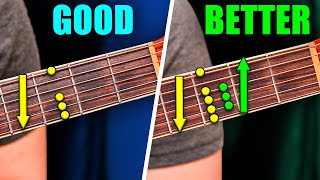
Very, very different feel, right? Very, very, very different feel. And I just think it opens up a song and it makes songs sound so much more beautiful. So what am I doing here? Let me show you two little simple ways to learn how to do this. The first is just descending down a chord. And I would just do this on quarter notes, one Note per beat. 1, 2, 3, 4. So if you're going to play a G chord, you could do strings six, three, two, one. Okay.
Okay. That would be a six string chord like G&E minor. Now for five string chords like C or A minor, you would go five, three, two, one.
Okay?
So the count will be one, one, two, three, four. One, two, three, four.
And then a D chord is four strings. So each string we get its own beat. Four, three, two, one.
Now that's a great way for you to start with arpeggiating chords. And that's where I tell everyone to start off because you got to get familiar with where your strings are. But you can hear when I did Country Roads, it sounds so much better when you descend the chord and also ascend back up. And that's what you're going to hear in most songs on the radio today. So let me go over what we're going to do. We're going to use an eighth note pattern here. Okay. 1 and 2 and 3 and 4. And so essentially we're going to be playing eight notes over each chord. We're going to be starting on the sixth string for that G chord and we're going to hop over the fifth string. We're going to go down to the fourth string. So it's going to go 6, 4.
3, 2, 1, 2, 3, 4.
And that'll be over the timing of 1 and 2 and 3 and 4 and. Okay, so that's what I was using on that Country Road song.
So that's what our G chord would sound like. Now we're going to do the C chord. So the C chord, we're going to start at the fifth string. And fortunately we don't have to skip any strings because it is a five string chord. And we're going to go five, four, three, two.
One, two, three, four.
Okay, again, five, four, three, two dot.
One, two, three, four dot.
Now the D chord, we have options because unfortunately the D chord doesn't have five strings. It only has four strings. And you will run out of notes if you try and stick with this eighth note pattern. What I like to do is I like to go one and two and three and four. And that's what I like to do. One and two and three and four. And so what I did there is.
I went four, three, two, one, two, three, four.
I'm actually coming all the way back up to that D note.
Okay. Now if you would prefer to have a note for every single count, you can just bounce on the bottom string. So you would go 4, 3, 2.
1, 2, 1, 2, 3.
You could do that.
But as you can see, I really like just holding that open, that open string on the bottom for an extra eighth note. 1 and 2 and 3 and 4 and. Okay, that's what I like to do. I think it sounds nice. So if we put it together, let's put it through a chord progression here. I always like applying things to chord progressions. Let's go G, E minor, C, D. So we have a six string chord, A five string chord and then a four string chord. I'll go very slowly. All right, just so you guys can play along with me.
Sam.
Now the great thing about arpeggios is even if you make a mistake, as long as you keep playing and stay in time, it really doesn't matter what you play. So if I play that same chord progression and say I make a mistake.
So you can see I'm just randomly playing whatever. I couldn't even tell you what I was doing. I have to go back and watch it. That's the great thing about arpeggios is that even if you make mistakes, it sounds good and why this skill is so important, especially for beginner guitar players to put some time in and practicing. So if you enjoyed this arpeggio lesson and you want to learn about finger picking arpeggios, then I have a really great lesson over there on the two finger picking patterns you can use on almost any sort of.