Views Don’t Pay The Bills. But THIS Does.
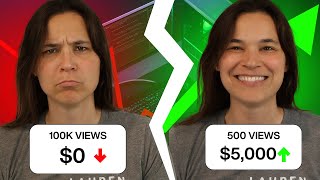
Lauren Bateman, who runs a guitar-teaching channel, argues YouTube creators should chase revenue, not views. She shows how lower-view videos can convert better than viral ones, and why every video needs a sales purpose: drive more content, capture emails, or send people to buy. Success means money, not subscriber count.
Questions this video answers
Over 550,000 subscribers.
Over $3 million in guitar course sales.
About 1.7 million views.
Around $7,000–$8,000 combined (two high-ticket sales).
About $35,000 in five days.
Chapters
Let me say it loud and clear. Views do not pay your bills. Neither do the number of subscribers. What really pays your bills is sales. If your course creator stuck chasing vanity metrics versus income, then you are focusing on the wrong thing. My name is Lauren Bateman, and I help YouTubers work on increasing their revenue, not just their views. Because. Because, let's face it, we're here to use YouTube as a business. And while getting a lot of views really makes us feel good, if we're not making money, we're going to get tired of making the content very quickly. Now, my guitar teaching channel has over 550,000 YouTube subscribers, and I've sold over $3 million in guitar courses. So if you are interested in learning how to build a course, profitable YouTube channel versus a popular one, we can still do both. But the key is to focus on the income. And that's what we're going to talk about right now. The most important thing to talk about from the start is the vanity metric trap. I fell into this trap as well. You get focused on the number of views you're getting on your videos, because that's what everyone's telling you, hey, post more, get more views, get more subscribers, get this, get that. But no one's really telling you, focus on getting sales. All right? I had a friend of mine, he had a video over on Instagram that went viral. And I said, how did that go? And he said, not really that great. He goes, I was excited to have a video go viral. He goes, but I wasn't in the video. It was one of those, like, funny meme type videos or funny meme reels. And he said, I wasn't in the video. And it didn't really do anything to help boast my business or my visibility versus another one of my clients recently, she released a video. It got 1.7 million views. And she got a number of leads from that video because she had come to it from a perspective of business. All right? Now, we all get caught up in that vanity metric track, but I would rather you have a video that Maybe only gets one or 200 views, but gets you one or two sales versus having a video that will get you millions of views but make you $0 in selling products or courses. Now, the second thing I want to say is the true metric that we should be following, the true scorecard, is sales, okay? Because sales are really what's going to motivate you to keep posting content. Like I said in the beginning, I was really chasing the vanity metrics. The views the subscribers. And I wasn't really making any money off of it. So after like a year or two, I kind of got frustrated because I'm like, I'm putting in all this time and effort and I'm not seeing anything in return from it. Okay, yes, sure, my videos were starting to get maybe like 2, 300 views, which was better than 10 or 20. But I'm like, why am I doing this? Okay, why am I doing this? I'm doing this because I want it to be a business. I don't want it to be a hobby. Now, if you're someone that's perfectly passionate and you are doing this a hobby, good for you. But I'm here to help you make YouTube into a business so that you can monetize it. And let me tell you, when you have a YouTube channel that's earning you 10,000, $20,000 a month because it's helping you sell your products and services, that's going to be super motivating. And you're going to want to keep making the content. Now, in order to pay the bills, we have to make content, but we can't just make any kind of content. We have to make the right content. And this is a big thing that I focus on, you know, with my YouTube clients and my business clients and my mentorship is we don't just want to willy nilly throw anything here over on YouTub YouTube. We really want to focus on making content that speaks to our ideal person. Going back to my friend that had that video that got 1.7 million views, we were talking about her avatar and she's, you know, she's a realtor and she's like, you know, I want to talk to brokers, but I also want to talk to sellers and I want to talk to buyers as well. And I was like, those are all very different people. They all have very, very different questions. All right? So I said, you really, with YouTube, you really got to focus down on who is the person that you want to talk to because you're trying to get them into your program. So she has a program that is for real estate brokers to help them, you know, either build an agency or get more sales. And I said, well, then your client on YouTube is not, you know, maybe a seller a little bit, because maybe they are a broker. I said, but it sounds like brokers are really the people you want to be talking to and you're going to use very, very language to speak to that person. So on YouTube, we need to know who our person Is what are their questions, what are their pain points? So on my guitar teaching channel, I really hone in on teaching older adults over the age of 50 how to play guitar. Do I get students that are under the age of 50? Absolutely. All the time I do. But on YouTube, I focus on speaking to an older adult. So I might talk about joint pain, I might talk about arthritis. Okay. I might talk about these things that I probably wouldn't bring up if I was teaching a 20 year old because 20 year olds typically don't have, you know, back pain arthritis. You know, they wake up in the morning and their fingers are stiff. That's not a common problem that a 20 year old has, but it could be a common problem that someone in their 70s have. So these are pain points that I can talk to my students and say, listen, if you're an older adult, starting with these more difficult hand patterns is counterintuitive. And when I teach people, I take it a little bit a step backwards to make it easier for you. I'm saying every video you put out on YouTube has to have a sales purpose. Either we're trying to get them to watch more of our content, we're trying to get them to give us an email so that we can email market to them, or we might be sending them somewhere to go directly buy a product and service from us. If our YouTube content is not leading our customer further down their journey, it's just noise, okay? YouTube is a search engine and people are searching for answers to their problems. And this is what I teach people in my 12 month mentorship. I'm like, you have a customer who is searching for specific questions and they're looking for the answers. These are the best kind of buyers. They know they have a problem and they are actively seeking a solution. And the goal of making YouTube content is that when they type that question into YouTube search, we are going to be the answer on the other side. And hopefully they are going to like us as a person. They're going to like our content and they're going to like how much we helped them. That either one, they're going to watch more of our content, which helps build trust with our brand. And people buy from people they trust. All right, so eventually you grow that relationship. That person now goes over to your website and then they buy your product in service. Now let me tell you about the hidden cost of ignoring sales. Okay? So I had a client of mine, he was a bass guitar teacher, okay? And he was making content and his videos were probably getting thousands of Views. I think when we were working together, you know, his videos were starting to get like maybe four or five thousand views. And he put out this video that I think had a very strong call to action for his high ticket program. Now this video was made for a very, very specific audience. I think it was made more for jazz bass players. Very, very specific genre of music. And you know, he was like, I, I didn't get that many views on this video. So compared to his other videos, maybe he got like, you know, 5, 6, 700 views versus like you know, 5 or 6,000. He said, But I sold two high course tickets or high, high ticket courses. And I think, you know those courses, I think it was around like 7 to $8,000. Okay. For both of them combined because I think his program was like three or $4,000. And I said, would you rather $7,000 in courses or would you rather 7,000 views? And he was like, I'd rather the course money. And I said yes. So I don't care that your video only got five or six hundred views. What I care is that that video actually produced a sale for you. Because his other videos that were getting thousands of views weren't quite yet performing and getting sales for him because I don't think they had very good, strong call to actions like this video. So it just goes to show you don't ignore making money on YouTube. And I know YouTube is all about free content. Okay? We're giving away a lot of free content, but you need to be encouraging people to work further with you being like, if you like what you're learning here. I have an entire program over on XYZ website. I'll put a link in the description below. Go check that out if you're interested. Okay. We want to let people know that there is an opportunity to work for further with us. You saw in that video that got 2 million views earlier, it didn't have a call to action, but people were actively searching for me because they knew I had the answer to their problem. So make it easy for people to work with you. Just put a link in the description below. You should also be pinning. Your first comment should be pinned with a link to your product or service or your website or your freemium or whatever you're trying to promote in that video. Make it easy for people to work with you. Even in my programs. Okay? I give a lot free here. Okay? If we talk about my business coaching, I give a lot of free content here on YouTube. But the real transformations happen in the program happen on the live calls with me. Okay, so I had a student, he just posted the other day or a few weeks ago. His name is Scott. And he's like, this is the first time I've made six figures with my online guitar teaching ever. And it's like, that's a huge milestone for someone. I had another student, Daniel, he. He was a high ticket client, but he wanted to do more of what I did in the guitar world, which was low ticket. And he did his first official launch for. For a low ticket. It didn't go so good. We tweaked some things. In his last launch, he did almost $35,000 in five days doing a. An offer that I think was like 197. Very, very low ticket. And he was like, wow, I didn't know that this was possible. And those are the transformations. You know, even if you're a fitness coach, you can give so much advice here on YouTube, but the real transformation comes from the accountability of working with that coach. Remember, you have knowledge, and that knowledge is worth a lot of money if you can help people transform. And the transformation is helping people from get from getting from point A to point B or point A to point C. All right? You're helping them along their journey. Okay? That is what we are here for. So the next time you upload a video, ask yourself, where does this video lead? Where am I going to send this person? And if you need help with selling on YouTube, you don't know how to get people from your videos over to your products and services, Go watch this video over here. I'm going to show you how I do this in my guitar teaching videos here on YouTube.










