Why I LOVE Teaching Older Students + Tips For Learning Over 50
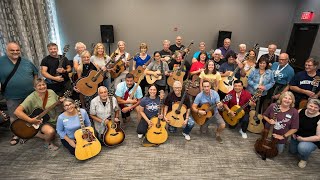
Lauren Bateman teaches guitar to older students, including a 92-year-old, and breaks down her seven-level system starting with basic finger exercises and simple chords. She emphasizes fundamentals like chord changes and finger dexterity, spider exercises for warmup, and building muscle memory through repetition rather than chasing trendy topics.
Chapters
Perfect. We are live, everyone. Megan was just helping me out with the camera there. Sorry it was a little late, guys. Megan and I were having a lovely conversation. I said, oh, shoot. I have my life this morning.
I know, I know. I'm so sorry, Douglas. I love you guys. Thank you so much. I was like, wait a minute, like, I have my live. I need to stop talking. We're having a lovely, a lovely business conversation about the music school. Ever have that happen? You get into a conversation, you're like, oh, my God, I forgot. I mean, I didn't forget, but I just said, wait a minute. I have my life this morning. Good morning, Kathleen. Who else is here? I see Douglas, David, Pam, Jeffrey, John from the Czech Republic. Wow. Hello, everyone. I'm glad you were all so, so talkative. I appreciate that. You guys, you are the best. I have the best students because you guys, really, honestly, you guys are the best. And that's. You know, I was going to go live today because you could probably still hear I'm a little stuffed up. I was sick for a little bit and I, I really couldn't sing too much and I didn't want to go all stuffed up at recording. I did record some stuff yesterday and I'm feeling much, much better. And you know, I was having a conversation with someone the other day and it always comes up on YouTube. Hello, Sven from Germany. Good morning, everyone. It always comes up whenever people interview me for YouTube stuff. The question they always ask me is, Lauren, why? How did you settle on, you know, teaching older students? And I said, you know what I said when I started YouTube? So I started uploading, kind of like really focusing on uploading guitar lessons. It was March of 2017 and I kind of did some self reflection because you guys know. Hello la. Hello. You guys are so awesome in the chat over there. John, Julio, nice to see you guys. You know, I really did some self reflection. I was just like, who are my favorite students to teach? Because in 2017, I had basically at that point cleared up my entire schedule with the exception of maybe like a handful of students who I had taught for maybe seven, eight years. Very, very long period of time. And I said, who are these clients? And all of them were in their 50s and 60s, all of them that I was still teaching because I just love teaching them so much. And the reason 72. Sven. Yeah, you're right in the age range for me. The reason I love teaching you Gu1. You have the best stories and I really love your outlook on life because I think for you guys Especially if you're retired. Yeah. Put your age in the chat. If you're on here, I see 72. I see 74. 56. Put your age in the chat and you guys will see you're not alone. 57. It's never too late to start to learn to play guitar. It's never too late. I even have. We might not have anyone here, but I had a couple students who wrote to me in my online course that they were 92. So the oldest student I've ever taught is 92. It just goes to show you, it's never too late. And I really love your outlook on life because, you know, you're kind of in the second half of your life, and for you guys, you know how important time is. And I think you've learned that, you know, when you're younger, you focus on all the small things that really don't matter. And I've become better at that myself, trying not to let the small things bother me. But you guys are great at knowing what you want at this stage in your life. And the thing with guitar is that, you know, for a lot of people, it's something they've wanted to do for a very, very long time. Most of the people when I used to teach in person and still here, you can see here. 70s. I saw an 80 in there. All right. Most people at this stage in their life, they know what they want and they don't want to have any regrets that they didn't try. You know, the biggest thing they say when they interview people on their deathbed, the biggest thing they talk about are their regrets, the things that they didn't do. And I love working with older adults because they have such a passion for life and they have a passion for learning now. There's always trade offs. You know, anything we do when we're younger goes a little bit easier. You know, our fingers are a little bit more flexible. And there are some challenges to learning the guitar when you're older. And that's why. That's why I really love teaching older students. We're all in a rush to get to the end, but I think you guys understand hard work and process. You just don't expect that magically, you know it's going to work. I think we all wish it would magically work, but you all understand that it's not a magic pill and that it takes hard work. You guys are not afraid of putting in the time and the dedication. I have so much respect for that. That's how I was raised. If you Want something, You put in the hard work, you put in the time and the effort and you get rewarded, you know, two, three, four years down the road. Unfortunately, it takes some time, but for older learners. And this is how I've set up the seven level guitar system. I always tell people, you know, my system moves a little bit slower than most of the generic systems out there. I've had a lot of students over the years. John, you're, you're young, 49. Love it. Hey, you're never too young and you're never too old. You know, I have, I've had students reach out to me and they'd be like, I use, you know, so and so's course, or I use this, this big brand name course. And they're like, it just moved too fast for me. It went from zero to 60 very quickly. And when you're an older learner, sometimes you need to take a few extra steps. One, because our hands don't move as fast as they used to, let's be honest, okay. As you age, muscles start to slow down and it can take a little bit longer to build the flexibility. But there's nothing wrong with that. That's okay. Sometimes we just need a couple extra stepping stones. Like, you know, I could teach someone maybe in their 20s and 30s, and they'd be on the two finger cords and maybe they'd only be on them a couple days. They really could pick it up really quick. Maybe they're only on it for a week. Whereas some of my older students, we might spend two or three or sometimes even four weeks just doing two finger chords. And there's nothing wrong with that because that's what you need. And those are the challenges when you're learning guitar when you're older is just understanding that the process, the timeline might take a little bit longer, but understand that adding in those extra stepping stones will help make each step in the process. You know, they're not going to be big jumps. You're going to feel like it's manageable pieces, all right? And that's why I teach the two finger chords and why I focus a lot in the beginning of my course on dexterity and finger exercises. I think that's such an important thing that a lot of courses and lessons forget to put in. You know, the strumming is important, the picking is important, the chords are important. But if we can't get our fingers moving, then we can't change chords. And then it makes playing the songs really hard. Okay? So when you're an older student, I know Jack. I think Jack was on here. He posted this great little hand warmer in the group. Jack, I don't know if you're in here, if you could type in the name here. I see Pueblo, Colorado in the house. He uses a hand warmer. And if you're an older student, warming up your hands before you even sit down to practice can be super helpful. Especially if you live in New England where I am, where things get really cold. Warming up those fingers and getting the blood flowing, especially if you're someone with arthritis, getting the warmth into the fingers before you even touch the guitar can be super, super helpful. So that's a tip if you are an older learner, you know, yes, there's warming up. Okay, we have our spider exercises that are a warmup, but there's also the pre warmup which is actually getting your hands warm, getting the blood flowing. Because the more blood flow you have in your hands, the easier it is to get things, get things started and get things going. You're welcome, George, you're so welcome. Gotta go. Oh, Douglas, so glad to see you here. The replay will be, will be coming through. Angela asked, hi, Lauren from Wheels uk. Can you tell me with your lessons, do you have to do them in a certain time? Great question, Angela. So everyone's unique. Just as I was saying, an age will play a part in that sometimes and how fast you can do things. So let's take the seven level system and all it is. I tell people it's kind of like a belt system in karate. You start at the white belt, then you get your yellow belt, then your orange belt, kind of the same thing. And it's all going to depend on you as an individual and mostly depending on dexterity. That's why I focus on dexterity so much. So level one of my course is basic finger exercises. A couple really simple chords and some very simple strumming patterns. For most people. For most people they can do level one in like one to two weeks. Level one is really just a confidence building level to let you know, hey, you know what, you can do this you like. Because that's the biggest question in most people's head. When they start something new, you start doubting yourself, am I too old? Can I really do this? I'm not talented enough. No one in my family plays music. Let me tell you, no one in my family plays music either. I'm the only, only musician in my family. So don't let that hold you back. But level one is just a confidence builder to let you know this is possible. You can do this. And if you take things step by step, we can get to the end. Then usually they hop on level two where we start learning like our, you know, our two finger chords, some more picking exercises and dexterity exercises. And you know, that one could take a little bit longer. Sometimes people are on that like two to four weeks maybe, depending on how much flexibility they have in their fingers. And then the hardest is level three. So level one and level two are all preparing you for level three because that's the first time we get into three fingered chords. Okay. And the thing with guitar, especially when you're older, even if you're not old, even if you're young, it's hard to move three fingers at a time versus one or two. Okay, one or two. So level three is the first time we start doing full chords and moving three fingers at a time. And for a lot of people, that's a very, very hard thing to do. And if you didn't do levels one and level two, it can be super frustrating. So that level. Because also in that level too, we start getting into really interesting, more. More interesting strumming patterns as well. That level could take two or three months. Now. When I worked with people privately, I was known, I was kind of a drill sergeant. I'm a drill sergeant when I do in person lessons. What I mean by that is we would learn these four chords, C, G, D and E minor. And I would find as many songs and possibilities for them to just practice playing and using these four chords because it would take time to develop the speed of going back and you know, C to G. You know, if you hate the C to G chord change, you know, put a 1 in the chat because you're not alone. I bet there's going to be a lot of ones that pop up in the beginning. That C to G or that C to D. It is A. It's hard to move between these chords. So I, I would put as many songs in front of them as possible. Yeah, see, I see some ones popping in there. There we go. Ones. One, one. We got some ones in there. All right. And I'm sure there's more. But the thing is, with level three, like I said, some students, depending on their age, we might spend four months on level three. Depends on when I think they're ready to move on. And people always ask me in the course, lauren, when's a good time to move on? And I recently updated the course. I put some suggestions on. You should move on if you feel like this. And Usually I tell people in the beginning, we're never working for perfection in the first, probably year of playing. We're not trying to really perfect every anything. The first year of your guitar playing is really focusing on mechanics, okay? Focusing on mechanics. So I tell people, you know, even if you're. Even if your chords are still sounding a little muted, but you're hitting them okay and your timing's getting better, you're probably. It's probably time to move on. Because the thing with guitar, you know, just because you move on from level three and you're going to start learning some new chords, it doesn't mean you're never going to see a C chord again or a G chord again. They're going to keep popping up. So even though we moved on from a level, that stuff's going to keep popping up in your playing. So you're always going to continue to keep working on the things. That's what the seven level does. You learn something, and then we build upon that. Next thing, next thing, next thing. So we keep building upon what we've already learned. So that's the key, and that's what I think a lot of teachers do. Like, they'll teach you one thing, and then they'll bring you over here to teach you something else, and then they'll bring you over here to teach you something else. And there's really no linear path. And with guitar, you know, eventually, you know, people tell me once they get through the seven level, they're like, where do I go from here? Then you can start branching out to your interests. If you love blues, blues guitar, do a blues guitar course. If you want to learn about lead guitar, do the lead guitar 101. You want to start learning music theory. Once you get those foundational items, you can go anywhere in the spectrum of guitar. And that's why in the beginner course, you know, I don't teach a scale. You know, I really focus on chords, strumming, rhythm stuff to really play along to songs. And then once you get those foundational items, then we can learn scales. Now, is a pentatonic scale hard? Could a beginner learn how to play a pentatonic scale? Absolutely. But I don't want to distract you with that yet, because, you know, just like me as an entrepreneur, we tend to have the. We call it the shiny object syndrome, where, like, you get a new idea and you go over there and then something else happens and you're over there. And with learning guitar, that can easily happen. You can be learning one thing and get distracted by something else, and now you're over here, and then you get distracted by something else, and now you're up here, and then something else comes along and you're down here. And then what happens is you keep getting distracted by all these different things that you end up getting nowhere. And I think for a lot of people, that's what happens. They get overwhelmed. Yeah, it's squirrel. Exactly. The squirrel. We called it dolphin. I was at a business retreat one time, we're by the water and there were dolphins, and all of us were like, oh, my God, dolphins. So it became dolphin, as opposed to squirrel. But yes. And. And what happens is you're so distracted by all these things, these different things you're working on that you don't know what to work on. And your progress stalls because you're focusing on so many things. And that's why in the seven level, I don't get into all the different intricacies of guitar, because I really want you to focus on three things. Really just want you to focus on three things. And that's it. Chords. Okay. And chord changes. Finger dexterity. And picking. Okay. And last one. Strumming. Rhythm. That's, you know, super important whether you're playing lead guitar. If you don't have timing and rhythm, you know, that's one of the most important things in music. So that's why, especially for older learners, if you focus on less things, you will get better at those less things much faster, versus if you practice 12 different things and you're trying to prove them all at the same time, you could do that. But I find the method that I use for my students is, hey, let's focus on these three things until we start feeling good about ourselves as a guitar player, and. And then we can start moving into some other things. Okay, maybe we're going to start doing pentatonic scales. So we'll start doing some lead guitar stuff. Or we'll find songs that have very simple intros. You know, something like, you know, some Pink Floyd stuff where they do some really easy pentatonic intros, little lead parts that come into a song like Sweet Home Alabama. Doing some simple things like that, you can start introducing those things. But I find that's the biggest thing, especially for older learners and especially if you're on YouTube here, if you're not in my course yet, if you're on YouTube and you're. And you're browsing around, you know, you watch a video, and then at the end, YouTube suggests a bunch of videos, but you never know if any of those videos are right for you as a player with where you're at with your playing. And that's why in the seven level system, I have to go back and add more because I have so many more videos now. I try to make suggestions of songs that are appropriate for that level so that you can feel comfortable. Like, if I click and go watch this video, I know I'll be able to play or I should be able to, you know, work, put some time and effort in and be able to play this song. So that's the tricky part with, with learning online is that there are so many distractions and I'm, I'm the worst. I get distracted all the time. But let me tell you a personal story about my, my own guitar learning. I actually started, believe it or not, I started taking guitar lessons again because I felt like I really wanted to improve upon my finger picking and some of my music theory knowledge. So I take lessons with a teacher at my studio. And I had my lesson last night, one hour, and I shared, I have some students here who are my private group. And I shared with them the chord progression I was working on. And people are like, that looks like a calculus equation. But for me, I actually had to go into that lesson, have a discussion with the teacher because he had, you know, knowing that I'm, I'm a more advanced player, he's throwing a lot of stuff at me. And I said, for me as a student, being back in the student position, I actually didn't practice much last week because I was so overwhelmed by all the stuff I had to work on. And I told him, I said, you know, because we started learning modes last week. And I was like, listen, you know what, I don't even want to talk about modes today. Can we just focus today on me feeling good about the things I've already learned? And I think it's important when you're working with the teacher, if you have a teacher one on one that you have an open conversation about how you're feeling because they can't adjust their lesson plan if they don't know. Like, if I didn't say anything to him, he might have thought I understood everything and he's ready to move on. I, as a student didn't feel I was ready to move on and add something else to my plate. So we went back to the finger picking and doing some stuff and it made me feel better about where I was at. So I still, you know, even someone who's played guitar for a long Time. I can still get overwhelmed by doing too many different things. Okay? So if I can get overwhelmed by doing too many different things, imagine, imagine, you know, a beginner player trying to learn all these different things. So that's what I suggest. Whether you're a young learner, middle age, older. Okay? Focus on less. Less will give you more in the beginning. Focus on your timing, focus on your strumming, okay. Focus on, you know, all these different spider exercises, finger exercises. Focus on getting the fingers moving. Okay. And then working on those chord changes. Just sit. Even if you're watching tv, this is something you can do while watching tv. It's all about repetitions. You don't even have to strum the guitar, just change the cords, okay? It's all about repetition, building muscle memory. And when you're an older learner, I think they call it neuroplasticity. It takes a little bit longer for those neural pathways to develop versus when you're in your 20s. Okay. There's no question about it. Scientific fact just takes a little bit longer for those neural pathways to develop. So for someone in their twenties, they might have to do this 5,000 times. All right? If you're someone in your fifties or sixties, maybe you have to do it 7,500 times. And if you're someone in your seventies or eighties, maybe you have to do it 10,000 times. But the thing is, the faster you can get these reps in, the faster it will come. So if you feel like your core changes are dragging or they're slow, really take the time. Set aside one or two days a week when you're practicing to just focus on this. I'm just gonna sit here. I know it's not the most exciting. It's really not the most exciting, but it's probably one of the most beneficial things you can do. Yeah. Can you play right side? Right side? You mean the opposite way? Could I play it as a left handed? I've tried that. I actually, I'm actually much better at playing a left handed guitar upside down. I'm much better that way than playing as, as a lefty. I should get a left handed guitar to show you guys how I would, how it would be as a lefty. That would be an interesting experiment. Yeah. I want to sign up to your course based on all of this. Yeah. If you're interested in the course, it's lauren batemanguitar.com backslash course. Laurenbatemanguitar.com backSlash course. That's the seven level guitar system. All right. And like I said, it's like a karate system. Level one, level two. And every time we get into a new level, we learn new things. But those new things build upon what you've already learned. So say in level one, your spider exercises, the first three fingers. Cause we're just trying to get those moving. Okay. Maybe in level two, we have the pinky. Okay. So you're still doing a spider exercise, but it's something different. And then in level four, we have a different finger exercise that we do. So you're always working on dexterity, rhythm, and timing and chords. Okay. Because those are the foundation for every song you want to play. Yeah. Lead guitar is something else. It's another foundation you can get into. But that's really the. If you want to play a song and have people sing along, you gotta have timing, you gotta have chords, and you gotta have, you know, finger dexterity. And that's where you can get a lot of satisfaction out of the guitar, is focusing on less developing those skills and being, like, great.
You know, lip symbol, Horse with no Name. Just being able to play a song that you recognize. Some of the best things I love when my students post this is they'll be playing, you know, Horse with no Name, which is one of the first songs that. That we learn in. In the course. And I don't have. We don't. Just so you guys know, I don't do copywritten materials in the course, but I have links out to YouTube. Like, I said, go watch this video on YouTube. This will be perfect for you right now. But they tell me, like, oh, my spouse came in the room and asked me if it was Horse with no Name. So there's a lot of satisfaction that comes with people that you live with, whether it's a spouse, whether it's a child, a grandchild. There's a lot of satisfaction that comes from someone coming in and saying, oh, is that this song? It's really rewarding the first time that happens. You do that by focusing on strumming chords and dexterity. Okay. So if you're an older learner, those are the three things I would focus on in the beginning. Because even down the road, if you want to get into, you know, playing scales and doing. Doing all kinds of cool lead guitar stuff, you can't do that if you don't have finger dexterity. Okay. The pentatonic scale. This is kind of like a finger dexterity exercise because you got to move your fingers. Okay. But if you can't move your fingers, you can't play a scale. So that's why, again, wild finger dexterity is so, so important. Yeah, yeah, that was good advice. Can do spider exercises with less fingers and add more. Yeah, again, less is more. Sandy, that's a great point. You could even pair up fingers. I do that because a lot of people ask me, lauren, I have trouble with my pinky. My pinky's not really working. And I said, well, just do the pinky and the third finger.
That's a spider exerc.
And you just focus on the problem fingers. Maybe it's the first. Maybe you just do all first and pinky, second and pinky, you know? Oh, that was even weird for me.
All right, so you work on these things little bits at a time. You know, it's. What do they say the best way to eat an elephant is? One bite at a time. Right. So you have to break things down. Again, I start. Everyone's like, oh, you're not doing the spider exercise correctly because you don't have the pinky. Why not work on the pinky? It's very frustrating in the beginning when you can't move a single finger to try and move 4. Let's focus on the three we're going to use the most right now. The first three. And by relaxing, without even working on the pinky, by relaxing these three, by learning how to make these three fingers independent, it will make your pinky easier to use down the road. Just because you're not working on the pinky directly doesn't mean there's not an indirect benefit. Because remember, we're talking about a hand. If you put your. Put your hand up like this and you bend your pinky, what happens? This finger goes with the pinky. This is the hardest finger in guitar. Your third finger, your ring finger. Okay. If you work on this finger, it will make the pinky better just because of the way the tendons are. Okay? So I always tell students, just because we're not working on something right now doesn't mean there's an indirect benefit. Okay? It's like doing I love exercise in the gym. It's like going to the gym. Yes. You could do a bicep curl and really focus on your bicep. But if you do a pull down, like a back exercise. I know it's a back exercise, but you're also working your bicep because you have to pull. So even though we're not directly targeting just the bicep, we're still working. It has an indirect benefit. And it's the same with finger dexterity. Even Though you're just focusing on these first three fingers and getting them to work, it will indirectly benefit the pinky. So that down the road, when you add that fourth finger in.
It'S not as crazy. All right. It's not as crazy. So. Got here a little late, but want to say thank you. You're so welcome. I'm so glad. Can you advise on timing, please? Absolutely. Let me see the one above you. Copperhead old guy learning to play simple open chords. I do use the Busker style. Is this bad? I. I will admit I don't know what the busker style is, so I. I can't comment on it. I'm gonna have to look that one up. So I don't know what the Busker style is, but there's many. Let me just start off, though. There's many ways to play chords. You know, there. They talk about the Django chords, these chords.
There's so many different ways to play chords. If it's a different way of playing chords, I'm sure it's probably fine. I don't really have too many issues with different ways and varieties of playing chords. Let me just see here. I want to go back. Can you advise on timing? Yeah. So for timing, the biggest thing I like to do is using a click track, a metronome. A lot of people find that very, very robotic. So the best thing to do with timing is listening. Listen. A lot of people are like, I want to play with timing, but sometimes you got to take a step back. Sometimes the best way to focus on timing is to listen. All right, so when I teach in the course, you know, say we have a strumming pattern that's 1, 2, 3, and 4, and 1, 2, 3, and four. And played as down, down, down, up, down, up. I would just sit there and listen. So if I'm playing.
Don'T even touch the guitar. Listen to the timing.
And four, and.
And then. Great. I'm just gonna. I'm just gonna count it. 1, 2, 3, and 4. And 1, 2, 3 and 4. And 1, 2,. 3, and 4. And 1- 2, 3, and 4. M. A lot of people don't realize that that oftentimes, if you can say something in time or hum something in time, you can do rhythm. So at the music school with younger children, when we work on timing, usually you'll use words like watermelon or cucumber because they can't understand different timing of things. Avocado. I think Avocado is a 16th note. So we use words to help students understand timing. And rhythm. And you can use the same thing as an adult. I mean, you. But just count with numbers. 1, 2, 3, M. 4 M. 1, 2, 3 and 4 M. 1, 2. Great. If I've got this timing, 1, 2, 3, and 4. And I should be able to put it on the guitar. 1, 2, 3, m. 4 m. 1, 2, 3, M. 4 m. I find most people.
I would say 90 to 95% of the time, most people don't have trouble with timing. If I take them off the guitar, their timing is usually okay. Usually the issue is mechanical. It's the muscles. Because a lot of people, when they go to put it on the guitar, they're so tense that the musculature is actually messing up the timing. So I would say 90 to 95% of people actually have really good timing. I think I've taught one student in my entire lifetime that had really, really bad timing. And we worked it out. It just took a little bit longer. But most people, if I say, put your hand, take your hands off the guitar and let's clap the rhythm.
1, 2, 3, and 4. And 1, 2, 3, and four. And most people have no problem doing that. Most people have no problem doing that. But then we go to put it on the guitar and it comes out like this.
You know, so it's not that they have bad tone timing. It's just the mechanics of the strumming and the relaxation of the muscles hasn't kicked in yet. The muscle memory hasn't kicked in yet. So that's my biggest tip on timing. As I drop my pick.
Do it away from the guitar. You don't always have to play the guitar and. And to work on something. And yes, someone mentioned humming helps a lot. I do a lot of stuff with singing because if I can sing it, I can play it. A lot of times people be like, you know, I'll be playing something with the song, and they'll be like, what's the timing? What's the exact rhythm? And I'm like, I don't even know. All I know is that if I can sing it, I can play it. I might not even be counting it correctly in my head, but if I can sing it, I can play it. And then, you know, I'll have to slow things down to break it down, to write it out. Well, it's the E after one and this and this note. But a lot of times when I'm playing really intricate rhythms on songs, I don't even know what I'm playing. A lot of times it's by feeling. And if I can sing it, I can play it. That's all I know. You know, so all this is super helpful. You are so welcome. Yeah, we got a couple of people here, 52, 53, 59 years old. I love you guys. I honestly do. You, you, you have so much, like I said earlier, so much passion for life and learning. Also, I will add, you also have the best music. So I think one of my favorite decades of music is the 19, like, kind of like the late six 60s through the 1970s, even like early 80s. I was listening to music on the way to the music studio last night for my lesson and I have, I have YouTube music. So I, you know, I told my phone, hey, hey, play music from the 70s. So I love kind of like that late 60s, 70s and very early 80s music. I think that's just a lot of stuff that my parents listened to growing up. And that's why I like it so much. It's also very guitar heavy. There's actually like, if you listen to music today, there's like, unless you're listening to rock and roll, there's like no guitar in the music. And I really just, I just love your music. I love John Denver, I love ccr. I love Zeppelin, Clapton, all the great, all the greats, you know, And I think your music is, is wonderful. It's well written. It's really well written. I mean, if you listen all the Beatles stuff, you know me, I love the Beatles. It's just really great music. It's a lot to play and it has a lot to teach, and that's why I like it so, so much. You guys are amazing. I'm going to run off, but thank you so much. I stayed on for a half hour. Sorry I was a few minutes late here with my business conversation. But thank you so much for being here. I just wanted to let you guys know that I really appreciate your support. Love having you guys here. And we'll have some new videos for you guys starting next week. And gals, adios everyone. And I'll see you in a lesson video real soon. Have a wonderful weekend. Bye, everybody. You're welcome.










