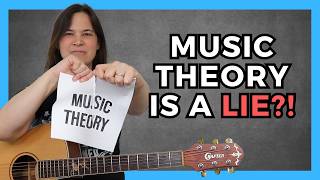
Lauren Bateman teaches guitar to beginners without theory first. She had a student arrive with theory notes who couldn't play a song, so she built her system around four easy chords instead. Theory matters later for songwriting, but starting with songs keeps people motivated.
Chapters
Music purists are going to hate me. But you don't need music theory to start having fun on the guitar. And how do I know this? Well, because I recorded two albums and I've played in front of 20,000 people without knowing a lot of music theory. Let me tell you a quick story that some of you might relate to. So I used to teach in the Boston area. So Boston is known for Berklee College of Music. So you can imagine that you could find a Berkeley trained guitar teacher on basically every corner. All right? And I had this student come into my studio and she had worked with one of these teachers, and she came in with this giant notebook full of notes about music theory and bar chords and all this stuff. She had been taking lessons for about three months. And I said that this is great, so what songs can you play? And she goes, that's the thing. She goes, I can't even play a song. So I said, okay, what we're going to do is we're going to put this book aside. I said, we're not going to look at this for a very long time. I said, what I'm going to do today, my goal is to have you playing a song by the end of your first lesson. And by the end of the lesson, we were playing the song Zombie by the Cranberries. And she was ecstatic. She was happy. And I didn't need to teach her anything about music theory to help her have that success and have that win. Now, before I go any further, for all the music teachers out there, music theory does have a place, especially if you want to get into songwriting. Music theory will open up worlds for you, and it will really open up the guitar for you. But there is a time and there is a place for it, and it is not at the beginner stages of learning guitar. Why? Because it really bogs down the process and it makes it tedious to learn to play the guitar. Music theory and music in general is like learning a whole nother language. So teaching a beginner music theory is like teaching them a language without them knowing what the nouns are or what the verbs are. And you're talking to them and you don't even understand what they're saying. I had a number of students who came into my studio and they were just like, the teacher was talking, but I had no clue what they were saying. They felt like the teacher was speaking a foreign language because they didn't know how to just talk. Simply for a beginner to be able to learn and have fun with the Instrument. And it's funny because I tease my teachers at my music school because a lot of them went to Berkeley or went to music schools, and I always tease them. I'd be like, oh, yeah, it's an F sharp minor, add 9 minus 2, divide by 3 plus 4. Because sometimes I couldn't even understand what they were saying. And I teach music, and they were talking at such advanced levels of theory that I'm like, I have no clue what you're saying right now. So I wanted my students to feel comfortable when they came into the lesson, that they didn't. They didn't feel stupid. I wanted them to feel comfortable and confident that this was something that they could do and something that we could accomplish together. So instead of rushing students into theory, what I do do this in my 7 level guitar system, is I teach students the foundations of music, and I will teach you simple chords to help you get started with playing music right away. That's exactly what I did with that other student. So a lot of teachers, they'll come in and they'll give you a printout. It'll have, like, 20 chords on it. And they'll say, hey, go home, learn all these chords, and then come back in a week. And you're like, I have to learn 20 chords in a week, which is really hard. You know, if you're doing something new and you're trying to memorize something and all these different shapes and patterns, it can be really difficult. So what I do is I give students four very simple chords that you can use to play thousands of. Yes, literally thousands of songs with four simple chords. And you don't need to know the music theory behind these chords or why they work together or why they sound good together. I'm just going to tell you to teach you these four chords, and we're going to use them to play thousands of songs. All right? You don't need to know the theory behind it. If you want to go learn those four. Those four chords. I'll put a link to a video up here that shows you those four simple chords. So what does this allow me to do? So instead of students getting, you know, bogged down in the complicated details of music theory, it allows me to get them to start appreciating the instrument, because this instrument is not easy to learn. It's. It is a hard instrument to learn. It takes time. It takes patience. If you don't enjoy the process, you know what's going to happen? You're going to take this guitar off. It's going to end up back in the closet or down the basement. In 20 years from now, you're going to say, oh, man, I really wish I had stuck with the guitar 20 years ago. I really wish I had learned how to play the guitar. So by keeping things really simple, simple, it makes music accessible to you. And my goal is to help you have fun with music, not bog you down by all the details that we can get into down the road. When you understand the instrument better, I want you to have fun. I want you to come to the instrument and say, I love this. I can do this. Because half of a teacher's job is giving students the confidence that they can do this. Because I've had so many students who've come from bad teachers, and they said, my teacher said I couldn't do this. My. My teacher said I should try a different instrument. One student, he said, my teacher told me I should play the harmonica instead. And I was like, that's really mean. That's really rude. So I don't want that for my students when they come to me, whether it's here on YouTube, whether they're taking my course, I want them to know that this is possible. It takes time, it takes patience. But if we go through a step by step process together and we break things down and we keep it simple, simple, okay. We leave the music theory out of it. I can help you have fun with this instrument a lot faster. So while theory is an important skill to learn down the road, I have taught thousands of students in person and in my online courses, my seven level guitar system to have fun with the guitar without music theory. Okay. So if you're looking for a step by step system to have fun with the guitar, where a teacher talks to you in a language you understand, that's made for beginners. I specialize in helping older adults ages 50, 60, 70 plus. Okay. And this system is designed to break things down step by step. Leave all the complicated stuff out for now. Okay? We can do that stuff later. I do have a music theory course you can take later. But in the beginning, the whole goal is for you to start having fun with this instrument. Because if you're having fun, you're going to want to practice, you're going to want to keep coming back to it, and it's going to make me happy. Because you are actually doing something that you've dreamed of doing for a long time. So don't let someone else shut down your dreams. You can do this. I believe in you. And if you're looking for a step by step system. To do it, go to the link in the description below. Check out my seven level guitar system and I hope to see you in a lesson real soon everyone.