You're NEVER too old! Top tips for older learners 50+.
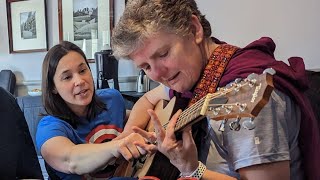
Lauren Bateman teaches guitar to adults over 50, starting with warm-ups for arthritis and simplified chords. She recommends short daily practice, light-gauge strings, and a seven-level course that focuses early on four chords. A patient teacher who works with older learners makes the difference.
Chapters
There's no question that the best time to learn guitar was maybe 20 or 30 years ago. But I'm going to share with you the top tips my older learners have said have helped them learn guitar and finally fulfill their dream of playing their favorite song. Now, in full transparency, as you get older, it does take a little bit longer to learn some of the things on the guitar versus someone who's maybe in their 20s and 30s. And I specialize in helping older adults when I have my private studio. My favorite students were in their 50s, 60s, and 70s. And today, the majority of the students who take my seven level guitar system are in their 60s and 70s. So it just goes to show you, just because you're coming into guitar at an older age and you're learning when you're older, it doesn't mean you can't do this. You can absolutely do this. And I know because I've had thousands of students who've gone through my course. You just like you. In their 60s and 70s, they're retired, all right? They're looking for a fun hobby, and they always wanted to play guitar, so they're doing it. All right. We just have to make some slight adjustments. And I'm going to go over some great tips that my students have reached out to me and said this was very helpful for me as an older learner as I was going through learning the guitar.
Number one is to warm up, okay. Especially if you're an older learner. I have many students who suffer from arthritis. Okay? My dad's in his 60s. He has rheumatoid arthritis. I know it can be very, very painful. And I've had a lot of students who just said, you know, doing a simple warm up, something as easy as getting a heating pad and warming up your hands can help get the blood flow going. Now, in my seven level system, I have a lot of exercises that focus on hand dexterity. Because I find for older learners, that's the thing that really trips them up in the beginning is that, you know, your fingers just don't move as fast as they used to in their 20s and 30s. So we really focus a lot on just getting the fingers moving. And having a proper warm up is a great way to start off. And it's something as simple as a spider exercise where you could just have your fingers, one finger at a time, moving up and down the strings of the guitar. Okay. Something like this, just to get those fingers moving is a great little warm up. You also could, you know, even just as simple as, like, you Know, flexing the knuckles and getting things moving, even doing a little bit of this before you even touch the guitar can help make your practice go so much better. Another tip is to simplify. Okay? I found when I was teaching one on one, the biggest frustration for my older learners was always chords. All right? We would get to chords. And the thing is, I was trying to teach them like my younger students, you know, a lot my younger students, I could throw them on three fingered chords right away and they would have no problem with it. But I found that my older learners needed an extra step. So what I did is I simplified things for them. And, you know, if you've watched any of my videos here on YouTube, you know, I love to simplify and make things easier. So instead of playing this three fingered C chord, I would tend to teach my students a two fingered C chord. And I would teach them pivot points, how to pivot easily from one chord into another chord. All right? We would simplify. And you know, a lot of guitar teachers out there, they look down on that because they're like, that's not a real C chord, when in fact it is actually a real C chord. And for me, it's more important for you to have fun on the guitar because for you as a student, you, it's way more motivating. Okay? I'd rather you play a song with simple chords and be able to play through a song versus really struggle to try and learn those bigger, fuller chords before your hand dexterity has caught up. So again, because we have less hand dexterity, we just need to take a couple extra steps, we will get there, that's totally fine. But do not be afraid to simplify. I'd rather you have fewer fun faster than struggle to do things perfectly right from the get go. Which brings me to number three, perfection. Okay? And whether you are 60, 20, 30, this is something that goes across all of the ages, okay? We all want the guitar to be perfect. We want it to sound amazing. We want our chords to sound like this versus this. And it's just a process, okay? Anyone who tells you that you can learn guitar in 30 days is crazy. This is a lifetime, okay? This takes time, it takes effort, and everyone's chords sound like that in the beginning, all right? And that's why, again, if you use simplified chords, it's more likely you're going to get a cleaner sound sooner and you're going to be able to have fun. So in the beginning, do not focus on perfection. A lot of people focus on perfection versus the Mechanics. In the beginning, it's all about learning the new mechanics. And then like in my course, usually starting around level four or five, we start refining things and working on making things sound better. But in the first three levels, we're really just working on getting the hands moving and refining the mechanics. The next tip I would encourage is shorter practice sessions. I encourage this in my course. I say, hey, in the beginning, especially if you're an absolute beginner, you might not have the calluses yet, so your fingers are going to be sore anyways. That does get better over time. But again, like I said, I've had a lot of students in the past who have had arthritis. And sometimes, you know, you have good days and you have bad days, and on those bad days, you might not be able to practice so much. And I always tell the students, listen, if it's five minutes, it's five minutes. That's great. I'd rather you do five minutes than nothing at all. And for a lot of students, they would find, you know, just by practicing, their hand would start, their fingers would start loosening up and then they would find that they could practice a little bit longer. So on those good days, if you can go a little bit longer, great. But don't think because you can't practice for an hour that you can't learn the guitar practicing in as little as five or ten minutes a day. If you do that consistently enough, you will get better over time. Remember, we're not trying to learn to play guitar in 30 days, all right? We're learning to try and play guitar or over the next year, the next two years, three years, etc. This guitar journey takes time and it's unique to everyone. You just have to find what works best for you, for your lifestyle. Are you retired and have more time? Maybe you can practice more. Great. Do you have arthritis? You might have to stick to shorter sessions if your hands are feeling great and you can do a half hour, 45 minutes. Awesome. But in the beginning, for all of my students, no matter how old they are, I recommend keep the practice sessions short, keep them fun, and you will see progress week to week. Now, here's a huge tip that I share with students that they said has made a big difference in their playing is to either use an electric guitar or change the strings on your acoustic to light gauge string. On my guitar, I, I have what's called custom light strings. They're a little bit thinner than the typical strings that come on a guitar. Now why do I do that? Because it makes pressing the strings into the guitar much easier. It means you need less strength to do that. So I always tell students, if you have an electric great, it's going to be a little bit easier to play. If all you have is an acoustic, that's okay as well. You can put thinner strings on an acoustic guitar, which will make it easier to play, especially if you don't quite have the hand strength yet. And that's a great thing about learning guitar as an older student is because you're going to actually build strength and more flexibility into your hand over time. Now, this next tip is huge because I find a lot of students, the reason they give up, whether they're young, whether they're old, is they overwhelm themselves by going too fast. They give themselves too much materials at once. Which is why I think it's super important for you to have a system, have a plan, go out there, take a course. Whether it's mine or someone else's, get on a blueprint. Because having structure is very, very important when you're learning. So in the first three levels of my course, we focus on four chords, all right? A G chord, an E minor chord, a C chord, and a D chord. And the reason we do that is because you can actually play a lot of songs with just those four chords. And also because it allows you to learn these four chords very well. A big mistake I see a lot of students make is they go out and they try to learn 20 chords at once. And I always tell people, if you it's the difference of remembering, you know, a 20 digit password versus a four digit password, okay, it's much easier to retain four numbers versus 20. So it's the same thing with guitar chords. If you're trying to learn, you know, a dozen guitar chords at the same time, or 20 chords at the same time versus four, you're going to be much better if you just focus on the four. So in the beginning, we're focused a lot of time and energy on doing these four chords, but doing them very well, okay? So that any song that uses those four chords, you can play it, no problem. And also, you know, we're working again on the finger dexterity. We're working on the strumming, we're working on the picking, we're working on other things. But when it comes to playing songs and playing music, we're focusing on four chords. Because then you feel really good about those chords and about yourself. And then we, when we go to learn more chords, you've developed so much finger dexterity, that learning your next set of chords is so much easier and it goes so much faster. And that's when things really take off on the guitar and you start having a lot more fun because you can do a lot more things. But in the beginning, go slow. Do not be in a rush to go too fast. Because I find a lot of students, they go too fast and then they skip over a lot of the foundational things that are very important for learning guitar. And probably the most important point that I can recommend for any older learner trying to learn the guitar, find a teacher that actually really loves working with older learners. I had many students who came to me, particularly in my in person studio and still online. I hear lots of stories how they went to a teacher and the teacher got frustrated because they weren't going fast enough or the teacher was more interested in showing them the, like what they could do on the guitar versus teaching the student how to actually play the guitar. And I say this to a lot of students, listen, there's some people who are great guitar players, but they're not great guitar teachers. And they get very impatient when they have to go slow because they already can go super fast. Right? I love going slow. I love breaking things down, keeping things simple. Okay, I have no problem if something is hard for a student. I, I have no problem saying, okay, well, let's make it easier. Let's break it down a little bit more for you. Let's, let's make it so that you can do it at your level. And that's what I do with my students. No matter how old they are, what they're playing ability. We want to meet you at your level. Because if I try to make you play at my level, it's going to be frustrating. You're going to want to give up and you're going to want to quit. And that's why I think my seven level guitar system has been so successful for older learners. Because it's a system that's really designed for you. It really is. And it's so step by step again, it probably moves a little bit slower than some of the other guitar courses out there. But I really think it helps you having those extra stepping stones. You can move through the course fast or slow, depending on your skill level, your dexterity. But the thing is, you're not going to miss any of those important functions, foundational items. The other great thing about older learners is that you guys have the best music. You really do. The music of the 50s, 60s, 70s, and even into the 80s. Have a lot of guitar, especially acoustic guitar, singer, songwriter type stuff. There's a lot of music that you can learn that is guitar focused. Today. Some of the music doesn't even have any guitar and it's all electronic, so. So I love working with older learners because I love the same music you do. This is my George Harrison guitar. I love the Beatles. I love Neil Young. I love ccr. All right, My dad grew up on the Stones and Fleetwood Mac. My mom was more of the Motown person, but she loved the Beatles. So I grew up on the music that you guys love and I love that music too. So if you are an older learner who's like, I finally am ready to take the guitar and start learning it and you're looking for a little bit more of a step by step system. I love YouTube. I love teaching for people for free on YouTube. But when you get a game plan, when you get a method behind your learning and that structure, you go from 0 to 60 much faster. So if you're interested in getting a blueprint that's designed specifically for you, scroll down to the link in the description below. Check out my seven level guitar system. Like I said, I've had thousands of students ages 60s, 70s, and even into their 80s take my course and finally make their dream of playing the guitar a reality. I hope to see you all in the course very soon.










