The Global Debate: Bridging Educational Inequalities (17 Feb 2022)
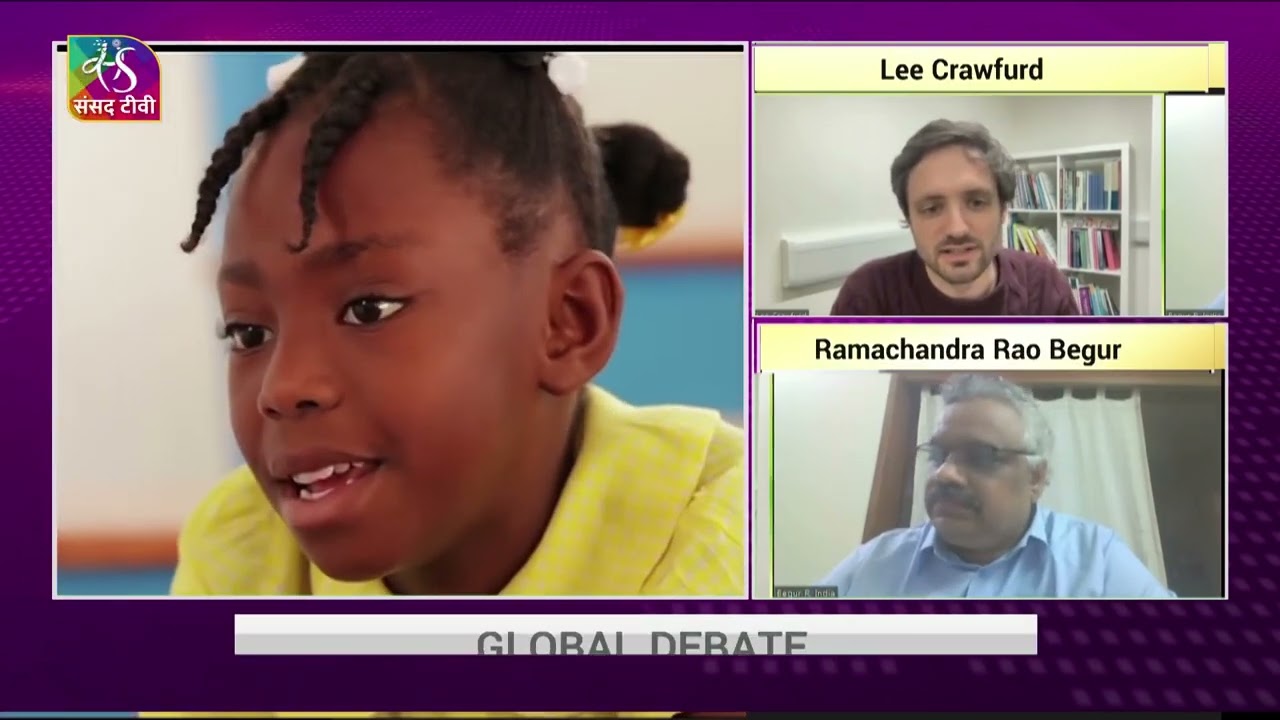
Lee Crawfurd and Ramchandra Rao Begur discuss how COVID-19 deepened a global learning crisis, with 1.6 billion students facing interruptions. School closures pushed learning loss so severe that the share of children unable to read could jump from 53% to 70% in developing nations. They argue for safe reopenings, remedial programs, and foundational literacy over tech-first solutions.
Chapters
Namaskar. Hello and welcome to Censored TV. You're watching The Global Debate. I'm Tina Jha. 7 years ago, 193 member countries of the United Nations unanimously adopted a landmark set of development goals. Intended to galvanize and guide the world's efforts to eradicate poverty, end hunger, address climate change, and ensure a more equitable world by 2030. The 17 Sustainable Development Goals, also known as the Global Goals, were broken down into specific targets that each country committed to try to achieve voluntarily over the next 15 years. That collective journey was which began in 2015 with an aim to ensure that no one is left behind, has reached halfway. The year 2022 is therefore a crucial and decisive one for the world to deepen the base of support and approaches towards achieving the Sustainable Development Goals. On Sunset TV, we will be focusing on some of these goals, steps towards achieving the SDG targets, the challenges and impact of the COVID pandemic and the kind of efforts required to accelerate progress in achieving a more equitable, prosperous, and sustainable world. Today's focus will be on SDG 4, that is, ensuring inclusive and equitable quality education and promoting lifelong learning opportunities for all. And to discuss these aspects, I'm joined on the program by 2 subject experts from different parts of the world. From California, United States, joining me is Mr. Lee Crawfurd. He's fellow Education Policy Center for Global Development. Thank you, Mr. Crawford, for joining us on Sunset Television. And I also have with me Mr. Ramchandra Rao Begur from UNICEF India. He's a senior education specialist, and he's joining us on the program from New Delhi. Thank you, Mr. Begur, for joining me on the program today. But before we begin the discussion, let's also listen in to what UN Secretary-General Antonio Guterres said recently on on the state of global education, how the pandemic has exacerbated the crisis. Listen in.
The COVID-19 pandemic has caused chaos in education worldwide. Some 1.6 billion school and college students had their studies interrupted at the peak of the pandemic, and it's not over yet. Today, school closures continue to disrupt the lives of over 31 million students, exacerbating a global learning crisis. Unless we take action, the share of children leaving school in developing countries who are unable to read could increase from 53% to 70%. But the turmoil in education goes beyond questions of access and inequality. Our world is changing at a dizzying pace, with technological innovation, unprecedented changes in the world of work, the onset of the climate emergency, and a widespread loss of trust between people and institutions. Conventional education systems are struggling to deliver the knowledge, skills, and values we need to create a greener, better, and safer future for all. Education is a preeminent public good and an essential enabler for the entire 2030 Agenda for Sustainable Development.
Education is an essential enabler for the entire 2030 Agenda for Sustainable Development. says the UN chief, implying that countries will have to shift from crisis to recovery and beyond to resilient and transformative education systems. How is that going to happen? How is the world going to reverse the damage done by the pandemic in terms of the progress that was made in achieving the SDG on education? How are we going to reduce the inequalities widened by the pandemic? If the year 2022 is going to be of bringing about equity, What kind of accelerated efforts will be required on part of the world to ensure a better sustainable future? These are aspects we will be discussing and analyzing on the program today. So let me get the first word from Mr. Begur, who's representing the UNICEF on the show today. Mr. Begur, thank you once again. So COVID-19 has created the worst crisis to education and learning in a century. As the world begins to rebound from the shocks of the pandemic. Give us a global picture of how grave is the crisis and the kind of impact on the global goal of equitable quality education.
Thank you very much for having me in this show. To begin with, let me tell you that most of the countries actually has, you know, Or in fact, especially in terms of the enrollment of children. However, children in school have to learn, and that was not happening, and therefore learning crisis has emerged. Even before the pandemic, most of the countries had the issue of, you know, learning crisis, and children were not able to learn, and While this was happening, the COVID struck. I think at that time, most of the governments, you know, opted for remote learning. While nearly every country in the world offered remote learning opportunities for students, the quality and reach of such initiatives varied greatly. And that made the difference in a significant way. The evidence on this shows that it has children's learning depicts very significantly. Learning losses have been large and inequitable. Recent learning assessment shows that learning in many countries have missed out on most of all the academic learning and they are ordinarily have acquired in schools. And therefore, I think one of the biggest challenge has been that children have not been learning, and this has been aggravated by the learning losses. To begin with, I will just say a few points how it has impacted across and in the divide. Schools closure actually has lasted more than, you know, the required in most of the low and middle income countries. That has been one of the biggest challenges. And also teachers received limited or professional support in translating remote learning and supporting helping children learn. I think the issue has been always in terms of, you know, children in school and learn. They have to learn. But that has been not happening especially, and that has got aggravated Especially with the COVID-19.
Mr. Crawford, let me get in your perspective on what is the kind of impact you see. Your research area is mainly in the low and middle income countries, and now that we are in the 3rd year of the pandemic, there is increasing evidence of how the pandemic has widened the inequalities that persisted before. What is the kind of impact that you see as we rebound from this pandemic, What will the world need to do to lessen this impact, to lessen the inequality?
Yeah, I absolutely agree. It's clear from the studies that are emerging that there has been a large amount of learning loss while schools have been closed, although we still have relatively few rigorous studies from relatively few countries to really show that. But, you know, the data that we— some of which we've collected and others does show quite significant learning loss, which is obviously a major concern. And I think that has exacerbated some of these pre-existing inequalities where more affluent parents have been able to provide better support to their children. So I think there really has to be this urgency about catching up. And sadly, I think we're yet to see that in many countries. And I think we see that around the world with governments not really taking this crisis as seriously as they need to if they're going to address it. And one data point, one reason that maybe they aren't, is that perhaps people don't yet recognize how bad the learning crisis is. So last year, we interviewed over 900 senior civil servants from 35 countries in Africa and Asia. And we asked them about this learning crisis. And they agree that there's a crisis, but when you ask them, how many children are at the appropriate reading level, they massively overestimated how many children were learning at the appropriate level. So they really don't— they realize that there's a learning crisis in theory, but they don't grasp at all quite how severe the crisis is. And if you don't realize you have a problem, then you're going to struggle to come up with solutions, I think.
What has also emerged in the pandemic is, apart from the learning losses that have happened, The response to COVID-19 has been different in every country. So basically, the transition to online learning has not been the same in every country. While in developed world, it has been quite smooth, if we compare it to the other countries, it hasn't been as smooth and fast as one would expect. Looking at that kind of disparity and going forth, when we talk about building resilient systems, what is the need of the hour?
I think first thing, now that, you know, things are improving, I think we need to get children in school. I think safe reopening of the schools is something which is very, very critical and that we need to do. The second part is around— we recognize that there is a learning loss. I think even in many a times, we really do not, you know, recognize in terms of you know, children has not been provided learning opportunities to the extent which otherwise it could have been possible in the physical mode. That recognizing that children have lost the schooling days and recognizing that there is a learning loss is itself is a first step. So once we understand that need, I think it's, it's important to know where they are What are the issues and challenges that are required to build upon, and what type of remedial catch-up programs needs to be built upon? Because looking at the situation, different children will be at different levels, and therefore we need to have differential strategies, differential plans of action moving forward. And that itself is very, very critical in terms of addressing the learning needs of children. And ensuring that the support is provided for all these children. And we have seen at this juncture as well, during this COVID period, there are a lot of innovative, you know, programs were implemented across different states. And what we need to do is that identify them, look at those models, what could be possible, and then we need to scale up. I think scaling up with quality for equitable education is critical.
Mr. Crawford, so scaling up innovation, particularly in these areas which are in a way being left behind in a crucial year like 2022, when we have covered half the journey and half the journey is yet to go, a critical juncture wherein we need to accelerate efforts. So how can technology and innovation help us build that kind of system which helps us sail out of the current pandemic and also makes us more resilient, prepares us for future such crises?
I mean, the question of scale is a really critical one, and one thing that you worry about as a researcher is that time and again you see a program which is shown to work at a pilot level, or it's really effective at quite small scale, and then when it is scaled up, it just doesn't have the same effect because It's really hard to scale things. And perhaps a program needs really skilled people, really capable people to implement it well. And as you get bigger, it's harder to find the same number of really talented people to help implement your program. And so one of the things that we're working on now is trying to recommend to people what programs can you find that are more robust to weaker capacity, weaker systems, weaker implementation. And there's some kind of programs that really require a lot of individual judgment and expertise. And that's always going to be hard. But there's other programs, just like just extending the school day, having a longer school day, building more schools so they are closer to people, making sure children are fed, making sure they're healthy, they get the right nutrition. There's these kind of interventions that are much simpler to implement at scale. And so, if you're trying to make the case for to a minister of finance for more money for education, which I think is needed, we need to show the investment case and show that you know there is an at-scale investment case that there that's ready for money to be plowed into and to start having an impact. And that's not going to you know maybe not work at scale because it's it's weakened. And you know technology may may play a part in in that, but I think there's a lot we can do with. Traditional kind of solutions. We have kind of traditional policy that maybe doesn't require the latest innovation that may or may not actually work.
Mr. Begur, in countries where the pandemic has actually thrown us into a situation where it is a matter of survival, and of course people have been pushed down into poverty, there is increased hunger levels in several countries, education has certainly taken backstage. But to ensure a more equitable society, we know how important, how critical it is to have quality education, to have education at the doorstep of everyone. So if we talk about India in terms of access to education, we have done pretty well. In fact, the NITI Aayog says that it's— we have 96% coverage when it comes to access to education at primary levels. The next stage is quality and equitable education. How are we doing on that front? How is India progressing on these 2 aspects?
I think we— I'll quote one data. You know, we had this National Achievement Survey in 2017, which has been conducted across the country on a sample basis. I think even there, close to 50% children are able to, you know, do at the grade-appropriate level learning. So there is this almost half of the children which are below the base, basic, and, you know, below basic proficiencies. So what, what is required is I think we have to do it in multiple folds. One is that we have a very good scheme and program in terms of some of the I think it is important to look at what is possible in terms of doing it at scale through that program, because that program gives an opportunity for an integrated and continuous way of providing education, and therefore that will be very, very critical. The second part is we also need to identify the pockets, the regions, the remote areas where we are not able to provide access. Especially be it for children, you know, in remote areas, or children with disabilities, or children from the disadvantaged communities, or for that matter, children, you know, in terms of migratory families. They are at a bigger loss, and therefore we need to find differential plans, different strategies as to how these programs can reach and help these children. And if we are able to do that, I think this will be a very, very critical step. And last but not least, while we focus on foundational learning, which is very, very critical, that is foundational for the learning, skills and competencies are critical. And therefore, moving forward, I think it is important that we focus on helping children with, you know, more competencies and skills as well. Skills are going to be critical as we move forward, and then that can make a huge difference.
Absolutely. Mr. Crawford, which are the other areas, the other countries that come under your research work where you think there is a renewed push required from the global body, from the United Nations perhaps, to ensure that we do not miss the target of having accessible education for all at least?
Yeah, I think there's still much further to go on access to school in many countries in Africa. And it's some of these traditional solutions around providing better— increasing the supply of schools and providing easier access. I mean, some of the things we're also concerned about beyond, I think, getting children into school and achieving these basic foundational skills, There's a whole range of other really important well-being issues which we think are somewhat neglected. So, you know, corporal punishment is rife in many schools, even where it's banned. We know it still happens in India and still in many African countries in schools. We know that sexual harassment of young girls and sexual assault is rife in all countries, including both rich and poor countries. We're just starting some research now on lead poisoning, which is a huge and I think neglected issue in education, where up to a third of children globally are affected by lead poisoning, including perhaps 250 million in India, which we know damages your brain development and lowers IQ. So naturally, that's going to have damaging effects on education, but we don't really know exactly how big of a problem that is for education. So there's a whole range of well-being issues there, which I think are absolutely critical and just as important as ensuring that schools are teaching basic literacy and numeracy.
Certainly, and also going forth, mental health of the children, Mr. Begor, isn't it? Because the prolonged lockdowns, and even now, this changed scenario of online learning, which obviously cannot replace The physical learning aspect, when the children can actually go physically go to school, have teachers around, that's a different kind of atmosphere. So going forth, the kind of effort not just towards the physical well-being and to ensure that the learning process is continued, but also towards these aspects that Mr. Crawford points out, which includes mental health.
Absolutely. I think that's something which is so, so critical at this juncture. You know, what is important in that situation is to what extent we are helping teachers to train. It's not about the children per se, teachers themselves are having an effect. So the teacher capacity development, the professional development for teachers is so critical because it's important to work on various levels. One, it is about personal transformation irrespective of who you are. It is important that you work on as an individual in terms of how you are dealing with, you know, thoughts and emotions. It's also— second is about interpersonal relationships. It's about how do you deal with that, you know, with the fellow colleagues, peers as well. The third is on the professional thing. Irrespective of what profession you've got, you need to have an impact on those. So therefore, while there are many of the programs related to children, I think that's with regard to mental health, I think There is very less in terms of helping or programs related to help teachers to also deal with the situation. Teachers are going to still play a bigger role, and they in turn create a very conducive and protective learning environment for children to progress, for all-round development of the children. And therefore, teachers do play a critical role. My sense is moving forward, teacher is going to play a big role, even in the years to come, much more bigger role with sort of technologies, because information and knowledge is required. But in terms of the higher level of critical thinking, creative thinking skills, and, and then in terms of the well-being, I think teachers can make a huge, huge difference.
Certainly. So a whole lot of transformation that would be required going forth to ensure that the learning outcomes of the children are not impacted. One final question to you, Mr. Crawford. In the changed scenario, when the United Nations is actually calling for reimagining education, we don't know for how long the pandemic is going to last, and with the threat of new variants looming on our heads especially. But in this changed scenario, what is the kind of reimagining education system that the United Nations is talking about, and which governments need to do swiftly Otherwise, the learning losses of which the experts are warning about is going to be grave.
Yeah, one thing I worry about when people talk about reimagining education is it's coming up with grand visions about the skills we'll need in the future, or different kind of social skills, or all sorts of different things. And I think the real gap in many places is these basic skills. And time after time, we've seen countries rip up their curriculum and write a whole new curriculum that just bears no relation to the actual ability and skills of the children who are struggling in classrooms. And the poor teachers are left to try and race through this heavy curriculum, even though half of the class have been left behind and aren't really following the content. And so that's a really big mindset shift which is needed, is to kind of stop and slow down and try and meet the children where they are and help them make some progress on these key skills. I mean, I think reading and numeracy are going to be 21st and 22nd and 23rd century skills that are always going to be there. And we need to meet children where they are and help them try and make some progress.
Okay, okay. Mr. Begun, so when the United Nations says there is need to reimagine education at a juncture where over 200 million children globally are on the verge of being left behind, there is fear that when things normalize, they will never return to education. What is this concept of reimagining education? Are we putting the efforts in the right direction?
I think it's, it's, it's definitely important. All these things what has that we need to look at much more differently and significantly. One is in terms of, you know, with the digital gap that has existed, I think there needs to be significant efforts in terms of how do you reduce this digital gap, because moving forward blended learning approaches could be reality, and therefore even schools depend— there is always important to see that how these approaches can be done. And children's access is so critical to learning. That's something which we need to do. As we talk about things, it's about foundational learning and skills. And therefore, children's, you know, access to learning, when we are talking about, you know, even the foundational learning from early childhood education to the early grades, they are so, so critical. And therefore, that foundation has to be provided and that's the way to go. Third, it's again, we need to provide a protective learning environment. Children are safe and are able to express and learn and blossom. And therefore, we need to reimagine in the sense that it's about education and learning and well-being.
Absolutely. And I'm hopeful that despite the inequalities that the pandemic has brought about, countries will accelerate efforts to bring about accessible, equitable, and sustainable education, because the time is very, very less now. We have completed half the journey towards achieving the Sustainable Development Goals, half the journey wherein the pandemic has sort of reversed the progress that was made earlier, and now renewed efforts going forth will be required to ensure that we do not miss the target of achieving equitable, accessible, and quality education for all, where no one is left behind. So with that, I'll have to call it a wrap on this edition of The Global Debate. Thank you once again to both my guests for joining me on the program today, sharing your thoughts with us and our viewers. It was indeed a pleasure having you on the program. So that's it from us on The Global Debate. Thanks very much to all my viewers as well for their time.
Thank you.


