Beyond 'Suck It Up, Buttercup': Reclaiming the Soul of Medicine with Dr. Todd Otten
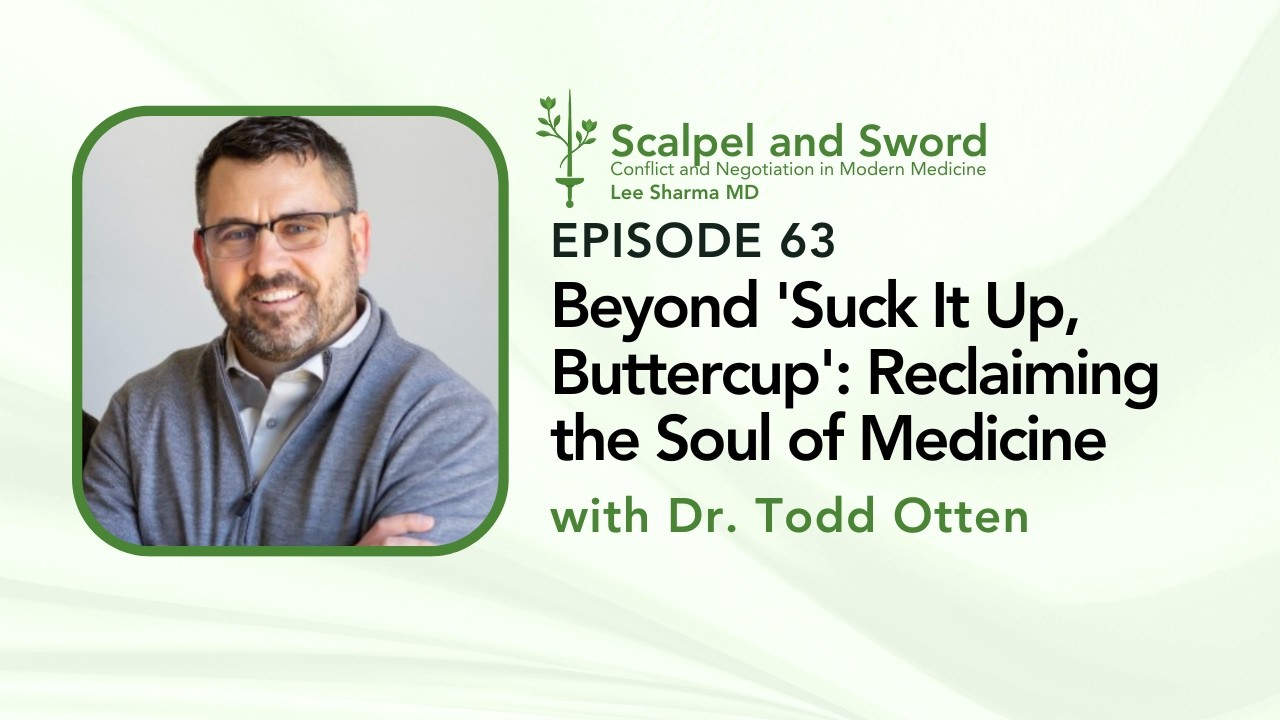
Dr. Todd Otten made a documentary called Suck It Up, Buttercup about physician burnout and moral injury after losing four colleagues to suicide. He assembled Mark Cuban, nurses, patients, and doctors to expose systemic problems in healthcare and calls for clinicians to unlearn helplessness and build networks that prioritize people over profit.
Chapters
Hello, my peaceful warriors, and welcome to the Scalpel and Sword podcast. I'm your host, Dr. Lee Sharma, physician and conflict analyst. I don't know about you guys, but I love movies. I speak movie. A lot of the way I express myself is in metaphors from movies. My children and I have often been known to send movie scenes back and forth to each other as a means of communication. And because I know how powerful movies are, I'm so excited to have on the podcast today somebody who is harnessing the power of this wonderful media platform and using it to tell the stories of physicians who see how important and necessary it is for us to produce change in our healthcare system. I am so excited to have on the podcast today, Dr. Todd Auten. Dr. Auten is a family physician. He did his medical school at Wayne State. He worked in the Navy and he did his residency in family medicine in St. John. And correct me if I get that wrong, Todd. He is the lead catalyst and chair of Medicine Forward, which is an organization that is using positivity to disrupt the status quo in medicine. And most importantly, one of the greatest things I think In terms of this teaser trailer that I'm so excited to talk about today is his movie that he has produced. He is the executive producer of Suck It Up, Buttercup: Trust and Betrayal, Healthcare in America. Todd, welcome to the podcast.
Thanks, Lee. You know, every time I do one of these, there's an intro. I just think, oh my gosh, are they talking about me? How did we get here? You know, and I seriously, I feel that way every time because a lot of these things are labors of love. So thank you for the kind words and intro.
I'm really so excited for this conversation. One of the things I did getting ready for our conversation today is I did watch the teaser trailer for Suck It Up, Buttercup. And one of the first things that struck me about watching this is the very first person who comes up on the podcast, and we talked about this, was Wendy Dean. And for people who don't know, Wendy Dean has been one of the leading voices in our country talking about burnout. And in particular, this concept of moral injury. And I know that this work is what led you to make this movie. What was the moment that you said to yourself, I have to do this, I have to get this done?
I have to give credit where credit's due. The inspiration actually came from a fellow colleague, another OB-GYN, Marianne Wilbur, who wrote a book called The Doctor Is No Longer N. Talking about why physicians were leaving, and she had a dream to make a documentary. And so it was definitely her inspiration. I got involved very early on from a handful of reasons: thought leadership, the fundraising aspect, and also I've got a pretty good physician network at this point. But this probably the other part of this for me anyways is kind of my three whys. You know, having been through really pretty classic horrendous burnout and understanding how devastating that is not only to The individual, but their family, their friends, or colleagues, and least of which how it negatively impacts patients. That's a big driver for me. Unfortunately, I've lost four of my colleagues to suicide in my career. Two of them I was close with, and shoot, one of them I didn't even grieve for the better part of eight years, to be quite honest with you. And then when I was in the fee-for-service world, the frustrations of patients were just daily and sometimes nonstop. And so those are the three things that really drive me. to the advocacy work that I do. And we're really a big part of the driver behind the film, you know, and getting it to the finish line. 'Cause it is, I'll tell you what, it is a lot of work to pull something like this off. But here we are.
I think all of us unfortunately have had the experience of losing colleagues. I, about 15 years ago, lost a dear friend to suicide. And I don't think you can really express Until you've had that experience of the helplessness that you feel when you lose colleagues in this way. So, the idea that we're paying homage and we're honoring their memory by doing what we can to raise awareness about not only the prevalence of burnout, because I feel like people understand that. Do you feel like there's a pretty good understanding right now of how prevalent burnout is?
Yeah, I think so. And I think especially since the pandemic, I think it was kind of put in the spotlight and people are understanding how that impacts individuals, not just in healthcare, but beyond. Absolutely. And even to echo the sentiments, my condolences, by the way, Lee, to, you know, losing your colleague. But yeah, I felt helpless afterwards. I felt guilty. I had survivor's guilt. I regretted never asking how one of my colleagues was doing. And for a long time, I just buried that down and like, We were all taught just compartmentalize, you know, suck it up, buttercup, keep going. You know, there's so many layers to the trauma that exists in the healthcare space, not only in healthcare delivery, but even in medical education when you think about it. So yeah, a lot to unpack for sure.
And I think that's one of the great things about the work that you're doing is you are unpacking it because I think there's a danger sometimes. And I think that's one of the reasons why I was really glad the first person I saw was Wendy Dean, because I think she was one of the first people that really brought the term moral injury. Into a more public sphere. This idea that burnout is not a person-centric process, it is a systemic process. And that unless you peel back all the layers of the system, you're never going to get to the root of the problem. You're never going to actually address why physicians are leaving, why we're losing colleagues in these tragic ways. So, part of the work that you're doing and the people you're including Are definitely addressing that. You're peeling the layers back on this onion, and this is what we so desperately need. As you started this process of planning and producing this movie, what guided you in terms of the voices you were including that were going to be expressing themselves in Suck It Up, Buttercup?
It's a fascinating process of determining what is actually going to get into the film, right? Like, so I'm not going to sit here and tell you that, you know, I went to I didn't go to film school or all these other things. A lot of this I learned along the way, and a lot of it was instinct and trusting colleagues and listening to other voices. But part of what we were trying to accomplish with the documentary is to have broad strokes in terms of the problems that exist, but also provide hope and some solutions and ways forward in the second half of the film. But we wanted a multitude of voices, not just physicians. We've got nurses, patients, former executives, a few celebrities are in there, but you wanted people where you could catch the emotion. You wanted people that when you talked to them, you were yearning for more. You wanted to know what the next word out of their mouth was going to be, or it was tugging at your heartstrings and those kinds of things. So that played a big role into it. Some of it was, you know, prominent thought leaders were key. Some of the celebrity component played a role in it, if you will. So there were multiple factors that contributed. And honestly, there were some pretty important people that didn't make it into the film even for different reasons. Right. And so there, it's just, there's all these little pieces. It's almost like this, probably more than a 1,000-piece jigsaw puzzle that you're trying to put together and going, okay, how does this voice go here? And what are we missing from this? And one of the most interesting parts of it, I would say, was how that would change a couple interviews. And We would need to take them into a little bit different direction. I can think of one, one, one very prominent person in the film is Mark Cuban. I mean, Mark Cuban clearly is wanting to disrupt things in a big way in the healthcare space, not only with the PBMs, but also using direct primary care and all these other things. But the interview was very business-centric when we were interviewing him the first half of it. And I was sitting there going, oh boy, this is not what we need out of this interview. And so I had gotten to the point where I was confident enough to raise my pen and, you know, say, hey, I have a question. And I led him into a little bit of what the calls to action were going to be around an impact network and getting more patients involved, getting more physicians involved, and so on and so forth. I was sitting in the corner of the room and he started to answer the questions to me and the camera was in the middle of the room. So my producer like grabbed my shirt and And he yanked me over behind the camera so he would look at the camera. It was awesome. And after that, it was incredible. You know, the thoughts that he was able to express, the emotions that he conveyed, it was just amazing after that.
That's a gift, Todd, to be able to encourage thought leaders to actually speak to a process and something powerful that you're doing, so much so that they've got emotion coming out of them. And you can feel that emotion. I mean, this is what you're doing. And this is why I think this work is so incredible, is that, like you said, the story, what's important about it is what it moves in us. What does it move us to do? We hear these stories all the time. One of my favorite stories ever about a movie making someone move to action. You've seen the movie Jaws, right?
Mm-hmm.
Okay. So you know the end of the movie? Where they're all in the boat, they're about to get attacked by Jaws. And this— forget who it is, which character is telling the story about— I think it's in World War II where a bunch of sailors are in the ocean and they're getting eaten by sharks. And he's telling the story and there's a little kid someplace in Maryland who's listening to the story with his dad and turns around to his dad and goes, is that true? And this kid became so obsessed with this story, he actually rounded up the survivors. And he went to Congress as a teenager and got them to pass a law honoring all of these people that survived the shark attack. This is one kid watching one movie. And so you think about what you're doing with Suck It Up Buttercup. You are encouraging people to tell these stories in such a way that people are moved to action. And that's what you did with Mark Cuban. That's incredible.
Wow. Thank you. And, you know, I think some of it being a family physician and helping people on some of their darkest moments of their lives with motivational interviewing and empathy and all these other things, I think definitely was a skill that I didn't realize was going to be so important in this process. Even in the early on, at this point, I think probably 3,000 or 4,000 people have seen the documentary. I mean, it's not even out widely at this point, but I'll give one example of something that occurred in Portland when we were doing a screening. The Glaucoma Pleccans were there, which is amazing. And we did a Q&A and that was a lot of fun and all these other things. And so you're getting all these Amazing dopamine hits as the day's going on, right?
Right? So that's just one of many things that I've heard as a result of this film. It's a tough film. I mean, we get into a lot of hard topics. There's some levity for sure, and it definitely ends on a very positive note. But people who have seen it, we're getting this sort of resounding energy that they want to do something. And I think that honestly, that's what we're trying to accomplish is I believe we need patients involved in helping us turn this thing around. Not a couple patients, not a few thousand patients. We need millions of patients being activated and participating in some capacity. And even if it's as small as donating a couple bucks to a nonprofit you believe in, fine. All that makes a difference. And when you start putting all this together, it's going to be hard to ignore. So it's exciting. It's super exciting. 100%. And I want to get into this on a couple of levels. The idea that this movie is not only going to speak to the healthcare establishment, it's going to speak to the patients that are actively participating in healthcare. And it's going to give them not only just an insight into what physicians experience and the economic challenges, the political challenges. One of the most moving parts of the trailer was the widow who was talking about the fact that she feels like medicine killed her husband. That her husband, who was a physician, died because of his job. And as I was watching the trailer and she started talking, and you think about all the people who are married to medicine, all the children of the parents who practice medicine, who've watched what their family members have gone through, and if doctors speak. To the experiences we've had with burnout and how helpless we feel and how much we want to change the system. When that family member spoke, one of the things that resonated with me is that we can tell patients all day long how hard it is to do what we do, and they do believe and they do want to help us. I absolutely believe the majority of patients in the United States do support their physicians and want to see healthcare better through them. I absolutely believe that. But when you have the widow saying to camera that medicine killed her husband, those are the insights that a lot of patients don't have. That's the kind of stuff they don't see. They don't understand all the birthdays that get missed. They don't understand the times that maybe their spouse came and this is the first meal they've had because they saw 45 patients in clinic and never had time to sit down and have a meal. And so The life experience physicians have is something that's very hard to shine a light on, but you do it in this movie.
And actually, that's one of the things that came out very early on. You know, whenever you have a project of this magnitude, you're going to get different feedback, and you're going to get different pushback. Oh, there's too much emphasis on physicians. There needs to be more patients, and all these other things. But one of the things that we heard consistently was that we humanized the role of being a physician. You know, instead of being this superhero or this superhuman being, people are like, you showed us that you're human, that we're fallible. You know, we make mistakes. We have families. We have loved ones. We cry, all these other things. And I actually think that's going to be one of the key things that helps to get more patients involved and understand like, we're working together. We need to work together on this. And actually Will and Kristen Plannery, who go by Dr. and Lady Glaucomflecken, Specifically talk about this in the film. They talk about the wedge or the divide between clinicians. They talk about physicians versus patients and that it's intentional. And at times even things are weaponized, even words are weaponized or relationships are weaponized. And so we shine a light on a whole bunch of stuff, but that's a big part of it. And I think we were successful, but of course I'm biased, I guess, a little bit.
I think that's such a huge point. That a lot of the conflict that goes on between patients and physicians, a lot of that is something that's not only in some ways institutionalized by the way healthcare works right now, but something especially maybe people who are profiting off medicine that aren't necessarily part of healthcare delivery, that conflict works for them. Having us separated and divided makes us weaker as advocates. And so they will definitely push for that continued separation. And so the idea that you're actively addressing that in Psych It Up Buttercup, I think that directly speaks to the idea we want patients and physicians to be together and be very aligned in what we're trying to accomplish. And if we are able to achieve that, the systemic change that we can create is unfathomable. I mean, I think we'll be able to do way more than what we even conceptualize.
I agree with you 100%. And actually this was part of the reason why I was the biggest stickler as we were going through the beginning of the film, like what the calls to action were going to be around the film. Dozens of phone calls with very prominent individuals, CEOs of this or this medical association, whatever. What's the call to action? It's gotta be something granular. It's gotta be, you know, 3 to 6 months. And every time I hear that, I'd be like, this problem is not going to be fixed in 6 This problem probably is not going to be fixed in 6 years. This problem might not be fixed in my lifetime. And so if I'm putting out a call to action that is no longer valid in 2027, have we really created the level of impact that we want? And I always came back to no, which is why we landed on 2 calls to action. One, unlearning learned helplessness. Learned helplessness is pervasive. Our colleagues are just going through their day, heads down. Somebody said zombie doctors recently, you know, blinders on, just trying to survive. Like, that's not what you want, right? We need to unlearn that at scale, not just clinicians, but also patients too. Your voice matters. Your words matter. Your actions matter. So that's one. And then the second one is to accelerate an impact network that values people over profits. And the idea behind that is Similar to healthcare delivery, a lot of these amazing organizations and people are somewhat siloed. They could have like the same mission statement and can't figure out how to work together. And we've got some pretty big obstacles in our way that are well-funded, well-lobbied, institutionalized, and are very happy with making a lot of money as it stands. So we have to get out of our own little bubbles and learn how to Collaborate, work together, give and take, agree to disagree at times, lean into the discomfort, whatever you wanna say. So that's where we landed. And I think I'm hopeful that it does what we think it can do.
I wanna applaud you on the call to action, specifically the creating the impact network. And one of the things that you said I think is so awesome is that in getting people out of their silos, One of the things that you have to address is the potential conflict that occurs in that. It's like, you know, anytime you're trying to bring different groups together for a higher purpose, you're going to have disagreements about that. And recognizing that as you're creating the network, I think already puts you ahead. Because sometimes I think there is sort of this idea, if I get everybody in this room and we all want to do the same thing, it's going to be fabulous. And it's like, yeah, it doesn't always work that way. So I think the fact that you already know that that's going to be something that's to happen and are prepared for that, it's gonna make this action network even more powerful. Because I've often seen people try to create advocacy networks where they didn't anticipate those things, and then they were surprised when people got in the room and they were getting conflicts that unfortunately threatened to disrupt the alignment. It's like, yeah, so you're already way ahead of the game. That's fantastic. Were there any obstacles that you came across in producing or making this movie that you didn't expect in the process?
How long's the show?
It takes as long as you want it, my friend.
Oh, you know, there were so many. Like, when we started this, I was a family physician with zero experience in filmmaking, you know, literally zero. And so when obstacles would pop up, I would either have to dig into it or look for help or ask somebody else that knew about it. So there were numerous things that occurred, whether it was related to fundraising or business development or relationships or egos, all kinds of things popped up. I think one of the most fascinating components to all of this, well, probably several, it seemed like whenever a door would close, a bigger one would just come opening up. Or if we were struggling to get funding, all of a sudden it would just show up in sometimes a very big way, which was huge for keeping people working and all these other things. But the other part of it is a lot of people said, hey, you know, I believe in this so much. I'm willing to defer payment. I'm willing to defer being compensated. I'm willing to wait as long as it takes because I want this to succeed. Every time that happened, I was just like, okay, we are just being guided. We're on a mission. I'm just kind of following along. You know, and so, yeah, there were tons of different obstacles, but also a lot of just amazing people that were willing to give more than I could ever even ask for.
I love that. Also, it really does sound like for you, this was not just a labor of love and a passion project, that this was an exercise in creativity for you. And I want to talk about this for a second because you used a term that I've never heard before, but I think is so important to address, which is the idea of the zombie doctor. The person who puts their head down and is like, I just wanna survive. I just wanna get through this clinic day. I just wanna get through this surgery day so I can go home. And my husband is pulmonary critical care and he's very, very good at what he does. But during the pandemic, he started carpentry. And when he started doing carpentry, he realized he really loved it. And not too long after that, he got involved with our local theater company. And so now he's been in a couple of productions for them. He's on their board and he helps them build sets. But he said something to me a couple of days ago, which again, I love how God provides in this way. It's so cool that he said, you know, I didn't realize how much of my non-creative self I wasn't using. It's just been dormant for 25 years. I see patients and I come home and I like seeing patients and I like what I do, but I've never gotten to exercise my creativity. And one of the things I think that happens when we start to develop other parts of our identity in this way, when you have people who are making movies, who are building things, any way that you're exercising a different part of yourself, you actually start to build confidence in engaging people, places, and events that you would never do it otherwise. You're not just a doctor who's locked into a doctor identity. You start to see yourself differently. And I think people become more willing to engage in processes when they embrace their creativity. Did you get to see anybody really come out of their shell? Anybody who was in this movie who really said, you know what, I think I can actually begin to fight this fight because I never saw myself as a person who was creative.
Oh yeah, I did. I almost trying to come up with a list of people potentially. There are so many people who were involved in this that it accelerated either their advocacy work or their relationships. Or their ability to start to network or fundraise for their nonprofit or whatever. It's incredible to see this product really provide a level of empowerment that I dreamed of, to be honest with you. And the same thing happened for me as we went through it, right? There's so many examples I would be sitting there going, how did we get here? Like, how am I in Don Berwick's backyard interviewing him? He was one of my heroes. You know, I was so excited. I had him sign my laptop because I forgot to bring something to have him sign. That's awesome. He got the biggest grin on his face. And actually, since then, he invited me to a couple meetings about a nonprofit that they're starting. And you're right. I think expressing this creativity gave me the courage to sit in a boardroom with another 20 physicians and take feedback on the documentary early on in the process. You talk about being in a room and Dodging bullets for a couple hours. That's what was going on. But it was that great, tough, critical feedback early on that we needed to continue to shape the product. And actually, some of my funnest moments were sitting in the production studio with two of the creatives. No agenda. I would just sit there. They would do their work, and they'd be editing something, and then we would start talking about something, and it would lead us down a little bit of a rabbit hole. I'll give you an example. Linda Pino's in the film. She was the whistleblower on. Humana back in the day when it was highlighted in Michael Moore's Sicko. I love Linda. She's an amazing woman. But she described this statue that they bought the day she denied a heart transplant. And she's describing this and I'm like, we need to see what this looks like. And so we researched the statue and that made it into the film. As she's describing the statue, it pans up and you can see what this— she describes this long, gangly, ugliest piece of sculpture she's ever seen in her life. So stuff like that, just those fun moments. Yeah. Like, I don't know that I ever would have thought that way in the past.
And look what this has done. Look how many people are going to be absolutely inspired to be part of this positive transformation because you invested in that creative part of yourself. That is so cool. One of the things that you've also done, because Psych of That Buttercup was not your first foray into working in public media, you also have a book that you've written.
Yeah. Ripple of Change started out as catharsis, honestly. I wrote a poem called The Medicine Is the World's a Grave about 2 years after coming out of burnout. And it was kind of a dark look at the realities of primary care and some of the things that go on. I then wrote a chapter called Anatomy of Burnout, which was really my journey and how burnout affected me and my family and those around me. The book took on a completely different trajectory when my co-author Joshua Judy got involved, one of my former patients. And so we wove our 2 stories together in both of our catharsis, really to try and inspire the collective to play their part. And so that was kind of the first foray into this world of advocacy. But what was interesting about the book is writing a book and having quite a few people have read it, which is good. And it's a thicker book, so don't be intimidated. But anyways, but it was like it. Key that opened doors. When I would go into conversations with different individuals and they knew I had written a book on healthcare transformation and all these other things, it gave this sort of level of gravitas. That's not why I did it. I did it because I wanted to make a difference, but just like I got to talk to all these amazing people and that was actually a key part of sourcing a lot of the interviews for the documentary. I had been doing networking pretty consistently for about a year between my roles. And so I got to meet people like Wendy Dean and I'd known Doug Drummond and Doug Drummond is friends with Mark Cuban and all these other connections were there. And so when we were going to source interviews, I was like, well, I know who might be good for this topic. And I would reach out to them and they would just almost every time the person would say, yeah, sure, Todd, we'll do an interview for, you know, whatever crazy project you got going on. And so it was a big part of the documentary, really all those dots that got connected as a result of the book.
I love the fact that you wrote Ripple of Change with a patient, that you were able to intertwine those stories. How did that happen? Did you approach your patient and go, I would love for you to do this project with me? How did that happen?
Well, probably a result of extreme desperation for him and me as his clinician and serendipity too. So Joshua had been struggling with cervical radiculopathy for years. And we tried all kinds of stuff and it was weighing on him. When you're in chronic pain, that weighs on so many things. And so he was getting kind of to a dark place and I was frankly running out of ideas for him. And so one of the visits, I was early on in the writing process, I brought it up and he seemed a little interested. And I told him about the quadruple aim and probably confused the heck out of him. He's like, what should I write? And I literally said, just write. And he did, and it was good. And so we had a meeting then, and that was where the idea of weaving our 2 stories in a yin and yang fashion came together. And I gotta give credit to Joshua for that idea. And after that, it took on a complete life of its own to the point where, you know, different sections needed to be moved or adjusted or woven together. But it really, our stories were so in parallel at the time. With our struggles that they kind of naturally came together. Pretty neat.
But it also was a real step of courage for you to be humble enough to share that you were writing this with your patient. You had to be transparent with him and tell him that you were going through this journey and invite him to share it with you. So I think that's one of the greatest things about the work that you do, not just with Ripple of Change, but with Suck It Up Buttercup. Is you are encouraging all of us to have that level of transparency and humility with ourselves and our patients. Because I don't think we can really be advocates for the change that healthcare needs unless we're willing to admit that we ourselves are suffering in the system. And sometimes that's hard. You know, like you said, it's like zombie mode doesn't always manifest itself as having our head down going through clinic. Sometimes zombie mode is walking through and acting like we're bulletproof when we're really not. And so the ability to allow us, I mean, that's one of the things I think this movie does is it's giving physicians, all healthcare professionals, the permission to say, we're hurting in this system, we're suffering in this system, and we don't know how much longer we can sustain it. We need your help to change it.
100%. That is music to my ears. My hope is that this film Has not just hundreds, but thousands, if not hopefully millions of individuals feeling empowered to speak up and play some little piece in moving this thing forward. We're, you know, I said it before, we're up against such well-funded legacy institutions. We've got such, such a huge amount of work to be done, but back to the— I don't know where I was going with that. I was going to talk about maybe the book a little bit more.
Yeah.
I often talk about when I'm seeing patients, it being a team game. You know, like I'm the physician, you're the patient. Yeah, we got that. I could make some recommendations to you. And if you say, Dr. Rotten, you're insane, you walk out the door and you're not going to do any of it. What's the point? Right. And I, as my career went on, I really started to let my guard down a lot with patients. You know, and I don't tell them everything, but I tell them, You know, intimate details sometimes about my headache history, or I've taken this medicine before for my post-concussive syndromes. And that's why I'm offering it to you. And I'm not saying we need to bare our soul all the time, but that the relationship needs to be two ways. It needs to be a two-way street. And when it is, it's magic. And sometimes the best prescriptions I ever gave were words of encouragement or compassion. Or whatever. It wasn't a medicine. It wasn't a surgery. It wasn't a cast. It was saying, I believe you're going to get better. You, I need you to believe it too. And that's missing, you know, as trust has been eroded and everything's about RVUs and productivity and the bottom line. We've lost in many places the humanity of it all, which is why most of us went into this. You know, we, and we need to bring that back. Sorry if I'm getting on a soapbox. I get—
No, go.
Sometimes you get on a roll.
No, but what you said, the idea that all of these things that have destroyed this physician-patient relationship, and then once you sort of let the economics even widen that divide even more, how do you reach back across? How do you bring patients back into these efforts to reform the system? How do you help them see that? You do it one patient at a time. You do it one visit at a time. You take that one extra second to actually look that patient in the eye and let them know that you've heard them. And it's hard. It's really hard. It's hard for so many reasons. It's hard because sometimes we get afraid of what will come out of those relationships. We get afraid of, are we going to be able to reimburse? Can we keep the lights on? I mean, there's so many things that unfortunately affect that relationship. But there is nothing in this world that is more wonderful than being able to hug a patient, shake somebody's hand, and then have them leave that visit. And you know, and they know that there was something that got established. There was something that got built. And if you can have that one thing happen, 100 patients, 1,000 doctors, 10,000 physician-patient dyads. How big can it go? That is the revolution. Because once you have that, once you actually have those relationships that are strong, honestly, that is where the magic happens. The finances, all the other stuff, the reform, I agree with you. We may not see that in our lifetime. We may not see overhaul of all this kind of stuff in our lifetime. But what we can see is we can see these relationships rewarmed.
I agree with you and it makes, so I'm currently in a direct primary care model with Plum Health. And so I have the luxury, I mean, I have the luxury of time with my patients, 10 to 12 patients a day. It's incredible for those that are familiar with direct primary care, but it's the joy for me. The joy has returned. Like work is so, it's just amazing. Like I don't feel this internal clock in the background of, hey, I've only got 15 minutes with this person or what have you. And you get to spend, you get to spend time with people. I mean, even just an interaction today, I could tell there was so much tension between the couple. You know, I paused my recording and I said, hey, I'd like to, I've known him for a long time. I said, I want to talk to his friends. You know, forget, forget the medicine, forget what we're here for. I want to talk to his friends. And just offer some maybe some simple advice to try and help the two of you get to to maybe a little bit better place. That's what medicine's all about, right? And I don't know what will come of that interaction. Hopefully it'll be positive. But you're right. I mean, if we can do that at scale, and we all have the courage to say, you know what? I'm not gonna add another five patients a day so that we can meet an an RVU budget in three months or whatever. I'm not gonna check some boxes that are aren't necessarily accomplishing that. You know, all these things matter and over time will allow us to take control back of the profession that we all, most of us loved at one point and went in to help others.
So let's say you've got an audience, physicians, patients, third-party payers, and they've all seen Suck It Up Buttercup. They literally, they're in, they're in the theater. They've seen the movie. They're walking out. In your dream world, in your perfect world, what do those people do when they walk out of that movie?
I've gotten this question sort of in a similar frame, maybe a similar, similar spin perhaps. I often joke my goal is I want to boil the ocean, which I take back to a friend of mine who said, Todd, you can't boil the ocean. I'm like, I know I can't boil the ocean, but I can boil 300 million people, right? And, you know, so I don't often— I hesitate to say I want people to do one thing because I'm not sure that there's one simple solution to the problem that exists, but I want people to feel educated and empowered to do something. And if that something is asking your physician how they're doing that day and buying you an extra 5 minutes with them in the room and making their day and putting a smile on their face, then that we've accomplished something. If that is getting involved, I often talk about time, talent, and treasure. Maybe you have some time to volunteer somewhere, get involved with a nonprofit that you believe in what they're working on. Maybe you have the talent to work on some creative outlet. Maybe you have a few extra bucks or more that you want to support one of these other individuals. If tens of millions of people do something in the realm of healthcare improvement, It is going to be so difficult to ignore that change will be inevitable, right? It becomes like, you know, the book's Ripple of Change, and I talk about I want a tsunami of change. But it's that additive effect, right? Like, it's that 1+ 1 that doesn't equal 2, that equals 1,000 or 1 million. So that's what I want to see. I want to see action from people when they come out of the film in some capacity, wherever. Whatever lights them up.
I love that. So Todd, tell people, how can they watch Suck It Up, Buttercup?
Good question. So there are layers to distribution, which is one of the obstacles that you don't know as you're going through this. Currently, uh, we are in the process of— we submitted the film to a third party to get it to major, hopefully a major streaming service. That'll take a few months. In the interim, people can request a screening or reviewing via the website, which is SIUB Film. So suckitupbuttercupfilm.com. I mean, you could Google me and you're probably gonna find it too. But in the interim, and to help generate some of the revenue needed to get the distribution to where we want it to be, if anybody makes a contribution to our GoFundMe at any level, they're gonna get a link to watch the film now. So there is access currently. So, and people are taking advantage of that, which is serving several purposes. Yeah. Thanks for asking.
Awesome. And we will put that link in the show notes. So hopefully all of our listeners will be so excited as I am about watching this movie. Todd, thank you so much for being here. This has been a fabulous conversation. Thank you for the work that you're doing. Thank you for taking your lived experience and turning it into something that's going to bless a lot of people.
Oh, it was an honor to be here. Thanks for inviting me. I appreciate your time. Having me.
For all of our peaceful warriors who have joined us today on The Scalpel and Sword, if this podcast has resonated with you, share it with a colleague, share it with a friend. Don't forget to check on all of your friends and colleagues. And until next time, be at peace.
More from Lee

Advocacy without Adversaries: Patients and Physicians Pulling Together with Shalita Thrasher

Ep73 | The Mountain Has the Final Say What Everest Can Teach Us About Burnout, Moral Injury, and ...

What Everest Can Teach Us About Burnout, Moral Injury, and the Limits of Control

Ep72 | Before Violence Happens : Using Anticipatory Guidance to Prevent Escalation


Ep71 | The "Invisible Hand" Series - The Impact of Medical Malpractice with Dr. Gita Pensa | Part 2

The "Invisible Hand" Series - The Impact of Medical Malpractice with Dr. Gita Pensa | Part 2

The "Invisible Hand" Series - The Impact of Medical Malpractice with Dr. Gita Pensa | Part 1


