#2 Author Insights: Harvey Castro, MD, Author of "ChatGPT AND HEALTHCARE"
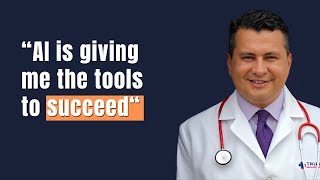
Harvey Castro, author of ChatGPT and Healthcare, talks with Leon Eisen about AI's role in medicine, education, and business. He uses ChatGPT daily to boost productivity in his practice, argues schools should teach students to work with AI tools rather than ban them, and warns that AI hallucinations pose real risks in healthcare. Castro sees AI lowering education costs and transforming how small businesses operate.
Questions this video answers
Every 72 days.
One stepson is 7 years old; another is 16 years old.
About 30–40 pages.
Scientific American (cited); verbal/IQ figure quoted as about 155.
Chapters
Hey there. Are you ready to tap into the minds of exceptional authors and thought leaders? So welcome to Masterminds of Life and Business Authors Talk. The new podcast series bring you insightful conversations with the brightest minds of our time. I'm Leon Eisen and together we will explore the wisdom, experience and perspectives of athletes who reshaped our understanding of life science and business. So subscribe to our podcast and unlock the secrets of these brilliant minds. Hello everybody. Today we meet with amazing, amazing guy. His name is Harvey Kafta. I think a lot of people know him very well because he is one of the most productive individual I've met in my life. We're not going to talk today about his books because but he wrote more than five books. We're going to talk about implications and any problem and Maybe solutions that AI and its first representative, ChatGPT, could have in our society and could have in humanity. So please meet amazing Harvey Castro.
Thanks for having me. Always a pleasure to talk to you. We always have great talks whenever we meet. So I appreciate your time.
Thank you Harvey for joining us and I really appreciate your time. I know you are very, very.
Very.
Busy and your time is very valuable because I think you are now writing another book and we just interfere here. But we are going to talk today about exactly about interference. As you know, new agent came to the scene. It's called AI agent. And how are going to deal with this AI agent, what it will bring to us, how to find the good communication with this AI agent. You know, in the recent lecture by Yuval Harari, he told us about some risks which the most risk is intimate relationship relationships that this agent could create with us. Even we do not notice about it. So I think we have to advance our education and education of new generations in a way how to deal with new agents. How to build ethical framework around communication with the new animal which play in our ground today? It's not conscious yet. It may be, it will be conscious in the future. But currently in any case, it interferes our life and even impact of our life much more than we have to accept. So please, Harvey, could you tell us more what you think about it?
You know, I think the main thing I even tell my children this, we need to accept AI. The worst approach is to say I don't want anything to do with it and I'm going to close myself off to it. I think it's important to have an open mind and because of my children, you know, my, you know, I have, I just got married and my stepson's 7 years old, he's a little young. But I'm already kind of putting the grounds for understanding AI. And let me give a quick example. You know, in medicine I'm a doctor. Every 72 days the medical knowledge doubles and so the amount of information that I'm responsible for is humongous. And so my worry is that, you know, I'm out of residency, I have to keep up with training, but AI is giving me the tools to succeed and you just mentioned it. You know, I'm very productive and honestly my secret is I just use AI to help me and I think it's important. I'm glad you're doing this. I think we need to discuss the good, the bad and the unknown about AI So let's keep going.
Yeah, it's very interesting because you are very. A good example of effective and efficient using AI. Not everybody can use it. Actually I try to teach my kids to do it. They're not ready yet, but I hope it will be. It will, it will come. So what do you think what new education should just what elements of new education should be to challenge this new agent?
Well, you said it perfect. I think every person that's trying to use AI and I know I'm trying to teach my children and they have different interests and they have different angles, I'm having to meet them halfway, I'm having to see what their interests are and then show them how to use AI. For example, I have a 16 year old stepson and he loves gaming and playing video games and, and he likes making YouTube videos. And I said, you know what, I showed him an AI that you can put the lyrics of the AI and he can pick his favorite rapper and it pretends to be that rapper and then it made a song. And so he's currently working on. I showed him the tool of making a YouTube video of his favorite video game but then he's going to put AI voice that's using a rap to the lyrics of his video game. And he's so excited and so I'm slowly showing him how to use Mid Journey and how to use different things and how to use different video coding because I'm teaching him how to use these tools and but he thinks it's just fun and whatever. But I know that he's 16 by the time he's 20 he's going to see this and maybe this might become a tool that he's going to start making money from because I know people won't know how to use this and he Will.
Yeah. Thank you. Very interesting. And what do you think about neuroplasticity? Because I think accepting new aging and communication with new AI aging requires a lot of neuroplasticity from humans.
Yes.
So what do you think which direction we have to advance our education to develop the better neuroplasticity?
That's a hard one. I love education. Obviously. I have an md, I have an mba, I have a bs, a BA I have so many years of studying. And I say that not to brag, but just to say that I love knowledge. And so in my brain I just want to be fed, I want more information, more information. And so we need to quantify. You know, you and I are a different generation, our kids are a different generation. And so the way they think, we need to modify AI and teach them these tools. And so to my earlier point to make them go halfway or teach them. My worry with AI is that our traditional education system is so against AI and a lot of them are saying, oh, this person cheated or they used AI. We need to change the way we think, our tools and encourage them. And instead we need to give them work exercises where instead of giving them a work home, home homework, we need to do it in the classroom and say, okay, here's a problem. Everybody get your A out. Let's see what you have to say. How would you solve this problem and help them with their critical thinking skills? And not to say that this is replacing their mind. It's the human being and the AI together to give you more. And that is what we need to teach our children and our future. My biggest worry is the population in the world that's saying, I don't want anything to do with AI, I want it away from me. But they don't realize it's in their car, it's in their series, in their watch, it's in their phone. But they are saying, no, no, no, this chatgpt, I want it a far away. And instead of fighting it, I think they need to embrace it, become a leader in it so that they can dictate how to use it, to dictate this is the right way of using it. Because obviously there's ethical issues. We can go into hallucinations and the mistakes of AI but big picture from a philosophical point of view, I think we need to teach our children.
Yeah. And I think also I would like to add that emotional intelligence is very important dealing with AI because it's, it's possible to just to leap into their AI direction and do not recognize in Time some non ethical stuff, cheating or some third party interest to influence on you. What do you think how is possible to avoid this? Specifically, if you are dealing with in a somehow intimate way with ChatGPT.
That'S a tough one because I see your point about the emotional intelligence. And with time, the more you use it, the more intimate you become used to it. And depending on what you're doing and how you're doing it, from an ethical point of view, it can be an issue because I can call out my teenager, uh, he'll use it for homework, but he's using it more as a shortcut to get the assignment done. But he's not learning anything. And so he needs to use it more as a tool to improve his mind instead of to do his work. And so there's a balance between just technology dependence where it's like, okay, technology is going to do it. I can stop thinking verse, here's my mind, let's use it for brainstorming. Let me explore this idea, let me go down this path, let me verify and to ask you, how can we do this? I think it's very important that we check our references with ChatGPT because of the hallucination. My biggest scare is ChatGPT can give you a half truth and half false. But in your mind you read it, you're like, that looks good and there's a conundrum. You go to ChatGPT to ask a question, but then you may not have the expertise to answer the question. And then to take this to another philosophical point, ChatGPT may grow or not ChatGPT, just AI in general may get to such a high level that we can make an argument that no human in the world will be able to look at it and say this is right or wrong because it's just so advanced.
Yeah, very, very interesting answer. You know, people ask me usually about what, what I, I think about if AI outperform the human and maybe lead to extinction of the human race and consciousness in general. So I usually answer in two ways. If you think that our world is not 3D world plus time and the fundamental world is conscious world, it will never get to extinction of consciousness, maybe human race, but not consciousness in general. So all the time AI will asymptotically just connect or growing asymptotically with growing of human race education towards. I call it ultimate knowledge. People call it God, ultimately I call it ultimate knowledge. So it just goes in parallel with human development. And never cross this line. You would think that electrons and atoms Create consciousness. And we see our reward through our vacuum inside. Because vacuum inside of everything matter is only 1% and all this stuff and other stuff is vacuum inside. In this case, sure, we'll get out of the world because consciousness is just creation by the brain. That's all so dependent on answering this question. Depending on the view of our world, you can answer this question and understand how humanity will be developing in the next thousand of years.
Yeah, very powerful. I agree. Everything is kind of subjective. You know, the eyes, how you see the world is basically in my opinion. And the way I see the world shaped on my experiences and what I've seen. But you know, to our children's defense, they, they haven't seen. I give you an example. The different generations you talked to someone that was part of the Great Depression or their parents were part of the Great Depression, they look at value of money totally different from other generations that have had more money and see different things. So that challenge will always be there and we'll always have to figure out how to teach our children AI and see it differently. And what'll be really interesting is, you know, I wrote an article about, you know, my grandkids may not go to college. My grand, my great grandkids may do all their education on maybe YouTube college or online. They may not go to a traditional school because knowledge is getting to the point where if I want to learn a trade, you can learn it. And there's so many companies right now, you know, like Khan Academy, they're using AI and their videos to create new tools to educate. And I think that's just the beginning. Another one is Sailor Academy microstrategies. He used to be the CEO and big in Bitcoin and he started his own academy to teach. And it's free. And so fast forward with the price of AI, you can argue that it's making a lot of these educational tools so cheap that moving forward the cost of competing should go down. And so in the future I could see, you know, YouTube taking down a small college because they can't compete.
Right, exactly. And maybe, maybe our grandkids will have some math tip inside that will help them to get all the knowledge. Like a Maverick movie.
Yeah, no, I believe that. And I really think our phone, our phone will have its own AI soon that it'll be on there. Our large language model that doesn't need the Internet has everything there and it will be able to answer. And so the future is crazy advances. I know that Amazon is working on adding more LLMs to their features of what they have and I know Siri is adding LLM to it and I know Apple is into their phone so before you know it we'll have an assistant that's going to be really good. I remember reading Scientific America I think it was 3-30-an article and it said that ChatGPT, the verbal portion was about 155 with its IQ and it was equivalent to 99.9% that top percentage. And I thought man, if we're getting there in the year 2023, where will it be even next year?
Yeah. So I think one of the most important challenge how to keep our human centric human approach having AI having some party agents that interfere, how to keep human centric.
You know I, I think at the end of the day I'm biased because I'm a doctor and so I feel like the human touch cannot be taken away and that empathy cannot be taken away and no computer can be empathetic or at least convey to another human that the, that the robot is trying to be very caring or empathetic. It's going to be difficult to believe. And so how to keep humanity in check is to use those principles. Don't let AI replace that empathy in you. Don't let AI make you almost a robot where you speak to a patient but you're just spitting out information. It's more important that you add your personality, your creativity and it's combined AI in the human that will keep it very humane. I'm more worried that not all of us are the same in the sense that some people will use it for wrong just like everything else and they'll use it the wrong way. And there are going to be laws coming up to make those corrections but it's going to be really tough to do that because AI and large language model. I read a study that somebody in Stanford was able to create their own equivalent of a ChatGPT 3.5 for like $600. They were able to train their own model. So if people are already getting to that point I worry what's going to happen in the future if it's just willy nilly that somebody in the black market can create their own large language model and do whatever.
Yeah, right. And you touch really interesting point about human touch here. I can share with you. In my company people come to the office twice a week and what I found that instead of so they're not working all day, they use this time to socialize. So maybe it's worth to go every day to the office. Otherwise we spend half of day socializing instead of working. So this is interesting. So human touch, nobody comes. That's very important. Now I think we're coming to the end of our very interesting discussion. I think this is the first discussion. We continue this discussion on more philosophical terms. But I would like to ask you about business implications. Business use of ChatGPT for small companies, for startups. How do you see Influence of ChatGPT and AI agents on business communication and creation of the business? So some business projection of the world of artificial intelligence.
I think it's going to be a huge role. You know, I like looking at memes because it's a picture is worth a thousand words, you know. And a couple of months ago I saw this funny picture and it had a picture of a startup company and it was just Company X. And then it had the picture of a CEO, CFO, all the C Suite, but all it said was ChatGPT, ChatGPT over and over. And I laughed. But I thought, you know, it's probably true because, you know, as a CEO, you're only as good as the people that you're working with. But if you have a strong, and I know I'm going to sound a little biased and crazy when I say this, but when you have a strong AI and you have the balance of having a human being and like, for example, me, I've started over 30 companies. I have the experience in my mind of starting companies. But then I add the power of ChatGPT that has unlimited resources and I know what questions to ask, I know what prompts to do. I think it's going to change the way I do business. And if that's just me, why not the other leaders around the world or other entrepreneurs? Because now if they have a finance question or if they have a marketing question, they can use that experience. And if they don't have any, they can help mold it. And I think 3.5 is okay, but I think ChatGPT4 and let's not even talk about them. Bard. And there's Claude, there's all these other AIs coming out that I think in the near future we'll be able to do so much for our company. My son, he wants to be an entrepreneur and he told me, hey, dad, I'm starting a power wash company. And he told me how he's going to do it. He said he's going to go knock on people's doors. But he asked ChatGPT to give them the best persuasive way to Talk to people and how to say it and what angle and their script and going back and forth and then help them with the business plan. And I thought, not bad. 19 years old, that's really good because if he keeps doing that, by the time in his 20s, 30s, he's going to have this down.
Amazing. I know you are getting to release a new book, right? Could you tell me just a couple of words about your new book and beyond? What are you going to do next?
So this was just like a mini glimpse, just like a starter ebook. And all it is, the goal is just to show how AI could help in healthcare, how it could change in the clinical world. And we talk about virtual reality and we talk about ChatGPT and other AIs and how it could morph the future of a clinic. And we just created. It's only like 30, 40 pages. But the goal was just to kind of put that thought into people's mind to say, huh, this is how it's being used, this is the future. Other projects that I'm working on in the future, I love education, I love teaching. So I'm actually thinking of starting my own just AI course in business, ironically, because I feel like there's a need on how to use these tools, how to be a leader in business and using this. So those are things that I'm already looking at creating my own curriculum and I started outlining and seeing what levels I want to, how far I want to teach. But I think there's a definitely need for this.
Thank you, Harry. Thank you very much. Harvey Castro, entrepreneur, physician after, I don't know, most productive guy in our world. Thank you very much for this amazing discussion.
Honor being here. Thank you so much. I appreciate you.









