#8 Intelligent Founder: Sat Ramphal, CEO and co-Founder of Maya AI.
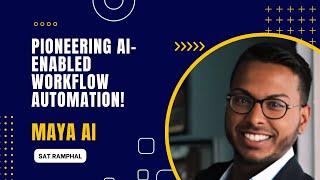
Sat Ramphal dropped out of college at 19 and built four companies by 30, one with an exit. His current startup, Maya AI, combines generative AI with robotic process automation to automate healthcare workflows like regulatory submissions. The eight-person team runs 110 models and partners with Nvidia, Microsoft, and AWS.
Questions this video answers
June 19, 2024.
Eight people.
Built four companies and had one exit by age 30.
About 110 models.
Nvidia, Microsoft, and AWS.
Chapters
For me, how I define the source of success is in a few different facets, right? Obviously the number one most common thing is is revenue. Is your company making revenue, are you profitable and it is your margins look like of the revenue. Being very transparent on where we were as a company and where we were going was important for any team members that were brought in. Some of my, excuse me, advice I'd give is community. Dive into community and build community. And here's why, if you don't know how to do something, don't try to do it. Find someone who is an expert in your community and do it.
Hello. In any industry, efficiency and efficient workflow is what defines effective use of resources and great outcome. Specifically it is very important for healthcare industry. And today we speak with very intelligent founder, Saad Renfel. Saad is a full time entrepreneur with one meaningful exit and today he is on his new journey, the startup called Maya AI. And this startup is all about AI powered workflow. Hello, hello, hello my friend, how are you doing today?
Hey Leon, I'm doing great. Thank you so much for having me on the show. It's a pleasure. Here in Tampa, Florida. It's about 90 degrees, so it's a good day.
Wow, wow, wow. It's very hot Florida. For you. How it's possible to think when you are in such a hot environment. This is what give you energy.
Yeah, right, it's true. But I'm in the office and it's so cold and I'm in jacket and everything.
I thought you are somewhere on the north, but I see you are. Yeah, you're very nice. So first of all thank you for joining my podcast, my show and I was amazed when I first time listened to you and was on your presentation. I really was amazed about the level of and even intelligence of things you are doing and level of your professionalism in how use AI and how to apply AI tools to healthcare. That is, I don't know, that is eager to automate and to reduce the cost. But first I would like you to tell about little bit your story. How did you succeed to make for startups and why you continue? What drives you? What does it mean to be multiple time entrepreneur?
Yeah, thank you for your question. That's a very loaded question too. I have a very interesting journey in my background. I come from a family of entrepreneurs, my father and my mother as well and grandfather, aunts and uncles. So it's kind of in the blood of the family. I myself going, you know from elementary to middle to high school, college, I Wanted to be an engineer. Two semesters into college I dropped out and I just plunged right into entrepreneurship at the age of 19 and I built my first AI company specifically in the finance and insurance industry and exited that company about a year and a half later. And now 10 years later of my life of 30 years old today, I built four companies, had one exit. I built all the other companies up to six seven figure businesses all bootstrapped and provided success. And then some of those winded down, some of those timing was issues and whatnot. And then with the journey of the last organization, you know, we dealt with a lot of like real world evidence data and you know, the data science world was kind of changing into this new AI realm. But we had to keep staffing humans to handle the real world evidence data that was growing in the world. So we winded that company down and that company was started by the a set of brothers. So the co founders are three brothers, I'm the middle child. And so when that company winded down, we went to kind of, we went to the beach and we wanted to figure out how were we going to escalate ourselves in our lives, what was the next step, what was the next chapter in our journey. And then we came together and we're like, let's solve the problem of what led to us winding down the previous company. Let's solve that problem of taking real world evidence data and efficiently, creatively and accurately building out these systems for the insurance and pharmaceutical industry to deploy and expand their markets. So that's a kind of, that's what was the kind of motivation that led us to start Maya AI. And it started right here in St. Pete on the beach.
Wow. It's amazing story. When people get on the peak, they see that, wow, we have around even higher peaks, high maintenance mountains. So that's amazing story. And what is about your company specifically today and why as I know you have a great success, you are growing exponentially. And it's very important to understand the source of this success. Not only experience, but how you define your company and how you define the source of success of your company.
Yeah. So for me, how I define the source of success is in a few different facets. Right. Obviously the number one most common thing is revenue. Is your company making revenue? Are you profitable? Does your margins look like of the revenue? So that's one bucket. And we've been graceful enough to almost exceed our revenue goals for this year. So I could say we were successful in our goals so far for the year. The other part I would kind of dictate success is from a team effort side, like the culture of the team, the team that comes together. LEON One of my best skills is putting together people, being able to bring together really smart people that can function really well together. And now today we're a team of eight people that we brought from these different experiences and companies that have just brilliant mindsets. And when we come together and we brainstorm and we get to build processes and we get to execute on these processes and plans that we develop, which is why we're able to hit our goals, I think that's a bigger success for me is the execution from what the team set up in place and how the team is executing upon it to hit our goals. Because the goals of the end result, like the revenue, is the end result of what's been achieved. And so being able to do that with processes and workflows and team effort and collaboration, everyone on the same page, that really means a lot to me of how well oiled the engine is to keep going from a scalability standpoint and then how we can think about building the company's culture future as we continue to scale and grow and add team members in. You know, we have a, we run the company in a sort of, I would say a data driven democracy. So, you know, I'm not as a CEO, coming in and controlling and making all decisions. I'm coming in as an, you know, as an equal to my peers that brings their experience and expertise to the table. And with data I get to make the final decision as that. So I'm not just making abrupt decisions. So I like to say a data driven democracy is how we kind of operate our internal company.
Wow, very interesting. So what I understand that the most important is to set the goal.
But.
It looks like your goal was too small because you outperform this goal. But it's a different story. The second thing is, which is very important for success is the team culture, right? So how you build it, how you manage your team, by the way, if people, eight people, it's okay, it's manageable. All the problems from my experience, start from 13, 15 people. This is where you have to apply really some very innovative tools for you. Innovative specifically to manage this team and execution. I just think you're talking about operations. So how to build the right operations and to, to build KPIs to build OKRs and how to apply it to your company. But what's interesting, I know you have seven, so you have a very huge, very big revenue. You Are growing. Yeah. Seven numbers revenue, Right. How you can. How did you make it by eight people?
Yeah. So as I mentioned, like, one of my best skills is putting together people and coming about it very humbly and building those relationships with a pure heart. So when we first built out our team and we didn't have any revenue at all, we had to learn how to be lean. And so being very transparent on where we were as a company and where we were going was important for any team members that were brought in. So I. Everything about me is community. Everything about me is community, from customers to investors to talent. And so I build my team from community from that aspect. And so being very, very upfront and transparent about where we are. And then here's the other thing, right? Like, there's three brothers that started the company. I'm not an extrovert. I'm like a extroverted introvert. But the other two founders, Sean and Shivam, they are. They're very much of an extroverts and they hold this. They hold a lot of charismatic features to them. And so people love being around them. There's something about our team that people just love to be around. So that was one of the big things that attracted the talent, was our energy as a team and the big vision and the humbleness that we wanted to our way of getting there.
So just, you know, if you consider yourself not extrovert, I just can imagine how your brothers look like and talk just kind of magic. Interesting. So I think we keep people intrigued because we don't know yet what company is doing.
Yeah.
So let's do it. Yeah, let's talk about what company is doing.
Yeah, yeah, definitely. Happy to talk about the big mission and vision that we're on with Mayan, the madness that we're up to in the lab. So what we're doing here at Maya, we're really bridging the gap between this big generative AI movement and kind of what's next. And really what's next is the execution. So you have generative AI in one bucket that can do a lot of really great things. Summarize this article for me. Diagnosis, patient data for me. Can you look at five different documents in different languages and help me come up with, you know, a piece of content or something like that? And that's great, but the big problem is, okay, what do I do with it? What's next? Okay, fine, you diagnose that patient for me. Now what do I do? And so that's where we bridge robotic process automation with Generative AI. And so we've been able to to build this technology and solution that can pretty much build efficiency and workflows. So if you have a workflow today and it takes you 10 steps to do something, the value of Maya, using her over time, it should take you nine steps or eight steps in the next couple of months because of her ability to create efficiency in the workflow. Now we've been able to hyper target this and hyper focus this inside of regulation and compliance. So what we do in that aspect is we work with companies like pharma companies, medical device companies, or even insurance companies. We help pharmaceutical companies with their regulatory reporting, regulatory submissions. They have a new drug that just came out of clinical trial. Well, what we couldn't do is help to curate the clinical data, fill out the new drug application or the IND application or the 510k and then we get stakeholders to approve pieces of that application before it gets sent off. So this is what we're not doing. What we're not doing is taking, taking all the clinical data and then pushing it and filling out an application form and then sending it off. As a company, I would never trust that. But what we're doing is building out the workflows in such a way where we're qualifying every piece that comes into that application because there's someone that's senior that has to approve piece of that application before it gets sent off. So there's very much of a human component to it. So that's like one example of how we help take a drug to market. A success story that we've had is we were able to help take a drug to market in under a year. Another use case of what we've been able to do in the regulatory compliance field is around, you know, the brand protection and efficacy of a product or medical device. So there's been a product recall. What my does is builds out the action plans. Hey, you need to take this product off the shelf. You need to communicate to the hospital and the patients, you need to contact the supply chain, contact logistics. And so then what Maya does is builds out the workflow and then communicates to those people to execute upon it and personalize the communication. And so her ability to have something executed from a triggered event incredibly fast. See, the big problem is, is there are tools out there that are traceability tools that can say, hey, here's a triggered event, you should do this. But never the workflow side because they can never ever get down to the real value of communicating the workflow properly. And Then tracing the workflow. That's why a product recall takes like 10 months for the company just to qualify and pull it off the shelves because of how many different workflows are involved in it. So that's what we're able to do. And we offer an API that, where Maya can just. You give us your workflow, we upload the workflow, Maya could learn off the workflow and then implement the API right on top of your communication channels or your data systems and sources. And then she just runs and goes with it. And now over time, as you execute a workflow, she learns on it, and that's how she is able to reduce the steps in a workflow over time. Now, we have a big philosophy, a backwards philosophy on AI where we don't believe the future is training on public or private data, but rather the execution of a workflow from the data and let that flywheel be what intensifies the quality of the data. So that's kind of what we can say.
Yeah, as I understand. Oh, first of all, very interesting. Thank you very much. As I understand, you do AI in somehow in a different way, not conventional way like others doing. Could you elaborate on, on this little bit?
Yeah, yeah, definitely. So. So, you know, everyone else is. And I'm not saying everyone else. You know, there are great geniuses that are probably in labs doing other great things they're coming up with, but on average, the most common thing is, hey, let me get like an LLM or something, then I'll train it on public or your private data, and then we'll try to deploy and then we're measuring against accuracy and whatnot. You know, what we've done is we have been able, from an AI side is created algorithms that can take our customers models or public models and create a average score and then create a throughput. So today we have about 110 models inside of Maya. And, you know, we could plug in and out, you know, models from, you know, OpenAI or Gemini or even your company's personal models, get an answer from those models and then get an average score altogether for throughput. So, and that's how we've been able to increase our accuracy. So that's how we do it from like an AI side, how we think about it from an AI side and how we think about like the, the models and the behavior of the accuracy and whatnot. And it's very closed loop, meaning it's only on your data and workflow. So the hallucinization is almost to the floor because we're not going out and looking at public data or retraining and then training on your private data from quality and quality data. So our approach to that is kind of unconventional. It's why a lot of our partners are interested in us as partners like Nvidia and Microsoft and aws. It's because of that unconventional approach to AI. We really focus in on the workflow. So we get an example of PDF and sop an image of your workflow. That is what trains our system to go ahead and execute upon and deploy is that workflow. And so that's kind of how we look at the AI as a whole in general. And it's a multimodal type of system that we have. We have LLM models, we have OCR models, we have regression models, we have statistical models that all work together harmoniously.
Interesting. So you know, you are not using as it is, off the shelf AI as it is. You develop your own type of AI based on workflow, not on just pure data. Right?
Correct. Right. And they're good at what they do. They're building LLMs, they're great at that. But there's just so many companies that are building LLMs and then they're so expensive. LLMs is going to be a thing of the past in a few months and the new SLM small language models are going to be the thing. And what we're creating essentially with our workflows and verticalized approaches is almost like an SLM environment that's very dedicated towards the workflow.
Interesting. So some kind of niche, niche workflow and niche model. Wow.
Right.
That's amazing. That's amazing. I can tell you one life hack, when I work to startups, I help startups to to grow understanding of their market positioning. And most of the startups, they don't understand from the beginning where they are. I know you also went from this stage, everybody, me too. And I developed so called workflow again workflow. So workflow is the center of the universe. I develop an industry workflow. For example, take agriculture. Yeah. What is a very simple workflow in agriculture? It's a seed, it's some nurses, it's a small thing and then it's a big crop. And so if you go to to help a big crop, that's okay. But if big crop get wrong and very dead some seed or this small crop, you can do anything what you want. You cannot help. So where is the critical path within the workflow? So you have to build this map. It could be industry map or it could be Some specific niche map and then to look for the critical path, but not only critical path, but political path that create some ripples, right?
Yes.
And this is where there is a business and usually this is the blue ocean business because nobody this way.
Correct. I love the fact that you mentioned that and you spoke about that because that kind of goes into the, to the how a startup grows and what they learned over time and how they kind of really focus in on what their niches and now they're able to repeat that over and over. We have Some, in my 10 years of entrepreneur experience, I've also developed some personal workflows to help us kind of navigate and gear towards. And what we've learned along the way is for us in our situation there are process automation systems all over the place. But what we realized is that every process automation system requires an RPA developer or a process engineer to go and develop and productionize. And with our system you don't need one. And so our niche is going after and finding companies that need automation, can't afford an RPA developer or don't have one that can easily implement our solution and productionize in less than a week. And so we've been able to learn that over the course of our existence and no, you're right, we didn't know that coming out the gate. We came out the gate, we deployed, we learned, we iterated, we deployed, we learned, we iterated, we deployed until we found a sector we can rinse and repeat over and over.
Yeah, right, very interesting. So you mentioned your partners like Microsoft, Nvidia, but actually could you just give some list over there, prominent clients you have from healthcare industry?
Yeah, yeah, definitely. So and so today, you know we, we work with two, we work with one of the largest cancer centers in Asia, we work with one of the largest medical device telecommunication companies in the world and we recently signed on the largest health insurance company in the eastern hemisphere, the east coast of the United States. And I mentioned them like this just because I'm, I'm not, I'm not at liberty to release some of their, their names. We don't have the clearance to do so. But who we are working with is the enterprise level organizations and some really magnificent ones at that and what kind.
Of testimonials you have. So what is the feedback from your big clients? Because usually you know it's very difficult to sign up big clients or sign in big clients but you know why they do these and how long time does it take to customer acquisition cost? If you are talking about Big companies that really, really and usually is a long time story.
Yeah, definitely to that point we have, we kind of have a parallel approach where we have like an enterprise focus and a mid market focus. As a startup, you know an enterprise deal could take up to two years to close. So how can we accelerate and land deals and so that's why we also have approach for mid market. So I just, I wanted to mention that because that's a strategy of ours that we take. Enterprise sales is a beast and it is very hard how we were able to land and gear up with some of our customers and the enterprise that we had is number one. We found that niche of they didn't have an RPA developer, they were looking for automation and they needed it. And so our ability to say hey we have a solution that does not require you to invest dollars and hire someone and then wait six months to productionize really got their gears turning. So that was something that allowed us to enter very quickly. The other thing behind that is how we architectured our system. It's a single tenant architecture, it's hosted, vpc, private cloud or on prem data leakages are very low. We kind of check mark the boxes that concern them. And are you training on my public or private data? Well no. Are you hosted in public cloud? Well no. Are you going to take my learnings of a workflow and take it to your customers? Well no, because here is what the way that you do something in a workflow is completely different than the way that company does a workflow. If I take what I do with you and I give it to that company, that company will fall flat on its face. Each company has their own workflow that's proprietary and special to them and so being very confident in that allowed us to get in a lot faster than others.
Yeah, that's interesting. So we are going to wrap up. Thank you. It was very interesting conversation and I think my audience just learn a lot from you. But you're actually four times entrepreneur. You're a serial entrepreneur. Do you have some life hack you can share with people about how to succeed from the beginning?
Yeah, and this is just my experiences and what I have done to get to where I'm at. Some of my, excuse me advice I'd give is community. Dive into community and build community. And here's why. If you don't know how to do something, I wouldn't try to do it. Find someone who is an expert in your community and do it. I'll give you a prime example in my second company I didn't have. I didn't really communicate with the community. I didn't really know anyone in the community. And so there were legal things I had to do and I thought I could do them myself, like incorporate the new business, costing me like 15 grand to fix it, by me thinking I knew how to do it myself. A big advice. If you don't know how to do it, get someone to do it for you and build that team and build that community. Incredibly important. The other thing I would probably, I would say very much so is don't get married to your product. It could be so easy as founders to get married and fall in love with your product and try to push something out that's perfect. If it's ugly, just push it out. Get some feedback, iterate, learn, grow. Because what you thought your product is going to be is not where you will end up. I can say that. 100% confident. I'm in saying that what you intended your product to be will never turn out that way because the market will dictate that. So let the market help you.
So this is the part of emotional intelligence that's very important for any entrepreneur. And people learn it on the go usually. So, yeah, learn it from experience. Thank you very much, Saad. And we had the privilege to have Saad Remsel in our podcast. Thank you very much. And continue to collaborate. Thank you, Saad.
Thank you so much, Leon. Cheers. Have a great day, everyone.
Thanks.









