Christopher Seifert, Author of Enabling Empowerment: How to Develop Decision-Making Skills in Teams.
Christopher Seifert discusses his framework for teaching teams better decision-making, covering cognitive traps like confirmation bias and framing effects. He shares how one capital-project exercise cut funding requests from $40M to $17M, and explains why AI tools can amplify human biases if teams don't think clearly first.
Questions this video answers
April 9, 2025.
www.enablingempowerment.com.
"Pretty much every day."
About $20 million per year.
Requests went from $40 million initially down to $17 million after teams resubmitted justifications (within three weeks).
Chapters
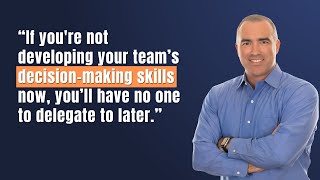
If you're not proactively developing those people's decision making skills now, then when it comes time to delegate to them, they're not going to be ready to take on that additional authority and responsibility. What I call decision traps. Right. These are the biases, the cognitive biases that our brains are susceptible to just because the way they're wired, it's not, not a fault of our own, it's genetically, biologically how our brains function that in the case of uncertainty, in situations that are uncertain or complex, we talk tend to not be very good at making decisions. As you're thinking about your models for what's important on who your team is, what capabilities they need to have, what skills you need to build in them, I would say make decision making a priority on that.
Hello everybody. Today we meet with amazing personality after all the I think one of the best book I was reading for the last 10 years, enabling, empowering. Please meet Chris Seaford.
Oh, thanks Dr. Eisen for having me. Thank you.
Hi. Hi Chris. I really appreciate our meeting and I appreciate you agreed to give me some interview and sharing sites about your book, about the product, even not product, about your product because your book is your product. Actually I'm talking about product because I am from startup and venture capital world and for me book is product that should deliver very important value for people. And what I can tell you that I learned about how to empower the team from your book, I learned a lot and I have a lot of questions about it because I consider you like one of their best experts in how to build the team and how to build the best performing culture of the of any company. But today, today we will talk from some new angle. Maybe for you it's a new angle but for me it's my angle of view because I am from startup and venture capital world and we will talk little bit how to apply your theory, how to apply your experience to building startup teams. But first my first question is why my audience should read your book.
Yeah, absolutely. Well, thank you for first off it's honor to be here and really, really appreciate the opportunity to talk to you and your, your audience and guests. Look, I think at the heart of the book the is my, you know, decision making framework, right? It's the framework that I've developed over the years that I use to make decisions and then I have taught to my teams to, to so that they can use when they make decisions so that I can make them better decision makers and I can empower them right, give them more authority and autonomy to do their jobs. And so look, I think certainly in the startup world, I mean, all you're making a lot of really important decisions, right, about what markets you're going to serve, what customers you're going to serve, what products you're going to sell, how you're going to price them, how you're going to, you know, go to market with those. And all of those decisions are critical. And you know, at the end of the day, decision making is a skill. I believe it's a skill. It's one that we can practice and learn and, you know, get better at. And you know, it also has a huge determinant on our success, right. How good our decisions are, are going to determine how successful our business is. And so if we're not being deliberate about being good at making decisions and our competitors are, they're going to beat us, right? And so, right. We need to be making sure we're making the best decisions. And then I think even more relevant or also relevant for startups is that eventually at some point you're going to begin to scale and you're going to need to push decision making down lower in the organization, right. To other people. And if you're not proactively developing those people's decision making skills now, then when it comes time to delegate to them, they're not going to be ready to take on that additional authority and responsibility. So I think that's the two ways I think it most impacts your listeners.
Yeah, thank you. That's interesting. But I have an idea. Do you feel any competition from ChatGPT about decision making? Because they, they help. I use it all the time. It helps a lot. So how are you going to use it in your practice? And do you feel any competition?
Yeah, absolutely. So I had just, actually just wrote one article about that a couple weeks ago and there's more to come because you're seeing a tremendous amount of, you know, articles and stuff in the news about that right now. Right. About using artificial intelligence to support decision making. And look, I think it's an incredible tool. But let me, let me just back up. One of the things that I talk a lot about in my book, in, in, in my practice that I help people with are what I call decision traps. Right. These are the conf, these are the biases, the cognitive biases that our brains are susceptible to just because the way they're wired, right. It's not, not a fault of our own. It's genetically, biologically how our brains function, that, that in the case of uncertainty in situations that are uncertain or complex, we tend to not be very good at making decisions. Right. And let me, I'll just give you a, a quick example of a decision trap. Right. One might be, you know, if I was to ask you what is the capital or how do you pronounce the capital of Kentucky? Do you pronounce it Louisville or Louisville? Do you know the answer to that?
No.
Okay, well, so so many people, many people will staunchly defend one or the other, right. The answer is that the, the capital Kentucky is pronounced Frankfurt. Right. It's neither one of the other two, but the way I ask the question tends to lead somebody to want to answer one of the other two. Right. That's called a framing trap, which just says that the way that we frame a problem or opportunity has a large impact on the solution that I come up with. Right. So I have to be very careful how I frame my problem. And if I'm not framing it right, then I'm not going to come up with a very good solution. So in a book I talk about specific strategies about how you can learn how to, to frame a problem, et cetera. So the, I share that to say that when it comes to AI, there are two issues where these decision traps can cause us problems. For one, it's been proven that AI is susceptible to some of the same decision traps we are. Right. It can hallucinate, it can, it can make up facts. Right. It can have, you know, biases in it. Another thing is that the way we're interacting with it can, can cause it to have biases because we can't separate our own. So for instance, we are subject to confirmation bias. Right? We as humans tend to seek out information that confirms what we already believe. And so if we're framing our questions and, and our, you know, the analysis we're asking the AI to do on our behalf, if we're not careful, we could, you know, be incorporating our own confirmation bias and other things into it. Right. So look, it's a huge area where there's not an answer. There's a lot of exploration. But the one thing we know for sure is that the same biases that affect us can, you know, can, can affect AI. And so I think the same, you know, just like using a decision making framework can help humans avoid those decision traps, doing the same thing when we're interacting with AI can help us, you know, not fall for the same traps in AI.
Yeah. So it's reflected in a prompt we're doing for AI for ChatGPT. So yeah but to avoid decision trap you have to have full awareness about it. You have to be conscious that you are in and 95% of people, they don't have this awareness. Yes, I think everything should start from creating such awareness, from teaching people. This is actually what your book is doing, teaching people that guys, you are, you are not good. You, you don't see, you, you think you're doing well, you help people, you help your team, but actually you just limit their creativity. And this happens in many of my companies. For example startups just CEO doesn't understand that. He just limits creativity making everyday meetings, asking some questions just to keep hands on the button. So that's a big problem really. So what do you think? For example, I'm a new startup entrepreneur so I created my company, I raised capital, now I have to build my team and definitely I'm looking forward to build high performance team. So how do I build this team? From delegation point of view, micromanagement point of view? Because no, there is no, without micromanagement nothing happens. You know, always, always it happens. The question what, what level of micromanagement? So how, what should I do? I do, what should I start from? I can start from CH GPT as well. But actually what should I think? Yeah, how to start?
Uh, yeah, I mean so if you're to that scaling point where you're like, you know, yes, I, I'm going to need to start delegating some of the authority. I mean the, the, the bottom line is start developing the decision making skills and more importantly your trust in your people's decision making skills and their trust in their own skills. Now, right. Where most leaders make the mistake is they get to the point they want to empower right people with more decision making authority but they haven't worked on the decision making skills so they give them the more authority. The person goes and of course makes a bad decision and then what do we do? Then we step in and of course take that authority right back. And now we've made the situation worse than it was before, right. So we, we need to start doing that now. And one of the things I, you know, help companies implement are, are a concept I call decision rights. And so that is to say that we don't, you know, what you see in a lot of organizations is that everybody like decision rights are deci are, are assigned based on a role, right? So like maybe every plant manager has the same level of purchasing rights or every, you know, purchasing agent has the same spending authority. But the reality is that probably shouldn't be like that. Right. There's probably some people who should have more authority to make decisions and some people who should have less based on their demonstrated competency. Right. So, so you know where we, when we start this journey and we like to start like let's, let's agree on what do we think is a safe decision that this person can make where we're not going to like, you know, cause irreparable harm. And let's let them start making decisions at that level and asking for permission above that level. But then as they ask permission and you keep granting it because they're giving you good recommendations, then increase their decision rights, right. Maybe from 5,000 to 10,000 or 20,000 or whatever. But start doing that now because otherwise, you know, you're not developing them in, in a way where they're going to have a safe place to start making mistakes.
So you're thinking about graduate delegation of decision making? Yeah, yeah, absolutely. Very interesting idea. Because usually in startups it's very important and this is what I teach startups like a coach, very important to, to distribute some specific roles and a startup is growing, you should as less overlap these roles. So how to complement roles with decision making authority. Different roles. For example, you're responsible for buying, you're responsible for selling, you're responsible for people. So how to complement this with decision making authority in specific area?
Yeah, so I think the first thing is to sit down and as you're describing very carefully, make sure, make sure we're very clear on the roles and responsibilities. So who gets to make what decision in my organization, right. Like who is the decision maker? And then what are their levels of authority where they can make that decision without consulting anybody? Maybe there's levels where they need to consult some people and then there's levels where it's not really their decision anymore, they're just making a recommendation, right? And so just like look, even simple things startup, right? So startup. One of the things I got is marketing, right. And so, you know, maybe I've engaged, even if it's a third party marketing agency on my behalf and maybe, you know, I've become comfortable enough with them where I'm like, hey look, you guys make good ads. You know what you're doing, you know, for this kind of, you know, an ad where I'm going to spend X dollars, I don't need you to ask me permission, I just need you to do it right. But over that I want to see what you're doing right. And then after you've Come to me three or four times, and I've said, you know, that, yeah, that's a really good ad. I like what you're doing now. Instead of $1,000 spend, it's a $5,000 spend, right? I mean, so you can even, you know, do the same things with your vendors. The challenge is just most people get this levels. They think about decision rights as static in their head, right. Once this person has this authority, they either have it or they don't. Instead of how do we change. How do we gradually change levels to find the right sweet spot where, you know, you have as much autonomy as you can handle. But we're not putting, you know, we're not making bad decisions and putting the organization at risk.
Yeah, exactly. Exactly. I agree. So the question here, how to balance. Balance capability and responsibility of people? Because, you know, as more responsibility, usually capability goes down and freedom goes down. So as higher level of responsibility, as less freedom people have. I remember Bezos, you correct me. Bezos said that I do not decide. I just help people to decide. So where this level of authority where you just coordinate people, your team, instead of giving direct orders and decide on what next.
Yeah, well, look, I. I mean, that. That's certainly the holy grail, and that's what you're going for, right? But, you know, you also have to. You have to meet the team where the team is. So, you know, people over my career, right, have been asked, chris, what's your leadership style? And the answer is whatever it has to be. You know, I would.
I.
My preferred leadership style is just, as you mentioned, one where I'm. Look, I've painted a broad vision and I'm coaching and I'm mentoring and. Right. You guys are the teams making the decisions and executing to get to the vision. But look, you know that sometimes that's just not possible, right? Sometimes the team isn't capable and you've got to step in and make the decisions and do the work. You know, analogy I like to use is, is somebody drowning in a lake? Right. If my team is drowning in a lake, this is not the time to stand on the dock and coach them on how to swim. Right? It's. It's time to jump in and pull them back to the. To the dock. But I better.
But.
But when I get them back to the dock, I better start thinking about teaching them to swim. Otherwise, I'm going to walk away and they're just going to jump back in the water and drown again. And. And that's where a lot of leaders find Themselves, Right. Is in this never ending having to jump in and pull the team out because the team's got themselves in trouble. And so, you know, it's really right to your point about starting at some point and then simultaneously building the capability and as they build the capability, giving them more and more authority to make those decisions.
Yeah, that's interesting. So what stages do you think leader should go through to become the coach?
As soon as it's right, as soon as you're ready. I mean, yeah, I don't think it's a, necessarily a stage dictated by the, what would the life cycle of the, of the company as much as it is by the, I guess, storming and norming of the team itself, if that makes sense. Right. I mean, ideally, look, as soon as I'm bringing people on, I'm, I'm, you know, wanting to be able to give them things that they, that they own and have domain over. You know, look, right. We, there's a lot, if you look at conventional wisdom about what creates an engaged team, right. And you know, if you go on LinkedIn, social media, whatever, what are you going to see drives employee engagement? Well, it's going to be things like, you know, oh, nice perks and a good coffee machine and bosses that talk nice to people and work life balance and all this other stuff. Right. That's not what drives it. What drives people's engagement and willingness to give discretionary effort is a vision that they're connected to and the belief that they can actually influence it. Right. That their actions have some in that they're important. Right. People need to feel like they're important at the end of the day. And so if you give them something that they own and they have the ability to make decisions about, then they feel they're more invested in the vision of the company. Right. So even for a startup, you know, I can't. Look, I like we're talking about marketing. Like I have vendors that I use for marketing, right. And I can't, can't tell you how many of them I've actually said to them, I really wish you would stop being transactional with me and start being an owner, acting like an owner, right. Like, like get in my business with me and like understand what I'm trying to do. And I'd like to actually give you part of my business, right. Like, you know, this marketing or the, or whatever, the accounting, right. Or the legal. I'd like you to take some ownership in it, right. And, and give, be able to give you some ability to make decisions on my behalf. And so I think, you know, you can do the same thing even, even in a startup.
Yeah, but sometimes you get rejection. So why people reject such opportunities?
Well, look, it's much easier to be transactional, right? Because if, if, if you tell me exactly what you want me to do and then all I got to do is do that. Right. And if the outcome's bad, it's not my fault, it's your fault. You told me I just did what you told me to do. Right. And that's the same, that, that's how leaders can fall into these micromanagement traps is because once a team starts to disengage and starts to say, hey, look, you know, oh, you, you know, you're just going to tell me what to do, fine, I'll just do what I'm told. Right. And if it doesn't work out, then it's not my problem, right? Of course it, it is their problem. You know, I mean, eventually the business goes out. You know, company goes out of business, it's going to affect them. But I mean that, unfortunately that's how the mode most people go into. Right. So, you know, that's why you need the, the minute, the, even, even if you're not giving them the authority to make the decision, even if you're just asking them to make a recommendation instead of, you know, you, you just telling them what to do. The minute they've made that recommendation, their level of ownership and the outcome has increased exponentially because they own, they, they made the recommendation. They can no longer say, I was just doing what I was told, it was their idea. So they have a vested interest in making that idea work. Right. And you know, that's why it's so important to, you know, try and give them some sense of ownership in it.
Yeah. This is some pros and cons of brainstorms. When ideas then rejected, people feel dead if they're not ready for brainstorming. So yeah, every, everything requires some balance. I have some different question about your social media presence. So how often you make any posts about your, your book, about your amazing vision and your experience in LinkedIn?
I post pretty much every day. Yeah, I'm out there pretty, pretty much every day.
Yeah. And what, actually what you're doing is a core business of LinkedIn. And if you go to some people post, they have thousand, two thousand likes, I don't know, million impressions. So what do you think it requires to, what does it require to, to become influencer in LinkedIn by publishing your expertise, specifically your Expertise.
Well, I'll tell you, I think what it, what it really truly takes is, you know, really just wanting to build genuine relationships, right? I mean look, we, Doc Risen, right, You and I met and we're having this conversation, right? Because of LinkedIn, right? You posted on something. I think I liked your comment. I posted. I like your comment. And here we are having a conversation and you know, I'll tell you the one thing that I have learned in my career that if I could go back and tell myself something at the beginning of my career, it was networking, networking, networking, right? I mean it's all about networking and, and just going into every, every relationship with the attitude of how can I help you? Right? Like what can I, and if I, if I keep finding people that I can help, the amazing thing is that those people turn around and help me back, right. And I don't even need to worry about it. I just go out and find people to help. And so that's what I do on LinkedIn is just find people I think got similar interests and we might be able, might have a good con conversation or might be able to help each other out in some way either connecting through people or frameworks or tools or whatever and enjoy it a lot.
So that's amazing. But here there is some interesting question. So people do not. Are not attracted in LinkedIn because of value delivery. This is what I learned. They're attracted when they can be engaged in dancing where thousands and millions of people just dancing and I want to dance there as well. Okay, maybe it's some, I don't know, bullshit music very bad, I don't like. But there is a dancing flow. I want to be part of this. So there is a balance between, so you can till the end of the century to, to write good posts about your book, about your, what you're doing and deliver amazing value. But if you are not in this crowd.
Yeah.
Algorithm doesn't allow you to do anything there. So the question how to get into this crowd with real value you deliver.
Yeah, yeah, well that, yes, you're right. I mean you've got to have real value, right? You can't be. I mean, look, there's plenty of people who are, who will start businesses and be successful for a short time until, but at the end of the day, if the service or the product doesn't solve a real customer's need and create a real economic benefit, then I mean, they're not going to be around for very long. Right?
Yeah. So we have some long time vision and this will Help. Because I feel the same I do everyday post. I deliver a lot of value for startups and I have very limited audience actually. So everything what Gary we talk about, just concur. Social, social network and social platforms and it's, it's bullshit. You should know exactly how to do it, whom to build connections and relationships with, and just after that, your value will start to support these relationships.
Okay, yeah, absolutely. Yeah.
So do you have some plan how to concur LinkedIn.
So do I have a plan on how to conquer.
Yes.
No, I would love to tell you. I, I had it. I mean, I think it's one of the many, it has to be one of the many tools in your, in your marketing tool bag. Right. I mean there's a lot of things out there, I mean, you know, that you used to get your message out there. I mean, there's the reason I wrote the book, right. The reason I do a lot of podcasts speak in general is to get the right, get the mission, the message out there. So yeah, I wish, I wish I had the blueprint, but there's plenty, apparently there's plenty of people on LinkedIn that do have the blueprint and we'll be happy to sell it to you for 1999 though.
Right, right, right. So finally quantity will be transformed to quality. So could you give me some specific example where decision make. So back to your expertise where decision making process, you, you build really lead to fring the company?
Yeah, absolutely. So this is probably a little more relevant to larger companies. But you know, look, you'll have it at some point, whatever size. But in my, so in my last company when I took over the capital budget, the maintenance capex budget for 10 plants was about $20 million. And so this is just the capital we spent every year to maintain equipment. Right. Not growth, you know, grow the business and not build on it. This was just to maintain it. The problem was that we had $40 million in requests from the plants for capital. So only 20 to spend, but the plants were telling me that we needed to spend 40. And the way that this had been handled in the past was, look, I mean, right, this is, this is 10 plants, $20 million. There's like 40 engineers submitting these requests. I mean, you know, the, my predecessor didn't have time to sit here and like have a discussion over every single one of these projects. Right? He just didn't. So what would he do? One of two things. He would either just draw a line and say, I'm doing all these projects and I'M not doing these. Or he would go back to the plants and tell them, look, you, you know, you asked for 40 million, I only got 20. So every plant give me $2 million worth of requests, right? Okay, now what, what's, what's the problem with that? The problem with that approach is at the end of the day, we're probably not investing in some things we should at some plants and, and investing in things we shouldn't at others, right? If we're just peanut butter spreading the budget, that's not right. We're going to spend money we shouldn't and not spend money we should. So we took this decision making framework, me, the accounting director and the projects director, and we took all the engineers and we said, listen guys, we've got to redo these, these business write ups, these justifications so that we can prioritize this properly. And we, we taught them the decision making framework and the decision traps and then we had them go back and redo the project justifications with coaching from us. And within three weeks they had resubmitted all the justifications and it went from 40 million to 17 million. And it was just because we told, we taught them how to think differently about how to solve the problem, right? About how to frame the problem, about brainstorming different alternatives. They were able to come up, get, get $23 million of their request to go away because they figured out better ways to do it without having to spend that money, right? And then the other 17, the writeups were so good and so easy for us to understand the project and how it was making would, would help us make more money and, and why we should do it that, I mean, the CEO even made comments, he's like, Chris, what, I don't know what you did with these guys, but like, I, like, I understand now why we, we need to spend this money and this makes sense, right? And so like that. And again, but it was just, if we didn't have the framework to teach them how to do those write ups, I don't think we could have done that that fast, right? If we, if my feedback had just been these write ups suck, go redo it in three weeks, we would not have had a different outcome, right? We would have been back in the same place. Everybody just mad at us, right? But the fact that we had training that we could say, here's why the way you're presenting these business cases is not helping. Right? And here's how you can present it in a way that's helpful. And we were able to make better decisions. But people were able to have their buy in in them and it wasn't arbitrary. Peanut butter spread budgeting right where, where everybody was left wondering why some projects got funded and others didn't. Everybody knew exactly why we were doing what we were doing.
So amazing. So the best way is how to ask yourself how can I make it better and what kind of algorithm I should build to make it better and then build this algorithm and then to implement this algorithm. Yeah. For example I have even algorithm how to say no to Sam who asked me to borrow the money.
Yeah.
From me I have algorithm because I found that if I catch up just I don't know what to answer. Usually I say yes but you know, it's quite sadly so so I built algorithm how to say no not to be catch up. Just well you know, so yeah everything requires algorithm. Everything requires a framework and decision making framework. It's amazing. By the way, I'm from healthcare business. So all my companies in the healthcare business I want to learn that most of physicians they have very defined, well defined framework on decision making what to, what to give to patients so they don't have to think about it. They have the framework, they have the protocol and everything just under the use some uses some algorithm. Everything is all about algorithm how to do it. So we're going to wrap up and my last question. What. What would you suggest young entrepreneurs again back to young entrepreneurs starting their startup, raising money and building the team. And here you should build team not to, to. To build it for some, I don't know, inner performance. Also they have to show this performance to investors. So team has some inside and outside shaping should have.
So.
What your recommendation for founder to build such a team?
So yeah, well look, I think just as you're thinking about your models for, for what's important on who your team is, what capabilities they need to have, what skills you need to build in them. I would say make decision making a priority on that. Right. Like so you know, when, how can you do that? Like when you're interviewing people, ask them talk, talk me through an important decision you had to make. How did you write what steps you went through? Right. That's an interview question I'll use and I'll listen for what were the steps that they went through when they made that decision? Did they actually have a framework or are they just guessing? Right. You know, they flip a coin. Is that their framework? Flip a coin, you know, so but, but start on that stuff now and look at the end of the day you're going to be making incredibly important decisions. As an entrepreneur, how confident are you in your own decision making process? And, and let me tell you, I think this is one of those things. If you tell me you're really confident in it, that probably means you have a lot of work to do because the, I think the more you understand the, the decision traps that affect us, the more skeptical you are of your own thinking processes. Right. Let's say it that way. Right. The more you realize how much the context and the environment around you affects your thinking, the, the more. Right. The more skeptical you are.
Less confident, I would say.
Exactly, exactly. So if you're sitting here saying, oh, I have, I'm really confident in my decision making, you're probably the one that definitely needs to read the book. Right. But you know, but, but be thinking of those things because you know, I promise you. Right. I, look, I've seen a million times, I mean there have been a million just great businesses, but one catastrophic strategic error and it's gone. Right. Like that business is gone overnight because of one just bad, you know, investment or bad decision about a market to go into. So, you know, start to learn those traps and how to combat them.
Yeah. And most of, most of errors happen in operational decision. What to promote, what to do, how to, how to build, different departments, how to.
Yeah.
To get to the market. So operation processes is very important. Yeah, sure.
Yeah.
And decision making there maybe is less, not less valuable than just the confidence and meeting with investors. I would say so.
Yeah. Right.
Yeah. Right. Thank you very much. So where, where we can find you?
Yeah, sure. Well, as we already discussed, I'm on LinkedIn a lot.
Yeah.
But www.enablingempowerment.com is the website. You'll find a link book there. It's also on Amazon. But more importantly, even in the book I reference a lot of tools and templates that you can download. For instance, if there's a, an Excel financial model that you can use to analyze capital projects. Right. That's available on the website. Right. So I mentioned in the book that it's there, but it's on the website to download and lots of other tools and templates like that. And I'm constantly adding more so would encourage people to check it out.
Amazing. So my advice to startups, just buy this book, put this book all into ChatGPT and then ask ChatGPT about decision making for any situation you have and ChatGPT will give you what Chris Specific thinks about it. So this is what I suggest, by the way, did you think about to make your own AI?
I actually. So. Dr. I have my own. I do have a GPT that I fed my book into. And I do that all the time, actually. But you can use the framework.
People use your brain and get answers. Exactly. From your brain using AI. Yeah, yeah. Like Goldsmith did, for example.
Yeah, absolutely.
Yeah. Amazing. Thank you very much. We met today after of amazing book enabling empowerment. Chris Surfer, please follow my podcast when you grow with lona, follow me on LinkedIn and see you next time. Thank you.









