Gil Bashe: Why Health Innovation Fails the People It Serves
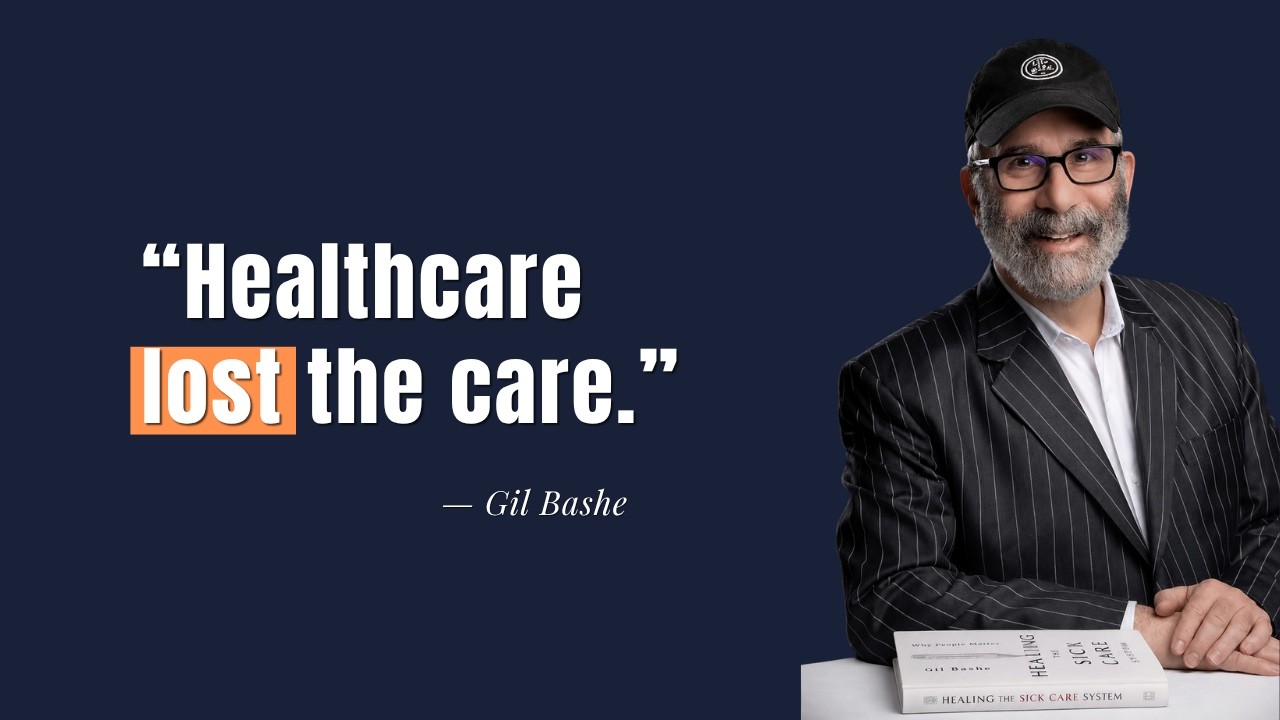
Gil Bashe, author of Healing the Sick Care System, explains why U.S. health innovation fails despite high spending. The conversation covers prior authorization delays, the collapse of primary care, obesity driving disease, and how AI might augment rather than replace human care.
Chapters
Hey, hello everybody. I'm so happy to meet today with the legend in healthcare, with Gil Bash. And Gil has an unusual perspective that stems from his work and personal life. He has worked across healthcare for more than 50 years, I think, 40, 50 years, like a combat medic. health policy advocate, communications executive, board member, and business leader. He is also experiencing healthcare firsthand as the parent and caregiver of a child with a rare condition. Consequently, the book he wrote that is called Healing the Sick Care System that I couldn't stop to read, I spent 2 days reading this book and it's amazing because it creates a lot of ideas and stimulates creative solutions. So today I'm going to present, I'm going to talk to Gil about healthcare, about healthcare problems, and definitely what kind of solution we can figure out. Gil, thank you for coming to my show. As I said, you are a legend.
Well, that's very kind of you, you know, Dr. Eisen, Leon. And first of all, I want to thank you. You have been a great advocate and supporter of my efforts, and I can't thank you enough. I also want to thank you because I know you have just returned to Israel from a 3-week trip to the United States with your family, visiting important sites here, you know, seeing the nation at work or, or not at work, as it were. And then you return to Israel and the first thing you do is jump into Healing the Sick Care System: Why People Matter in a 2-day marathon read. I want to thank you for that as well. But I also want to thank you because you have been involved in championing health innovation for quite some time. You are a venture capital advocate and you understand the importance of how capital actually is the petrol, is the fuel for great ideas that can save humanity. So thank you for that. Thank you for having me here today.
Thanks for coming to my show. And I can tell you, I come to all your talks when you are in town, maybe for the last 10 years. I try not to miss it. Brilliant. Yeah, I remember our first meeting maybe 12 years ago or something like this. Maybe even 13 when I published my first paper about clinical trials we conducted for the world's first wearable medical monitor. It became world's first wearable medical monitor that measured blood oxygen saturation. FDA cleared it, by the way. And I remember you told me, you publish clinical trials, you publish the paper, How are you going to promote it? And I was a young entrepreneur, I didn't think about promotion, I was thinking about making something. I'm a physicist and I like technology and quantum physics and I created this technology and I didn't think about marketing at all. And you said, you have to not only publish, you have to show this to the world. You have to share your success with the world. And this made a lot of changes in my understanding how to build the business. And finally, we built this business, we commercialized this product. And I think people like you just impacted me a lot on my career. Thank you very much.
You know, innovation is invention.
Yeah.
Unless it's accessed by people and used. So there are many inventions that never see the light of day. Innovation is a statement that the market embraces the idea and deploys it. And so marketing is not about the, just the pure selling of the idea of the invention. It is actually making sure that the idea lives in harmony With the people it intends to help. And so when I say, look, you know, you have to create awareness about your research, your paper, it is not selling for the sake of selling. It is actually communicating for the sake of serving. And so much good comes from our industry, from, you know, the work that you do, the people you support. And so when I offer suggestions like that, It is, it is, it is to say, I see the potential in what you're doing. I see the great life-saving impact of what you're doing. Make sure that the world knows about it, why it's important, how it works, and, and how they can access it. And by doing so, you take an idea, an invention, and you apply it so that it can become embraced as innovation.
Yeah. And, you know, following these, I'd like to talk about the paradox. United States spends roughly $15,000 per person on healthcare, and that's almost twice Australia and about 50% more than Switzerland.
That's 3 times what Hong Kong spends.
Yes, yes. But at the same time, life deficit is about 4 years between these countries. So people live in the United States 79 years and in Australia 83, for example. So America isn't suffering from the shortage of money and isn't suffering from the medical innovation shortage as well. So we have extraordinary science, AI, devices, drugs, hospitals, entrepreneurs finally. And that brings me to the question at the center of your book. What we are doing wrong between innovation and human being it's supposed to help?
Yeah, you touched on something very important, human beings. Our health system, the reason I say healing a sick care system, Is we, we have shifted to the abyss that we're very good at engaging when people are sick. If you have a heart attack, if you have diabetes, if you have a respiratory disease, heaven forbid, if you have a cancer, if you have— you're struggling with mental illness, our system is very good at engaging and trying to help. And, and to your point before, we have some of the most Innovative medicine in the world comes from the United States. And also, some of the great physicians of the world train in the United States, you know, postdoc or residency. The United States is a come-to place when it comes to knowledge. And this is what I was talking about before indirectly. Knowledge is like invention.
Yeah.
Innovation is about application. And so we're very good at invention. What we're struggling with in this country is application, and we've created a transactional system. So the backbone of medicine, which most nations still have, is primary care, internal medicine. But for someone to be an internal physician, internal medicine physician, primary care physician, general practitioner, they can't afford to be that. They can't afford to, to be a primary care physician, and they can't afford to be in private practice. So once upon a time, doctors had private practices. They can't afford to do that. The cost of medicine for the physician is way too high. Now, the cost of buying a subscription to Epic for a small practice is out of reach. And so it becomes transactional. These doctors who have a smaller practice sell themselves. To either a bigger practice or a hospital system that brings them on as almost a loss leader. In other words, they know primary care medicine is not a moneymaker. But the reason they love it is that primary care medicine is the gateway to diagnose diseases and refer into the system.
Uh-huh.
Yeah, you have high blood pressure. Let me, let me refer you to our cardiologist. Aha, you have, you know, your prediabetes is now type 2 diabetes. Let's go see an endocrinologist or, you know, a nurse practitioner who specializes in diabetes. And so primary care is a conduit to specialization. Historically, historically, we had a relationship with those health professionals and they intervened Or sought to work with us to prevent these illnesses from occurring. We stripped away— almost, not entirely— we've stripped away that preventive care system in this country. Primary doctors, to stay independent, have what's called walk-in clinics. And probably when you and your family were in New York, you may have passed one of these stores that, you know, sort of like You know, you know, MD Doc or something like that, where you can just walk in without an appointment and see a doctor or see someone who can act as a doctor, a nurse practitioner or physician assistant, and, and take care of that immediate need. Whatever that immediate need is, it doesn't mean they know your whole health. They don't know that maybe you're, you know, someone is pre-diabetic. They don't know someone is high blood pressure. They know that you are complaining about your shoulder to do an x-ray and to say, no, it's probably a sprain, it's a bruise, it's not a break, don't worry. That's what they do. They satisfy your immediate need. But who you are as a person, a biological person, they don't know. They have no idea. So that's one of the reasons why we have so much sickness. The other aspect is We've become one of the fatter, obese nations of the world. So I think we're on the top 5 obese nations of the world. What is obesity? Obesity is like a domino. It leads to high blood pressure, prediabetes or type 2 diabetes. It can create 4 types of cancer. It contributes to respiratory disease. All sorts of aspects. puts pressure on joints that could result in the need for a knee replacement or a hip replacement. So obesity is a catalytic disease. We have a lot of that here in this country. Interestingly enough, Leon, this is going to— you probably will find this to be funny. If you're 300 pounds, your BMI is maybe 20%, you're pre-diabetic. And you're in high blood pressure, high cholesterol, you sound like a pretty good candidate for a GLP-1, a weight-reducing drug. Interestingly enough, a lot of payers will not authorize the use of a GLP-1 until the person is diabetic. In other words, they're diagnosed not as pre-diabetic, but as diabetic.
Wow.
So think about it. You're pre-diabetic, about to graduate to be a diabetic. You need to lose the weight somehow. You're struggling to do that because exercise and diet isn't enough. You should go on a GLP-1 to reduce that weight, but the health insurance says no, you got to be diabetic as a condition.
Yeah.
That's the antithesis of health, isn't it? It's sick care. not healthcare. And so there's a lot of reasons why we're dying sooner, we're costing more, and doctors are feeling burnt out from the process. So we have about 56% of our doctors don't want to be doctors. In my book, I talk about some great doctors.
Yeah.
One who was my physician for many, many years, my urologist for many years, he quit. He loves medicine. He loves patients. He just loves patients. He says he can't stand dealing 2 hours a day fighting with insurance companies for authorization to do an MRI on someone who has potentially prostate cancer, or he couldn't stand it anymore. My wife's OB-GYN, who I mentioned in the book, quit being an OB-GYN. She became a real estate agent. She couldn't stand— The liability insurance aspects of being an OB-GYN, couldn't afford it. So is that working when our doctors don't want to be doctors or quit medicine? Is that working for our society? I say no. Nurses, by the way, they don't want to be nurses. More than 50% at a certain point don't want to be nurses in hospitals because of the pressure. More patients, less time to understand the patients. So the system doesn't value the health professional, and the system doesn't value the investment in wellness. It values taking care of sickness. That's a problem. And our birth— our life expectancy isn't going to shift for the better if we continue on this trajectory. Innovation can play a role, though.
I would say insurance company can say, we warned you. To be diabetes, diabetic. We want you to become sick.
Look, here's the reality: I don't think anyone from the CEO down to the newest administrator in an insurance company wants to hurt people. I firmly believe that. I firmly believe that they want to help people, and I firmly believe that they do have to find some way to. Assess the cost of care for a person. However, when the data show that most rejections at prior authorizations are overturned upon appeal, most, great majority are overturned on appeal. Obviously, we have to say if they're overturned on appeal, why are they rejected in the first place? If they're overturned, maybe there was new information. But maybe the, the evaluation criteria are way too strict, and that is just creating an unnecessary friction point for the doctor and the patient. Maybe someone who understands that medical field needs to step in and say, hey, before you reject, ask these questions. It might very well be that we should approve it at the first round and not on appeal. So I would say, yeah, it sounds like insurance companies don't care. I do believe they care. I do believe they care. I do believe they have to be more customer patient-centric.
You know, I am originally from Soviet Union, left it 30 years ago, and we had a saying there that each communist guy is a great person. He has a family, very high culture, very educated, but together It's a huge destructive force. So this is, it looks like, happens in healthcare. Everybody is okay, everybody doesn't want to harm patients, but together the system is built in a way that it harms patients. And I can tell you another story. Just a week ago, we visited BTS K-pop concert, entertainment. And it was about 70,000 teenagers there. And I paid attention that almost all of these have obesity. I can tell you directly, they were fat. All, almost all. I did a picture. I didn't believe. 16 years old, 18 years old, very big. It was, you know, I told my wife, what happens here? What happens? So I think the problem will get worse and worse in time.
Well, I hope it won't.
Yeah, I hope as well, but what I see, yeah, it's—
I will say that I think a low point in our system was the assassination, the murder of insurance executive Brian Thompson from UnitedHealthcare on the streets of Manhattan, not far from where I'm speaking to you and your listeners from, and the amount of people in the United States that rallied to the suspected murderer, Luigi Mangione, who has pleaded guilty on federal charges, but he's raised more than $1 million in crowdsourcing funds From a supportive public, and my hope would have been that the insurance industry would have said when people applaud the the basis murder of our executives, it's symbolic of pent-up rage and the need to change our voice, our direction, our our experience with our customers. That hasn't happened yet. Unfortunately, it hasn't happened yet, and that's the point where I think. You have the right to be worried. I'm worried as well, but at the same time, I'm hopeful because I do believe that doctors under the leadership of Dr. John White, who's the CEO of the American Medical Association—I'm grateful he endorsed healing the secure system. Why people matter? Doctors have to regain the authoritative voice over medicine in this country, and they've lost it to insurance companies. When a doctor says, "Leon, I want to do this for you, but I've got to get." Prior authorization, the doctor's voice is diminished. And you know, if the doctor is willing to spend time battling or arguing for their patient, then then the patient also has to add their voice with the doctor. The the patient and the doctor are aligned around the quality of care, and payers who are profitable in this country need to start listening to the customer. Both the health professional and the paying customer. So that's really critical. Now Israel has a very interesting health system. I respect it greatly. In many cases, you you have someone who comes into the home of senior citizens in Israel, you know, and the ability to access affordable home care. So if someone is healthy and in their home and they need help. Cleaning the home, cooking, shopping—that's accessible in Israel at a very affordable rate. Obviously, you have to be able to have some some money to do that still, but you can do that in this country. That care is out of reach, and so what what happens is as people age, ideally they should age in place, but because they can't, they end up going into long-term care facilities. We've created an industry for that. Here, and it doesn't mean that they get all the care they need. Being part of community, having your friendships, being close to family is part of longevity. And we're also losing that in this country. So we have a lot to work on, but I'm optimistic.
Yeah. Okay. Thank you. You know, your optimism is contagious.
I hope it's good optimism, good contagion, bad contagion.
Right. I would like to focus on the following chain because we're going to move a little bit to the business side of healthcare because as written in your book, healthcare consists of business and mission. So we were talking about mission, now let's talk about business. And by the way, business just somehow winning in healthcare in the United States. In Australia, we have social agreement about mission. In United States, no social agreement, but everything around business is around business. So there is a following chain: capital, innovation, adoption, behavior, and outcome. And United States is great in first 2, capital and innovation, and all the rest is very much problematic. So a company could have FDA clearance. I had FDA clearance. Clinical evidence, reimbursement, technology, capital, and still fail because physicians don't use it. In your cities, it's like another burden. Patients doesn't understand how it works at all. Innovation doesn't think about patients 80 years old, 78 years old, as you wrote in your book. Or payer doesn't have economic incentive to use this product. And so there is no trust. And we can talk about healthcare conversion gap, why more innovation isn't creating more health.
Well, these are very important. Let me start with the beginning of what you said, which I appreciate. You really have read this book. My friend, that's evident. And that that whole section, which is the beginning of you see, I did a lot of you boy, you did. But that whole section that you talked about, I talk about business and mission. You're right. And I say, look, for for structure to be sustainable, it needs capital. It needs technology. It needs maintenance. It needs education. It needs training. It needs to make difficult choices. That's the business. I said the mission and the business are inseparable. So why is the mission so often sidelined? Now, in the United Kingdom, NHS, they have a very clear mission. Healthcare should be made accessible regardless of the person's ability to pay. That's a very, very important mission. And yet, as a business, NHS is failing miserably.
Yeah.
It is literally collapsing on itself. So it's not mission Or business, it's business and mission combined, as you really sort of like nailed on that, you know, put the nail on the head, so to speak. Now, the challenge is that we're singularly focused on business, and we're actually not really even focused on good business. What generally should happen is innovation should be created in concert with the people who have to use the innovation. So I'll give you an example. EMRs, electronic medical records. They're needed. They're essential. They're important. And yet they weren't created, the system wasn't created with the health professional in mind. It was created with the legal aspects of capturing data. So in my book, I talk about my physician father-in-law who died 3 years ago. But when he was in the hospital before his death at 97, I said to the nurse, she asked me a question. I said, it's in his electronic medical record. And she said, I don't have time to read the EMRs. Now, what good is an EMR, is an electronic medical record, if the system doesn't allocate sufficient time for the nurse who comes onto the floor to, to get up to speed on the EMRs of the patients she's overseeing. That's a problem. Now, EMRs are not reading like a book. They don't read like a book, page after page, newest page first, oldest page last. They don't summarize. They, they are disjointed. They're not created— they're created to capture data, not necessarily to synthesize that data or make that data available to the people who have to deploy it. That's the problem with invention versus innovation. Innovation considers the customer's needs. We invent in this country because we think it's something people need, not necessarily something that they can deploy access. That's a problem. The other aspect is we have rules and regulations that often are in conflict with the health professional and the patient. An example of that would simply be when you come to this country, I joke. Often, and you go into a doctor's office, and for your appointment, they hand you a clipboard, some pages on the clipboard, and a pen. They want your medical history that you gave them six months earlier. They could say, "Has anything changed?" No, nothing's changed. Sign the iPad that all the information is accurate and updated. They could give you an iPad that allows you to review the information. of your file and just do the updates. But nope, it's a piece of paper and a pen and a clipboard. I joke around that it must be the clipboard industry must have a lobbyist that's protecting clipboards. But when you think of the technology we have today, why is it that we're using clipboards? Now, on my phone, I have a doctor's appointment this Friday with my primary care physician. I do that. And then online on my phone, I use the app, the Epic app on my phone, and I update my medical records from my doctor. Still, when I get to the doctor, I'm asked to update my medical records. So we have built-in efficiencies and inefficiencies on top of the efficiencies. That's one reason why our system is chaotic. No, we we we don't use technology to accelerate access to care. Other aspects, maybe you have friends, maybe you're investing in this, or people are remote patient monitoring. Yeah, remote patient monitoring is is a godsend. The Center for Medicare and Medicaid Beneficiary Services is seeking to upgrade it and encourage doctors and health professionals. to use RPM, remote patient monitoring. But still, there are a lot of bureaucratic steps to that. We have to find ways to sort of look at the bureaucracy and say, how many steps separate the patient from the innovation? I call it friction. What we don't do is when we invent, we don't look at the supply chain of access or utilization on the physician. We invent and we say, here it is, doctor. Here it is, patient. But we don't say, how do I streamline the application process so it's super easy for doctors' offices to use the idea or super easy for patients to communicate with their doctor? We have not yet done that. And so we're, we have a blend of old school medicine, old school process with layers, with new world expectations in conflict with each other. That's not good. No, I can order a pizza online. I can't always make an appointment with a doctor online. And I'll give you a classic example, a life-threatening example of this at work. When COVID happened, you mentioned COVID earlier. When COVID happened and you needed to make an appointment to get a vaccination and you didn't really understand how to use the system, let's say you were 84 years old. And certainly a priority patient to get a COVID inoculation. It said online, if you're having difficulty utilizing the system, click here and someone will help. Well, that's great. You think someone from the state health department is going to pick up. You click there, you go to that new site, and it says, if you're having someone— if you're having trouble accessing our system, has someone who knows how to access our system. Assist you. Well, think about that. How's that help? I mean, how do you invent a system that you need to find another person to access the system? So places of worship were assigning younger people to assist older people. Leon, you're an investor in technologies. You know the application of technologies.
Yes.
You've been doing this for years and years. Would you create a system in a life-threatening situation that said, if you have trouble accessing the system, click here, and you click there, and then it says, find someone to help you access the system, right?
That's crazy.
No, right? It's crazy. It's crazy. So you ask why, why are we dying off, so to speak? We don't think of the end user of our technologies. We invent or deploy without thinking about the people who have to actually use the tool. That's a problem. We've got to solve it.
Yeah, that's a problem.
Got to fix it.
And you know, we should fix from maybe starting even from the money because in venture capital community, we do not assess innovation based on friction removing, how it removes the friction. And we assess some clinical risk, FDA clearance, business capability, market size of the market, but we do not assess most important metric, how adaptive this technology, how much removes the— so how you can penetrate into the healthcare business with your technology. So I think we have At least I started to look at the company from this angle, not about business, not about sales, not about some, some, some, exactly about how it removes all the frictions for the patients. And I have some idea why it happens. I think because, as you said, it doesn't go together, mission and business. We have some more weight on the business. And if you do business in highly regulated ecosystem, business becomes disaster because you cannot regulate business because in this case you have some discrepancies, we have some different weights on different stakeholders. So regulated system should be built on mission and passion and business just to support the system to live, to be alive.
Absolutely. You know, it's interesting. I want to give a compliment with your permission to my Finn Partner colleagues in Israel and around the world. You know, Finn Partners was created by Peter Finn, That, and he thought about mission and business simultaneously. Um, you know, he is a visionary who created this community that today is 1,400 people and 38 offices around the world. And he, Leon, to your point, he understood that mission and business had to find a common ground. And he made it work. He created one of the world's largest communications agencies from that understanding. And he has impact. He's impacted people's lives profoundly.
Mm-hmm.
Not just the employees of this company, but the people that the company serves. And actually, he's a role model. He actually revitalized the community in Hunter, New York, that when he made his decision to do something with his wife, Sarah, there were 2 murders in the town, this little town, in one week. 2 bar murders in one week. And he felt something needed to change, that the despair of the town had led to the disease of anger and hate. And that disease was leading to people's deaths now, to deaths. And he created a revitalization, economic revitalization of a community, of a city, of a region, Hunter and Tannersville, which is a major area in upper New York State. And he took that insight to create a business community. He understood that business and mission have to find some compatible place together.
Yeah.
And that actually was a catalyst for me to join Fin Partners when I looked at that, because I fundamentally believe that, to your point, business is good. I believe in business. I believe in innovation. I believe in the application of innovation. And I believe that in that business is the best place to actually fuel, support, and deploy innovation. But I also believe in mission. I also believe that, you know, for what purpose are we creating? Now, if it's only, only for money, and I think money is needed, we recapitalize ideas and businesses with money. But if money is the only purpose, then, then we have no direction to improve other than to, to, to drive profit. Profit is important. You need it. But if the only purpose of the business is profit, I don't know if that business is sustainable. It is actually the sense of mission that creates the sustainability of the enterprise. And so the, the health system had a mission.
Yeah.
It really did have a mission. People entered health because they felt a calling to heal. And, and doctors and nurses, pharmacists, technicians actually initially 90% of them feel that calling. They feel the calling. What happens is the system squeezes that calling out of them. And so when the system is doing that, we have to say, is that working for our society? And the answer is, I'm not so sure. Probably not.
Yeah.
And so the prescription is pretty simple. It's not more invention. It's not more money. It's not more training. It's actually reorienting the system around people.
Yeah.
Around people. If doctors, nurses, pharmacists, health professionals actually are reoriented to doing well by people, and if the system does that, I think not only are we going to reduce the burden of sickness, but actually I think innovation will be more valuable. Because it will be the tools that doctors use to spend more time with their patients and understand their patients' needs more. So that's essentially it.
So mission can be economic variable, and it's not economic variable still because I think founders, hospitals, they calculate return of investment. And I think they have to add some factor, friction-adjusted return of investment, and they don't. They don't.
Absolutely. But to your point, you're spot on. But when I look at hospitals or physicians in hospitals that are, um, mission and business oriented, like Mayo Clinic is a great example of a mission business, um, institution. NYU Langone set itself besides to be a very consumer-centric institution. And you then take a look at Cleveland Clinic, the rise of Cleveland Clinic as a global sort of icon of patient excellence. Again, making it— they had a mission to make it centered around the patient. These hospitals that have done that, Consistently get better ratings, and as a result of that, better. No, the doctors are more enthused, inspired. They get better outcomes. It shows that their outcomes. I do want to say that there are some doctors I cite in my book by name because I think they're extraordinary in in doing what you've just said, and and there are some doctors I don't name, but I I I focus on the conversation. Because they're not. They're not patient-centric. They're actually self-centered. And I don't mention them by name, but I mention the conversation and the instance because I think it comes down to that sense of why do I do this? Why do I believe in this? Doctors who really are clear about their mission and understand the parameters they exist in business actually perform better for patients and have better outcomes and make more money for the institution. The data show that. So I do think we have a path here. I do think when we focus solely on business, we're going to screw up often and we're going to pay for that screw up and it's going to lower our profitability and not improve our outcomes. So there you have it. The book does deal with that. And I also think that medicine is not just about high tech. It actually is about the combination of high tech plus high touch equal high outcomes.
So humanity should be in P&L as well.
You know, it's funny you say that. I think that we need 2 balance sheets. I think we need a financial balance sheet. And I actually think we need a quality patient satisfaction, patient experience, patient outcome balance sheet.
Love that.
If, if one is strong and the other isn't, then we, we have to sort of like, like look at that in combination. But we can't say our, our hospital or our, our pharmaceutical company or a medical device company or a digital health company is highly profitable. But, um, we don't know if we're helping people or not. If that's the case, it's not a sustainable business. Because someone will say, you know what, we bought this app, we bought this technology, it cost us, it looked great on paper, it didn't make a difference. And you know what's gonna happen? They're gonna stop buying it and you won't have a sustainable business.
So now I will add this balance sheet, new balance sheet, into my due diligence for startups from today. Please. Please. Yeah, I'll do it. Thank you very much. That's amazing.
You're a trendsetter. You're a trendsetter. Yeah, I discovered it. You're what the world will follow.
That's amazing. And I'll share with you my approach.
Thank you. I'm looking forward to that.
Yeah, thanks. So very interesting. I think we have to touch AI as well because this is the future of what happens today. So could you, what do you think? Could AI make healthcare more human precisely? You will remove non-human work, for example.
Yeah. So I just wrote a piece on AI and the health professional in response to a great debate that was hosted by societal journalist Christina Farr.
Yeah.
And she hosted a debate between Dr. John Whyte, who I mentioned before, CEO of the American Medical Association, and Zeke Emanuel, who of course has been part of White House conversations on the future of health. He's a great sort of physician policy leader in his own right. The two of them debated. I don't think that there was a slugout in their debate, Dr. Emanuel believes that AI in many cases can replace physicians. Dr. White, obviously representing physicians, says no way. I have a slightly different approach to all this from my experience as clergy. As you know, not only am I sort of a former special unit combat medic, but I'm also trained as a rabbi. And so often I'm in hospital systems And I'm I'm speaking to patients, and they know I know a lot about medicine. And and they know they're they're in the hospital; they have cancer, and they're they're asking me about the treatment. And and I I speak to them candidly. I speak to them about what they're what they need, what they need, what their soul needs, what their spiritual soul is telling them, and. What I've found and I wrote about is that doctors are not very good at dealing with people's feelings. Now, you can justify that and say, well, it's to protect their own feelings. But I've been in situations where I've been called into hospitals. I don't know if I talk about this in the book. A young, a relatively young man, a father of 2. had had an aortic aneurysm. He was in the ICU. There was no brain activity. And I came in, I was asked to come in by the hospital quickly because the hospital ICU team had talked about— asked the wife if she wanted to remove him from life-saving support.
Yeah.
And the children were upset. Young children, by the way. The oldest was not even 13. The children were upset. The wife, the mother, was very upset. And I asked the doctors to be quiet. They were explaining clinically why the wife should do this. They had all sorts of good clinical explanations. What they didn't realize is they were asking the spouse, the wife, the loving wife, To make a decision, in her interpretation, to terminate his life.
Okay.
Could you terminate the life of someone you love under any circumstance? Very difficult. Now, they were speaking to the wife clinically, and they were clinically astute, but that's not the decision that needed to be made. The decision that needed to be made, which I sat with the wife, with the doctors being quiet, was, You don't decide whether your husband lives or dies. That actually is your husband's decision, and the, the, the one who controls the universe has to make that decision. You cannot possibly make that decision. I said, what you can do is decide how your husband would like to live. Would he like to live connected to machines? He's alive. He's alive right now. He asks that you speak on his behalf. Would you? Does he? Do you think he'd like to live like this or live another way? And she said immediately when she heard that, my husband would not like to live connected to machines. Yeah, right.
I recall. Yeah, I recall the movie, famous movie by Clint Eastwood. Remember? Yes. Yeah, it's exactly the. This movie about this situation and emotions around it.
So they went in to speak to the father, the husband. They all sort of shared their thoughts, their feelings with him. And then the wife said, no, I'd like to see my husband not connected to the machines. And they were able to go back in after they removed all the connections and be with him.
Yeah.
And so our doctors are not right now trained to deal with feelings, life-and-death realities, and that puts them at a deficit. It makes them the weak partner to AI instead of the interpreter of information that people can use to live. And that's their strongest point. They should really be the translators of the information, AI is nothing more than curated information. It is a mirror of humanity. It is not humanity. It is a computer working. And we have to remember, doctors are human. Doctors are interpreters. Doctors should understand feelings. And I do say in the book and believe we have to choose a new generation of doctors who are both brilliant IQ-wise and actually powerful in terms of EQ, their emotional intelligence. has to be extremely high as well. That's not been the priority. It must become the priority once again.
I got it. Yeah, I agree. My question is about how AI will evolve because, for example, physicians will never learn how to read micro-emotions, how to read body language, and AI can catch up micro-emotions and translate it. into some empathetic solution so AI could read it and maybe become more empathetic than physician in attention to these tiny things.
So AI could mimic that behavior, mimic that behavior, but I Bring into the book my father-in-law, who was both an infectious disease doctor at Rockefeller and originally at Walter Reed, one of the great hospitals in the United States, and then went to Rockefeller and then later became a psychiatrist. He became a chair of the department in the Department of Psychiatry at Albert Einstein Montefiore in New York City. And later, And later became a sports medicine psychologist and president of the Sports Medicine Psychology Association in his 80s. So he had 3 medical expertise. He was brilliant. He had almost total information recall. So he was AI when AI wasn't AI yet. He could remember everything he had ever read. He was He had an extraordinary brain. Extraordinary brain. So this is pre-AI, but he was machine-like in his retention of information, his ability to deploy. What made him a great physician wasn't his machine-like memory.
Yeah.
It was his ability to be with the person who sat before him. That was his superpower. Now, are humans capable of out— AI mimicking emotions? Yes, if we give them sufficient bandwidth to do that and we choose them well. If we do that. Now, why do some physicians prefer to be radiologists or pathologists? They don't necessarily have to deal with people. Pathologists certainly don't have to deal with people, but they're not talking back at them, I would assume.
Yeah, right.
So they choose that because that's also a reflection of what they want to do and maybe their personality. But if you're a doctor who has to interface with patients, you you you have to be trained. There is no training in medical schools officially to deal with people. It's physiology. It's remembering of body parts, remembering organic chemistry of medicines. But there is no year-long course on dealing with patients' sensitivity, emotions, and touch. Right, right. We we can't keep on dumping new things like we should train doctors on EMR. and AI. But if we start to do all that, we're going to add another year to medical school. So we can't do that. What we can do is say AI can handle your physiology. You'll have a little physiology, but we're not going to focus on physiology. We're going to focus on the application of medicine. Now, you were kind enough to mention my background. You mentioned I was a combat medic.
Yeah.
And I was a very senior-level combat medic. In, as I mentioned before, a unit of paratroopers, and I really loved the role. And I would do hospital rotations. Mentioned in the book, I was in the GI department, the ER department. They would send me when there was a gap. They'd say, "Okay, Bash, you're spending two weeks in the ER at Tel Aviv Medical Center, Yechilov," and I would do that. You're spending a week at you know gastroenterology department. You know, with, you know, you'll be assigned to a GI, you're spending a week in cardiology. And I would do all that. And what I loved was I was embraced immediately by the department, particularly the ER department, for what I could do. Yeah. If I had had to spend years learning all the other stuff, would I have loved it as much?
No.
That's me. I went into health policy as a result of that because I did not want to spend all the time learning organic chemistry and physiology. I love the application of health, not necessarily the journey to become a doctor. In many cases in the ER, doctors would defer to me on certain cases and they would, you know, say, hey, what do you think this is? Or what do you think we should do immediately? They were experienced. But look, doing what I did, it was like, you know, you just deal trauma. So when a car accident comes in, it's messy. You know, get like, get Gilda help. Doctors really need to look at the application of medicine. What's the application? Dealing, Leon, with you and your family's needs emotionally and medically. That's what—
Right. Gil, we can talk for another 2 hours, but I value your time, so I have the last question to you. Imagine we have conversation in 10 years from now. I hope so. Yeah, again, I hope even before, but what will happen in 10 years? Healthcare spending is still very high. Technology is dramatically more powerful. And AI elsewhere. What would have to be different for you to say we finally stopped building a sick care system and started building a health system?
Well, one thing we have to do more in the United States than in Israel— Israel actually doesn't penalize people for declaring illness. That, that's an interesting thing because You don't have a situation that denies you health insurance or denies you long-term care insurance if you're ill. In the United States, if you're ill, let's say you have an illness, you could be denied long-term care insurance or life insurance.
Yeah.
And so it leads people to try to not get on top of things early because their medical records could be used against them. One thing we've got to do, Not use people's health situations against them. That is impeding people getting the help they need. They're frightened. They're frightened about taking care of their families. We've got to handle that in a different way. You know that that's a human decision. It's not a technological decision. So one thing technology could do much better is in terms of health records. If you're joining a health plan. Ideally, with the electronic medical records, the AI should punch out to the doctor. It should say, you know, previously this patient has seen over here a doctor and had high blood pressure. Make sure that that's controlled. They're pre-diabetic. Maybe refer them to a nutritionist or even see if you can get them into a health club of some sort on an active basis and check in with you. We need to give doctors more time to use technology, apply the benefits of technology to the benefit of the patient. That's one thing. If we're not giving people time to use the knowledge, what good is the knowledge? So we need to give people more time. We need to take away administrative burden off of nurses and doctors. Let the machine do that. Let the technology do that. Let them work caring for their patient. I have a great picture of of in a hospital floor I took one night, a whole bunch of laptops on little tables lined up like very nicely, like soldiers in a row, and nurses at the stations typing in all of them. They're not in any patient rooms. They're at their laptop. They have to care more about their laptop than the people who are calling, hitting the red button saying, I'm in pain, or I need a bedpan, or— No, I need help going to the bathroom.
Yeah, right.
We need to use technology to free up these very skilled, caring health professionals to do exactly why they got into medicine— care. Health and care. Care is part of healthcare. We need to be able to prioritize the care. Technology can do a big job making sure care is once again prioritized. And technology is working silently in the background. How? Example, some patients will authorize transcription service in their hospital room or in the examination room so the doctor doesn't have to spend 10 minutes of the 15 minutes banging away at their laptop. They can spend 15 minutes looking directly at you and letting the transcription technology, Dragon, for instance, Capture the notes, print out the notes, check them with you, make the corrections, and boom, 10 minutes with you instead of 10 minutes on the laptop, 5 minutes with you.
Right.
Technology will play a big role, ideally supporting both the health professional and the patient. I think that that's not in 10 years, my friend. I'm hoping that's next year. Let's hope for that. Now, I hope to see you in December. I'll be there speaking in December in Israel, and I'm looking forward to seeing you, looking forward to signing your book personally.
I definitely will come. I think I remember. Yeah, I remember you said some time ago, you said we met again at some of your presentations, and you said, oh, everywhere I meet you, what happens?
I know, and I'm honored. I think I saw you at HITLAB. I think I saw you at HITLAB not too long ago.
Yeah, right.
I'm really, Dr. No, no, Dr. Eisen. I'm honored to know you, Leon, and Leon just Leon. Well, you have the PhD. We should never forget you worked hard to get that. But I want to thank you so much for a big deal today, PhD. So well, my wife has one of those, and I respect that too. Look, I want to thank you so much for this, and I want to thank you for reading the book. So thoroughly and signing the book. And I also want to thank you for being such a great advocate for health innovation that can improve the human condition.
Yeah, thank you very much, Gil, and thank you for coming to my show. And I really appreciate all what you're doing for healthcare. As I said, you are a legend, at least for me, and I know a lot of people who appreciate your work and just keep going. Thank you very much.
Take care.
I was happy to meet you today. And today we had amazing discussion with Gil Basch, who is, I think for me, he's the number one in healthcare, like healthcare advocate, and who promotes, and Gil promotes mission in healthcare and mission and business together, I would say. So combination and synergy. Thank you very much, Gil. See you next time.
Thank you, Leon.









