Ivan & Mariana Pollock: The Shift That Took Them to 2-Hour Weeks
Ivan and Mariana Pollock explain how to free founders from burnout by replacing them with 3-5 skilled people and shifting to question-based coaching. One client cut their work from 80 hours to 2 hours weekly while revenue doubled and profits tripled.
Chapters
Hi! You built something real. Customers, a team, results. But it still leans on you. When you are not there, things slow down. Decisions wait. The team looks for your signal. Not because you love control. Because the company never learned how to run without you. Welcome to the Venture Grow with Leon Eisen podcast. Today's guest, or two guests, are Ivan Palach, co-author of the book Shift Intelligence, and his amazing wife Mariana. We will learn how to build a company and a system that can decide, act, and win without constant help from the founder. As always, subscribe, like, and comment to the algorithm because algorithm can help to promote this podcast to other founders. So let's begin. Hello, Ivan and Mariana. So happy to see you on my podcast and I expect amazing conversation and learn a lot from you. So thank you and just let us know who are you? And what is your book about?
Well, thank you very much for having us. Um, it's a, it's great to be with you.
Uh, it's an honor.
And, uh, we, uh, this is a conversation we love to have, you know, how, how can we as, as founders and leaders create self-sustaining organizations and teams? And, you know, this didn't come to us, well, you know, just by accident. It's probably a, it's a result of a decade worth of difficulty and challenge. We ran an aerospace business that had very demanding product. We were cutting metal to less than a hair's tolerance and we had a 24/7 operation. So every morning when you wake up, something went wrong overnight. So extreme stress.
Very familiar, very familiar. Yeah.
And millions of our parts are flying through the sky right now, carrying people through it safely. We did a lot of great work, but it was under extreme stress, and we really had to build a team and people that can actually carry all this. It was very, very extreme pressure. So with that, we tried many different things, many different initiatives to build a team, to empower them, to— support them, to have them grow, to grow together. And we kept getting, you know, we kept hitting roadblocks that didn't even make sense. It was just like, what is this Twilight Zone? How come, you know, we did everything, we hired the best people, we put them in the right situation. We would bring in a person that had extreme great experience. That had amazing resume, that had the proven results, execution competence, execution intelligence, everything. And within 2 or 3 weeks, then they joined the organization. Somehow they would blend in with our guys that were not taking initiative. And we kept thinking, what is wrong here? What's happening? And Mariana played a key role in this because I, as the leader, was in the way. I was in the way that I was so over-functioning. I was everywhere trying to provide the certainty and trying to provide the high standards and watching everything and touching everything that people started to learn that I'm going to do it anyway. And I'm going to do it in a certain way. And it was too risky for people to actually wrestle with me over the who's going to do it, that they would just let me do it. And because of that, I would just keep carrying and carrying a large load, and capable people would just watch and just enjoy the shade. And Mariana was a key influence in this because over time she would tell me, hey, If you keep jumping in to solve every problem, nobody else is going to have a chance to do that. And she gave me a nickname. In the most extreme stress, she gave me a nickname. And maybe she can tell about it because it's a very—
What was the nickname?
Yeah. So the nickname was Darth Vader for all Star Wars fans out there, you know what I'm talking about. I mean, he was a high-strung operator who needed to finish the Death Star, you know, under the directive, and, you know, he needed to have it under control. And that's what Ivan's, you know, desire to make sure that all the responsibilities are met, you know, all the customers and also employees and auditors and everyone. He wanted to make sure that everything was working and operating seamlessly. As you know, aerospace is a very demanding industry, and, you know, one mistake is definitely fatal. And, you know, Ivan wanted to make sure that, you know, everything was right. And, you know, somewhere along the way, because of so much control and, you know, making sure that everything is right, you know, people kind of, they were not only that they were taking a back stand, they were also kind of afraid not to make a mistake. And then that's one of the reasons why they wouldn't take initiative. So, you know, we came up with that nickname and we were kind of, I was in the middle a little bit, you know, trying to, give him the perspective that he needs to let go and show some trust. And then also for the team that they need to have patience and understanding because the business owner carries a lot. And, you know, usually people, a team, you know, it's having a hard time to understand because it is a, it's a 24-hour operation, but it's also a 24-hour carry load on the, on the founder.
Interesting because, you know, you somehow brought tight weather from dark side to the white side, right?
Guys, there is good in him.
Yes.
In the dark side, I was lifting people up by the neck. Not lifting them up emotionally, but lifting them up by the neck because I was under such extreme pressure. And one day I drove up to the building and I couldn't get out of the car. I was so— I couldn't let go of the wheel. I was like, if I go in there one more time, I think I'm going to have a heart attack or something. I'm going to fall over. And from that moment on, that was the wake-up call that I had that if I keep going like I'm going, I don't think that I— I think I'm going to— this business is going to be the end of me. That was the flash of lightning in my brain that happened that You know, I, I'm doing this for my family. It's going to take me away from my family ultimately. So we have to do this differently somehow. We must do it differently, even if it, even if it becomes at risk and threatened all the way, we must do it differently. And from that point on, it took us about 3 years of very concentrated effort to decentralize, to empower, to support, to build. Build a team that ultimately independently ran things and supported us on exiting to private equity. You know, private— seasoned private equity investor said that this is the best team and culture we've ever acquired. And that was after the history that we had. So it's definitely possible. You may be an owner out there and you may be hearing this story and saying, oh, I am in a similar spot, and I don't even think it's possible for my business. I don't think it's possible for my team. In my darkest moments, I didn't think it was possible. I was thinking, you know, who's going to do this if I don't do this? You know, and it's a very dark place. So I want to say that as someone that has made it through, I want to say that it's possible. It's possible for everyone. It's a set of steps and a set of structures and a different way of looking at things that will enable this change. It's not going to happen overnight because you didn't create this overnight. You probably created this over maybe even decades. And to change from that way of operating to a new way, it's going to take a little while, but it is possible and you can do it. And the sad state of affairs is that only 1 or 2 out of 10 founders, owners are able to transfer their business. Most businesses that are founder-led, when the founder retires, they go out of business.
Yes, this is what happens. And, you know, and usually if I'm a founder, I do my company in using this Create Company for several reasons. I want freedom, I don't want to have the boss, and I want money as well. But finally it happens on expense of my health and my family because I don't have freedom. In any case, I have the boss, I call it board of investors, and I have to work 24/7. And this is a big problem and nobody knows how to get out of this loop. And I know a lot of startups pitch me and I ask, how much time are you working? He said, you know, I'm from 9 to 12, 1 tonight. So that's crazy. How long time do they take for you to learn how to change the system?
Well, uh, it took, it took a large commitment, um, a, a, a wake-up call really, uh, to realize that something had to change, or otherwise the ultimate— and I, I was going to fall over one day. So that was the big push, the big, big motivation. And then The big part of things that made the biggest difference is that I had to realize, I had to notice what was the effect that I was creating inside the organization. Was I creating more stress or was I creating better results? Or what was I actually creating tension inside of the team and inside of the leadership and Or was I creating more results? So I had to, I had to look at myself and my own actions through a more objective lens than previously. Just being in the, in the hustle— while you're in the hustle, you can't really think straight. You're just, you need the next thing and the next thing. You got to take care of them to solve the next problem and all of that. And you, you need a little bit You need to pull back your awareness a little bit and take a little pause. I always say take a pause for, for a day, two, three. Take a breath, take a break, and really think, is the way I'm doing it fulfilling the potential of this organization and of myself?
And in terms of time, you know, when you ask how much time, the time that it takes to make that change is directly related to the willingness of the founder to introspect, to look deeper within themselves and see exactly what Ivan was talking about. What am I to this organization? What am I bringing? What am I taking away from it? And how is my behavior affecting all of this? And the, the, the deeper introspection, the less time to change.
At the same time, you should understand what you are doing and nobody did teach you how to do it. So how did you learn it? And then we will talk about how, why you decided to teach these other entrepreneurs.
Yeah, so, um, it is definitely a path. When you're really stressed out and burnt out and you're really at the edge, you're really at the edge of your capacity. And how does this happen? At the beginning, you're making all the decisions. You're making all the decisions. And that's right. You know, you are the founder. You're starting everything. You're starting from scratch. You got to be there. You got to be influential. You are making all the decisions, the $10 decision, the $100,000 decision, the $10 million decision. Every decision you make.
Many. Many do the same today, continue to do it after 10 years of company.
Yes. And so you're, you're, you from the beginning, it kind of gets hardwired into your nervous system. Your nervous system is there to save the day. You're saving the company. You're saving the decisions. You're saving everything. You're the savior and you're used to it. And then you start hiring people and you may even have a very senior leadership team. But you're still operating from that early day kind of, I'm the cowboy, I make all the decisions, and I'm gonna control everything, I'm gonna be everywhere. So it's really an inner world change, inner world shift that is required so that you can start to let go piece by piece. And I always say you have to start small because You're just not used to it. You're not good at it. So start with the thing that you hate the most in the business. There is something that just, you know, you're always there to check on it, but it's a pain in your neck. It's a pain. You don't like to do it. You're not good at it. You don't, you have the other 5 things that you gotta do and that maybe that 6th thing you can start there. Start working on that one, of letting go of that one. Get the best person you can for that piece, the piece that you hate the most. And then by the relief you create by letting go of the ugliest thing, maybe you then take the next ugly thing and you go in reverse order of all the things you don't like, little piece by piece. And eventually, slowly, you're going to approach things that you even enjoy.
So it's about the right delegation. And this is a big problem because people don't know how to delegate. And one of the reasons is because they don't trust. They hire somebody, but at the same time doesn't trust him or her. I don't understand this. If you hire somebody, you should trust. So how to generate or change your mind? So toward trusting people on something that you get to use or to do by yourself.
So typically founders are multidimensionally talented people, and they probably could outperform many people in different arenas. They're good at sales and good at engineering at the same time, and then they have the good eye for things and They're multi-talented kind of unicorns. And so when a unicorn thinks in their brain, I really need a break. Who can fix— who can do what I do? And they think, but no one can do what I do. I'm special. There's not another person like me out there. I'm a unicorn. And they are correct. And they stop. Investigating after that. They're like, oh, there's no, there's no hope. Ah, and it gives them the permission to continue to be the, the hero. They want, they like to be the hero. And so they need to continue to investigate because you cannot replace a unicorn by another unicorn, but you can replace a unicorn by 5 capable people. 3 to 5 capable people. So when a founder thinks, how do I do this? Well, the stuff that I do, you know, the superhuman effort, 3 to 5 other people could probably do 90% of what I do. 80 to 90%. They're never gonna hit exactly like I do. But if I free myself up that much, I'm gonna think of a new direction and a new product and a new thing and a something that other people cannot do. And I'm going to come up with a new angle and we're going to continue to grow, even though it's not going to be at 100%, it's going to be at 80%. But we'll add verticals, we'll add other things, and we'll be able to get it done that way. It's a shift in the way you look at it that enables the actual freedom and growth and the reasons why you even started the business. You didn't start the business to get trapped, you started the business to get free.
But in the beginning, for the beginning, you have to know exactly what to delegate. I can share my experience in my first company. I didn't know anything. I didn't know marketing, I didn't know financials, I didn't know product development, I didn't know anything. Customer success. And because I didn't know this, I didn't know how to hire. And how to validate people to hire. Okay, I can trust some companies, but usually I don't trust other companies, HR companies or something like this. So what I did, I started to learn by myself. Okay, I have to learn product development, I do it by myself. Then I hire somebody who can continue, but I know exactly what to delegate, what to ask, and how to to get them accounted. Because if you don't know what to ask, you don't know. And same in marketing, I tried to sell, market and sell by myself, build sales pipeline, and just after that hired some guy to manage sales. And step by step through the 2 years, I built the team around myself who learned first how to do it and then delegate it.
Right. You, you're smart. So you made your one-two step was I learned what needs to be done and then I learned who to outsource it to, as opposed to I learn what needs to be done and I keep doing it because I don't want to trust anyone else.
It's impossible to keep doing because it's, it's grew so much that it was just impossible and I had to hire somebody to delegate.
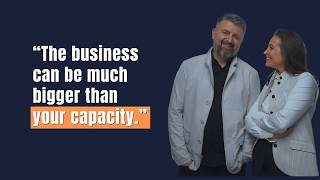
Yeah. And this is the, this is the problem. So when the person is not letting go, the most influential person doesn't let go, keep, keeps going. At some point, the business outgrows their capacity, their capacity of one nervous system, one brain, and the wiring and the circuitry that we have. The business can be much bigger than your capacity. And so if you don't let go to other people and build and include more people, you're either going to fry your nervous system and get sick and have a big problem, or you're going to sabotage the business to survive.
Right.
And there is another side of this stuff. Okay, I let go, but now I do micromanagement. I think I'm coordinator. People should come to me asking, I want to do this, let me do this. Okay, go and do this. And then next days we ask these people, have you done this what you ask us to do? So we do not generate, we stop generating tasks. They generate tasks but come for coordination. So they cannot coordinate inside. And this is the problem that finally you gave up something, you delegated, and you keep control through micromanagement. How to avoid this loop?
Well, when they bring the monkeys to your desk, and bring the problems to your desk. You don't let the problems stay in your office. Don't let them stay in, you know, don't collect the problems. You want to talk with them and troubleshoot, and while at the same time, the whole way, have them own the problem and the solution and the plan. Because, because if you, if you build a plan by yourself, the likelihood of that plan being implemented is much lower than if you build a team to get the plan together with them. You build it together with them, it's higher likelihood of, of it happening. And if they build a plan by themselves, even higher chance of implementation. So when they bring you a question you ask them back a question, right? So, uh, we don't know how to do this. So what, did you try anything? Do you have any ideas? What do you think is the best way? What are the 3 solutions you can recommend? Which one do you think has the highest probability? So, uh, giving less answers and asking more questions is a very helpful thing, but In order to be able to ask the questions, you have to, you have to accept not being the hero.
Right. And it's a very counterintuitive approach. It's a very, very counterintuitive approach that we ask founders to do because it's, they don't want to not take responsibility. They don't want to give the monkeys back. They don't want to build it together with a team. They, they want to be involved because It is their creation at the end of the day. And, you know, how can I let go of my creation and have someone else make use of it?
Yeah, it's very small. It's significance. They get a huge boost of significance by solving every problem. And then they learn, the team learns that, well, let's have the boss do it.
You know, let's play the game a little bit because founders, it's very difficult to change their opinion. So could you pitch your, uh, how you transform the founder so I, I, I, I, I, I can change my opinion? For example, just imagine I'm one of your clients, I'm a founder who is looking for how to grow my company, and pitch me.
Well, you know, we had the One of our clients was very similar to you and she came to us saying, you know, this is the third team that is blowing up under me. Can you help me make a sustainable organization as a good team? This was 3 years ago. She was, she was doing everything and she was actually doing the client delivery work as well. She had a very, um, um, high, high-level advisory consulting firm and she was still doing the work after 20 years. She was still doing delivery to the clients along with other people, but she, she was still controlling all the contracts and everything. She was on top of everything. She was stressed out, out of her brain. She, she got a brain tumor in the process. And we, we worked with her now for 3 years. And in the process, there were multiple times where she had a very hard time letting go. But now after 3 years, she is fully, she's 6 months away from being fully remote, doing no delivery work and having a team and a culture that she's proud of.
And healthy.
She's healthy. She's, she's working. She is growing the business. The business in the meantime. This is the— this is another interesting thing. You may be thinking, oh, my business is going to suffer because I have to do this. We're not going to be as efficient. We're not going to be as good. We're not going to make as much money. What actually happened is that this business doubled in revenue and tripled in profits while the transition was going on. So results, results can actually improve tremendously. And that's usually the way we work. So we always go at your speed because that's the speed that is available. Yes. We have to go at your speed and at your perspective. We cannot rush the process because if we rush the process, bad things and bad outcomes and bad results happen. So we must do this gradually so that we don't create a vacuum of capability or capacity that you pull back too quickly. If you pull out too quickly, there will be bad things that happen in the organization. So we have to do this gradually and precisely so that nothing suffers while you're getting more time and more space and allowing more growth in your organization.
Oh, finally, finally. Ah, sorry.
It's, it's kind of like having a personal trainer when you hire a personal trainer and on a good day you think, oh my God, this guy's amazing. I'm doing great. All of that. And then on a bad day, you call him names because he's giving you too hard of the workout and you don't want to do this. It's kind of like that. We move at the pace and we follow, uh, where the gold is. Of the founder, you know, managing themselves and their perspectives.
So my dream having 4-hour week, working week will come true, right?
Yes.
Well, and I went—
Next day transition.
I went from 80-hour weeks to 2-hour work weeks. So it's possible, you can do it. Whether you want to go all the way down to that few hours, that's a decision to be made. But you would be able to eventually if you stay with it and continue building capacity in your organization.
Wow. So all these I can learn from your book Shift Intelligence, right?
Yes. Read the book. You're going to see. Stories from the trench, the very hard moments in our journey, the pieces that made the biggest difference. Each chapter starts with a real human story of what it takes, how to do it, where to go, what to think. There are exercises at the end. It's a very human book, if you would. It really deals with that actual process of changing from controlling everything to enabling other people to, to do it. And it's not an easy thing, but it's so worth it. We say that founder dependence is the most expensive and the most difficult problem in business. Why is that the case? Because it costs you your health, it costs you your stress, it costs your family, it costs you your growth of your business, it costs the valuation of your business, it traps you so you can't even leave. And out of all the problems in business, that one is the most painful and the most expensive. And because of that, that's why we decided to focus on it and write a book on it. And the book subtitle is End of Founder Dependence and Building a Business That Can Stand on Its Own.
Wow. So I definitely should read this book very, very carefully. And when you help beyond the book, when you help startups, how do you start? What you do, some discovery or something like this, or what's your— strategy working with founders?
We usually have a conversation, and typically we work with a, with a little bit more seasoned businesses. So, you know, and maybe sometimes it's still a startup in year 8. So depending on what the business is and what it's doing, always the first, first piece of, of of the start of us working together is always a conversation with the founder where we can see and feel and hear what is the founder's perspective. We find the— where is the most highest risk, highest risk in the organization? What is the highest risk on the founder? Where is the node or the leverage point that is the most influential that could, that could cause the biggest pain in the business. And we work on that usually the first. If there are any single points of failure, and many times the founder is the single point of failure, sometimes there are key individuals in the business that could be also single points of failure, as well as certain processes or systems or softwares or whatever it might be. And so we look at while we're working with the founder on letting go, We look at those critical aspects that could actually remove the floor underneath us. So we don't— we are buying time for creating this transition. But if we— if something risky takes us out, then we don't have the time. So we are looking at both the founder and the business and we find the best leverage points to engage in and work on. And that's how we do it. We start with what is there. We start what is, uh, what is present and what is needed. And then from there we go at the pace that the founder is able to metabolize.
Mm-hmm. So simple thing, you convince founder that he's a bottleneck. Well, at some point become bottleneck.
It's not easy to say that directly. You know, but when we, when the situation recognizes the need for that, we actually get brave and we tell them in those terms as well.
Yeah, that's very important at some point when founder is warm up already.
Yeah, so they have to be ready. So we don't take them too far ahead into the future. We stay with them at their readiness level. So the more they're ready and building their capacity, the more truth we deliver.
Okay, very nice. So we're going to wrap up now. So where people can find you and founders can find you?
They can find our book on Amazon. It's available in both Kindle and a printed version. They can find us on LinkedIn. We are there very active. They can check us out on our website, shiftintelligence.co. There's some, you know, different goodies available there, the assessment, there's some downloads, you know, something to read more about us. You know, we also, you know, guest on other podcasts and things. We love sharing our story and, you know, they can find us there. We are available to help in any way.
Okay, very nice. So thank you very much, guys. It's really the Amazing opportunity to talk to you and learn from you. So, thank you. We were happy to have in our podcast Ivan and Mariana Pollock after the Shift Intelligence book, which is all about how to delegate and not to bear all the burden of the company. Through all the years. So thank you and like, subscribe, comment, so help algorithms to promote our podcast for other founders. Thank you. See you next week.









